Why Aren’t MosChip Manufacturing Chips?
The global semiconductor rush has taken retail stock markets by storm. Investors eagerly hunt for the "next Nvidia" or "next TSMC" in emerging markets, often bidding up companies tied to the word semiconductor.
In India, MosChip Technologies frequently finds itself in the spotlight of this hype. With a booming stock price and growing national focus on silicon sovereignty, a widespread narrative has taken root among retail investors: “MosChip is going to manufacture India’s domestic microchips.
But, the biggest mistake people make is assuming that because MosChip operates in semiconductors, it manufactures chips like Taiwan Semiconductor Manufacturing Company or Intel. It does not.
But before you rush to click the "sell" button on your trading app, you need to understand something crucial: not manufacturing chips is exactly what makes MosChip an incredibly valuable business. To understand why, we have to look past the hype and demystify how a microchip actually comes to life.
The Semiconductor Value Chain: Where Does MosChip Stand?
To understand where MosChip stands in the grand scheme of things, you have to look at how a microchip actually comes to life. It moves through a highly synchronized, step-by-step pipeline where different companies own very specific slices of the labor.
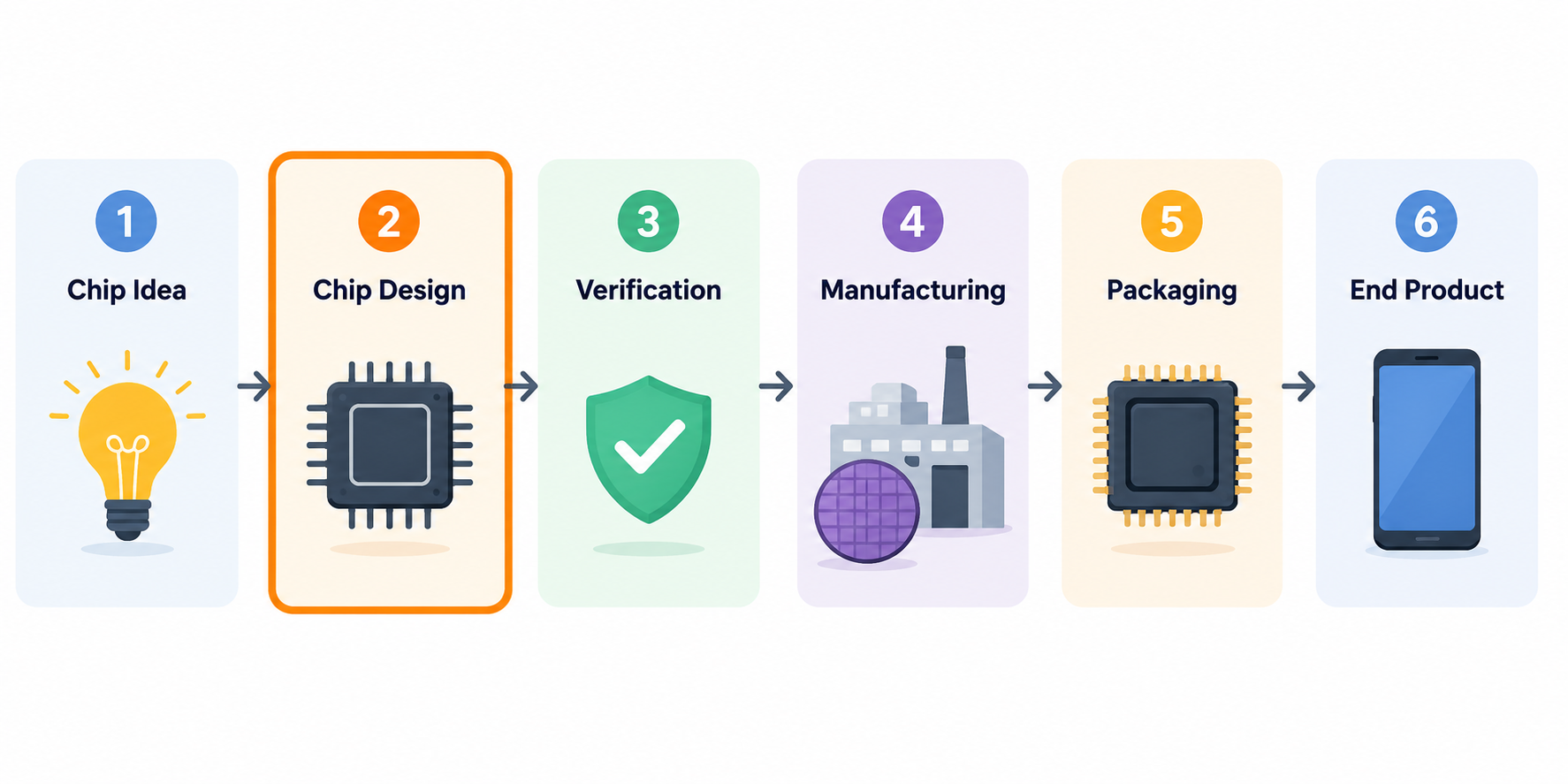
The journey begins with a Chip Idea, where a client determines exactly what they want the device to do. This idea is then handed over to design specialists like MosChip, who handle the incredibly complex phases of Chip Design and Verification—essentially writing the software code and rigorously testing the digital blueprint on computers to ensure there are no bugs.
Once MosChip perfects and approves the design, the digital blueprint is sent overseas to a dedicated Manufacturing foundry, such as TSMC, where the physical circuit pathways are printed onto silicon wafers. From there, the raw silicon moves to a Packaging specialist (known as an OSAT provider), who cuts the individual pieces and encases them in a protective shield.
Finally, these packaged chips are sent to electronics companies for End Product assembly, where they are soldered onto circuit boards to power everything from smartphones to electric vehicles.
To visualize this easily, see how the labor is divided:
| Stage | What Happens | Who Does It? | |
| 1. Design & Verification | Creating the chip's digital "brain" and blueprint. Testing it for errors. | MosChip, Nvidia, Qualcomm | |
| 2. Manufacturing | Physically printing the design onto silicon wafers. | Fabs / Foundries (TSMC, Samsung) | |
| 3. Packaging (OSAT) | Cutting the wafers and putting them into protective cases. | OSAT Providers (ASE, Amkor) | |
| 4. Assembly | Placing the packaged chip onto a phone or car circuit board. | Electronics Manufacturers |
The Critical Concept: Fabless vs. Foundry
The semiconductor world is strictly divided into two corporate kingdoms: Fabless Companies and Foundries.
Fabless Companies (The Thinkers): They design the chips, write the code, and own the Intellectual Property (IP). They are completely "asset-light" because they don't own factories. Global giants like Nvidia, AMD, and Qualcomm are fabless. MosChip is also fabless.
Foundries (The Makers): They own the multi-billion-dollar physical factories (called "fabs"). They don't usually design chips; they simply take blueprints from fabless companies and print them. TSMC is the ultimate example.
Why doesn't everyone just build a factory?
Building a modern fabrication plant is one of the most expensive human endeavors on Earth. A single advanced fab can easily cost thousands of crores. The highly specialized lithography machines inside them are extremely costly, require pristine clean rooms, consume massive amounts of power, and become obsolete every few years.
For a company of MosChip's scale, trying to build a factory would be financial suicide. Instead, they choose a smarter path: selling brains instead of bricks.
What MosChip Actually Sells: Going Beyond "Design"
When people hear "chip design," they often assume it's just drawing lines on a screen. In reality, MosChip provides high-end engineering services that keep the tech world running. They monetize intellectual labor through services like:
ASIC & SoC Design: Creating specialized, custom-built chips tailored perfectly for one specific client (like an automotive sensor or a defense drone)
Verification Services: Putting a digital design through millions of automated stress tests to ensure it won’t crash before millions of dollars are spent printing it.
Embedded Engineering: Writing the raw, low-level software code that allows hardware to talk to software.
The Blueprint Analogy
If a microchip were a massive skyscraper, RTL (Register Transfer Level) development is the architectural blueprint. MosChip’s engineers write code to design how the rooms, plumbing, and electricity inside the chip will behave. The factory (Foundry) will physically construct the building later, but the blueprint determines whether the building functions or falls apart.
Unpacking the "RTL to Volume Production" Model
In practice, MosChip’s "RTL to Volume Production" model acts as a seven-step relay race. It transforms a software concept into a physical chip without MosChip owning a single factory conveyor belt.
Here is how the lifecycle works cleanly and concisely:
Client Request: A company outlines the specific task they need a new chip to perform.
RTL Design: MosChip engineers write the foundational software code acting as the chip's logical brain.
Verification: Computers aggressively simulate and stress-test the code to catch hidden digital glitches.
Physical Design: Engineers precisely map out how billions of microscopic wires will fit without overheating.
Tape-Out: The team locks, encrypts, and packages the perfected layout into a final blueprint file.
Foundry: MosChip sends this blueprint to an external foundry giant like TSMC to physically print the silicon.
Delivery: MosChip manages the final packaging logistics and delivers the physical mass-produced chips to the client.
MosChip project-manages this entire journey, but third-party factories handle all the physical manufacturing.
Why the Asset-Light Model is an Investor’s Friend
MosChip's decision to focus on design and engineering services instead of chip manufacturing reflects a broader industry trend. Some of the world's most valuable semiconductor companies have built their businesses around a similar asset-light model, making the comparison particularly insightful.
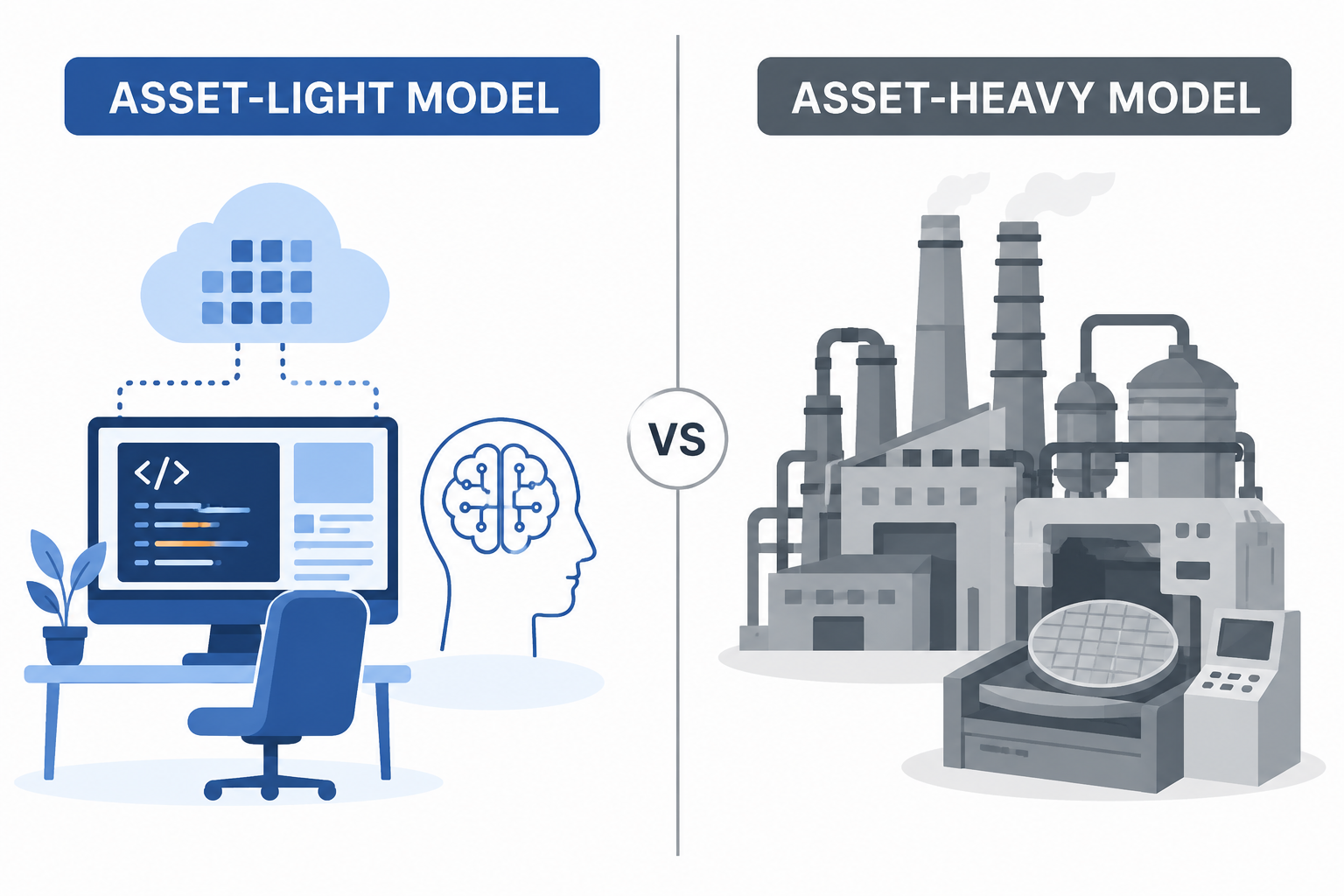
| Feature | Asset-Light Design Model (MosChip) | Physical Manufacturing Model (Fabs) |
| Capital Expenditures (CapEx) | Low. Spending goes toward computers and software. | Massive. Requires billions for machinery and facilities. |
| Financial Risk | Low. Debt is manageable; cost structures are flexible. | Extreme. Highly exposed to high fixed costs and debt. |
| Core Asset | Human Capital. Top-tier engineering talent. | Infrastructure. Machinery and clean rooms. |
| Flexibility | High. Can instantly pivot to design chips for AI, Autos, or Space. | Low. Upgrading a factory line takes years and billions. |
| Scalability | Fast scaling via hiring and software optimization. | Slow, painful expansion cycles. |
The Hidden Risks Investors Must Understand
MosChip relies entirely on engineering services rather than heavy infrastructure, it comes with a unique set of structural risks that retail investors often overlook during market hype cycles:
The Localized Talent War: MosChip’s primary "machinery" is its human talent. Global chip giants like Qualcomm, Intel, AMD, and Apple have set up massive R&D design campuses right next door to MosChip in Indian tech hubs like Hyderabad and Bengaluru. MosChip faces severe wage-inflation pressures because it competes directly for engineers against multi-billion-dollar multinational firms.
Extreme Valuation Multiples: Because of the domestic semiconductor narrative, MosChip trades at an incredibly steep Trailing Twelve Month (TTM) Price-to-Earnings (P/E) ratio well over 110x. Paying a premium for an asset-light model makes sense, but retail investors must realize that a service-heavy business model can struggle to justify astronomical product-style valuation multiples if headcount costs rise.
Dependence on Customer R&D Spend: Since MosChip provides design services, its revenue depends entirely on other companies allocating budgets to research and development. If global tech spending pauses or if macroeconomic conditions soften, design contracts get delayed or canceled quickly.
Foundry Bottlenecks: Even if MosChip designs a flawless, glitch-free chip layout, they remain completely dependent on third-party foundries to print the final silicon. If global supply chains choke or foundry capacity gets squeezed by tech giants, MosChip's turnkey delivery timelines can face delays beyond their control.
Here is the detailed video on the risk factors which I've discussed in my video.
Conclusion
The semiconductor revolution isn't just a story about brick-and-mortar factories and multi-billion-dollar manufacturing infrastructure; it is a story about raw intelligence.
MosChip is not a bricklayer; it is an architect. For retail investors, the key question shouldn't be whether MosChip is going to build giant manufacturing plants in India. Instead, the question is whether it can expand its high-margin turnkey ASIC design contracts, maintain its utilization rates, and successfully command a larger share of the global chip design market.
They aren't baking the cookies—they own the secret recipes. And in the technology ecosystem, that is exactly where the most sustainable value hides.