Dhan Gold Vault vs NSE Electronic Gold Receipts (EGRs)

For decades, Indian investors had only a few practical ways to own gold. Traditional options included jewellery, coins, and bars. Later, Gold ETFs, Sovereign Gold Bonds, and digital gold expanded investor choices.

Now, two newer structures have entered the market: Dhan Gold Vault and NSE Electronic Gold Receipts (EGRs). Both aim to combine the benefits of physical gold ownership with the convenience of digital infrastructure.

At first glance, they appear very similar. Both offer digitally owned gold backed by physical bullion, removing storage needs and tracking gold prices.

However, the underlying structures are quite different. Dhan Gold Vault is primarily designed as a platform for buying and holding physical gold through professional vaulting infrastructure. EGRs, in contrast, are SEBI-regulated securities that can be traded on stock exchanges and represent ownership of gold stored in accredited vaults.

As a result, while both provide exposure to physically backed gold, they serve somewhat different purposes. One focuses on simplified bullion ownership, while the other integrates gold ownership into India's exchange-traded securities ecosystem.

Understanding these differences may help investors determine which structure better fits their investment goals.
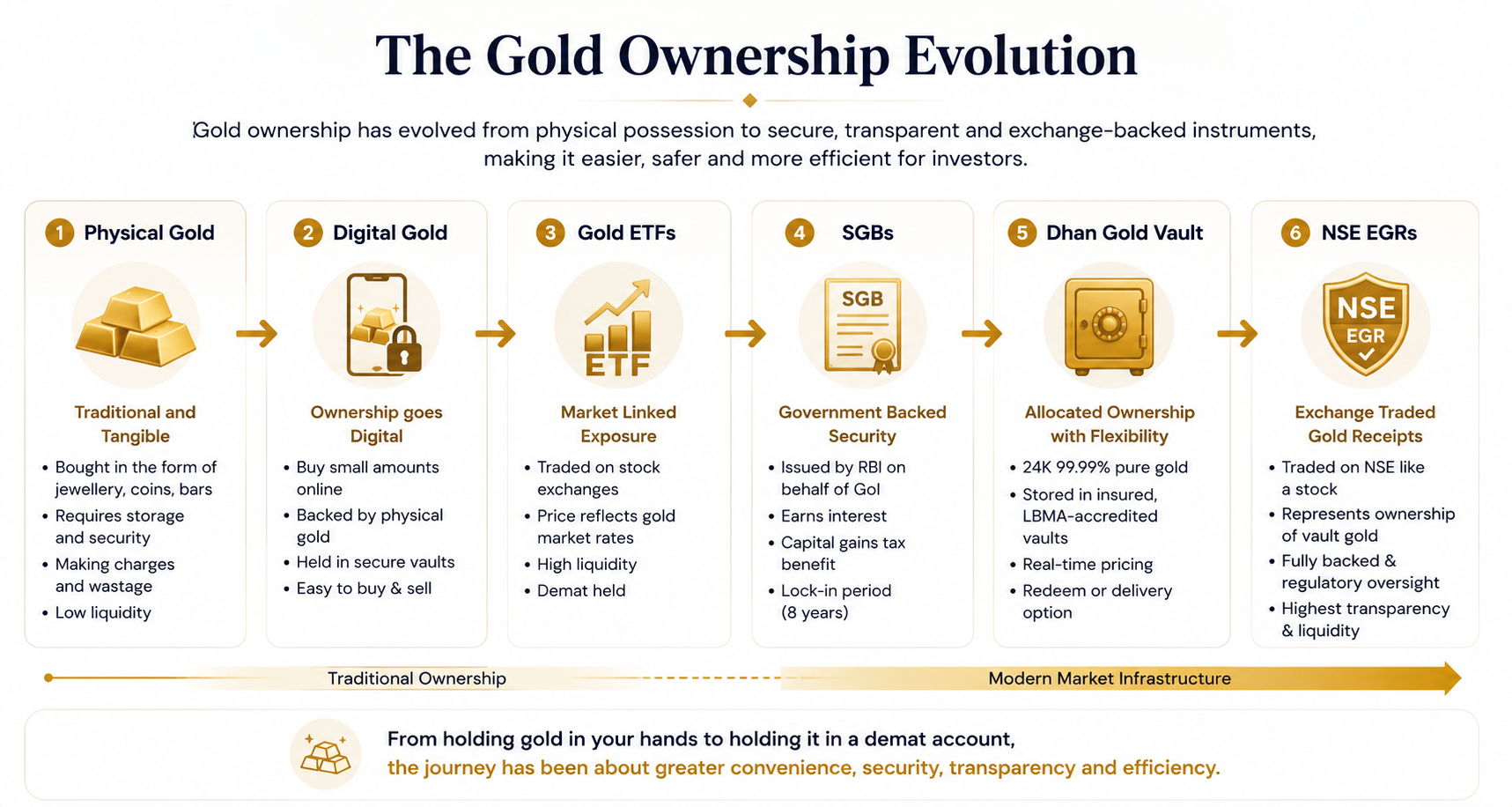
India's gold market is gradually moving toward more transparent and regulated ownership structures.

Understanding Dhan Gold Vault

Dhan launched Gold Vault in 2026 with the objective of making gold and silver ownership more accessible through exchange-linked infrastructure. The product was designed as an alternative to traditional digital gold platforms, allowing investors to gain exposure to physical bullion while benefiting from a fully digital investment experience.

According to the company's published information, purchases are routed through infrastructure connected to the commodity market ecosystem, including MCX and MCXCCL settlement mechanisms. The underlying gold or silver is stored in regulated vaults, while investors can track their holdings digitally through the platform. For those who prefer physical possession, the product also provides an option to request delivery of the underlying bullion, subject to applicable terms and conditions.

A key part of Dhan's positioning is the distinction it draws between Gold Vault and conventional digital gold offerings. Rather than presenting the product as a technology-platform claim on gold, Dhan emphasizes ownership of actual bullion backed by exchange-linked processes and professional vault storage. The company has also highlighted exchange-based price discovery as an important feature, aiming to provide pricing that is closely aligned with the broader bullion market.

In essence, Dhan Gold Vault seeks to combine the convenience of digital investing with many of the characteristics traditionally associated with physical gold ownership. Investors can accumulate gold in a digital format while relying on regulated storage infrastructure and retaining the option to convert their holdings into physical bullion if desired.

Understanding NSE Electronic Gold Receipts (EGRs)

Electronic Gold Receipts (EGRs) take a different approach to gold ownership. They are SEBI-regulated securities that represent ownership of physical gold stored in accredited vaults.

When physical gold is deposited with an approved vault manager, corresponding EGRs are created and credited to a demat account. These receipts can then be bought, sold, and held through stock exchanges, allowing investors to access physical gold through the securities market infrastructure.

The EGR ecosystem involves multiple regulated participants, including exchanges, clearing corporations, depositories, and vault managers. This structure is designed to provide transparency, standardization, and regulatory oversight throughout the ownership process.

A key feature of EGRs is convertibility. Physical gold can be converted into EGRs, and EGRs can later be converted back into physical gold through the prescribed process. According to the NSE, the objective is to bring greater transparency, standardization, and efficient price discovery to India's gold market.

How The Two Systems Work?

Although both Dhan Gold Vault and NSE Electronic Gold Receipts provide exposure to physically backed gold, the way they operate is quite different.

In the case of Dhan Gold Vault, an investor purchases gold through the Dhan platform. The transaction is linked to commodity market infrastructure, with the underlying bullion stored in regulated vaults. Investors can continue holding their gold digitally or choose to request physical delivery of the bullion, subject to the platform's terms and processes.

The EGR framework follows a different structure. Physical gold is first deposited with an accredited vault manager, after which Electronic Gold Receipts are created against the deposited gold. These receipts are credited to a demat account and can be traded on stock exchanges like other securities. Investors can buy and sell EGRs through the exchange ecosystem and may also convert them back into physical gold through the prescribed redemption process.
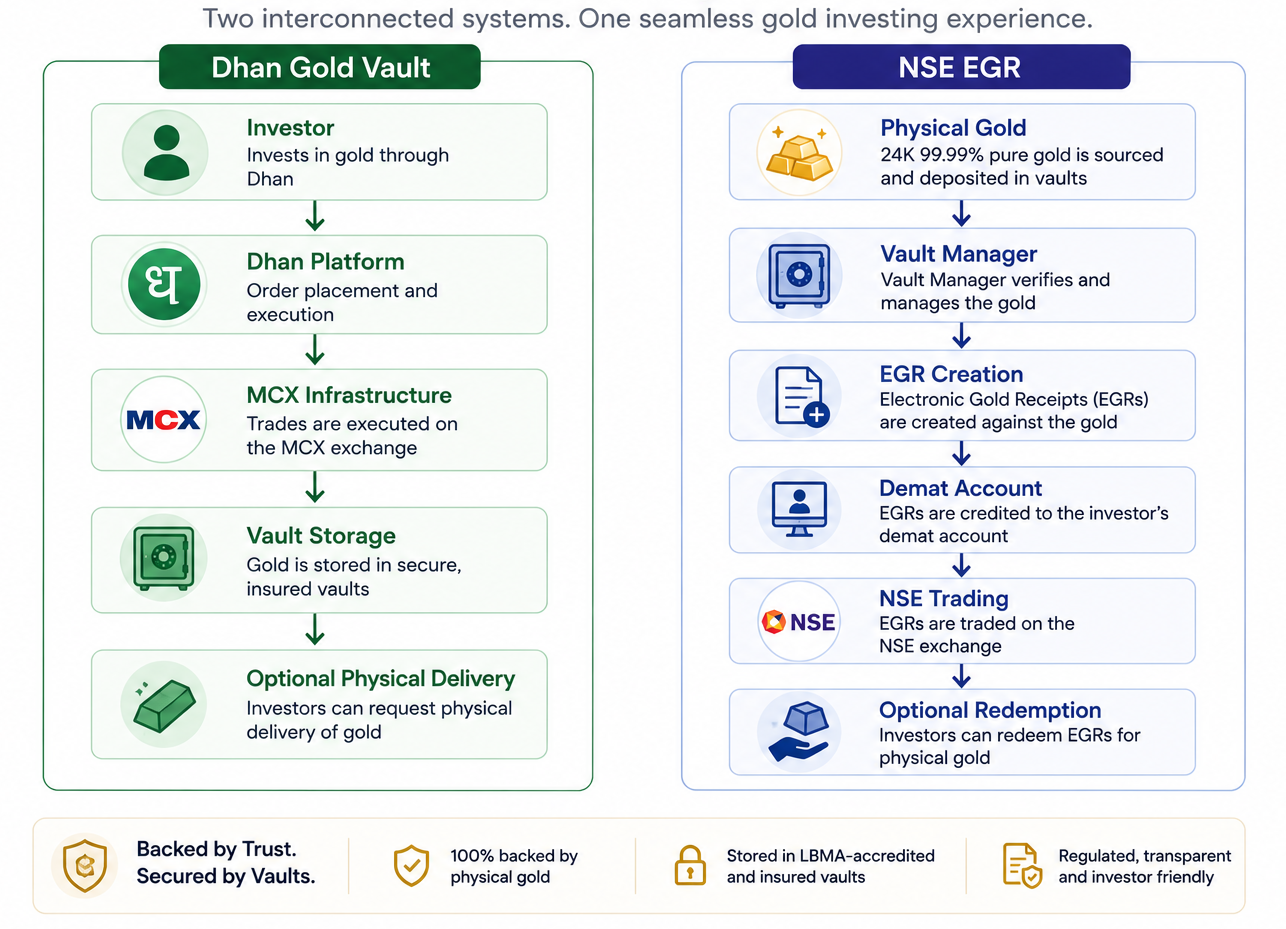
In simple terms, Dhan Gold Vault is primarily built around the digital ownership and storage of bullion, whereas EGRs are designed as exchange-traded securities that represent ownership of physical gold within India's regulated capital market infrastructure.

Similarities Between Dhan Gold Vault and EGRs

Despite their structural differences, Dhan Gold Vault and Electronic Gold Receipts share several important characteristics that make them distinct from many traditional gold ownership methods.

1. Both Are Linked To Physical Gold

Neither structure is designed to provide purely synthetic exposure to gold prices. In both cases, the investor's ownership is ultimately connected to physical bullion held in institutional vaults. This physical backing is a key feature of both frameworks and differentiates them from products that only track gold prices without direct bullion linkage.

2. Both Aim To Reduce Storage Risk

Owning physical gold traditionally involves concerns around storage, security, insurance, and locker costs. Both Dhan Gold Vault and EGRs address these challenges by relying on professional vaulting infrastructure. Instead of storing gold personally, investors can hold their exposure digitally while the underlying bullion remains in secure institutional facilities.

3. Both Offer Physical Redemption Pathways

Although the ownership experience is primarily digital, neither system restricts investors to digital holdings indefinitely. Both frameworks provide a mechanism through which investors can obtain physical gold, subject to applicable procedures, minimum quantity requirements, fees, and delivery conditions. This helps maintain a direct connection between the digital holding and the underlying physical bullion.

The Fundamental Difference

This is where the comparison becomes particularly interesting. At first glance, Dhan Gold Vault and Electronic Gold Receipts may appear to be different ways of accessing the same underlying asset physical gold. However, the two structures are built around fundamentally different concepts.
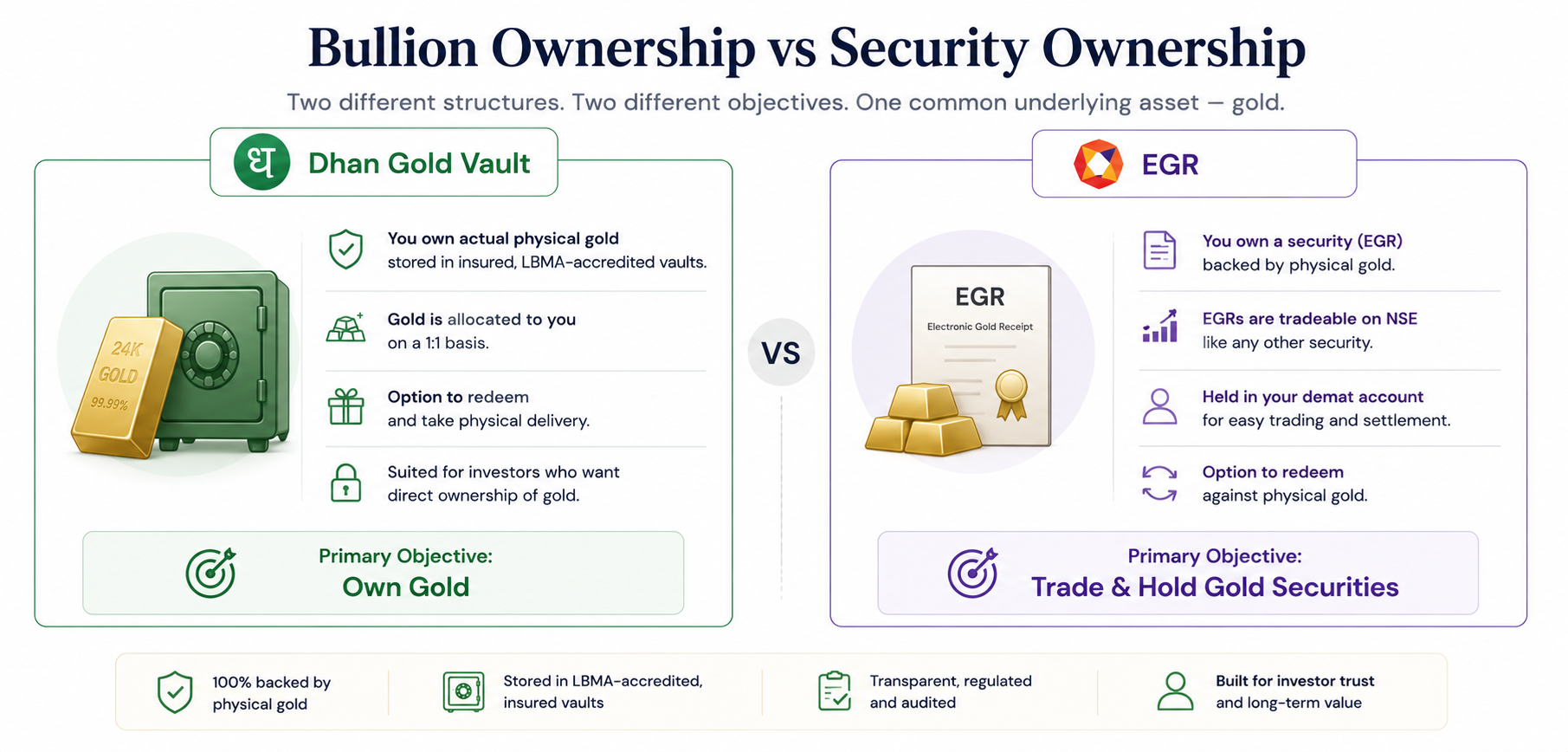
  • Dhan Gold Vault is primarily designed around the idea of owning bullion. The focus is on enabling investors to accumulate and hold physical gold through a digital interface while relying on professional vaulting infrastructure for storage and safekeeping.
  • EGRs, in contrast, are designed around owning a tradable security. While each receipt is backed by physical gold, the investor's holding exists within the securities market ecosystem and can be traded through exchange infrastructure like other listed instruments.

This distinction may seem subtle, but it has important implications. The structure of ownership can influence liquidity, trading behaviour, settlement processes, regulatory treatment, and the overall investor experience. As a result, the two products may appeal to different types of investors despite both being backed by physical gold.
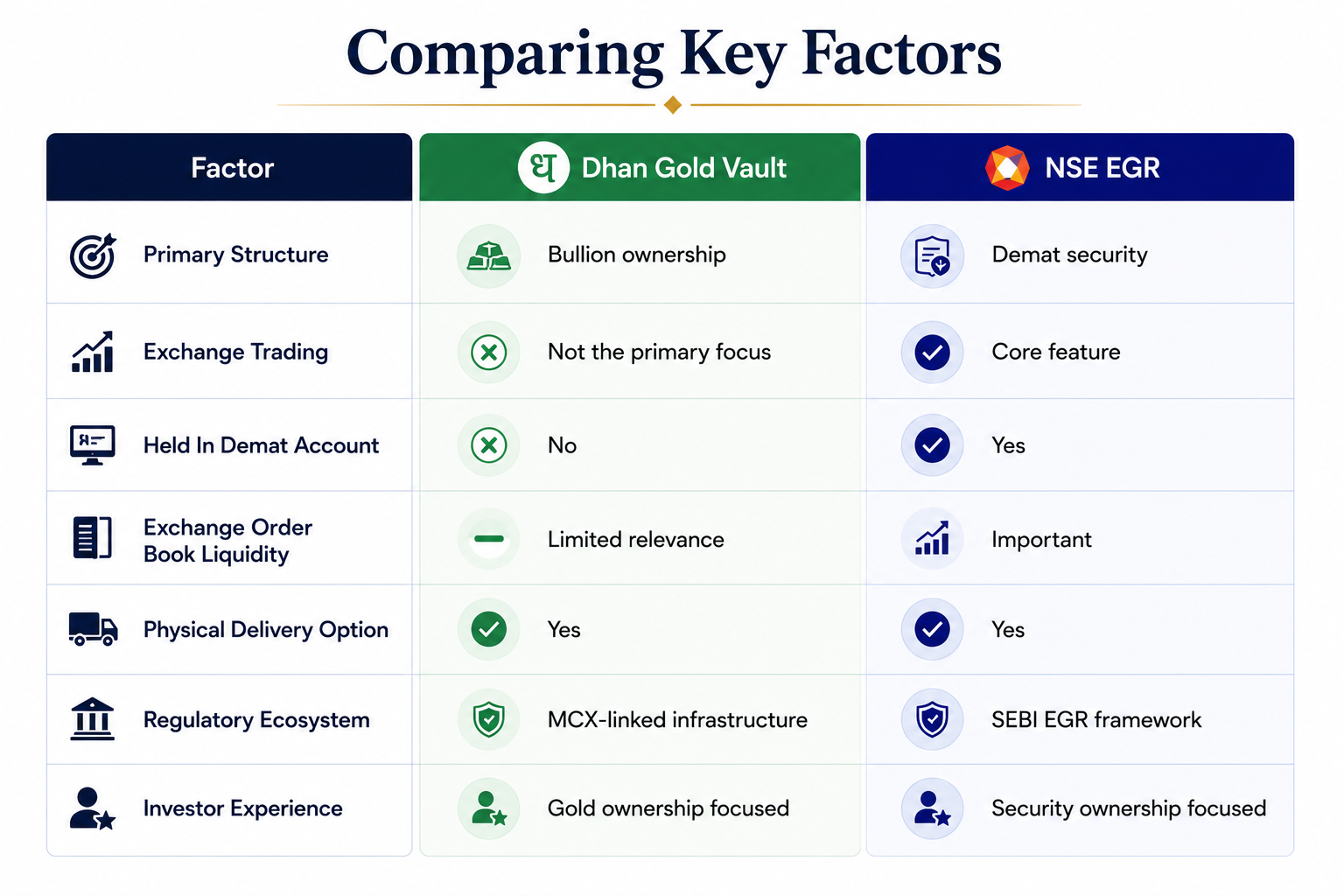
In simple terms, Dhan Gold Vault centers on digital bullion ownership, while EGRs center on exchange-traded ownership of a gold-backed security. Understanding this difference is essential because it shapes how each product functions in practice and the role it may play within an investor's portfolio.

Liquidity May Become The Biggest Variable

One of the most important factors determining the long-term success of Electronic Gold Receipts may be liquidity. While the EGR framework relies on established market infrastructure and operates within a highly regulated environment, the investor experience will ultimately depend on how actively investors trade the receipts. Higher trading volumes generally lead to better price discovery, tighter bid-ask spreads, and easier entry and exit for investors.

As a result, liquidity is likely to be one of the key metrics investors should monitor as the EGR ecosystem matures. Even a well-designed market structure can take time to develop meaningful trading activity and participant adoption.

Dhan Gold Vault operates somewhat differently. Because the product primarily focuses on the ownership and accumulation of bullion rather than exchange trading, its value proposition depends less on secondary market activity. Investors are generally using the platform to own and potentially redeem physical gold rather than trade it frequently.

This does not necessarily make one approach better than the other. Rather, it highlights that the two products are solving slightly different problems. For EGR investors, market liquidity may become a critical consideration. For Gold Vault users, ease of ownership, storage, and physical redemption may be key factors to evaluate.

Lessons From MCX and NSE Gold Futures

The importance of liquidity is not unique to Electronic Gold Receipts. A similar pattern can be observed in India's gold futures market.

Although both MCX and NSE offer gold futures contracts linked to the same underlying commodity, trading activity has historically been concentrated on MCX. As India's largest commodity derivatives exchange, MCX has built a deeper ecosystem of traders, hedgers, bullion dealers, and institutions over time, resulting in higher trading volumes and greater market depth.

This concentration of liquidity often creates a self-reinforcing effect. Higher trading volumes typically attract more participants, which in turn can improve price discovery, narrow bid-ask spreads, and make large transactions easier to execute. Markets with lower participation may still offer the same underlying exposure, but investors can occasionally face wider spreads and lower trading efficiency.

As a result, many professional traders view liquidity as a competitive advantage rather than merely a market statistic. The comparison between MCX and NSE gold futures illustrates how two products tracking the same asset can deliver different investor experiences depending on the depth of market participation.

Which Investor Might Prefer Each Structure?

Dhan Gold Vault May Appeal To:

  • Investors primarily focused on owning bullion rather than trading gold
    Dhan Gold Vault may appeal to investors who view gold as a long-term asset and are more interested in accumulating physical bullion exposure than actively buying and selling it. For such investors, the emphasis is on ownership rather than trading activity.
  • Individuals who may want the option of physical delivery in the future
    Some investors eventually want to convert their digital holdings into physical gold. Dhan Gold Vault may appeal to these investors by offering bullion ownership and a path to physical delivery.
  • Investors seeking exchange-linked pricing without necessarily using exchange-traded securities
    Many investors want prices that closely reflect the broader bullion market but may not want to trade gold through a stock exchange. Dhan Gold Vault can provide exposure to market-linked pricing while maintaining a focus on bullion ownership.
  • Long-term holders who view gold as a store of value rather than a trading instrument
    For investors using gold primarily as a hedge against inflation, currency depreciation, or economic uncertainty, frequent trading may not be a priority. In such cases, a structure centered on ownership and storage may align more closely with their objectives.

EGRs May Appeal To:

  • Investors who are comfortable operating through demat accounts
    EGRs fit naturally within the existing securities market ecosystem. Investors who already use demat accounts may find the structure familiar and convenient.
  • Market participants seeking exchange-traded liquidity
    Because investors can trade EGRs on stock exchanges, they may appeal to those who value the ability to buy and sell positions through the market. As the ecosystem develops, liquidity could become an important advantage for active participants.
  • Investors who prefer holding gold through a SEBI-regulated securities framework
    Some investors may prefer a structure that operates within established capital market infrastructure involving exchanges, depositories, clearing corporations, and accredited vault managers. Regulators specifically designed EGRs around this regulated framework.
  • Those who want gold ownership integrated with their broader investment portfolio  Since investors hold EGRs in demat accounts alongside other securities, they can manage their gold exposure within the same investment ecosystem as stocks, bonds, and ETFs. This can simplify portfolio monitoring and asset allocation decisions.

Neither preference is inherently superior. Dhan Gold Vault may appeal to bullion-focused investors, while EGRs may suit those who prefer exchange trading. The right choice ultimately depends on how an investor intends to use gold within their overall portfolio strategy.

What Investors Should Monitor Going Forward?

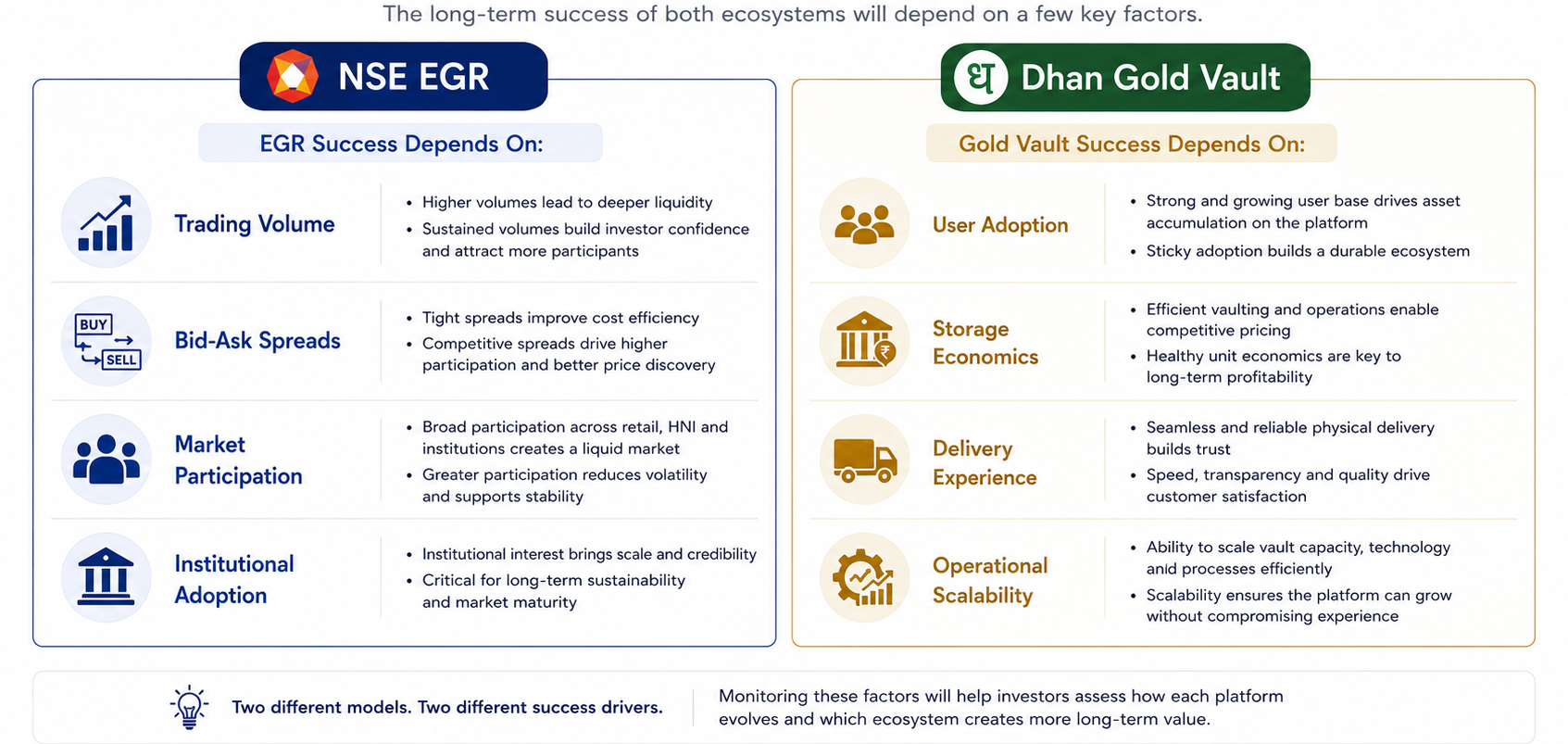
The long-term success of both models may depend more on investor adoption than gold prices. As these models mature, investors should pay attention to a number of operating and adoption metrics.

For EGRs

  • Daily Trading Volumes
    Trading volume may become one of the most important indicators of the health of the EGR market. Higher volumes generally suggest greater participation, improved liquidity, and more efficient price discovery.
  • Bid-Ask Spreads
    The gap between buying and selling prices can reveal how liquid the market truly is. Narrower spreads typically indicate a healthier and more efficient trading ecosystem.
  • Number of Active Participants
    The growth of EGRs will likely depend on participation from investors, traders, institutions, and market intermediaries. A broader participant base can strengthen liquidity and improve market depth.
  • Growth in Vault-Backed Gold Inventories
    Increasing quantities of gold stored within the EGR ecosystem may indicate rising confidence and adoption. It can also provide insight into the scale at which the framework is developing.

For Dhan Gold Vault

  • User Adoption Rates
    One of the clearest indicators of success will be the number of investors using the platform. Growing adoption could signal that investors find value in the product's ownership and storage model.
  • Assets Stored Within The Platform
    The amount of gold and silver held through Gold Vault may provide a useful measure of investor trust and engagement. Rising assets could indicate increasing acceptance of the platform.
  • Delivery Utilization
    Monitoring how often investors choose physical delivery can offer insight into user behaviour and how investors use the platform in practice.
  • Expansion of Bullion-Related Offerings
    Future product enhancements, additional bullion products, or new services built around the vault ecosystem could help expand the platform's appeal and strengthen its competitive position.

The key question is not the better structure, but which model attracts users and delivers a better experience. Over time, ecosystem adoption may prove to be the most important variable of all.

Conclusion

Dhan Gold Vault and NSE Electronic Gold Receipts are often compared because both seek to modernize how investors own gold. Both offer digital access to physical gold and address some limitations of traditional gold ownership.

However, the two structures serve different objectives. Dhan Gold Vault primarily enables investors to own and potentially take delivery of physical bullion through exchange-linked infrastructure. By contrast, EGRs create a standardized, regulated, and exchange-traded security that represents ownership of physical gold.

As a result, the comparison is not necessarily about determining which product is superior. Instead, it is about understanding what each structure is trying to achieve and how it fits an investor's goals.

Investors may ultimately benefit more from asking a simple question:

"Am I trying to own gold, or am I trying to own a gold security?"

For those focused on bullion ownership and eventual physical delivery, one structure may feel more natural. For those who value exchange trading, demat-based holdings, and securities-market infrastructure, the other may be more appealing.

The answer varies by investor, which is why both models can coexist in India's evolving gold investment ecosystem.

About the Author

Harjot Singh

Harjot Singh is BBA graduate with a background in finance and business studies. He has developed knowledge in financial analysis, business operations, and corporate finance through academic training and practical exposure. His professional interests include financial planning, investment analysis, and business strategy. He is committed to continuous professional development and contributing effectively within dynamic organizational environments.

View All Articles by Harjot Singh

Check Other Post Posts


Leave a Reply

Your email address will not be published. Required fields are marked *

Important

Rohit Tripathi is a SEBI Registered Research Analyst with Registration No. INH000022543.
Registered Office Address – 8th Floor, Imperial Tower, Plot No. 252 El-821, CP 67, Sector 67, Punjab, Mohali, 160062
Email – ra-support@retireithrohit.com | WhatsApp – +91-987-619-2817

Investment in Securities Market is Subject to Market Risk. Please read all related documents carefully before investing. 

Registration granted by SEBI and certification from NISM in no way guarantee the performance of the intermediary (Rohit Tripathi) or provide any assurance of returns to investors.

SEBI Head Office – Plot No.C4-A, G Block, Bandra-Kurla Complex, Bandra (East), Mumbai – 400051, Maharashtra. Tel: +91-22-26449000 / 40459000
SEBI Local Office – NBCC Complex, Office Tower-1, 8th Floor, Plate B, East Kidwai Nagar, New Delhi – 110023. Tel: 011-69012998 Email: sebinro@sebi.gov.in

Copyright: © 2023-25 Rohit Tripathi. All Rights Reserved.