Solar Value Chain in India
India’s solar industry has emerged as one of the most important sectors in the country’s transition toward clean energy. Over the last decade, India has rapidly increased its solar power capacity due to rising electricity demand, government support, falling solar panel prices, and the global push toward renewable energy.
India’s solar value chain refers to the complete ecosystem involved in producing solar energy — starting from raw materials and manufacturing of solar equipment to installation and electricity generation.
India is one of the fastest-growing solar markets in the world because the country is rapidly shifting toward renewable energy to reduce dependence on fossil fuels, improve energy security, and meet climate goals.
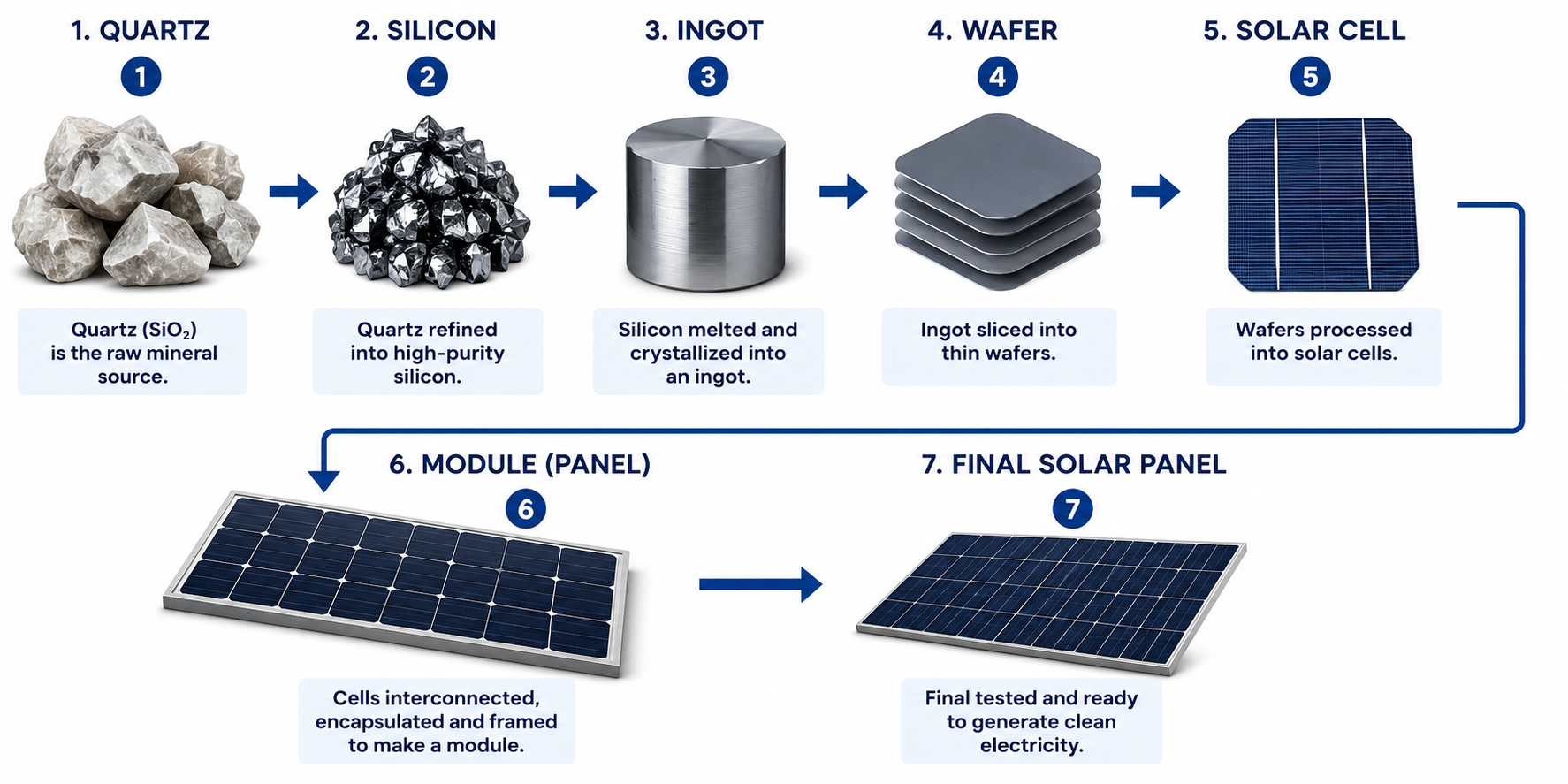
The following sections explain the complete solar value chain in India, from raw materials to finished solar products.
Raw materials
The solar industry uses different raw materials at different stages of the value chain.
SILICON
Quartz/Silica sand
This is the starting raw material of the solar industry. It contains Silicon dioxide (SiO₂). Quartz or silica sand is mined from the earth and converted into silicon. The silica sand is very important for the solar industry. Without it, silicon, wafers, and solar cells cannot be manufactured. Think of it like iron ore's importance in the steel industry.
Major companies involved in silica sand and quartz mining include Omega Minerals, India Quartz, LSC Mines and Minerals, and Mangal Minerals.
METALS & CONDUCTORS
Silver
One of the major players in precious metal products is Hindustan Platinum. India still imports a large portion of advanced photovoltaic silver paste from China, Taiwan, and Japan.
Aluminium
Aluminium is heavily used in solar modules. Solar panel frames and mounting structures require large quantities of aluminium because it is lightweight and corrosion resistant. Major Indian aluminium producers include Vedanta Aluminium Limited and Hindalco Industries Limited, which supply raw aluminium and billets used in solar module frames and mounting structures.
Copper
Copper is used for wiring, electrical connections, grid connection and in inverters. It helps transfer electrical energy from solar panels to inverters and eventually to the electrical grid.
One of the major companies is Hindalco Industries Ltd (Birla Copper) - Operating a massive smelting facility.
Tin and Lead
Manufacturers use tin and lead in the electrical connection systems of solar panels. They primarily use these materials for soldering, creating conductive joints, and connecting ribbons within the panel.
Gravita India and Vidya Wires are major Indian manufacturers involved in tin and lead products.
After the extraction and sourcing of raw materials, the next stage in the solar value chain is processing. In this stage, manufacturers convert raw materials such as silica, metals, and chemicals into specialized industrial materials like polysilicon, solar glass, and conductive pastes, which they then use in solar manufacturing.
Processing stage
POLYSILICON PROCESSING
Polysilicon is an ultra-pure form of silicon used in solar panels, semiconductors and electronics. In the solar industry polysilicon acts as the main raw material for the manufacturing of ingot and wafer production. The manufacturing process is highly technical and energy intensive.
Polysilicon production is heavily dominated by China. Major polysilicon companies are Tongwei and Daqo New Energy and GCL technologies.
SOLAR GLASS PROCESSING
This stage converts silica and specialty chemicals into high- transparency solar glass. In this process silica sand, limestone, speciality chemicals and various other materials are used.
Solar glass is used on the front side of the panel. It protects solar cells and allows sunlight to pass. Borosil Renewables Ltd and Vishakha Renewables Pvt. Ltd are one of the dominant players that produce ultra-clear tempered, anti-reflective, and bifacial solar glass.
METAL PASTE PROCESSING
Manufacturers process metal paste using silver, aluminium, copper, and other conductive chemicals. They use this metal paste to collect electricity and improve conductivity in solar cells.
They apply the paste on the front and rear sides of the solar cell through a process called screen printing.
How they use it:
Machines print thin metallic lines on the front side of the solar cell. These lines collect electricity generated from sunlight and transfer it through metallic pathways.
Manufacturers call these thin conductive lines fingers and busbars. Major companies such as DuPont and Heraeus process and supply metal paste for solar cell manufacturing.
EVA SHEET AND BACKSHEET PROCESSING
EVA (Ethylene Vinyl Acetate)
It is a transparent polymer sheet used inside solar modules. It is placed between the glass and solar cells and between the cells and back sheet.
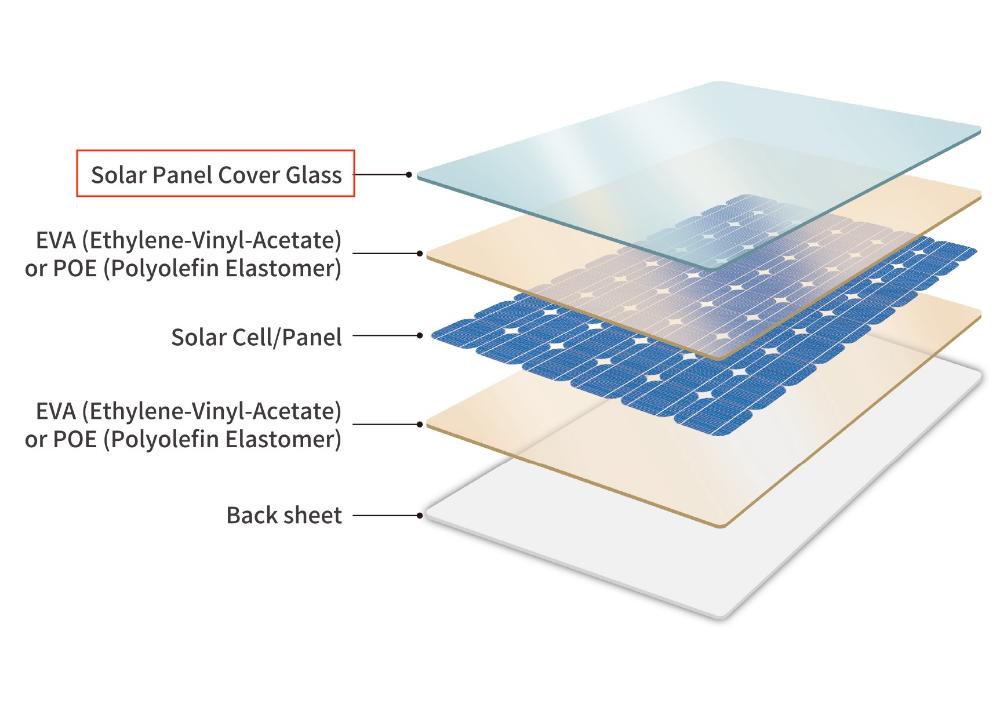
EVA (Ethylene Vinyl Acetate) is used to protect solar cells from dust, moisture, and mechanical damage. It acts like a protective seal for solar cells.
Poor EVA quality can lead to yellowing, delamination, moisture penetration, reduced efficiency and this would directly impact panel life and performance.
Backsheet
Backsheet is the rear protective layer of a solar panel. Manufacturers install it on the backside of the module.
Solar module assembly:
Glass → EVA → Solar Cells → EVA → Backsheet
Backsheets protect solar panels from rain, humidity, UV rays, and dust. They also provide mechanical strength and durability, which helps extend the lifespan of solar panels.
CHEMICAL PROCESSING
Hydrochloric Acid (HCl)
Hydrochloric acid is used in silicon purification, cleaning metal impurities and in the Production of trichlorosilane. Hydrochloric acid helps remove unwanted metallic contaminants from silicon materials and this is important because even microscopic impurities can reduce solar cell efficiency.
India still imports a large amount of high-purity solar chemicals, but several Indian chemical companies manufacture industrial and electronic-grade HCl that can be used in solar manufacturing processes.
Major Indian companies are TANFAC Industries and Gujarat Alkalies and Chemicals Limited.
Nitric acid
Nitric Acid (HNO₃) is a strong industrial acid which is widely used. But in the solar industry nitric acid is used for Cleaning, etching, and purification processes during solar cell and wafer manufacturing.
India has several large nitric acid manufacturers. Major nitric acid manufacturers are Deepak Fertilisers and Petrochemicals, Rashtriya Chemicals and Fertilizers (RCF), Gujarat Narmada Valley Fertilizers & Chemicals (GNFC), Smartchem Technologies.
Phosphorus and Boron
Phosphorus and boron are extremely important materials in the solar industry because they are used to create electrical properties for solar cells. Without them, silicon alone cannot efficiently generate electricity.
Pure silicon is not a very good conductor of electricity. So, scientists intentionally add tiny amounts of certain elements into silicon to improve its electrical behaviour. This process is called doping.
Boron is a chemical element which is used to create P- type silicon and phosphorus is used to create N- type silicon.
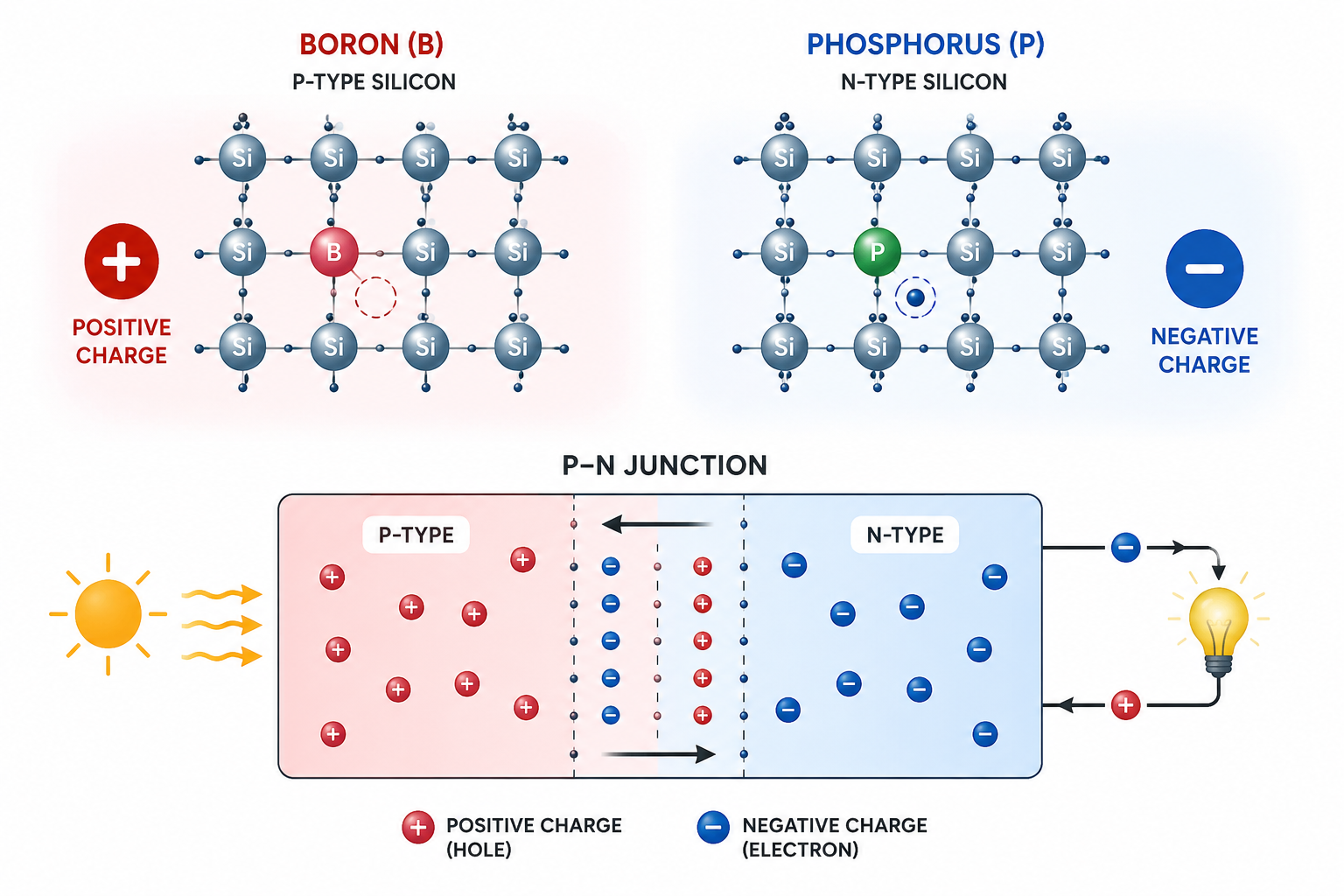
Coromandel International and Boraz Morarji Limited are one of the major producers of phosphorus and boron respectively in India.
Manufacturing stage
INGOT MANUFACTURING
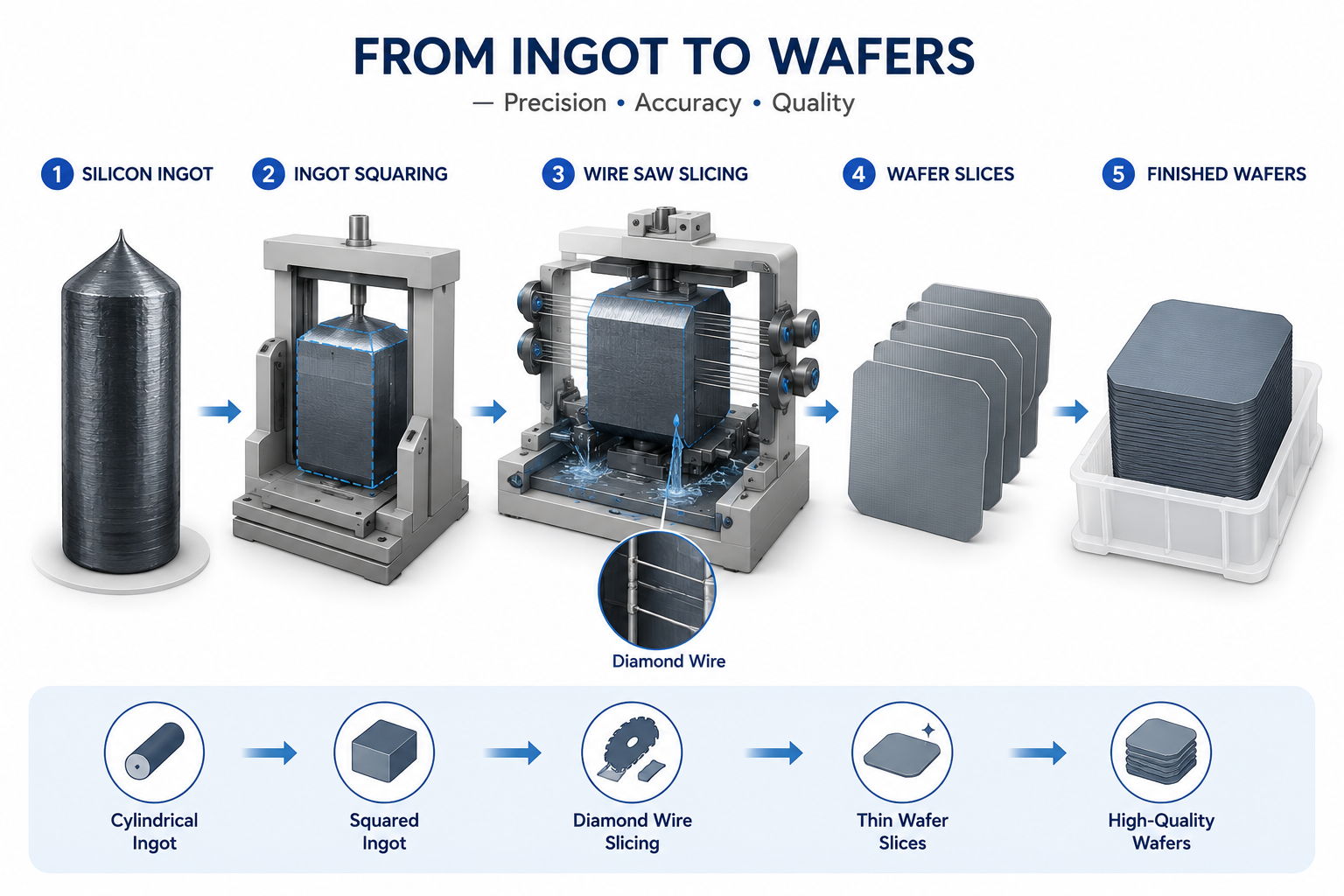
Ingot manufacturing is the first major manufacturing activity after polysilicon production. An ingot is a large solid block or cylinder made from purified polysilicon. It acts as the base material from which solar wafers are sliced.
There are mainly two types of ingots -
1. Monocrystalline - Single crystal structure
2. Polycrystalline - Multiple crystal structures
Ingot manufacturing process
The widely used process in ingot manufacturing is Czochralski Process
Melting polysilicon - Polysilicon chunks are placed inside a quartz crucible. The material is heated at extremely high temperatures until it becomes molten silicon.
Seed crystal insertion - A tiny silicon seed crystal is dipped into the molten silicon.
Crystal pulling - The seed crystal is slowly pulled upward while rotating. This forms a large cylindrical single crystal ingot.
Cooling - The ingot is slowly cooled to maintain the crystal quality.
The quality of the ingot determines wafer quality, solar cell efficiency, electrical performance, and even small crystal defects can reduce power generation and lifespan.
WAFER MANUFACTURING
Poor wafer quality can cause cracks and lower efficiency. China dominates global wafer manufacturing due to its massive scale, low cost, and integrated supply chains.
Major wafer manufacturing companies are LONGi Green Energy Technology and TCL Zhonghuan
SOLAR CELL MANUFACTURING
This is the most technologically advanced stage in the solar manufacturing chain. A solar cell is the device that converts sunlight into electricity using the Photovoltaic Effect. Solar cells absorb sunlight – generate electrons – produce electrical current. Cell manufacturing involves several advanced semiconductor manufacturing steps.
Wafer cleaning - Wafers are thoroughly cleaned using chemicals. This removes contaminants, dust and surface impurities.
Surface texturing - Tiny pyramid-like structures are created on the wafer surface to reduce light reflection and improve sunlight absorption.
Doping - Manufacturers add chemical elements such as phosphorus to create positive and negative layers within the solar cell.
Anti - Reflective coating - Manufacturers apply a special coating to improve light trapping and increase energy conversion efficiency.
Metal contact printing - Manufacturers print metal paste containing silver and aluminium onto the cell surface to create electrical contacts.
Firing process - Manufacturers heat the cells in furnaces to bond the metal contacts to the silicon.
Testing - Cells are tested for electrical outputs and defects.
Major Indian cell manufacturers are Adani Solar and Premier Energies.
MODULE MANUFACTURING
A module is a collection of interconnected solar cells enclosed inside a protective structure. Module manufacturing is the final stage of solar manufacturing. This stage involves assembling solar cells into finished solar modules.
Module manufacturing process
Cell sorting - Technicians sort the cells based on their output, quality, and efficiency.
Cell interconnection - Manufacturers connect solar cells using copper ribbons and advanced soldering systems.
Lamination - Manufacturers heat and press the module to permanently seal and protect its internal structure.
Framing - Manufacturers attach aluminium frames to provide structural strength and support installation.
Junction box installation - Manufacturers install the junction box to enable electrical connections and current output.
Testing - Modules undergo testing for durability, weather resistance, output efficiency and mechanical strength.
Leading Indian module manufacturers include Waaree Energies, Vikram Solar, and Tata Power Solar.
EPC & INSTALLATION
EPC and Installation is one of the most important segments of the solar value chain. At this stage, EPC companies and installers convert manufactured solar components such as solar modules, inverters, mounting structures, and cables into a fully operational solar power plant capable of generating electricity.
ENGINEERING
This is the planning and technical design stage. In this stage, EPC companies study land, soil conditions and grid connectivity. Then it designs the solar power plant.
What comes under engineering?
A) SITE ASSESSMENT - Under this the company evaluates land quality, solar irradiation, terrain. This helps the company to determine project feasibility.
B) SYSTEM DESIGN - In this stage, engineers decide the number of modules, module layout, row spacing and cable routing The design aims to maximize electricity generation.
C) ELECTRICAL DESIGN - Inverter selection, Transformer design, Grid connection systems and Earthing systems fall under electrical design.
D) STRUCTURAL DESIGN - Mounting structures must withstand wind loads, rain, dust, temperature change.
PROCUREMENT
This stage involves sourcing all equipment required for the solar project like - solar modules, inverters, mounting structures, cables, transformers and SCADA systems. Procurement is important because it determines plant reliability, efficiency and long-term performance. Procurement strategy on which EPC companies are focused on lower cost, best quality, reliable suppliers and delivery timelines.
CONSTRUCTION
At this stage, construction teams physically build the solar power plant. Major activities performed in construction are -
A) LAND PREPARATION - it includes cleaning land, levelling and road constructions.
B) FOUNDATION WORK - Mounting structures require strong foundations. Depending on soil type Pile foundations, Concrete foundations and Ballasted structures may be used.
C) MOUNTING STRUCTURE INSTALLATION - Metal structures are installed to hold solar panels. The tilt angle is optimized for Maximum sunlight exposure.
D) MODULE INSTALLATION - Solar modules are mounted and interconnected. This process requires precision, safety standards and proper alignment.
E) ELECTRICAL INSTALLATION - it includes cable laying, inverter installation, transformer setup and grid connectivity.
F) TESTING & COMMISSIONING - The system is tested before operations begin. It includes voltage testing, safety testing, output testing and grid synchronization.
Types of EPC contracts
Turnkey EPC
The EPC company handles everything from design to commissioning; it is the most common model used in the solar industry.
Balance of systems (BOS)
The client procures modules separately. Under this contract EPC company handles Remaining installation work.
O&M CONTRACTS
After installation, companies may also provide operations and maintenance services like cleaning, monitoring, repairs, performance optimization.
Major EPC companies in India are Larsen & Toubro, Jaypee Group, Tata Projects Limited, Reliance Infrastructure Limited and Hindustan Construction Company (HCC).
POWER GENERATION
Solar power producers convert sunlight into usable electricity and supply it to homes, industries, commercial buildings, and the electrical grid. At this point, the solar power plant becomes an operational energy-producing asset capable of generating electricity for 25–30 years.
The power generation stage is extremely important because this is where the actual monetization of solar energy happens. Solar power generation refers to the process of converting sunlight into electrical energy using solar panels. This occurs through The Photovoltaic Effects.
When sunlight strikes a solar cell, electrons become energized, Electrical current is generated and Electricity flows through the system.
Let us understand the complete process of how electricity is generated
1. SUNLIGHT HITS THE SOLAR PANEL - solar panel contains multiple solar cells. The cells absorb photons from sunlight.
2. ELECTRONS START MOVING - The silicon semiconductor inside the cell reacts to sunlight. This movement of electrons creates direct current electricity.
3. ELECTRICITY FLOWS TO THE INVERTER - solar panels produce DC electricity but homes and grids require alternating current. Therefore, inverters convert DC into AC.
4. ELECTRICITY DISTRIBUTION - Electricity distribution is the final stage of the power supply chain where electricity is delivered from the transmission network to end users such as homes, factories, offices, shops, schools.
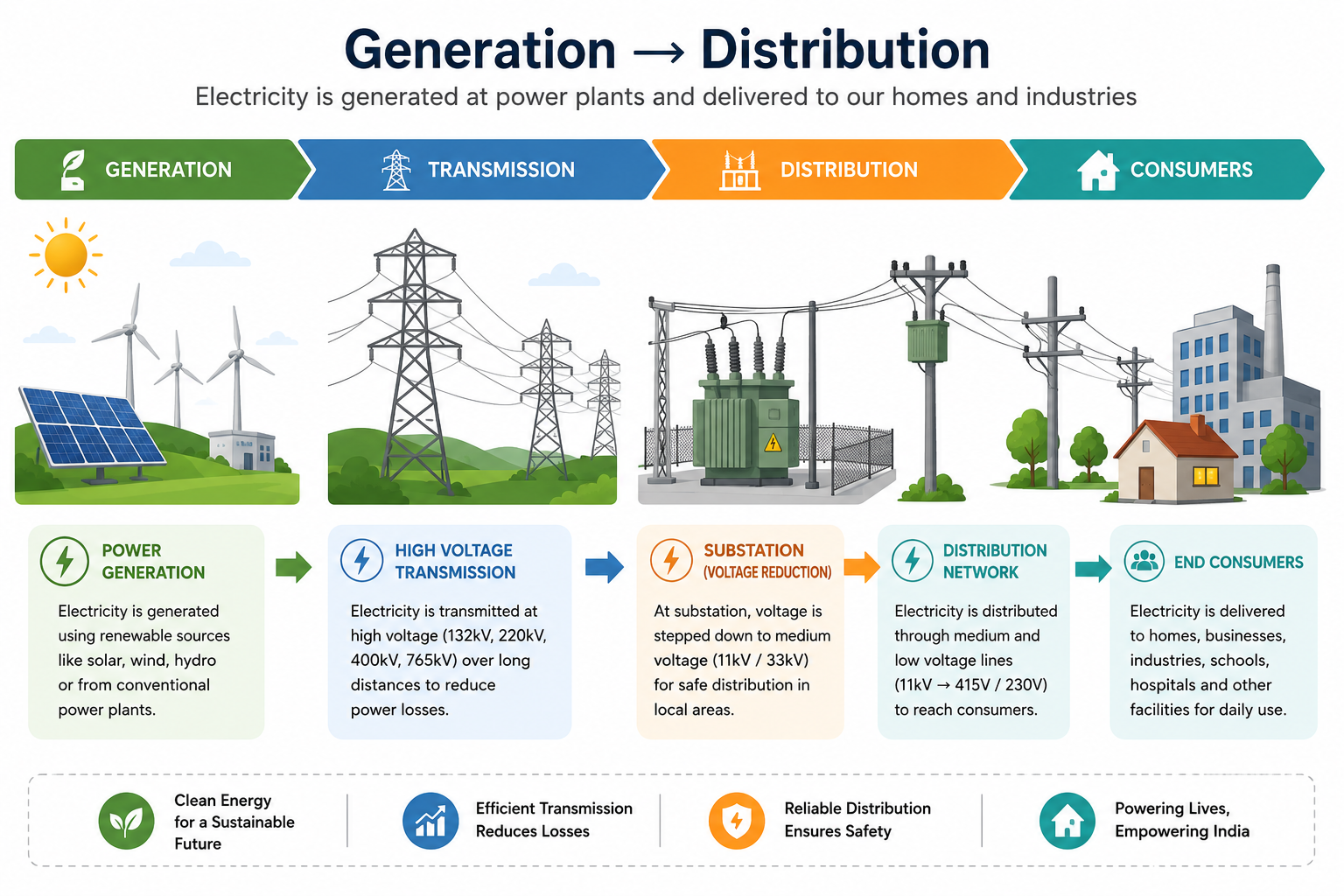
Major components that are used in power generation are solar modules, inverters, transformers, battery storage systems and SCADA systems.
Conclusion
India’s solar industry is rapidly evolving into one of the most important pillars of the country’s clean energy transition. The solar value chain consists of multiple interconnected stages starting from raw material extraction and chemical processing to manufacturing, EPC installation, electricity generation, and power distribution. Each stage plays a critical role in ensuring the efficient production and delivery of solar energy.
The industry heavily depends on key raw materials such as quartz, silica sand, silver, aluminium, copper, specialty chemicals, industrial gases, and semiconductor materials. These materials move through various processing and manufacturing stages including polysilicon production, ingot manufacturing, wafer slicing, solar cell fabrication, and module assembly before becoming a finished solar panel.
India is gradually strengthening its domestic solar manufacturing ecosystem through government initiatives such as PLI schemes, renewable energy targets, and infrastructure investments. However, challenges such as import dependence on China, raw material availability, advanced technology gaps, and supply chain concentration still remain significant concerns for the industry.