How does Zaggle Make Money?
Most people think Zaggle is just a prepaid corporate card company.
But in reality, the company is building a much larger ecosystem around corporate spending, rewards, payments, and expense management software.
That difference is important because software-driven businesses usually create more recurring revenue and stronger long-term profitability.
Let’s see the Revenue Breakdown, Geographic Split & Future Growth Drivers of Zaggle in this article.
Quarterly & Annual Performance
Zaggle delivered its strongest-ever performance in FY26, with both revenue and profit growing sharply.
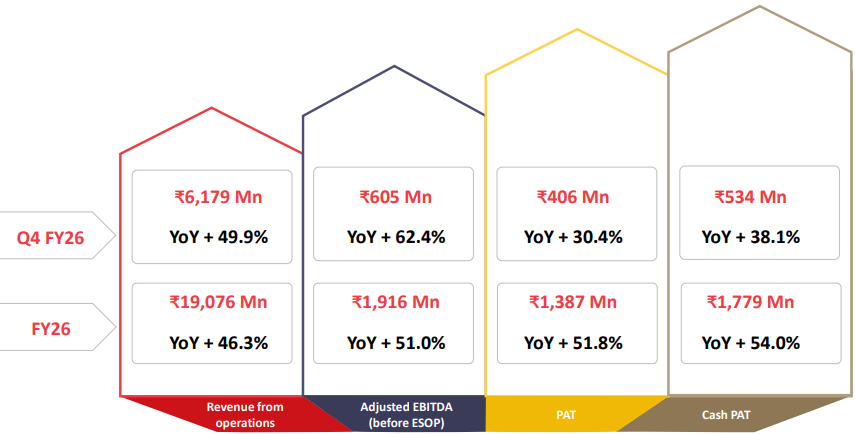
Management highlighted that FY26 marked a major “inflection point” where profitability started scaling faster than revenue growth.
One important insight here is that Zaggle’s profit growth is now beginning to outpace its revenue growth.
This usually signals improving business efficiency and a gradual shift toward a more scalable software-driven model rather than only transaction-led growth.
Revenue Breakdown of Zaggle
Zaggle earns revenue from a combination of transaction-based services and software-based solutions.
Its business is mainly divided into three key segments:
| Segment | What it Includes | Revenue (₹ Mn) | Contribution % |
| Program Fees | Corporate cards, employee benefits, rewards & incentives | 449 | 2.4% |
| Propel Revenue | Gift cards, rewards redemption & loyalty ecosystem | 7523 | 40.6% |
| SaaS / Platform Fees | Expense management and procurement software | 10556 | 57% |
(FY26 Gross Revenue Segment Split)
Currently, Program Fees and Propel Revenue contribute the largest share of revenue, while SaaS revenue remains smaller but higher margin.
One important insight investors should notice is that not all revenue has the same quality.
Transaction-heavy revenue boosts topline growth, but SaaS revenue is more recurring and profitable over the long term.
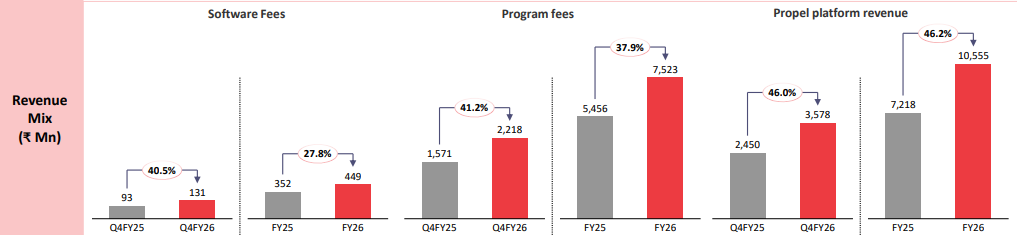
This means Zaggle’s future valuation may depend not only on how fast revenue grows, but also on how much of that growth comes from software and recurring platforms rather than transaction-based activities.
Geographic Split
Currently, Zaggle generates the majority of its revenue from India, where it serves clients across sectors like IT, banking, manufacturing, healthcare, and FMCG.
India remains the company’s core growth market because corporate expense digitization and automated spend-management adoption are still growing rapidly.
Zaggle generates 100% of its revenue from the Indian domestic market, with no material financial contributions currently coming from international or specific geographical segments.
According to the latest reported annual financials (FY26), the company's consolidated revenue from operations reached ₹1,907.65 crores, all generated within India.
At the same time, Zaggle is also exploring international opportunities in:
- MENA
- North America
- APAC regions
This expansion is important because international markets can help the company increase scale, diversify revenue sources, and strengthen its position as a broader SaaS and fintech platform rather than just a domestic corporate card business.
Geographic Expansion ( UAE & US )
Zaggle is planning global expansion, but timelines have been adjusted due to external and operational factors.
The UAE is a key growth market, but expansion is currently delayed due to regional geopolitical uncertainty in the broader Middle East. Management has stated the region will be activated once conditions stabilize.
The US launch has been pushed by a few quarters from earlier plans ( previously around June 2026 ), as the company focuses on strengthening its platform for complex requirements like multi-currency operations and high regulatory compliance, supported by its DICE and AI capabilities.
Overall, Zaggle is prioritizing readiness over speed, which may delay near-term growth but reduce execution risk in highly competitive global markets.
Future Growth Drivers
For Zaggle, future growth will come from multiple reinforcing levers rather than a single source of expansion.
1. Corporate Digitization Tailwind
Companies are steadily moving away from manual expense tracking and reimbursement systems toward fully digital, automated platforms. This structural shift is a long-term tailwind for Zaggle as enterprises increasingly adopt spend-management software.
2. Cross-selling Within Clients
Once a company is onboarded, Zaggle can expand its relationship by offering additional products like rewards programs, procurement tools, and expense management solutions. This improves revenue per client and strengthens long-term retention.
3. SaaS & Recurring Revenue Growth
Zaggle’s software offerings are still evolving, but they are strategically important. SaaS revenue is more predictable and higher margin compared to transaction-based income, making it a key driver of future profitability.
4. International Expansion
Expansion into markets like UAE, US, and APAC can significantly increase the company’s addressable market. However, this is being done cautiously, focusing on compliance readiness and platform strength before scaling aggressively.
5. AI and Automation Integration
AI is expected to play a growing role in automating expense processing, improving fraud detection, and streamlining enterprise workflows. This can improve efficiency and deepen platform stickiness.
FY27 Guidance & Key Management Focus Areas
FY27 expectations for Zaggle point to strong growth, with standalone revenue expected to grow around 25–30% and consolidated growth closer to ~40%, driven by multiple business lines like Green Edge, Zag.money, and Tax Planner.
EBITDA guidance has not been given due to costs related to the DICE structure and employee onboarding, with updates expected in the coming months.
Management’s main focus for FY27 is clear: first operating cash flow, then revenue growth, and finally margins.
This shows the company is prioritizing financial stability along with expansion.
Innovative Product Offerings
Zaggle offers a set of digital products that together form its enterprise spend ecosystem.

1. Zaggle Save is its expense management platform that helps companies automate employee reimbursements and track business spending.

2. Zaggle Propel focuses on rewards and incentives, enabling companies to manage employee benefits, gift cards, and loyalty programs digitally.

3. Zaggle Zoyer is a procurement and workflow automation tool that helps enterprises manage approvals, vendors, and internal processes more efficiently.

4. Zaggle Zati is Zaggle’s AI-powered employee benefits and rewards platform that helps companies automate incentives, recognition, and engagement through digital vouchers and prepaid cards, making workforce reward management faster, more structured, and cost-efficient.
Together, these products work as an integrated system, helping businesses manage spending in a more centralized and automated way.
Conclusion
Zaggle is becoming a full corporate spend management platform, not just a prepaid card company. Its growth is strong, driven by rising revenue, more enterprise clients, and products like Save, Propel, Zoyer, and Zati.
Most revenue still comes from India, but the company is slowly preparing for global expansion. Future growth will come from digital adoption, cross-selling, SaaS growth, and AI automation.
Overall, Zaggle looks like a strong long-term growth company, though profits may stay uneven in the short term due to expansion costs.