What Will It Take for Adani Ports to Raise Its Logistics Returns?
What Will It Take for Adani Ports to Raise Its Logistics Returns?
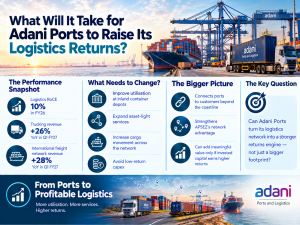
Adani Ports and Special Economic Zone (APSEZ) raised its logistics return on capital employed (RoCE) to 10% in FY26. Its next challenge is to make existing infrastructure more productive while expanding businesses that require less capital.
The Q1 FY27 earnings call highlighted three important developments: trucking revenue grew 26%, international freight network revenue increased 28%, and rail volumes declined 19% year-on-year. Management also said four major inland container depots (ICDs) had yet to reach their targeted 80% utilisation.
These figures reveal the central issue. APSEZ can increase cargo movement and grow asset-light services, but the financial benefit depends on how much additional operating profit these activities generate relative to the capital employed.
The company has not disclosed enough segment-level information to calculate the exact earnings benefit of higher ICD utilisation or determine the profit contribution of individual logistics businesses. However, the available data helps establish measurable return hurdles and identify the operating improvements investors should monitor.
Higher ICD Utilisation Could Improve Earnings Without Proportionate Investment
APSEZ targets 80% utilisation at its four major ICDs, but management confirmed that none had yet reached this level. Management highlighted Patli, Tumb and Virochannagar as important opportunities. It also discussed the need for shipping lines to accept bills of lading from newer ICDs, including Malur, Kilaraipur, Kishangarh and Patli.
The earnings opportunity comes from using existing infrastructure more intensively. An ICD incurs fixed costs for facilities, equipment and operations. When more containers move through the same infrastructure, the business can spread these costs across a larger volume of cargo.
Illustrative scenario: Assume an ICD currently operates at 60% utilisation. If it reaches 80%, cargo throughput would rise from 60 to 80 units for every 100 units of annual capacity. This represents a 33.3% increase in throughput, assuming the capacity and definition of utilisation remain unchanged.
If revenue per unit remains constant, revenue would increase at the same rate as cargo throughput. The additional operating profit would depend on revenue per unit, variable costs and the fixed costs the ICD already incurs.
APSEZ has not disclosed the current utilisation or combined capacity of the four ICDs, nor their revenue and operating margins. Therefore, investors cannot reliably calculate the actual rupee benefit. The key test is whether higher utilisation generates additional cargo and profit without requiring comparable new investment.
Moving Logistics RoCE From 10% to 12% or 15% Requires Higher Operating Profit
APSEZ reported logistics RoCE of 10% for FY26. Investors can assess the improvement required by calculating operating profit against a fixed capital base.
RoCE generally measures operating profit, or EBIT, as a percentage of capital employed. The following analysis illustrates the required return hurdles rather than management guidance.
For every ₹100 of capital employed:
- At 10% RoCE: Operating profit would be ₹10.
- At 12% RoCE: Operating profit would need to reach ₹12, an increase of ₹2.
- At 15% RoCE: Operating profit would need to reach ₹15, an increase of ₹5.
Moving from 10% to 12% therefore requires a 20% increase in operating profit if capital employed remains unchanged. Reaching 15% requires a 50% increase under the same assumption.
The earnings-call transcript does not disclose the logistics business's capital-employed base or operating profit in rupees. Investors therefore cannot calculate the actual rupee profit required to achieve either target.
APSEZ could also improve RoCE by generating the same profit with less capital tied up in underutilised assets and working capital. In practice, the company could improve returns through a combination of higher ICD utilisation, rail-volume recovery, better operating margins and disciplined investment.
For investors, the important measure is not simply whether logistics revenue grows. Operating profit must rise faster than the capital required to generate it.
Rail Volumes Need to Recover, but the Full Earnings Impact Remains Unknown
APSEZ's rail volumes declined 19% year-on-year in Q1 FY27. Management attributed the weakness to trade disruptions, an LPG shortage that severely affected Morbi tile exports, and customers shifting from containerised cargo to bulk cargo as container freight costs increased.
The Morbi disruption was significant. Management said the usual 2,000–3,000 containers associated with Morbi were almost absent during the affected period. At Tumb, some customers shifted cargo to bulk movement through Hazira instead of using the container network.
The evidence suggests that disruptions, rather than a permanent loss of demand, accounted for at least part of the decline. Management also reported that rail volumes had started to recover during the call. However, some customers had shifted cargo to different transport formats, while higher logistics costs had prevented other shipments from entering India. Investors therefore cannot yet conclude that volumes will recover fully and sustainably.
A useful recovery calculation: If rail volumes stood at an index of 100 in the year-ago quarter, a 19% decline would take them to 81. APSEZ would then need a 23.5% increase from this reduced level to return to 100.
This calculation measures the required volume recovery, not the earnings benefit. APSEZ has not disclosed the rail business's revenue per unit of cargo, incremental contribution margin or the exact volume lost at each ICD. Investors therefore cannot calculate the rupee impact on revenue and operating profit from the transcript alone.
Investors should look for sustained year-on-year rail-volume recovery alongside improved ICD utilisation. A recovery that allows APSEZ to use existing assets more intensively would create greater value than volume growth that requires substantial additional capital. Check our latest video for more details.
Asset-Light Growth Is Promising, but Revenue Growth Does Not Prove Higher Returns
Management identified four distinct logistics activities: rail and ICD operations are asset-heavy, trucking is asset-light, international freight network operations are asset-zero, and EXIM services are asset-light.
In Q1 FY27, trucking revenue grew 26% and international freight network revenue increased 28%. These growth rates support management's strategy of scaling services that require less physical infrastructure than rail and ICD operations.
However, the transcript does not disclose separate EBITDA, operating margins or capital employed for trucking and the international freight network. Investors therefore cannot establish whether either business currently generates superior returns or quantify its contribution to the overall 10% logistics RoCE.
Asset-light operations can improve capital efficiency when additional shipments generate earnings without a proportionate increase in assets. However, these businesses still incur costs for freight procurement, subcontracting, service delivery and customer acquisition. Faster revenue growth will not necessarily improve returns if these costs rise at a similar or faster rate.
The financial test is straightforward:
- Revenue growth should translate into higher operating profit.
- Incremental operating profit should require relatively little additional capital.
- Margins should remain healthy as shipment volumes increase.
- Growth should complement the existing port and inland network rather than depend on uneconomic pricing.
Investors should seek more segment-level disclosure on operating earnings and capital employed. Until APSEZ provides these figures, the reported growth rates indicate encouraging demand but do not prove superior profitability.
Integrated Logistics Must Generate More Earnings From Each Cargo Movement
APSEZ's network connects customers to inland depots, rail transport, trucking, port handling and freight services. This gives the company an opportunity to serve multiple stages of a shipment instead of earning revenue from just one part of the journey.
However, adding services does not automatically create economic value. The additional revenue must exceed the incremental costs of arranging and delivering those services, while the capital required must remain proportionate to the earnings generated.
The Q1 FY27 call offers a useful example of why revenue per unit matters. In its domestic ports business, management attributed revenue growth to changes in cargo mix, fuel surcharges, premium services and associated customer services. Domestic port revenue grew 12% while cargo volumes increased 2%. Management also emphasised revenue per tonne and cost control as important drivers of profitability.
These figures relate to the port business, not the logistics segment. Investors cannot use them to calculate logistics revenue per shipment or its incremental margins. However, they illustrate a broader principle: improving realisation and service mix can matter as much as increasing volume.
For its logistics business, APSEZ has not disclosed revenue per container or shipment, segment-level operating earnings, or the capital employed required to calculate the additional value from integrated services.
Future disclosures should connect cargo volume with revenue per unit, operating profit and capital employed. These figures would help investors determine whether APSEZ earns more from each customer's logistics journey rather than simply handling more shipments or offering more services.
What Investors Should Monitor Next
Investors can evaluate the next phase of APSEZ's logistics performance through a small set of operating and financial indicators.
ICD utilisation: Track whether the four major ICDs move towards the 80% target. Determine whether additional cargo drives the improvement rather than a simple shift in volumes between facilities.
Rail volumes: Monitor whether the reported recovery continues and the business regains the volumes lost during Q1 FY27.
Asset-light profitability: Check whether trucking and international freight network growth translates into higher operating earnings and attractive capital efficiency.
Logistics RoCE: Assess whether APSEZ improves on its reported 10% FY26 return through higher profits, better utilisation or lower capital intensity.
Incremental economics: Determine whether additional revenue and cargo generate enough operating profit to justify the associated costs and investment.
Management has also emphasised disciplined capital allocation. This makes existing infrastructure particularly important: adding capacity creates less value when the company has not fully utilised its available facilities.
The main limitation for investors remains the lack of disclosed logistics segment-level operating profit, capital employed and ICD-specific financial data. Without these figures, precise earnings scenarios would depend on assumptions rather than demonstrated company economics.
Conclusion
APSEZ has several identifiable routes to improve logistics returns: increase ICD utilisation, restore rail volumes, expand asset-light services and generate more value from each cargo movement.
The numbers establish the scale of the challenge. Logistics RoCE stood at 10% in FY26. Moving to 12% or 15% would require operating profit to increase by 20% or 50%, respectively, if capital employed remained unchanged. Separately, APSEZ would need a 23.5% increase in rail volumes from the reduced base to return to the previous year's level.
These calculations establish useful hurdles, but they do not predict APSEZ's future results. The company has not disclosed enough information to quantify the actual earnings benefit of higher ICD utilisation or the returns generated by its individual asset-light businesses.
The decisive evidence will be sustained growth in operating profit, better utilisation of existing assets and improving RoCE without a proportionate increase in capital employed. Until APSEZ demonstrates these results, investors should view logistics growth as an opportunity to prove its returns rather than assume that growth will automatically improve profitability.