Can Adani Ports Reach 1 Billion Tonnes by 2031?
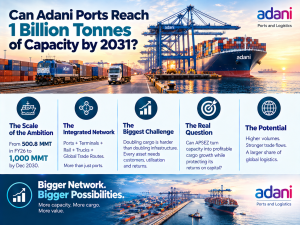
Adani Ports and Special Economic Zone (APSEZ) has set an ambitious target: handle 1 billion tonnes of cargo by December 2030. The company handled 500.8 million tonnes (MMT) in FY26, making the target a question of whether it can nearly double its annual throughput in less than five years.
The opportunity extends beyond building more terminals. APSEZ is expanding domestic ports, adding international assets and growing its logistics and marine businesses. These operations can help it attract cargo and capture more value from each customer relationship.
However, expansion also brings financial challenges. International ports and logistics currently generate lower returns on capital than domestic ports, while capital expenditure has already exceeded guidance. Acquisitions have also contributed to reported growth, making it important to separate the benefits of adding assets from improvements at existing operations.
The central question is whether APSEZ can achieve its volume target while maintaining financial discipline. The target is credible only if capacity expansion, cargo demand and returns on investment progress together.
The Cargo Target Requires Faster Growth
APSEZ handled 500.8 MMT in FY26, compared with 450.2 MMT in FY25. This represented cargo growth of 11%. The company aims to reach 1,000 MMT by December 2030.
The growth required to reach this target is considerably higher than the latest annual growth rate.
- FY26 cargo handled: 500.8 MMT.
- December 2030 target: 1,000 MMT.
- Additional annual throughput required: 499.2 MMT.
- Required annual growth rate: approximately 15.3%, calculated over 4.75 years from March 2026 to December 2030.
- FY26 cargo growth: 11%.
This means APSEZ needs to grow cargo volumes at an annual rate approximately 4.3 percentage points higher than FY26 growth.
The calculation assumes a steady compound annual growth rate. Actual growth will fluctuate as new terminals open, acquisitions are consolidated and trade conditions change.
The challenge is not simply the additional 499.2 MMT. APSEZ must also sustain growth as its existing volume base becomes larger. Every subsequent percentage point of growth represents more cargo than it did at the beginning of the period.
The key test is whether APSEZ can accelerate volume growth through a combination of higher utilisation, additional capacity and market-share gains. FY26 provides a strong base, but the target requires sustained execution beyond the growth already achieved.
Capacity Expansion Must Translate Into Actual Cargo
APSEZ's domestic port capacity stood at 653 MMT as of March 31, 2026. By June 30, 2026, the company continued to report the same domestic capacity while outlining an expansion programme targeting 1,000 MMT by December 2030.
That represents an increase of 347 MMT, or approximately 53.1%, over the March 2026 domestic capacity base.
The company's earlier investor roadmap also divided the 1-billion-tonne cargo ambition into 850 MMT from domestic ports and 150 MMT from international ports. These are cargo-throughput targets, not a direct statement that total port capacity will be split into those exact amounts.
This distinction helps assess the infrastructure requirement. If domestic capacity reaches 1,000 MMT and domestic cargo reaches the roadmap's 850 MMT target, domestic utilisation would be 85%.
That calculation is a target-based scenario, not a reported utilisation figure. International capacity must be assessed separately because the disclosed roadmap does not provide a comparable consolidated international capacity figure.
The capacity plan appears designed to provide room for domestic throughput to grow without requiring every terminal to operate at full capacity. That is important because ports need operational flexibility for maintenance, cargo mix, vessel scheduling and demand fluctuations.
However, capacity is only useful when cargo demand supports it. APSEZ must attract sufficient volumes to make the additional infrastructure productive.
The bigger constraint could therefore shift over time: construction may initially determine how quickly capacity becomes available, but customer demand and terminal utilisation will determine how much of that capacity earns a return. Check our latest video for more details.
Low Returns From International Ports and Logistics Need Attention
APSEZ's domestic ports business is its strongest benchmark for capital efficiency. In FY26, domestic ports delivered a RoCE of 23%, compared with 8% for international ports and 10% for logistics.
The difference matters because the company is directing investment towards businesses that are growing rapidly but have not yet delivered comparable returns.
International ports revenue increased 34% to ₹4,539 crore in FY26, while EBITDA rose 180%. Logistics revenue grew 55% to ₹4,478 crore, but EBITDA increased only 34% to ₹863 crore.
Logistics therefore added ₹1,597 crore of revenue over FY25, while EBITDA increased by ₹221 crore. Revenue expanded faster than operating earnings, suggesting that the additional sales did not translate proportionately into EBITDA.
For international ports, the 180% EBITDA increase also needs context: the business benefited from NQXT Australia and Colombo's ramp-up. Moreover, FY26 international RoCE excludes NQXT because consolidation began in Q4. The reported 8% therefore does not reflect a full year of the acquired asset's contribution.
What would it take to improve returns?
The available results do not provide the segment-level capital-employed amounts needed to calculate exact additional operating profit requirements. However, the RoCE hurdle can be quantified for every ₹1,000 crore of capital employed:
| Segment | Current RoCE | Profit at 12% RoCE | Profit at 15% RoCE |
| International ports | 8% | ₹120 Cr | ₹150 Cr |
| Logistics | 10% | ₹120 Cr | ₹150 Cr |
These are illustrative operating-profit requirements using the RoCE formula, not company forecasts. At 12% RoCE, international ports would need ₹40 crore more annual operating profit per ₹1,000 crore of capital employed than at its current return; logistics would need ₹20 crore more. At 15%, the respective gaps would be ₹70 crore and ₹50 crore.
The priority is not just faster growth. It is ensuring that growth produces enough operating profit to justify the capital tied up in these businesses.
Can APSEZ Fund Expansion Without Stretching Its Balance Sheet?
APSEZ spent ₹15,320 crore on capital expenditure in FY26, above its guidance of ₹11,000-12,000 crore. For FY27, management has guided for capex of ₹12,000-14,000 crore and a net debt-to-EBITDA ratio of up to 2.5 times. The reported ratio at the end of FY26 was 1.9 times.
The company's FY26 net cash flow from operations was ₹20,356 crore. Comparing that figure with FY27's capex guidance provides a useful funding reference:
- FY27 capex at ₹12,000 crore equals 58.9% of FY26 operating cash flow.
- FY27 capex at ₹14,000 crore equals 68.8% of FY26 operating cash flow.
This suggests that the guided capex range is below the previous year's operating cash generation. However, this is a comparison between different financial years, not a forecast of FY27 free cash flow. Operating cash flow can change, and the company also has financing costs, dividends and other cash requirements.
The previous year's overshoot also deserves attention. FY26 capex exceeded the top end of guidance by ₹3,320 crore. Although net leverage remained within the company's stated policy, repeated overspending could reduce the flexibility available for future investments.
The risk becomes more significant if new terminals take longer to attract cargo. Capital is committed upfront, while the expected earnings arrive gradually. During that period, debt and depreciation can increase before assets reach their intended utilisation.
APSEZ's expansion will be more sustainable if operating cash flow funds a substantial share of investment, leverage remains controlled and new projects begin contributing to earnings on schedule. The company's stated intention to fund future capex through internal accruals makes execution and cash conversion especially important.
How Much Growth Is Organic, and How Much Comes From Acquisitions?
A major part of APSEZ's growth story is the distinction between increasing volumes at existing ports and adding cargo through acquisitions.
In FY26, international ports revenue rose 34% to ₹4,539 crore, with growth supported by NQXT Australia and the ramp-up of Colombo West International Terminal. The contribution from these assets means reported growth cannot be treated as purely organic.
Q1 FY27 makes this distinction even clearer:
- International port cargo increased from 7.7 MMT in Q1 FY26 to 22.8 MMT in Q1 FY27.
- NQXT Australia contributed 10 MMT in Q1 FY27.
- Colombo contributed 6.9 MMT, Tanzania 3.7 MMT and Israel 2.2 MMT.
- International ports revenue rose 80% to ₹1,747 crore, while EBITDA increased 256% to ₹730 crore.
NQXT's 10 MMT contribution alone represented a substantial part of the increase in reported international volumes. Colombo's ramp-up also contributed, so the entire increase should not be attributed to the acquisition.
Domestic operations offer a different picture. In Q1 FY27, domestic cargo volumes increased 2% year on year, from 112.9 MMT to 115.3 MMT, while domestic port revenue rose 12%. This shows that revenue growth can also come from product mix and realisation, rather than volume growth alone.
The company has not disclosed a complete like-for-like organic cargo-growth bridge that isolates every acquired asset and existing port. Therefore, assigning an exact share of the 1-billion-tonne target to organic growth versus acquisitions would go beyond the available evidence.
The important question is whether existing ports can sustain volume growth while acquisitions and new terminals add incremental cargo. Acquisitions can accelerate the target, but their contribution must be assessed alongside the returns they generate.
What Investors Should Track Until 2031
The 1-billion-tonne ambition is measurable, but the quality of progress will depend on several indicators moving in the right direction.
- Cargo growth: APSEZ needs to move beyond its FY26 base of 500.8 MMT. The required CAGR of approximately 15.3% is higher than FY26's 11% growth, making sustained acceleration important.
- Capacity utilisation: Domestic capacity is targeted to rise from 653 MMT to 1,000 MMT by December 2030. Investors should track how quickly the added capacity becomes productive and whether cargo demand keeps pace.
- Returns on capital: Domestic ports delivered 23% RoCE in FY26, compared with 8% for international ports and 10% for logistics. Improvements in the latter two segments would help ensure that expansion creates value rather than merely increasing scale.
- Cash generation and capex: FY27 capex guidance of ₹12,000-14,000 crore should be assessed alongside actual operating cash flow, debt and project commissioning. FY26's capex overshoot makes spending discipline particularly important.
- Organic versus acquisition-led growth: Investors should examine whether volumes at existing ports are rising, how much additional cargo comes from acquired assets and whether newly added assets improve returns after consolidation.
These indicators should be considered together. Cargo growth without improving returns may indicate that expansion is capital-intensive; stronger returns without sufficient volume growth may not support the long-term target.
Conclusion
APSEZ has a strong starting position, with 500.8 MMT of cargo handled in FY26, domestic capacity of 653 MMT and an expanding international network. Its plan to reach 1 billion tonnes by December 2030 is supported by infrastructure expansion, acquisitions and a broader logistics offering.
However, the required cargo CAGR of approximately 15.3% is materially higher than FY26 growth of 11%. The company must expand throughput while ensuring that new facilities attract cargo quickly enough to generate adequate returns.
The financial challenge is equally important. International ports and logistics have lower RoCE than domestic ports, and rapid revenue growth has not always translated into comparable earnings growth. Capital expenditure must also remain aligned with operating cash generation and the pace at which new assets become productive.
The decisive test is whether APSEZ can turn additional capacity into recurring cargo, stronger cash flows and improving capital returns. Reaching 1 billion tonnes would establish its scale. Delivering that growth without weakening capital efficiency would determine how much long-term value the expansion creates for shareholders.