The “Compounding” Story- A Coal-Tar Company Becoming A Battery-Materials Powerhouse
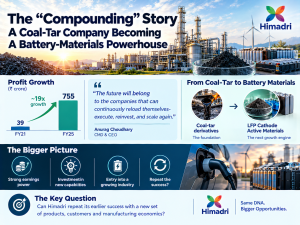
Himadri grew its profit from ₹39 crore to ₹755 crore in four years. Now, it wants to use that earnings power to build its next growth engine.
“The future will belong to the companies that can continuously reload themselves- execute, reinvest, and scale again.” - Anurag Choudhary, CMD & CEO
For a company that began with coal-tar derivatives, Himadri Speciality Chemical’s next chapter looks very different. It is building a position in lithium iron phosphate (LFP) cathode active materials, a key component used in lithium-ion batteries.
But the interesting part is not simply that Himadri is entering a growing industry. It is that the company is attempting this transition after a sharp improvement in profitability, with an established business generating the earnings needed to fund its expansion.
The question for investors is whether Himadri can repeat its earlier success with a new set of products, customers and manufacturing economics.
The Profit Growth Is Real, But What Drove It?
Himadri’s financial performance between FY22 and FY26 shows how dramatically its earnings profile changed.
| Metric | FY22 | FY26 | CAGR |
| Revenue | ₹2,791 Cr | ₹4,661 Cr | 14% |
| EBITDA | ₹163 Cr | ₹1,006 Cr | 58% |
| PAT | ₹39 Cr | ₹755 Cr | 110% |
| EBITDA margin | 5.8% | 21.6% | — |
Revenue grew approximately 1.7 times, but EBITDA increased more than sixfold. The EBITDA margin expanded by around 1,580 basis points, from 5.8% to 21.6%.
The company’s FY26 annual report attributes its performance to product selection, value addition, integration and scale economies. These provide a credible explanation for the improvement, but they do not quantify how much each factor contributed.
Product mix: Moving towards specialised carbon products and higher-value applications can improve the average profitability of sales. Himadri’s portfolio includes speciality carbon black, coal-tar pitch and other speciality chemicals. Its annual report identifies value addition and product integration as contributors to improved margins.
Pricing and raw-material spreads: The spread between selling prices and input costs directly affects profitability. However, the available figures do not isolate the contribution of pricing from changes in coal-tar prices, feedstock costs or product-specific margins.
Operating leverage: A larger revenue base can spread fixed manufacturing and overhead costs across more output. Himadri’s integrated manufacturing facilities also allow one process’s output to become another process’s input. Yet the disclosures do not quantify the separate earnings contribution of this effect.
The honest conclusion is that product mix, integration and scale are documented contributors, but the exact contribution of pricing, raw-material spreads and operating leverage cannot be conclusively separated from the available figures.
That distinction matters. Himadri has demonstrated substantial margin expansion, but investors should not assume that its historical 110% PAT CAGR can continue at the same pace.
The ₹2,000 Crore Investment Programme: Where Is the Money Going?
Himadri’s next phase of growth involves investments across battery materials, advanced carbon products, speciality chemicals and tyre manufacturing. The company has announced approximately ₹2,000 crore of capital expenditure, which management plans to fund internally.
LFP: The Largest Identified Investment
Himadri has committed ₹1,125 crore to its lithium iron phosphate (LFP) cathode active material project. Phase I is planned at 40,000 metric tonnes per annum (MTPA), with an initial 2,000 MTPA milestone targeted for Q3 FY27 and the broader rollout scheduled across FY28–FY29.
Management has indicated that the full Phase I capacity could generate ₹3,000 crore in annual revenue at current values. This makes LFP the most clearly quantified growth opportunity in the investment programme. However, the revenue potential depends on commissioning, customer qualification, utilisation and achievable selling prices.
CNT and Super Speciality Carbon Black: Earnings Visibility Is Still Limited
Himadri is investing ₹70 crore in a 200 MTPA carbon nanotube (CNT) facility, with commissioning targeted for Q4 FY27. CNTs have applications in advanced materials, including battery-related technologies, but the company has not separately disclosed the project's expected revenue or EBITDA contribution.
Another ₹170 crore is earmarked for Super Speciality Carbon Black expansion, with commissioning targeted for Q4 FY28. Its eventual financial contribution will depend on demand, utilisation and realisations. Until these factors become clearer, the announced investments indicate additional capacity rather than a quantified earnings opportunity.
Speciality Chemicals: A Defined Revenue Target
Himadri is expanding its anthraquinone and carbazole capacity in two phases. Phase I, with a capacity of 2,600 MTPA, is targeted for Q2 FY27. The second phase would increase cumulative capacity to 5,300 MTPA by Q2 FY28.
Management has indicated revenue potential of ₹250–300 crore for this product group. The key measure of progress will be how quickly the additional capacity translates into customer orders, sales and operating profits.
Birla Tyres: The Investment Needs a Revenue Bridge
The programme also includes approximately ₹500 crore for Birla Tyres, supporting a production ramp-up across off-highway, commercial vehicle and passenger-car tyre categories.
However, a separate revenue or EBITDA contribution attributable to this investment has not been quantified in the figures available here. Investors will need evidence of production volumes, sales realisations, capacity utilisation and margins to assess whether the investment can generate adequate returns.
What Investors Should Track
The announced projects have different commissioning schedules and levels of financial visibility. LFP has the largest disclosed investment and a stated revenue benchmark. Speciality chemicals also have a revenue target, while CNT, Super Speciality Carbon Black and Birla Tyres need clearer earnings frameworks.
The central question is how quickly these investments can convert into profitable revenue. Investors should track actual capital expenditure, commissioning progress, customer approvals, utilisation and operating margins rather than treating announced revenue potential as realised business.
The disclosed project amounts are rounded and do not constitute a fully reconciled breakdown of the entire ₹2,000 crore programme. Since management plans to fund the expansion internally, cash generation and working-capital requirements will also matter. The success of the programme will ultimately depend not just on how much capacity Himadri adds, but on how efficiently that capacity generates cash and earns returns on the capital invested. Check our latest video for more details.
What Could The 40,000 MTPA LFP Plant Earn?
Revenue Potential Depends on Utilisation and Realisation
Management has indicated that Himadri’s 40,000 MTPA LFP cathode active material plant could generate ₹3,000 crore in annual revenue at current values. This implies a realisation of ₹7.5 lakh per tonne at full capacity.
The following scenarios illustrate how operating conditions could affect revenue and EBITDA. These are analyst estimates, not management guidance.
| Scenario | Utilisation | Selling price per tonne | Annual revenue | Assumed EBITDA margin | Illustrative EBITDA |
| Conservative | 50% | ₹6 lakh | ₹1,200 Cr | 10% | ₹120 Cr |
| Base case | 75% | ₹7.5 lakh | ₹2,250 Cr | 15% | ₹337.5 Cr |
| Upside | 90% | ₹9 lakh | ₹3,240 Cr | 20% | ₹648 Cr |
Method: Revenue = 40,000 tonnes × utilisation × selling price per tonne. EBITDA = revenue × assumed EBITDA margin. Prices and margins are illustrative assumptions, not disclosed forecasts.
The sensitivity shows how strongly the outcome depends on commercial execution. At 50% utilisation and ₹6 lakh per tonne, annual revenue would reach ₹1,200 crore. At 75% utilisation and ₹7.5 lakh per tonne, it would rise to ₹2,250 crore. The upside scenario reaches ₹3,240 crore, but requires both higher utilisation and a higher realisation.
What Would These Earnings Mean for the ₹1,125 Crore Investment?
Revenue alone does not establish whether the project will earn an attractive return. Under the illustrative base case, EBITDA of ₹337.5 crore would represent 30% of the ₹1,125 crore investment in annual EBITDA relative to stated capex.
That ratio is not a return on capital employed or a payback forecast. EBITDA excludes depreciation, interest and taxes, while actual cash returns must also account for working capital, maintenance expenditure and the time required to ramp up production. The assumed 15% EBITDA margin also remains unverified until the plant establishes its operating economics.
Why the Initial 2,000 MTPA Milestone Matters
The initial 2,000 MTPA milestone, targeted for Q3 FY27, is an important early test. It can help establish manufacturing consistency, product quality and customer acceptance before the broader Phase I rollout across FY28–FY29.
Investors should focus on the pace of customer qualification, actual production, utilisation and realised selling prices. These indicators will help determine whether the ₹3,000 crore revenue benchmark can translate into sustainable earnings and adequate returns on the ₹1,125 crore investment.
Can Internal Cash Generation Comfortably Fund The Expansion?
FY26 Cash Flow Leaves Limited Room After Capital Expenditure
Management plans to fund Himadri’s expansion programme internally, reducing dependence on fresh borrowing. However, FY26 cash flows show why self-funding should not automatically be interpreted as effortless funding.
Himadri generated ₹465.8 crore in standalone operating cash flow in FY26. It spent ₹418.1 crore on property, plant and equipment (PPE), paid ₹29.6 crore in dividends and ended the year with ₹144 crore in cash and cash equivalents.
| Standalone FY26 cash-flow indicator | Amount |
| Net cash from operating activities | ₹465.8 Cr |
| Purchase of property, plant and equipment | ₹418.1 Cr |
| Dividend paid | ₹29.6 Cr |
| Cash and cash equivalents at year-end | ₹144.0 Cr |
| Net cash from operations less reported PPE purchases | ₹47.7 Cr |
Source: FY26 annual report. The last figure is a simple calculation before other investing activities, acquisitions, investment purchases and financing movements.
Operating cash flow exceeded PPE purchases by just ₹47.7 crore. This does not mean Himadri cannot finance its expansion, but it shows that FY26 operating cash generation left a limited surplus after capital expenditure, before accounting for other cash requirements.
Liquidity Helps, but Borrowings Still Matter
The consolidated balance sheet provides additional financial context. At March 2026, Himadri reported approximately ₹164.8 crore in cash and cash equivalents, ₹566.7 crore in other bank balances and ₹721.8 crore in borrowings.
The company should therefore not be described as having zero borrowings. Its reported net debt-to-equity ratio was negative 0.03, indicating a net-cash position under the company's reported measure. However, cash, bank deposits and borrowings are not interchangeable, particularly where deposits may be restricted or earmarked for specific purposes.
This distinction matters because the expansion programme will require cash at different stages, while the existing business must continue funding its regular operations.
Working Capital Could Increase the Funding Requirement
Capital expenditure is only one part of the funding equation. Inventory requirements, customer receivables and supplier-payment terms also determine how much cash remains available for investment.
As production expands, Himadri may need to purchase raw materials, hold additional inventory and extend credit to customers before collecting the resulting sales proceeds. These requirements can absorb cash even when reported revenue and profits are growing.
The timing of cash generation is therefore as important as the eventual profitability of the new facilities.
The Real Test Is Funding Capacity, Not Just Debt Avoidance
Management's internal-funding plan must be assessed against the scale of the proposed investment. If spending reaches around ₹1,000 crore annually over the next two years, as indicated by management, the cash requirement would be substantially larger than the surplus left after FY26 standalone capital expenditure.
Funding could come from future operating cash flows, available liquidity and the timing of individual projects. However, the actual funding mix will depend on cash generation, working-capital movements and other investment commitments.
The key question is not simply whether Himadri can avoid raising fresh debt. It is whether the company can fund its expansion without weakening liquidity or constraining investment in its existing business. Investors should track operating cash flow, capital expenditure, working-capital movements and borrowings together to judge whether the expansion remains financially comfortable.
The Existing Business Remains The Foundation
Himadri's established operations are what make this expansion possible. Its integrated carbon complex has coal-tar distillation capacity of 600,000 MTPA. The company reports a 65% domestic market share in coal-tar pitch, a speciality carbon black portfolio spanning more than 70 grades and sales across 61 countries.
These capabilities provide manufacturing scale, customer relationships and an established industrial base. They also help explain why the company can consider investments in adjacent materials rather than relying entirely on external financing.
The transition into battery materials nevertheless introduces different risks. LFP cathode active material requires consistent product quality, technical validation and customer qualification. Commercial volumes must build before the new facility can contribute earnings at scale.
The framework for assessing the next phase is straightforward:
Existing business generates cash → capex builds new capacity → customer qualification enables sales → utilisation drives margins → cash returns justify reinvestment.
Every link matters. A delayed qualification can postpone revenue even when a plant is ready. Low utilisation can weaken margins because fixed costs remain. Strong EBITDA may also fail to translate into free cash flow if working-capital needs are high.
That is why investors should monitor commercial milestones alongside financial results. The most useful evidence will be commissioned capacity, customer approvals, actual sales volumes, realised prices, segment profitability and cash generation after capital expenditure.
Conclusion
Himadri's historical transformation is visible in its financial results. Between FY22 and FY26, revenue grew at a 14% CAGR, EBITDA at 58% and PAT at 110%. Its margins improved substantially, creating a stronger earnings base from which to pursue new opportunities.
The next phase is more demanding. Approximately ₹2,000 crore of announced investment must be converted into operational capacity, qualified products, commercial sales and sustainable cash generation. The LFP project provides the clearest opportunity to measure that process, with management indicating ₹3,000 crore of revenue potential for Phase I at current values.
The risks are equally measurable: commissioning delays, lower utilisation, weaker realisations, cost pressure and working-capital requirements could reduce the returns from the investment.
Himadri has demonstrated that it can improve profitability in its established business. It has not yet demonstrated that the new investment programme will produce the same outcome.
The next chapter of compounding will be decided by how efficiently Himadri converts its capital into cash-generating businesses, not by the size of its expansion announcements.