India’s First CNT Plant -The Material That’s 100x Stronger Than Steel
Himadri is moving into one of the most technically demanding corners of carbon materials: Carbon Nanotubes (CNTs). The company says it developed CNT technology in FY2025-26 and is working to commission a 200 MTPA commercial plant, which it describes as one of only six such plants in the world.
The investment is interesting because CNT is not a volume game like conventional carbon black. A small quantity can change the electrical, mechanical or thermal properties of another material.
Himadri’s annual report identifies applications ranging from lithium-ion batteries and conductive plastics to aerospace, defence, electronics, coatings and advanced composites. It also describes CNT as a high-margin product that could strengthen the profitability of its carbon business.
But the investment case is not simply that CNT is a powerful material.
The real question is whether Himadri can turn its technology into qualified customers, commercial volumes and attractive margins.
That makes the ₹70 crore investment targeted for a 200 MTPA plant and Q4FY27 commissioning less about adding tonnes and more about proving that a laboratory breakthrough can become a profitable speciality-materials business.
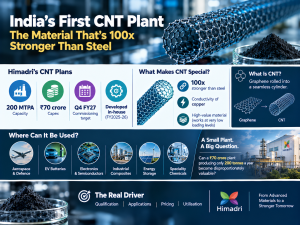
The “100x Stronger” Claim Needs A Closer Look
The headline around CNTs is impressive, but it needs context.
Carbon nanotubes are among the strongest materials studied at the nanoscale. A 2010 ACS Nano study estimated maximum stress of 99 GPa for individual nanotubes and calculated a strength-to-weight ratio 117 times that of steel. More recent research, however, shows that measured strength varies significantly with nanotube structure, defects and how the CNTs are assembled.
That distinction matters for Himadri.
The company is not selling an individual laboratory nanotube as a structural replacement for steel. Its commercial product will be used as a functional material in applications such as batteries, plastics, rubber, coatings and composites.
So the more useful investor takeaway is not simply “100x stronger than steel.”
It is that CNTs can deliver high mechanical strength, conductivity and functionality at extremely low loading.
That is exactly how Himadri describes the material in its annual report.
For investors, this changes the question from “How strong is CNT?” to “How much value can a customer extract from using a small quantity of CNT?”
If the answer is significant, the economics can support a high-value speciality-material business even at only 200 tonnes of annual capacity.
₹70 Crore For 200 Tonnes: What Could The Economics Look Like?
Himadri has not disclosed a selling price per tonne or an EBITDA margin for the CNT business. That means any revenue calculation today has to be treated as a sensitivity analysis, not company guidance.
A simple framework shows why the economics could become interesting.
Assume:
- Capacity: 200 tonnes
- Selling price: ₹20 lakh per tonne - analyst assumption
- Utilisation: 75% - analyst assumption
- EBITDA margin: 30% - analyst assumption
At 75% utilisation, the plant would sell 150 tonnes.
That would imply:
150 tonnes × ₹20 lakh = ₹30 crore revenue
At a 30% EBITDA margin:
₹30 crore × 30% = ₹9 crore EBITDA
Against a ₹70 crore investment, that would represent EBITDA equal to about 13% of the initial capex in a full year at those assumptions.
At 100% utilisation, the same assumptions would produce ₹40 crore revenue and ₹12 crore EBITDA.
But this is exactly why the assumptions matter. At ₹10 lakh per tonne and 75% utilisation, revenue falls to ₹15 crore. At ₹30 lakh per tonne, it rises to ₹45 crore.
The plant's economics therefore depend far more on realised price, utilisation and margin than on the 200-tonne capacity number alone. Check our latest video for more details.
The Real Hurdle Is Customer Qualification
This is where the CNT story becomes much more interesting and much riskier.
Himadri lists several potential applications: lithium-ion batteries, automotive components, high-end rubber, plastics, coatings, aerospace and defence, electronics and semiconductors.
But an application list is not the same thing as commercial demand.
For CNTs, customers have to establish that the material consistently delivers the required performance inside their own products. That can involve testing dispersion, conductivity, strength, thermal behaviour, compatibility with other materials and consistency from batch to batch.
And the annual report does not disclose any named CNT customers, CNT orders, commercial revenue or customer-specific qualification programmes.
That is an important gap.
Himadri has already demonstrated the ability to develop the material and is moving toward commercial manufacturing. The next proof point is whether customers are willing to qualify it and purchase it at commercially attractive prices.
For investors, the progression to watch is therefore straightforward:
Technology → plant → qualification → orders → utilisation → realised price → EBITDA.
Until the middle of that chain becomes visible, CNT remains an attractive technology opportunity rather than a proven earnings contributor.
“One Of Only Six Plants" Sounds Powerful But It Is Not Automatically A Moat
Himadri says its planned 200 MTPA CNT facility will be one of only six such plants in the world.
That is an unusual position, but the number needs to be interpreted carefully.
The annual report does not identify the other five plants, their capacities, their customers or their economics. It also does not establish that Himadri's technology is fundamentally superior to those competitors.
So the scarcity of commercial plants should not automatically be treated as a competitive moat.
The real moat would have to come from something harder to replicate:
- Consistent CNT quality at commercial scale
- Reliable production economics
- Customer-specific formulations
- Successful qualification with demanding users
- Ability to scale without losing product performance
- Long-term customer relationships
This is particularly important because CNT is an advanced material where laboratory performance and commercial performance can be very different.
Himadri's advantage could ultimately be its ability to manufacture a consistent, application-ready product, rather than simply being one of a small number of companies with a CNT plant.
₹128 Crore Of R&D Matters But It Is Not ₹128 Crore Of CNT Investment
There is another number that can easily be misunderstood.
Himadri says it invested ₹128 crore in R&D during FY2025-26 and had a workforce of more than 180 R&D professionals.
That is significant evidence of the company's broader R&D capability.
But it should not be interpreted as ₹128 crore spent developing CNT.
The ₹128 crore figure covers Himadri's company-wide R&D effort across its product and technology pipeline. The annual report separately identifies CNT as a technology breakthrough achieved in FY2025-26.
The distinction matters because CNT is only one part of a much broader innovation programme that includes battery materials, silicon-carbon technology, speciality chemicals, recycling and other advanced-material initiatives.
The more relevant investor insight is therefore that Himadri has built an R&D platform capable of taking products from research toward commercialisation.
CNT is one test of whether that platform can repeatedly produce high-value commercial products.
That is potentially more important than attributing the entire R&D spend to one technology.
CNT Could Be Small In Tonnes But Meaningful In Profits
The 200 MTPA capacity looks tiny when compared with Himadri's existing carbon businesses.
That is precisely the point.
Traditional carbon businesses depend heavily on tonnes sold. CNT can potentially create value through the performance improvement it delivers to the customer's product.
If a small CNT addition improves conductivity, strength, charging performance, durability or electromagnetic shielding enough to justify a premium, the value of the material can be much higher than its physical weight suggests.
Himadri itself describes CNT as a high-value, high-margin product line and identifies premium-margin opportunities across batteries, automotive, rubber, plastics, coatings, aerospace and electronics.
But investors should not capitalise that description before the economics are visible.
The first commercial plant is only 200 MTPA. The important number will not be capacity alone. It will be revenue per tonne and EBITDA per tonne at meaningful utilisation.
That is where the CNT project could either become a genuinely valuable speciality-material business or remain a technically impressive but financially small experiment.
The Bigger Opportunity Is Himadri’s Ability To Move Up The Carbon-Value Chain
CNT fits into a much larger transformation underway at Himadri.
The company has historically operated across carbon-intensive businesses, but it has increasingly moved toward specialised and application-driven materials.
Its FY2025-26 annual report describes this transition from commodity carbon products toward advanced materials and highlights CNT alongside battery materials and other technology-led products.
That creates an interesting strategic logic.
Himadri already understands carbon chemistry, feedstocks, process engineering and large-scale manufacturing. CNT gives it an opportunity to apply those capabilities to a much more technically specialised material.
If successful, the company could progressively shift a greater portion of its earnings toward products where performance, qualification and intellectual property matter more than commodity pricing.
That is potentially more valuable than the ₹70 crore CNT project itself.
The investment is small enough not to transform Himadri's consolidated earnings immediately. But it can serve as a test of whether the company's R&D platform can repeatedly convert scientific development into high-margin commercial products.
What Investors Should Watch Next?
The next few disclosures will tell far more about CNT's financial potential than the technology headline does today.
- Commissioning
Himadri is targeting Q4FY27 for the commercial plant. Any delay would push out the revenue opportunity.
- Customer qualification
Named customers, trials, development programmes or qualification milestones would provide the first evidence of commercial traction.
- Selling price
The biggest missing financial variable is realised CNT pricing. Even small changes in price per tonne can materially change the economics of a 200-tonne plant.
- Utilisation
A 200 MTPA plant running at 30% utilisation is a very different business from one operating near full capacity.
- EBITDA per tonne
This will ultimately determine whether CNT is genuinely a high-margin product or simply an expensive advanced-material project.
- Expansion
If the first 200 MTPA facility reaches meaningful utilisation and customers continue qualifying the material, a larger capacity expansion would provide much stronger evidence that Himadri sees real commercial demand.
For now, the investment case should be viewed as an option on future high-margin earnings, not as earnings already secured.
The ₹70 Crore Question Is Really A ₹30 Crore Revenue Question
The most useful way to look at Himadri's CNT project is not to ask whether 200 tonnes is a large capacity.
It isn't.
The question is whether those 200 tonnes can generate enough value to justify the capital invested.
Under one purely illustrative scenario ₹20 lakh per tonne, 75% utilisation and 30% EBITDA margin, the plant could generate ₹30 crore revenue and ₹9 crore EBITDA.
Those numbers are not forecasts. They simply show the sensitivity of the project to three variables that Himadri has not yet disclosed.
If realised pricing is substantially higher and the plant reaches high utilisation, the economics become considerably more attractive. If pricing or utilisation is weak, the ₹70 crore investment takes much longer to earn an adequate return.
That is why the next phase of the CNT story is not about how impressive the material sounds.
It is about whether Himadri can prove commercial demand, pricing power and repeatable production economics.
The technology has created the opportunity.
The customers will determine whether it becomes a business.