Recycled Water Is Becoming Big Business for Indian Factories
India’s next major source of industrial water may not come from a new dam, river or groundwater aquifer.
It may come from water that has already been used once.
For decades, wastewater was largely treated as the final stage of the industrial and urban water cycle, a problem that had to be cleaned up before being discharged. That thinking is beginning to change. As freshwater becomes harder to access and industrial water demand continues to grow, treated wastewater is increasingly being viewed as something far more valuable: a potential source of supply for factories.
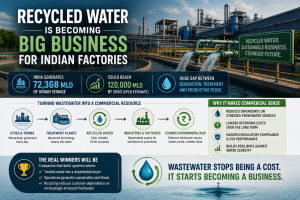
The scale of the opportunity is striking. India generates 72,368 million litres per day (MLD) of urban sewage, according to CPCB data. Yet only 20,235 MLD is currently treated, leaving 52,133 MLD untreated. CPCB estimates that urban sewage generation could rise to 120,000 MLD by 2050.
That creates two problems but also one potentially enormous business opportunity.
India needs more wastewater treatment infrastructure. But beyond that, it needs systems capable of turning treated water into something factories can actually use.
And that is where recycled water is becoming big business.
Wastewater Is Slowly Becoming A Water Supply
The most important change in India’s water sector is not simply that more sewage treatment plants are being built.
It is the changing purpose of those plants.
Traditionally, the objective was straightforward: collect wastewater, treat it sufficiently and prevent pollution of rivers, lakes and groundwater. The water cycle effectively ended there.
The emerging model is different.
Collect → Treat → Upgrade → Reuse.
This matters because not every industrial activity requires freshwater-quality water. Depending on the application and required quality standards, treated wastewater can be used for industrial utilities and other non-potable purposes.
CPCB’s latest guidelines explicitly argue that untreated sewage should increasingly be viewed as a resource that can be treated according to requirements and used for non-potable purposes and industrial utilities.
That shift changes the economics of wastewater infrastructure.
A sewage treatment plant that only prevents pollution is essentially a compliance asset. But a plant that produces water which can be supplied to industries creates a potential commercial output.
In other words, the wastewater treatment plant stops being just the end of the pipeline.
It can become the beginning of a new water supply chain.
That distinction could be crucial for India’s water industry over the coming years.
The Untapped Opportunity Is Enormous
India’s wastewater numbers reveal why recycling is attracting increasing attention.
According to a NITI Aayog report, just under 1,000 MLD of treated wastewater was being reused for valuable purposes, equivalent to around 3% of treated wastewater and 1% of total wastewater generated, based on the data assessed in the report.
That means India has historically spent money collecting and treating water without fully capturing the economic value of the resource created at the end of the process.
This is perhaps the biggest insight behind the recycled-water opportunity. The problem is not only that India lacks water. It is also that India has not yet built enough infrastructure to keep water circulating through the economy.
Every litre of wastewater that can be safely reused can potentially reduce pressure on:
- Rivers and lakes
- Groundwater reserves
- Municipal freshwater supplies
- Freshwater allocations to industries
For factories facing increasing water stress, recycled water offers something particularly valuable: an alternative source of supply.
The opportunity, therefore, is not simply about building more treatment capacity. It is about upgrading wastewater infrastructure so that the final output meets the requirements of an actual customer.
And increasingly, that customer could be industry.
Factories Are Already Paying For Recycled Water
The strongest evidence for the recycled-water thesis comes from projects where an industrial customer is already attached to the treatment plant.
Mathura is a useful example. A 20 MLD tertiary treatment plant was developed to supply treated wastewater to Indian Oil’s Mathura refinery. The project cost ₹162.38 crore. IOCL agreed to pay ₹8.70 per kilolitre towards the capital cost, while the 15-year O&M arrangement was valued at ₹82.38 crore. The project was designed to save 20 million litres of freshwater every day.
Nagpur provides another model. A treated-sewage project supplying MahaGenco’s thermal power plant had a project cost of ₹133.11 crore, estimated O&M expenditure of ₹8.12 crore, and a recycled-water tariff of ₹2.23 per kilolitre. The project documentation put annual water-sale revenue at ₹2.73 crore.
The two projects should not be compared as if they have identical economics- the treatment specifications, contractual structures and customer requirements differ.
But they establish an important point: Indian industry is already paying for treated municipal wastewater.
The business case becomes particularly strong where a factory needs a reliable year-round supply and a nearby municipal treatment plant can provide it.
The question is therefore no longer whether recycled water has a customer.
The question is how many more industrial clusters can support the economics of the model. Check our latest video for more details.
The Real Money Is Beyond Basic Treatment
The bigger opportunity is not simply treating wastewater. It is making that water good enough for a factory to buy and use again.
That requires a different layer of infrastructure- tertiary treatment, ultrafiltration, reverse osmosis, membrane systems and, for tougher industrial effluents, Zero Liquid Discharge (ZLD).
The economics can vary sharply. A NITI Aayog study for Ballari considered a 30 MLD advanced used-water treatment project with a capital cost of ₹90.60 crore. Its estimated monthly operating cost was ₹107 lakh, of which electricity accounted for ₹57.80 lakh.
This shows why the addressable market cannot be calculated by simply multiplying India’s sewage volume by an assumed treatment price. A municipal reuse project, an industrial RO plant and a ZLD system have very different capital and operating requirements.
The broader market is already sizeable. Frost & Sullivan data cited in Concord Enviro’s DRHP puts India’s water and wastewater treatment market at ₹26,800 crore in FY2025, including an ₹8,900 crore industrial segment. Industrial wastewater treatment alone was ₹4,100 crore.
Recycled water is only part of this market, but its growth can push spending towards higher-value treatment technologies.
That is where the opportunity becomes more interesting for investors: not more treatment capacity for its own sake, but higher-value treatment that converts wastewater into a product an industrial customer is willing to pay for.
Zero Liquid Discharge Raises The Stakes
The industrial wastewater opportunity becomes even more significant when factories begin recovering their own water.
India already has a substantial Common Effluent Treatment Plant network. Government data shows 197 CETPs operating across 20 States and Union Territories, with a design capacity of 1,810 MLD and operational capacity of 1,070 MLD.
However, only 45 CETPs across seven states, with an operational capacity of 114.13 MLD, had installed water recovery systems, according to government data.
That gap is important. It suggests that wastewater treatment infrastructure and water recovery infrastructure are not the same thing.
A treatment plant can clean wastewater sufficiently for discharge. A recovery system goes further by attempting to bring usable water back into the production cycle.
This is where technologies such as Zero Liquid Discharge become important, particularly for water-intensive industries. For sectors such as textiles, pulp and paper, sugar, distilleries and tanneries, the government and CPCB have promoted technological upgrades, wastewater reuse and recycling to reduce freshwater consumption and wastewater discharge.
For companies supplying these systems, the opportunity is potentially higher-value because they are solving two problems simultaneously:
pollution compliance and freshwater dependence.
That gives industrial recycling a stronger economic rationale than wastewater treatment alone.
Where The Economies Already Work
Location may be the single biggest variable in recycled-water economics.
The most attractive projects bring three things together: a large wastewater source, concentrated industrial demand and a relatively short distribution network.
Chennai is already following this model. WABAG’s 45 MLD tertiary-treated wastewater reverse-osmosis project is designed to supply industries in the Manali-Ennore and Manali-Minjur industrial corridors. The project is structured as a PPP, with WABAG responsible for refurbishment, financing, operation, maintenance and eventual transfer.
Ghaziabad provides another example. WABAG’s 40 MLD TTRO plant converts secondary-treated sewage into industrial-grade reclaimed water for the Sahibabad Industrial Area, using disc filtration, ultrafiltration and reverse osmosis.
Surat has pursued an even larger industrial-reuse model. An ADB-supported project was designed around 726 MLD of wastewater treatment capacity for industrial reuse, with tertiary treatment including sand filtration, ultrafiltration and reverse osmosis.
These projects point to a very specific investment insight.
A city generating huge volumes of sewage is not automatically the best recycling market. The better opportunity is where wastewater and paying industrial demand sit close enough together to make the pipeline economics work.
That is why Chennai, Ghaziabad and Surat are more relevant to the investment thesis than a simple national sewage-generation figure.
The Bigger Opportunity May Be Recurring Revenue
For investors, the most interesting change may be what happens after a recycling plant is built.
Traditional EPC companies largely monetise the construction phase. Recycled-water projects can create additional revenue through long-term operations, maintenance, consumables and, in some structures, the sale of treated water itself.
WABAG’s Chennai project is an example of the PPP model, while Thermax offers Water-as-a-Service through build-own-operate structures. Ion Exchange and Concord also have businesses spanning treatment systems and O&M.
This matters because a water company can have a large order book without necessarily generating equally strong cash flows. Construction delays, receivables and working-capital requirements can absorb a significant portion of the accounting profit.
A long-term operating contract changes the revenue profile, but it does not eliminate risk.
The company may have to invest capital upfront, absorb energy costs and meet water-quality or availability guarantees.
That is why investors should separate three things:
order-book size, recurring revenue and cash generation.
A ₹500 crore EPC project and a ₹500 crore long-term water-services contract may look identical in an order-book table, but their economics can be very different.
The recycled-water opportunity will ultimately favour companies that can move further down the value chain from building water infrastructure to operating it and earning from the water it produces.
Which Listed Companies Are Actually Positioned?
The recycled-water opportunity is not evenly distributed across India’s listed water companies. Their exposure differs significantly by technology, customer and business model.
VA Tech WABAG has one of the clearest listed exposures to advanced water reuse. Its portfolio includes the 40 MLD Ghaziabad TTRO project, the 45 MLD Chennai PPP project, and a roughly ₹340 crore GAIL order for a UF-RO-based effluent recycling and ZLD plant at Pata. The recovered water will be used for cooling-tower makeup.
Ion Exchange (India) is more heavily exposed to industrial recycling and ZLD. Its disclosed projects include a 48 MLD effluent-treatment and recycling plant at a Jamnagar refinery, a 30 MLD sewage-recycling plant for a textile major, and a 1.2 MLD ZLD system for Reliance Industries.
Thermax brings a different proposition. Its water business covers industrial effluent treatment, recycling and ZLD, while its Water-as-a-Service model allows it to provide treatment infrastructure under build-own-operate structures.
Concord Enviro Systems is more specialised, with exposure to ZLD, membranes, RO and industrial wastewater recycling. The company says its systems currently deliver more than 70 million litres of recycled wastewater per day.
The distinction matters: WABAG is strongest in advanced municipal and industrial reuse, Ion Exchange and Concord have deeper industrial/ZLD exposure, while Thermax has a broader industrial-water platform.
For investors, that is more useful than treating all of them simply as “water stocks.”
The Payback Depends on What Freshwater Costs
The biggest mistake in evaluating recycled water is assuming that it will automatically be cheaper than freshwater.
The economics depend on the complete cost of producing and delivering recycled water.
The Ballari project makes the point. Its proposed 30 MLD advanced used-water treatment plant carried a capital cost of ₹90.60 crore and estimated monthly operating expenses of ₹107 lakh. Electricity alone represented ₹57.80 lakh per month.
Mathura offers a different benchmark: IOCL’s contracted payment included ₹8.70/KL towards capital cost, while Nagpur’s recycled-water tariff for MahaGenco was ₹2.23/KL.
The difference is substantial, and that is precisely why there is no single national ₹/KL benchmark for recycled water.
A project using relatively straightforward treatment for a nearby power plant can have very different economics from a high-purity industrial reuse system involving UF, RO and ZLD.
Investors should therefore look beyond project capacity and ask:
- What is the contracted water tariff?
- Who pays for the infrastructure?
- How much electricity does the system consume?
- Who bears membrane and maintenance costs?
- Is there a long-term O&M contract?
- How far must the recycled water travel?
The best projects are not necessarily those recovering the most water.
They are those where the value of the freshwater displaced is high enough to justify the complete cost of recycling.
Conclusion
India’s wastewater challenge is usually discussed as an environmental problem.
But that misses the bigger commercial story now emerging.
India generates 72,368 MLD of urban sewage, while CPCB estimates that the figure could reach 120,000 MLD by 2050. At the same time, the country still has a massive gap between wastewater generation, treatment and productive reuse.
That gap represents wasted water but also a future market.
Factories need reliable supplies. Cities produce wastewater every day. Technology can increasingly connect the two.
The next phase of India’s water infrastructure may therefore look very different from the previous one. It will not be only about bringing fresh water to factories. Increasingly, it could be about ensuring that the same water does not leave the economic system after being used once. That is what makes recycled water such an important opportunity.
The real winners, however, will not necessarily be the companies announcing the largest water order books. They will be the ones that can build systems where the economics actually work where treated water has a dependable buyer, operations generate sustainable cash flows and recycling reduces a customer’s dependence on increasingly stressed freshwater sources.
That is the point where wastewater stops being a cost of doing business and starts becoming a business itself.