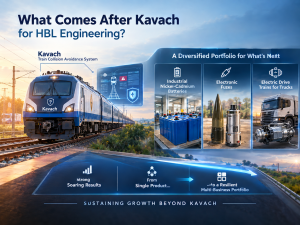
What Comes After Kavach for HBL Engineering?
Kavach has changed HBL Engineering’s financial profile. The harder question is what happens when that contribution stops expanding.
HBL’s FY26 revenue reached ₹3,252 crore, up from ₹1,946 crore in FY25. EBITDA rose to ₹1,130 crore from ₹417 crore, while net profit increased to ₹797 crore from ₹267 crore. Net cash from operations reached ₹713 crore, compared with ₹227 crore a year earlier.
Kavach contributed almost 50% of FY26 sales, and HBL expects that proportion to remain broadly similar in FY27. Management expects sales to remain strong through FY27 and FY28, but says competition could increase thereafter, with sales and PBT potentially declining from FY29.
That creates a very specific financial problem.
If Kavach contributes roughly ₹1,626 crore based on 50% of FY26 revenue, a 20% decline would remove about ₹325 crore of annual revenue. A 30% decline would remove about ₹488 crore.
The replacement requirement is therefore not theoretical.
HBL needs between ₹325 crore and ₹488 crore of additional annual revenue from its other businesses simply to keep the revenue base at the same level, before accounting for growth elsewhere.
At HBL’s FY26 consolidated EBITDA margin of 34.75%, that revenue gap corresponds to roughly ₹113 crore-₹170 crore of EBITDA as a neutral reference point. This is not a forecast of Kavach margins or the margins of the replacement businesses; it simply shows the size of the earnings hole at the existing company-level margin.
That is the number investors should keep in mind when assessing everything HBL is developing.
The Post-Kavach Gap Is Smaller Than It First Looks But Still Material
The easiest mistake is to assume HBL needs another ₹1,600-crore product to replace Kavach.
It does not.
The immediate problem is much smaller.
| Kavach Scenario | Revenue Impact |
| FY26 Kavach Contribution at 50% | ₹1,626 crore |
| 20% decline | ₹325 crore |
| 25% decline | ₹407 crore |
| 30% decline | ₹488 crore |
So the portfolio does not need one new Kavach.
It needs enough businesses to collectively fill a ₹325-488 crore annual revenue gap if Kavach eventually declines by 20-30%.
This changes how HBL’s pipeline should be evaluated.
TMS/CTC already has management-disclosed potential of ₹100 crore, ₹200 crore or ₹300 crore a year if deployment accelerates.
At the upper end, that alone could cover between 62% and 92% of a 20–30% Kavach revenue decline. But management has also explicitly said TMS/CTC will not become another Kavach.
The remaining gap would therefore have to come from Ni-Cd batteries, electronic fuzes, electric drives and HBL’s other businesses.
This is where the distinction between technology validation and commercial scale becomes critical.
Four Businesses, Four Very Different Financial Starting Points
HBL’s FY26 Annual Report identifies four business units expected to contribute the most to sales over the next four years: Kavach, industrial nickel-cadmium batteries, electronic fuzes and electric drive trains for trucks. It also expects other industrial-electronics and special-defence products currently in development to be commercialised by FY30.
But these four businesses are not at the same stage.
| Business | Current status | Commercial milestone | Disclosed financial visibility |
| Ni-Cd batteries | Established business | Existing sales + replacement demand | Current business; HBL names it among four largest contributors |
| Electronic fuzes | Early commercialisation | Army/155mm approvals expected in 2027; FY28 ramp-up | No company revenue target disclosed |
| TMS/CTC | Qualified/reference installations | Additional deployments | ₹100-300 crore annual opportunity disclosed |
| Electric drives | Development/validation | Homologation March 2027; pilot sales July 2027 | No company revenue target disclosed |
This table exposes an important difference.
Ni-Cd already has financial scale. TMS has a quantified opportunity. Fuzes have technology and qualification progress. Electric drives have technical validation but are furthest from demonstrated commercial scale.
That is a much more useful way to assess the post-Kavach portfolio than simply counting how many products HBL has under development.
1. Ni-Cd Batteries: The Existing Earnings Buffer
Ni-Cd batteries are the least speculative part of the post-Kavach story.
HBL already has an established Ni-Cd business, including dedicated manufacturing capability at its Visakhapatnam SEZ facility. The company describes defence batteries as recurring “revenue” items because they require replacement, even though demand for individual battery types can fluctuate from year to year. Exports are also a significant contributor.
HBL’s total exports increased to ₹520 crore in FY26 from ₹453 crore in FY25.
The important point is that Ni-Cd does not need qualification before it can contribute.
The technology is already commercial. Customers already exist. Replacement demand already exists. Production infrastructure already exists.
That gives Ni-Cd a different role from fuzes and electric drives.
It can provide the cash-generating base while newer technologies move through qualification.
However, HBL does not disclose a standalone FY26 revenue number for Ni-Cd in the annual report. That prevents a precise calculation of how much of the ₹325–488 crore Kavach gap Ni-Cd could absorb.
So investors should not treat Ni-Cd’s inclusion in HBL’s FY30 top-four list as equivalent to a disclosed revenue target.
Technology validation: complete.
Commercial scale: established.
Financial visibility: highest among the four new growth engines.
2. Electronic Fuzes: The Most Important Commercialisation Test
Electronic fuzes are potentially more consequential because HBL is moving from a long R&D cycle into actual defence procurement.
The technology work began in 2006. HBL says it developed the required components and subsystems in-house and does not import proprietary items for these products. The company has developed fuzes for multiple applications and has established a licensed manufacturing facility in Telangana.
The first commercial milestone has already arrived.
HBL’s grenade fuzes have received Ministry of Home Affairs approval and sales have started. Indian Army approval is expected during 2027, while approval for fuzes used in artillery shells fired from 155mm guns is also expected during 2027. Other fuze types remain in the approval pipeline.
But this is exactly where investors need to separate capability from scale.
Sales having started does not tell us whether the business contributes ₹10 crore, ₹50 crore or ₹200 crore annually.
HBL has not disclosed a standalone fuze revenue target or production capacity in the FY26 Annual Report.
Management has, however, indicated why FY28 is important. It does not want to accept orders faster than it can safely execute them and expects the next year to be used for ramp-up.
That makes FY27 a transition year.
The milestones to watch are therefore not just approvals:
- Indian Army approval
- 155mm fuze approval
- Production ramp-up
- Repeat orders
- Actual annual revenue
- Capacity utilisation
- Margin and cash conversion
The strategic attraction is clear.
But 20 years of R&D proves technological capability; only repeat orders and revenue will prove commercial scale.
3. TMC/CTC: The Only New Engine With A Quantified Revenue Opportunity
TMS/CTC is less glamorous than fuzes, but financially it is easier to model.
HBL says less than 2% of the Indian railway network is currently covered by TMS. It has four satisfactory installations and therefore has the reference base that previously made qualification difficult against foreign competitors.
Management has put an unusually clear number around the opportunity: ₹100 crore, ₹200 crore or ₹300 crore a year, depending on how quickly deployment accelerates.
That gives investors something the fuze and electric-drive businesses currently lack: a disclosed revenue range.
The ₹300-crore upper case is particularly useful when placed against the Kavach gap.
A ₹300-crore TMS/CTC business would cover:
- 92% of a ₹325-crore 20% Kavach decline
- 74% of a ₹407-crore 25% decline
- 61% of a ₹488-crore 30% decline
But that does not mean TMS/CTC can replace Kavach.
Management itself has said it will not become another Kavach and expects the number of orders to be lower.
Its value is therefore as a secondary railway revenue stream.
Technology validation: established through four installations.
Commercial scale: not yet proven at the ₹100-300 crore level.
Financial visibility: highest among HBL’s newer businesses because management has disclosed a revenue opportunity.
4. Electric Drives: Strong Technology Validation, Weak Financial Visibility
Electric drives have reached an important technical milestone but remain commercially unproven.
HBL began developing the electric drive train around 2016 and later focused on 55-tonne electric trucks. The company has developed the complete drive train in-house, including batteries, motors and electronics, with battery cells being the main imported component.
The engineering has now moved beyond the laboratory.
HBL has completed approximately 40,000 km of internal road testing on 55-tonne trucks.
The next milestones are clearly defined:
- Homologation expected by March 2027
- Pilot sales targeted from July 2027
- Initial focus on off-highway customers
The shift towards off-highway applications is strategically important because charging infrastructure is less of a constraint there.
But the financial data remains incomplete.
HBL has not disclosed the expected annual revenue, number of trucks, average drive-train selling price or production capacity for this business.
Therefore, 40,000 km of testing should not be converted into a revenue assumption.
Technology validation: strong.
Commercialisation: expected from FY28.
Commercial scale: unproven.
Financial visibility: currently low.
The same caution applies to maritime electric drives. HBL and Cochin Shipyard formed Green Maritime Propulsion Pvt Ltd in June 2026, and the JV has already placed an order on HBL for batteries for two electric tugs. But HBL says marine sales will remain limited until September 2027 while the required development and certification work progresses.
That is validation of the technology, not yet evidence of a large revenue stream.
So Which Business Can Actually Fill The Gap?
There is no responsible way to rank fuzes and electric drives by ultimate revenue potential because HBL has not disclosed comparable revenue targets for them.
But the businesses can be ranked by financial visibility today:
- Ni-Cd batteries - established financial contribution
It is already commercial, generates revenue today and benefits from replacement demand. HBL itself includes it among the four business units expected to contribute most over the next four years.
- TMS/CTC - highest disclosed incremental opportunity
Its ₹100-300 crore annual opportunity provides the clearest numerical framework, although management explicitly says it will be smaller than Kavach.
- Electronic fuzes - potentially significant, but scale still unquantified
The technology has been developed over two decades, approvals are progressing and commercial sales have begun in grenades. But the company has not disclosed a revenue target.
- Electric drives - largest uncertainty
The technology has passed extensive road testing, but commercialisation begins only after homologation and pilot sales. No revenue target or capacity has been disclosed.
This is not a ranking of ultimate market size. It is a ranking of how much financial visibility investors currently have.
That distinction matters.
What Would a FY28-FY30 Replacement Bridge Look Like?
Rather than pretending HBL has provided a detailed FY30 revenue split, the better approach is to start with the number management has actually disclosed.
HBL says its current businesses together should achieve more than ₹5,000 crore of sales in FY30. The company specifically identifies Kavach, Ni-Cd batteries, electronic fuzes and electric truck drives as the four businesses expected to contribute most over the next four years.
But HBL does not provide the individual FY28, FY29 and FY30 revenue contributions of these businesses.
So the useful investor model is a replacement threshold, not a fabricated forecast.
| Scenario | Revenue that must be replaced if Kavach slows | What the portfolio must collectively add |
| 20% Kavach decline | ₹325 crore | ₹325 crore |
| 25% Kavach decline | ₹407 crore | ₹407 crore |
| 30% Kavach decline | ₹488 crore | ₹488 crore |
Now bring in the one quantified new opportunity.
If TMS/CTC eventually reaches ₹300 crore annually, the residual requirement becomes:
| Kavach decline | Kavach revenue lost | After ₹300 crore TMS/CTC |
| 20% | ₹325 crore | ₹25 crore |
| 25% | ₹407 crore | ₹107 crore |
| 30% | ₹488 crore | ₹188 crore |
That is the central financial insight.
HBL does not necessarily need fuzes or electric drives to immediately become ₹500-crore businesses.
If Ni-Cd continues growing, TMS/CTC reaches a meaningful portion of its disclosed opportunity, and fuzes begin producing recurring revenue, the replacement requirement becomes much more manageable.
Electric drives then become an additional growth layer rather than the business that has to save the entire portfolio. Check our latest video for more details.
The Real FY28-FY30 Bridge Is About Timing
The timing is more important than the headline opportunity.
Kavach is expected to remain strong through FY28, while management sees the possibility of declining sales and PBT from FY29 as competition increases.
Meanwhile:
FY27
- Fuzes: approvals and production ramp-up.
- Electric drives: homologation for 55-tonne trucks.
- TMS/CTC: convert reference installations into additional orders.
- Ni-Cd: continue established domestic and export business.
FY28
- Fuzes: management expects this to be the ramp-up period.
- Electric drives: pilot sales should have begun from July 2027.
- TMS/CTC: opportunity depends on railway deployment speed.
- Kavach: still expected to be an important contributor.
FY29-FY30
This is where the portfolio test becomes much more important.
If Kavach begins losing share of revenue while fuzes have moved into repeat production, electric drives have moved beyond pilots and Ni-Cd continues to grow, HBL can transition from a Kavach-heavy growth story to a multi-business model.
If those businesses remain stuck at qualification and pilot stages, the ₹325-488 crore revenue gap becomes much harder to absorb.
Why Electronic Fuzes Deserve More Attention Than Another Product Count?
The most interesting feature of fuzes is not the number of products HBL has developed.
It is the amount of time already invested before commercialisation.
HBL began the development programme in 2006. The company has developed the underlying components and subsystems internally and says there are no imported proprietary items.
The qualification process itself creates another barrier.
Fuzes must be tested on actual weapons and warheads at declared ranges, and approval timing depends partly on the availability of the relevant weapon and testing range.
This makes the business difficult to enter but also makes the commercial ramp slower.
The financial question is therefore no longer:
Can HBL make electronic fuzes?
The evidence increasingly says yes.
The question is:
How quickly can approved products turn into repeat production at meaningful scale?
That answer should become visible through FY27 and FY28.
Until then, assigning a ₹500-crore or ₹1,000-crore opportunity to fuzes would be speculation because HBL itself has not provided those figures.
HBL’s Advantage Is That It Can Finance the Waiting Period
There is another part of the equation that is easy to overlook.
HBL generated ₹713 crore of operating cash flow in FY26. Net debt was negative ₹74 crore and the debt-to-equity ratio was only 0.03.
That matters because HBL’s development cycle is unusually long.
The company says most products take 10-15 years to move from development towards commercialisation. Kavach began development in 2005. Electronic fuzes began in 2006.
A company following this model needs mature businesses that generate cash while the next technology is being developed.
That is why Ni-Cd, existing defence batteries and other established businesses are strategically important even if they do not attract the same investor attention as Kavach or fuzes.
The balance sheet gives HBL time.
The question is whether that time is converted into businesses large enough to matter.
What Investors Should Measure Through FY30?
The post-Kavach story should therefore be tracked using a much more specific scorecard.
Kavach
- Revenue contribution
- New order wins
- Execution rate
- Margin
- Decline, if any, from FY28 onwards
Electronic fuzes
- Indian Army approval
- 155mm approval
- Production capacity
- Repeat orders
- Actual FY27/FY28 revenue
TMS/CTC
- New installations
- Annual order intake
- Revenue approaching the ₹100–300 crore opportunity
Electric drives
- March 2027 homologation
- July 2027 pilot sales
- Number of commercial customers
- Repeat orders after pilots
- Revenue per vehicle/drive train
Ni-Cd
- Export revenue
- Replacement demand
- Order sustainability
- Operating cash generation
The most important number is not the number of technologies HBL has developed.
It is the amount of recurring revenue generated by technologies that have already crossed qualification.
Conclusion: The ₹325-488 Crore Question
Kavach contributed roughly ₹1,626 crore to HBL’s FY26 revenue if its “almost 50%” contribution is translated into the company’s ₹3,252-crore revenue base.
A 20% slowdown would therefore create a ₹325-crore revenue gap.
A 30% slowdown would create a ₹488-crore gap.
That is the financial hurdle HBL’s post-Kavach portfolio eventually has to clear.
TMS/CTC already provides one measurable piece of the answer, with management indicating a potential ₹100-300 crore annual opportunity. Ni-Cd provides an established revenue base and recurring replacement demand. Electronic fuzes are entering commercialisation after two decades of development, while electric drives are approaching homologation and pilot sales.
But the crucial information is still missing for the two most interesting newer businesses: HBL has not disclosed comparable revenue targets for fuzes or electric drives.
That is why the next phase should not be judged by technology demonstrations alone.
The 40,000 km of truck testing matters. Four TMS installations matter. Fuze approvals matter.
But none of them replace revenue.
The real post-Kavach transition begins when these milestones turn into repeat orders, production capacity, cash generation and meaningful annual sales.
HBL’s FY30 framework calls for more than ₹5,000 crore of sales from its current businesses. Whether that target is achieved with a still-dominant Kavach or with a genuinely diversified portfolio will depend on what happens between FY27 and FY30.
The key investor question is therefore no longer simply what comes after Kavach.
It is whether ₹325-488 crore of potential Kavach revenue risk can be absorbed before Kavach becomes a smaller part of HBL’s earnings base.