Why did CRISIL downgrade Unimech?
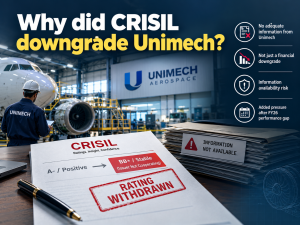
Unimech’s CRISIL episode is easy to misunderstand. On November 27, 2025, CRISIL migrated Unimech Aerospace’s corporate credit rating from A-/Positive to BB+/Stable with an “Issuer Not Cooperating” suffix, and subsequently withdrew the rating at the company’s request. The immediate trigger was inadequate information: CRISIL said repeated attempts to obtain the required information from Unimech had not resulted in sufficient cooperation, preventing it from taking a forward-looking view of the company’s credit quality.
But the more important question is why an information problem became serious enough to produce a BB+ rating in the first place.
The answer lies in the timing. By the time CRISIL faced the information gap, Unimech’s FY26 numbers had already weakened materially. Revenue from operations fell from ₹242.93 crore in FY25 to ₹240.49 crore in FY26, EBITDA declined from ₹92.06 crore to ₹75.12 crore and PAT fell from ₹83.46 crore to ₹63.28 crore.
So the rating episode cannot be viewed only as a communication issue. The information gap emerged precisely when the underlying operating trajectory had become harder to assess.
FY26 Weakened The Credit Story Before The Rating Changed
CRISIL had entered FY26 with a positive view of Unimech. In March 2025, it reaffirmed the A-rating and upgraded the outlook from Stable to Positive, citing strong revenue growth, healthy profitability, increased manufacturing capacity and stronger financial strength following the ₹500 crore equity raising.
FY26 subsequently challenged that trajectory.
Revenue from operations declined by ₹2.44 crore despite the company having expanded its manufacturing base. EBITDA fell by ₹16.94 crore, while PAT declined by ₹20.18 crore. The problem, therefore, was not simply that Unimech failed to deliver another year of high growth. The company was generating lower operating earnings while carrying a larger cost and asset base.
That is important because the ₹500 crore equity raise had strengthened the balance sheet and provided capital for expansion. The credit story then depended on that capital translating into higher capacity, revenue and operating earnings.
Instead, demand weakened and aerospace customers became more cautious. Order patterns shifted from build-to-inventory toward build-to-order, while capacity had been added ahead of demand. The result was pressure on utilisation and weaker absorption of the expanded cost base.
The financial statements show the consequence. Employee benefit expenses increased from ₹46.53 crore to ₹53.42 crore, depreciation and amortisation from ₹10.56 crore to ₹26.26 crore, and finance costs from ₹4.37 crore to ₹15.39 crore.
The chain is therefore more important than any individual cost increase:
₹500 crore equity raise → capacity expansion → weaker-than-expected demand/order pickup → lower utilisation → higher depreciation and fixed-cost burden → weaker operating profitability and returns.
That made FY26 more relevant to credit quality than a simple revenue miss would have been.
Information Availability Became The Trigger
The rating problem became acute in October-November 2025. CRISIL said it was awaiting adequate information from Unimech to conduct its rating review. By November 27, it stated that repeated attempts through letters, emails and telephone calls had not produced the required cooperation.
That meant CRISIL could not adequately assess expected financial performance or strategic intent and therefore could not take a forward-looking view of the company.
This is where the operating deterioration and information issue intersected.
A rating agency does not assess only reported historical numbers. It needs sufficient information to evaluate future cash generation, leverage, liquidity, business risks and management plans. In Unimech’s case, that assessment became more difficult precisely when FY26 had weakened the evidence supporting the earlier Positive outlook.
CRISIL consequently migrated the rating to BB+/Stable with the “Issuer Not Cooperating” suffix. CRISIL’s own framework says such ratings are based on the best available information, which can be limited or dated, and lack the normal forward-looking component. It also notes that non-cooperation can be associated with deterioration in credit risk.
That does not establish that Unimech was financially distressed or heading toward default. It means the agency could no longer support its earlier assessment with sufficient current information.
The subsequent withdrawal at Unimech’s request removed the independent CRISIL rating altogether. For investors, the key issue was therefore not simply the numerical move from A- to BB+, but the loss of independent forward-looking visibility at a time when the operating trajectory itself had become less certain.
The Cost And Earnings Mix Made The Weakness Harder To Ignore
The FY26 earnings decline also needs to be separated into operating and non-operating components.
Consolidated other income increased from ₹24.77 crore in FY25 to ₹46.97 crore in FY26, while PAT was ₹63.28 crore. The increase was significantly linked to interest and investment-related earnings following the IPO fund raising.
That income is legitimate, but it does not have the same credit significance as recurring operating profit from Unimech’s aerospace business. The distinction became more important because EBITDA fell from ₹92.06 crore to ₹75.12 crore while other income almost doubled.
This creates two separate questions for assessing the FY26 credit profile.
First, can the expanded operating asset base generate the revenue and margins expected when the ₹500 crore was raised?
Second, how much of reported profitability is being supported by surplus capital and treasury income rather than the underlying manufacturing operation?
The second question should not be interpreted as saying FY26 profit was overstated. It is about the quality and sustainability of earnings available to support future financial obligations.
Customer Concentration Added To The Uncertainty
The information gap would have been less consequential if Unimech’s underlying business had been highly diversified and rapidly growing. Instead, customer concentration was already a documented credit consideration.
CRISIL had highlighted that more than 85% of revenue came from three large customers and their affiliates. It also identified exposure to cyclicality in end-user industries and working-capital-intensive operations.
FY26 provided a practical reason for those risks to matter. Aerospace customers became more cautious, order pickup weakened and purchasing behaviour shifted toward build-to-order.
This matters because concentrated customers can make revenue visibility more dependent on the spending decisions and production cycles of a small number of accounts. When utilisation is already under pressure, weaker order visibility can also delay the point at which newly added capacity begins generating sufficient returns.
The combination therefore became more important than any single factor:
high customer concentration + weaker order pickup + lower utilisation + higher fixed costs + limited rating-agency information.
That is the context in which an information problem became a credit-quality issue. Check our latest video to know more.
What Would Change The Credit Narrative?
The next meaningful evidence will not simply be a return to the old A-rating. It will be whether Unimech produces enough operating and financial visibility for an independent rating agency to reassess its credit profile.
Several developments would matter:
- Order inflow and conversion: sustained new orders followed by actual revenue conversion would show whether the FY26 slowdown was temporary or reflected weaker underlying demand.
- Capacity utilisation: higher utilisation would indicate that the expanded asset base is beginning to absorb depreciation and fixed costs more effectively.
- Operating cash flow: stronger cash generation from the core business would provide evidence that accounting profitability is translating into financial capacity.
- Receivables and working capital: tighter receivable days and better cash conversion would reduce pressure from the working-capital-intensive nature of the business.
- Customer concentration: a lower contribution from the largest customers, or evidence of meaningful diversification, would reduce dependence on a small customer base.
- Treasury-income dependence: a greater share of earnings coming from operations rather than interest and investment income would make the profit profile more representative of the core business.
- Fresh rating-agency coverage: a new independent rating based on current financial and strategic information would restore an external reference point for credit quality.
These indicators address the specific weaknesses exposed by FY26 rather than simply measuring whether revenue grows.
Conclusion
CRISIL’s action had two layers. The immediate trigger was inadequate information and lack of cooperation, which prevented a forward-looking credit assessment. But the issue became significant because it occurred after Unimech’s operating performance had already weakened.
FY26 showed lower revenue, EBITDA and PAT despite the much stronger capital base created by the ₹500 crore equity raise and subsequent capacity expansion. Higher depreciation, employee costs and finance costs increased the pressure, while treasury income became a larger component of reported earnings.
The credit question going forward is therefore whether Unimech can demonstrate that its expanded capacity is translating into higher utilisation, operating cash generation and sustainable returns, while restoring sufficient information flow for independent credit assessment.
That evidence, not the rating label alone will determine how the FY26 episode is ultimately understood.