How a New Payment System Fixed India’s Broken Sewage Plants
India has invested heavily in sewage treatment, yet a large gap remains between sewage generated and treatment capacity actually used. CPCB’s 2021 inventory recorded 72,368 MLD of sewage generation and 20,235 MLD of treatment capacity utilisation. However, investors should not interpret the difference as 52,133 MLD of untreated sewage. Utilisation also depends on sewer connectivity, collection networks, pumping infrastructure and actual sewage inflow.
That distinction exposes a deeper problem with sewage infrastructure. Building an STP does not guarantee sufficient sewage inflow. Nor does it ensure that the plant will meet treatment standards after construction. A government can create treatment capacity, but the asset’s economic and environmental value depends on whether the wider wastewater network functions and the plant remains operational.
India’s newer payment model attempts to address part of this problem by keeping private developers involved beyond construction and tying a portion of their payments to long-term project performance.
The important question, therefore, is not whether HAM has solved India’s sewage problem. It is whether changing the payment structure can make individual wastewater projects more accountable, financially sustainable and capable of generating better long-term outcomes.
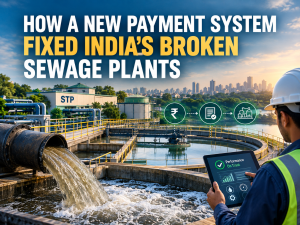
The Old System Rewarded Construction More Than Performance
The fundamental weakness in conventional sewage infrastructure was the separation between building an STP and ensuring that it continued to perform. A contractor could complete construction, meet the requirements and receive its payments. A government agency would then take over the plant’s operation and maintenance.
That structure is particularly problematic for sewage treatment because an STP is not a one-time infrastructure asset. Its value depends on whether it continues to operate every day and produces treated wastewater within the required quality parameters. The plant needs funding throughout its operating life. This includes electricity, chemicals, maintenance, equipment replacement and skilled manpower.
This created a mismatch between construction incentives and operational outcomes. The government could spend heavily on creating treatment capacity while the actual utilisation of that capacity remained weak. CPCB’s 2021 figures illustrate the issue: of the 31,841 MLD installed capacity, only 20,235 MLD was actually utilised.
The policy response was therefore not simply to spend more, but to change the commercial structure behind the spending.
Hybrid Annuity Model Changed What Operators Were Being Paid For
The government introduced the Hybrid Annuity Model (HAM) for sewage projects under the Namami Gange programme, changing the commercial relationship between the government and private developers. The government pays 40% of the project cost during construction. It pays the remaining 60% through annuities over 15 years, along with O&M payments. The deferred component is linked to project performance during the concession period.
That structure matters because the developer does not simply construct the STP and exit. The developer finances part of the project and operates the asset long term. It must also meet contractual treatment standards to earn the full project returns.
The 60% deferred component is therefore the most important financial feature. It creates a longer revenue relationship, but it also means that capital remains committed after construction. Debt, working capital and capital employed can consequently become more important to the developer’s returns than they would be under a conventional EPC contract.
For the government, the structure creates a stronger connection between payments and continued service delivery. For investors, however, the equation is more nuanced: a HAM order can provide greater revenue visibility while simultaneously demanding more capital and exposing the company to performance and execution risks for years.
HAM therefore changes the investment question from “How large is the order?” to “How efficiently can the company deploy capital to execute and operate it?”
But An STP Cannot Work If The Sewage Never Reaches It
There is an important limitation to the payment reform: performance-linked contracts cannot solve every problem in the sewage chain. An efficient STP can still remain underutilised. The sewer network may simply fail to deliver enough sewage.
This is one reason the difference between operational capacity and utilised capacity deserves more attention. CPCB recorded 26,869 MLD of operational capacity, compared with only 20,235 MLD actually utilised. The shortfall is not simply a treatment-technology problem; it can also reflect inadequate collection and conveyance infrastructure, pumping constraints and insufficient connections.
The complete wastewater system therefore has to work as one chain: sewage must be collected from households and commercial establishments, transported through the sewer network, pumped where necessary, treated at the STP and then either safely discharged or reused.
For investors, this creates an important distinction between a large STP order and a genuinely attractive wastewater contract. The quality of the sewer network, the source of sewage inflow, the payment mechanism and the operator’s ability to control operating performance can all influence the eventual economics.
HAM Makes Order-Book Size Less Important Than Capital Efficiency
HAM can make future revenue more visible, but that benefit has to be weighed against the capital required to support the project. Because the developer finances part of the construction and remains responsible for long-term operations, HAM can increase capital employed before the full annuity stream is realised.
VA Tech Wabag’s numbers illustrate why this matters. In FY25, the company reported RoCE of 18.4% and net working capital of 110 days. The company reported net cash of ₹705.6 crore excluding the transitory impact of HAM projects, compared with ₹589 crore including it. By September 2025, Wabag reported net cash of ₹561 crore, or ₹675 crore excluding transient debt under HAM entities.
The significance of the temporary HAM debt is not simply that reported net cash becomes lower. Debt associated with HAM projects increases the capital supporting the business. If the operating profit generated by those projects does not rise proportionately, the denominator in a return-on-capital calculation becomes larger without a matching increase in earnings, putting pressure on ROCE.
This is why a HAM order book cannot be evaluated like a conventional EPC backlog. Investors need to assess how much capital is deployed, how quickly that capital starts generating operating profit and whether eventual cash generation is sufficient to compensate for the financing and execution risks.
HAM can improve visibility, but capital efficiency determines whether that visibility creates shareholder value.
Treated Wastewater Could Become The Next Source Of Value
The reuse opportunity becomes more meaningful when a project has both a tertiary treatment facility and an identified industrial buyer. Mathura provides such an example. Its HAM project included a 20 MLD tertiary treatment facility, and NMCG recorded an agreement for Indian Oil Corporation to reuse the treated wastewater at its Mathura refinery. The overall project cost was ₹437.95 crore.
The investment significance is straightforward: the STP is not relying solely on government payments for the economic value of treatment. A defined industrial off-taker creates a potential second revenue stream from water that would otherwise be discharged after treatment.
However, investors should distinguish between a reuse facility and a monetised reuse business. The publicly disclosed project information identifies the 20 MLD reuse arrangement with IOCL, but does not disclose a per-kilolitre tariff that would allow the incremental revenue or return from water sales to be calculated.
That makes the off-taker important evidence, but not a reason to automatically assign additional earnings value to every tertiary-treatment project. For reuse to materially improve project economics, investors need visibility on the buyer, contracted volume and commercial terms.
The broader opportunity is that wastewater infrastructure can potentially generate value twice: through treatment and O&M payments, and through the sale or supply of treated water to industrial users. Check our latest video for more details.
What Investors Should Actually Track?
HAM makes order-book quality more important than order-book size. Investors should focus on six factors that determine whether a project ultimately generates attractive returns:
- Capital employed: How much equity and debt must the company commit before the annuity stream begins?
- Annuity terms: What portion is deferred, for how long and on what interest mechanism?
- Performance risk: What treatment standards trigger deductions, and how material can those deductions become?
- Working capital and cash conversion: How much cash remains tied up in construction and receivables, and does operating cash flow keep pace with reported profit?
- O&M economics: What recurring revenue and margins can the company earn during the operating period?
- Sewage inflow risk: Who bears the financial consequences if the sewer network does not deliver the contracted sewage volume?
These factors determine whether a HAM contract is genuinely attractive or simply large on paper. A project with a long annuity stream can still produce weak shareholder returns if it absorbs excessive capital, suffers persistent working-capital pressure or faces deductions because the underlying wastewater network does not perform.
For water companies, therefore, the quality of a HAM order book should ultimately be judged by cash generation and ROCE, not merely by the value of contracts won.
India Has Not Fixed Sewage; It Has Started Fixing The Incentive
India’s sewage problem remains unresolved, and HAM should not be presented as a national solution. Its significance is narrower but important: it changes the commercial structure of selected wastewater projects by keeping private developers responsible beyond construction and linking part of their economics to long-term operation and performance.
That creates a different investment equation. HAM can provide a longer stream of annuity and O&M revenue, but the developer also has to commit capital, manage execution and protect project returns over a much longer period.
For investors, this makes the balance sheet as important as the order book. The strongest HAM projects will be those where contracted revenue, operating performance and eventual cash generation justify the capital tied up in them.
The real test of the model is therefore not how many crores of HAM orders companies can announce, but whether those contracts can be converted into cash-generating assets at attractive returns on capital.