What Market Research Shows about Rising Demand of Coffee in India?
India’s coffee market is changing. But the bigger story is not simply that Indians are drinking more coffee. It is how this demand is being created.
The Coffee Board’s latest available domestic-consumption data puts India’s coffee consumption at 96,000 MT in 2024, compared with 91,000 MT in 2023. The Board’s current statistics page does not yet report a newer nationwide domestic-consumption figure for 2025 or 2026.
These numbers point to a market expanding on both sides: India has a sizeable domestic consumer base, while global demand is also drawing the country’s coffee industry further into international markets.
But the bigger question is: what is actually driving India’s domestic coffee demand?
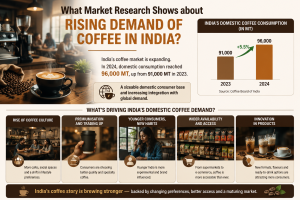
What Is Actually Driving India’s Coffee Demand?
India’s coffee demand is being shaped by several trends at the same time, but they point towards one larger shift: coffee is moving from a regionally concentrated beverage towards a more frequent, accessible and diversified consumption habit.
The Coffee Board-commissioned CRISIL study found that consumers in the South accounted for 75-80% of India’s coffee consumption, but coffee penetration in other regions had increased compared with a decade earlier.
The 25-34 age group was also the largest coffee-consuming demographic across all regions surveyed, accounting for 47% to 56% depending on the region.
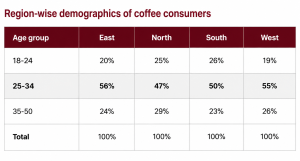
Consumption is overwhelmingly home-based.
Consumers drank 93-94% of their coffee at home, compared with just 6-7% outside the home. This means the café boom is important for discovery and premiumisation, but it should not be confused with the core volume market.
Three demand drivers therefore matter most:
- Geographic expansion: consumption is gradually spreading beyond the traditional South.
- Higher frequency: coffee is increasingly becoming part of daily routines and multiple consumption occasions.
- Convenience: packaged and instant formats allow consumption without the time or equipment associated with traditional brewing.
For investors, this distinction matters. India’s coffee opportunity is not simply about the number of cafés opening. It is about how many additional households consume coffee, how frequently they consume it and which formats they choose.
How Large Could the Rural Consumption Opportunity Become?
The urban-rural consumption gap gives the coffee story a measurable dimension.
The CRISIL study found that urban India accounted for 70% of coffee consumption, compared with 30% for rural India. More significantly, annual per-capita consumption was 140 grams in urban India versus 31 grams in rural India.
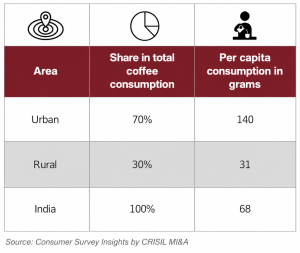
Using the study’s 91,000 MT 2023 domestic-consumption base, Rural consumers accounted for approximately 27,300 MT of consumption based on the reported 30% share. If rural consumers were to reach the reported urban consumption intensity of 140 grams, while holding the underlying population constant, the mechanical calculation would imply rural consumption of roughly 123,000 MT.
That represents a theoretical increase of approximately 96,000 MT over the existing rural consumption base.
This should not be interpreted as a forecast. The CRISIL study’s regional shares and per-capita figures are survey-based and rounded, so the calculation is better viewed as a sensitivity showing the scale of the opportunity.
Even partial convergence would be significant. A rural consumption level halfway between the reported 31-gram rural figure and 140-gram urban figure would imply substantially more demand than today.
The investment implication is straightforward: rural coffee penetration does not need to reach urban levels for the opportunity to become meaningful. Even incremental increases in consumption frequency could create additional volumes for companies with strong distribution in smaller towns and rural markets.
Why Instant Coffee Could Capture a Disproportionate Share of Future Growth?
The strongest signal in India’s coffee-consumption research is the importance of instant coffee. The Coffee Board-commissioned CRISIL study estimated that close to 65% of India’s total coffee consumption was instant coffee in 2022. It identified affordability and hassle-free preparation as key reasons behind its adoption.
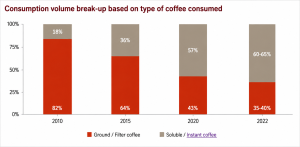
This matters because the consumers driving future growth may not necessarily be traditional coffee drinkers. New consumers in smaller cities and rural markets are more likely to adopt a format that requires minimal preparation, equipment and time.
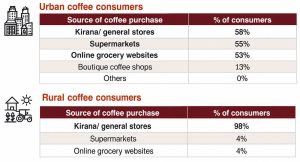
The distribution data supports this argument. 98% of rural coffee consumers surveyed purchased coffee through kirana or general stores, making packaged formats particularly relevant to rural expansion.
Instant coffee also gives manufacturers several ways to capture value:
- Spray-dried coffee can address the mass market.
- Agglomerated coffee offers another convenient soluble format.
- Freeze-dried coffee allows manufacturers to participate in the premium end of instant coffee.
- Coffee extracts and premixes can supply cafés, food companies and other institutional customers.
This makes the instant segment more than a consumer preference, it is a manufacturing opportunity.
Companies with established soluble-coffee capacity can potentially benefit from both higher domestic consumption and demand from international customers. CCL Products, for example, manufactures spray-dried, agglomerated and freeze-dried soluble coffee and operates extensively in the private-label market.
For investors, the key question is therefore not merely whether India’s coffee consumption rises. It is whether incremental consumption is captured by formats in which manufacturers can scale volumes while protecting margins.
Who Benefits If India’s Coffee Demand Rises?
Rising consumption does not benefit every part of the coffee industry equally. The impact depends on where a company sits in the value chain and whether its business is exposed to domestic consumption, exports or both.
- Instant and soluble coffee manufacturers
These companies have one of the clearest volume opportunities because instant coffee already represents close to 65% of total consumption in the CRISIL study. Manufacturers with spray-drying, agglomeration and freeze-drying capabilities can participate as consumption expands across both mass and premium formats.
- Packaged coffee brands
Branded companies can benefit when occasional consumption becomes habitual. Their advantage comes from distribution, brand recognition and the ability to introduce consumers to different price points and formats.
- Integrated coffee businesses
Companies operating across multiple stages of the value chain can capture more than one part of the opportunity. Tata Consumer Products, for example, has exposure to branded coffee as well as its Solubles business, which produces soluble coffee and coffee extracts.
- Café and out-of-home operators
Cafés benefit from premiumisation and increased out-of-home occasions. However, their exposure should be viewed separately because only 6-7% of coffee consumption in the CRISIL study occurred outside the home.
- Coffee processors and exporters
These businesses are exposed to a different opportunity: global demand. Their performance should not automatically be treated as a proxy for Indian consumption because India’s production base also serves export markets.
The key investment distinction is therefore domestic-volume exposure versus export exposure. A company can benefit from India’s coffee ecosystem without necessarily being a direct beneficiary of rising Indian consumption.
Rising Production Does Not Equal Rising Domestic Demand
India’s coffee production story needs to be separated from its domestic consumption story.
The Coffee Board’s latest statistics put the 2025-26 final production estimate at 3,73,000 MT, comprising 1,11,000 MT of Arabica and 2,62,000 MT of Robusta. The Board’s 2026-27 post-blossom estimate is 4,04,000 MT.
These numbers show an expanding supply base, but they should not be interpreted as additional domestic demand.
India has historically exported a substantial proportion of its coffee production. The Coffee Board states that around 65-70% of production is exported, with the balance consumed domestically.
That creates two separate investment stories:
- Domestic demand: benefits companies with Indian brands, retail distribution, domestic processing and café exposure.
- Export demand: benefits processors, soluble-coffee manufacturers and companies serving international customers.
The distinction is important because production growth can be absorbed by exports rather than Indian consumers. Conversely, domestic consumption can increase without requiring an equivalent increase in Indian production if processors use imported beans or if existing stocks and supply are redirected.
For investors, production is therefore a supply-side indicator, not a direct measure of India’s consumption opportunity.
The more useful question is whether companies have the right combination of capacity, distribution, pricing power and market exposure to monetise whichever side of the coffee market is growing faster.
Conclusion
India’s coffee opportunity is becoming more interesting when viewed beyond the headline consumption figure of 96,000 MT in 2024.
The real opportunity lies in the gap between current consumption and potential consumption. Rural per-capita consumption of 31 grams is far below the reported urban level of 140 grams, while close to 65% of total consumption is estimated to be instant coffee.
That creates several different routes to growth.
For manufacturers, the biggest opportunity may lie in soluble and instant coffee, where convenience can support wider penetration. For packaged brands, the opportunity is converting occasional users into regular consumers. Cafés can capture premiumisation and out-of-home spending, while processors and exporters remain exposed to global coffee demand.
The important point for investors is that rising coffee consumption is not a single investment theme. The same additional tonne can create very different revenue and margin outcomes depending on whether it is captured by a soluble-coffee manufacturer, a branded consumer company, a café operator or an export-oriented processor.