HFCL vs STL – Orderbook Comparison – Who has bigger and better orders?
An order book can look deceptively simple: one number representing business already won but yet to be executed. But for investors, the number becomes useful only after asking what is inside it, how it was built, and where that business is headed.
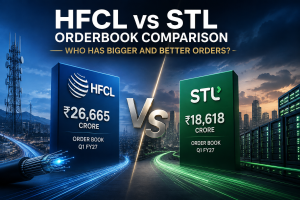
That makes the current HFCL - Sterlite Technologies (STL) comparison interesting. At the end of Q1 FY27, HFCL had an order book of ₹26,665 crore, against ₹18,618 crore for STL. The gap is ₹8,047 crore.
But size is only the starting point.
HFCL’s backlog reflects a broad shift towards products, exports and higher-value connectivity and defence offerings. STL, meanwhile, entered FY27 with an extraordinary jump in order intake, led by large hyperscaler and AI-data-centre opportunities.
So the real question is not simply who has more orders, but what those orders reveal about each company’s next phase of growth.
HFCL: What Is Actually Inside ₹26,665 Crore?
HFCL’s ₹26,665 crore order book is spread across three categories:
- Products: ₹17,339 crore
- O&M: ₹5,099 crore
- Networks: ₹4,227 crore
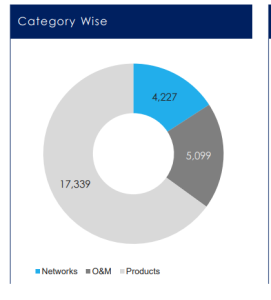
Products therefore account for 65.02% of the total backlog.
This composition is important because HFCL is actively trying to change the nature of its business. Its investor presentation describes a deliberate shift away from low-profit turnkey work towards higher-value products. It is targeting 80-85% of revenue from products and more than 60% from exports in FY27.
That means the order book is already reflecting the company’s intended direction.
The backlog also spans both private and government customers, with ₹16,164 crore from private customers and ₹10,502 crore from government customers.
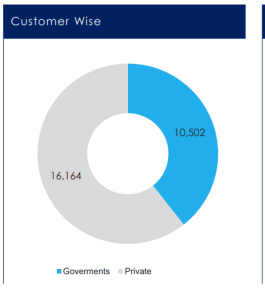
The important takeaway is therefore not just that HFCL has ₹26,665 crore of business.
A large majority of that backlog is sitting in the product category HFCL wants to make increasingly important to its business.
The more important question is whether this product-heavy backlog is likely to be economically attractive. HFCL does not disclose the expected EBITDA margin of its ₹17,339 crore product order book, so applying the company’s current margin to the entire backlog would be misleading. What can be established is that HFCL reported a 23.25% EBITDA margin in Q1 FY27, giving it a stronger current profitability profile.
That makes the quality of the backlog more relevant than its size alone. A large product backlog is valuable only if it is executed at attractive margins. For now, HFCL’s reported margin profile provides more evidence of profitability than the order-book figure itself.
STL: How Did ₹18,618 Crore Appear So Quickly?
STL’s ₹18,618 crore order book is less about its absolute size and more about the speed at which it was built.
At the end of FY26, STL had an order book of ₹7,687 crore. By the end of Q1 FY27, that figure had climbed to ₹18,618 crore - a 2.4x increase in just one quarter. The key reason was an exceptional ₹13,100 crore of order intake during Q1 FY27, compared with ₹7,687 crore secured during the entire FY26.
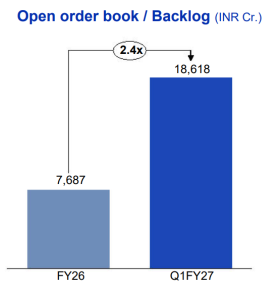
But the more revealing comparison is against the companies’ revenue bases.
STL’s ₹18,618 crore backlog equals 3.92x its FY26 revenue of ₹4,745 crore. HFCL’s ₹26,665 crore backlog is even larger relative to its FY26 revenue of ₹4,949 crore, at 5.39x.
That changes the interpretation of the two order books. HFCL has both the larger absolute backlog and deeper backlog coverage, while STL’s differentiator is the pace at which its order book is expanding.
The distinction matters because backlog coverage indicates the scale of contracted business relative to the company’s existing revenue base, but it does not mean either company has secured several years of revenue automatically. Execution timing, order mix and customer delivery schedules determine when that backlog becomes reported revenue.
STL’s real strength, therefore, is not that its ₹18,618 crore backlog is bigger than HFCL’s. It isn’t. Its strength is how quickly it has moved from ₹7,687 crore to ₹18,618 crore, creating a sharp acceleration in future revenue visibility.
What Did Customers Actually Order?
The difference becomes clearer when the actual contracts are examined.
STL’s biggest win is a US$1.11 billion (₹10,000+ crore) multi-year contract to supply optical connectivity products for next-generation AI data centres from FY27 to FY29. It also secured US$100 million+ of multiple hyperscaler orders for its Neuralis portfolio.
This is strategically different from simply adding more conventional fibre orders. STL is moving further into high-density connectivity and integrated data-centre infrastructure, with its Neuralis portfolio designed around AI workloads and 400G/800G networks.
HFCL’s order book is broader. Its ₹17,339 crore Products backlog sits alongside Networks and O&M contracts and covers optical connectivity, telecom equipment and defence-related products.
The margin question, however, needs restraint. Neither company discloses the expected EBITDA margin of these specific backlog categories, so it is impossible to accurately calculate the eventual profit from either order book.
The available evidence favours HFCL on current profitability: 23.25% Q1 EBITDA margin versus STL’s 20.8%. STL’s margin, however, reached its highest level in nearly 20 quarters.
The Concentration Question Matters More Than the Headline Number
STL’s US$1.11 billion hyperscaler contract is impressive, but its significance needs to be put into perspective.
The contract is worth ₹10,000+ crore, while STL’s reported Q1 FY27 open order book is ₹18,618 crore.
The headline value of the single award is therefore more than half the size of STL’s current reported backlog.
But this does not mean that exactly 53.7% of STL’s ₹18,618 crore backlog comes from this hyperscaler. STL does not state that the entire ₹10,000+ crore award is already included in the reported open order book. It is described separately as a multi-year Product Award Letter.
The more important insight is what the contract reveals about STL’s growth model.
Its recent order momentum is increasingly connected to AI data-centre infrastructure and hyperscaler spending. The company also secured US$100 million+ of additional Neuralis orders from multiple hyperscalers.
That creates significant upside if these relationships generate repeat business.
But it also creates a monitoring point for shareholders: STL must keep converting the current AI opportunity into fresh orders rather than allowing one exceptional contract to define its growth trajectory.
When Does the Order Book Become Revenue?
This is where backlog size meets execution.
STL entered Q1 FY27 with ₹7,687 crore of FY26-end backlog and added ₹13,100 crore of orders during the quarter, taking the closing order book to ₹18,618 crore. Yet Q1 FY27 revenue was ₹1,910 crore.
The gap is not necessarily a problem. It reflects the fact that new orders are executed over future periods. STL’s own backlog schedule shows ₹2,228 crore scheduled for Q2 FY27 and ₹16,390 crore for Q3 FY27 and beyond.
HFCL reported ₹1,914.98 crore of Q1 FY27 revenue alongside its ₹26,665 crore order book.
However, neither presentation provides a sufficiently consistent historical opening-backlog and execution dataset to calculate a like-for-like order-book conversion rate.
That means the comparison should stop short of claiming one company converts backlog faster.
What can be established is more useful: HFCL currently combines a larger backlog with strong reported profitability, while STL has built an unusually large pipeline ahead of future execution.
The next few quarters will determine how efficiently that pipeline becomes revenue.
The Order Books Are Also Revealing Where the Companies Are Going
The order books are not just financial cushions; they show where each company expects future growth to come from.
HFCL is building a broader technology platform spanning optical connectivity, telecom products, digital infrastructure and defence. Its presentation highlights data-centre products as a high-growth adjacency to optical fibre and cable, while defence is being developed as another growth engine.
STL’s direction is more concentrated around AI-ready connectivity and data centres. Its Q1 FY27 revenue mix shows Data Centre & Cloud contributing 21%, compared with just 1% in FY26.
That shift is particularly important because it means STL’s AI thesis is beginning to show up in reported revenue rather than remaining only in its order pipeline.
The two strategies therefore have different characteristics.
- HFCL: broader growth engines and greater diversification.
- STL: sharper exposure to the AI/data-centre investment cycle.
For shareholders, the question is not which theme sounds more attractive. It is whether the faster-growing theme can produce sustained revenue and margin expansion.
HFCL currently offers breadth; STL offers greater thematic concentration in a potentially faster-growing market.
Bigger vs Better: Which Order Book Wins?
If the question is simply “Who has the bigger order book?”, HFCL wins comfortably.
Its ₹26,665 crore backlog exceeds STL’s ₹18,618 crore by ₹8,047 crore. More importantly, using FY26 revenue of ₹4,949 crore for HFCL and ₹4,745 crore for STL, the backlog-to-revenue ratios are 5.39x and 3.92x respectively.
HFCL therefore wins on both absolute backlog and backlog coverage.
It also currently has the stronger reported EBITDA margin: 23.25% in Q1 FY27 versus 20.8% for STL.
STL’s advantage is momentum. Its Q1 FY27 order intake of ₹13,100 crore was 1.7x its entire FY26 order intake, and the company added major AI-data-centre contracts.
So the better order book today is HFCL’s.
STL has the more exciting acceleration story, but it needs to prove that the current order surge can be repeated and converted into profitable revenue.
For risk-adjusted backlog quality, HFCL wins. For high-growth optionality tied to AI infrastructure, STL is the more aggressive bet. More about this has been explained in our latest video.
Conclusion
The order-book comparison produces a clearer answer than the headline numbers suggest.
HFCL has the stronger order-book foundation today. Its ₹26,665 crore backlog is larger, its 5.39x backlog-to-FY26-revenue coverage is higher than STL’s 3.92x, and its Q1 FY27 EBITDA margin reached 23.25%.
STL’s case rests on something different: acceleration. Its order book expanded 2.4x in one quarter, driven by ₹13,100 crore of Q1 order intake and major AI-data-centre wins.
That makes STL potentially more rewarding if AI infrastructure spending continues to drive repeat orders.
But on the evidence available today, HFCL has the better combination of backlog depth, diversification and demonstrated profitability.
STL needs to prove execution and repeatability; HFCL needs to maintain execution while converting its larger backlog into sustained growth. That is the key difference shareholders should watch.