KEI Industries: Data Center Business, Revenue Mix & Growth Guidance
India’s data-center boom is creating a less visible opportunity beyond servers, chips and cloud platforms: the cables that keep these facilities powered. For KEI Industries, this is important because data centers do not require a new product category. They require a new product category. They require more of the high-value cables KEI already manufactures, from extra-high-voltage cables feeding large campuses to copper cables used inside them.
That makes data centers less of a standalone business for KEI and more of a structural upgrade to its existing wires-and-cables franchise. The company does not disclose data-center revenue separately, but management has repeatedly identified the segment as a major future demand driver.
The bigger investment case, therefore, is not about how much data-center revenue KEI generates today. It is about whether the rapid build-out of digital infrastructure can accelerate KEI’s shift toward institutional, higher-value cable demand while its new capacity comes online.
How Big Could The Data-Centre Opportunity Become?
KEI’s materials estimate India’s data-centre capacity could rise from 0.95 GW in FY24 to around 5 GW by FY30, implying roughly 4.05 GW of additional capacity.
A useful benchmark comes from the same sector research: Polycab estimates that 1 MW of data-centre capacity requires around ₹3.5 crore of cables. Applying that benchmark to the incremental 4.05 GW suggests an industry-wide cable opportunity of roughly ₹14,000 crore through FY30.
KEI does not disclose its current data-centre market share, so it would be misleading to convert this directly into a revenue forecast. But a simple scenario shows the scale: a 5% share would represent roughly ₹700 crore of cumulative revenue, while a 10% share would imply around ₹1,400 crore over the period.
That is meaningful, but it is unlikely to transform KEI on its own. The bigger economic benefit is that data centres can increase demand for HT and EHV cables, where KEI is expanding capacity. In FY26, HT cables generated ₹1,632 crore and EHV cables ₹670 crore.
So the opportunity is best viewed as a mix-and-utilisation catalyst: data-centre demand can help KEI fill new capacity while gradually shifting growth toward technically more demanding cable applications.
The Real Opportunity Is Bigger Than India
India’s data-center expansion is becoming a meaningful demand catalyst for the wires-and-cables industry. Industry estimates cited in KEI’s materials put India’s installed data-center capacity at around 0.95 GW in FY24, with capacity expected to approach 5 GW by FY30.
For KEI, however, the opportunity is not restricted to domestic construction. The company has already built a presence in the US market for data-center applications, particularly in medium-voltage HT cables, while also seeing potential for HT cables and copper flexibles.
This creates an important strategic advantage. Data-center construction is capital-intensive and power-heavy regardless of geography, so the underlying cable opportunity can travel with the global expansion of digital infrastructure.
KEI expects exports to reach roughly 20% of sales in FY27, compared with 15.6% in FY26. Its US business has also restarted following tariff-related disruption, with a ₹50–60 crore US order book as of March 2026.
The implication is that data centers can become a bridge between KEI’s domestic capacity expansion and its international growth ambitions.
Why The Revenue Mix Matters More Than A Separate Data-Center Number?
KEI generated ₹11,748 crore from Wires & Cables in FY26, accounting for about 95% of revenue. Within this, LT power cables contributed ₹5,063 crore, house and winding wires ₹3,900 crore, HT cables ₹1,632 crore and EHV cables ₹670 crore.
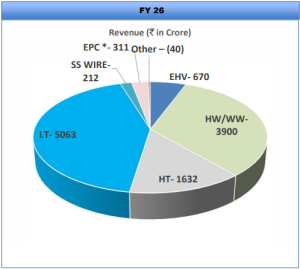
This mix reveals something more important than the headline data-center opportunity: KEI is already moving deeper into the cable value chain that data centers require.
The institutional channel contributed around 42% of FY26 sales, compared with 54% from dealer/distribution channels. Data-center projects naturally fit into this institutional ecosystem because they involve large developers, EPC contractors and infrastructure projects rather than conventional retail demand.
KEI therefore does not need data centers to become a large standalone revenue segment to benefit. Even modest penetration can improve the quality of growth if the incremental business comes through institutional projects, higher-voltage products and exports.
That distinction is crucial. The opportunity is not simply more cable volume; it is potentially a better mix of cable volume.
Sanand Could Turn Demand Into Financial Growth
The timing of KEI’s capacity expansion is particularly relevant. The company is guiding for 17-18% volume growth and more than 20% revenue growth in FY27, with a medium-term growth expectation of more than 20% CAGR.
A major part of this capacity story is the ₹2,000 crore Sanand project in Gujarat. Phase 1, covering LT and HT cables, was commissioned in December 2025. Phase 2, including EHV capacity through a 158-metre vertical tower, is expected by Q4 FY27. At full ramp-up, the project is expected to have capacity equivalent to around ₹6,000 crore of revenue, including ₹1,200 crore of EHV and ₹4,800 crore of LT/MV capacity.
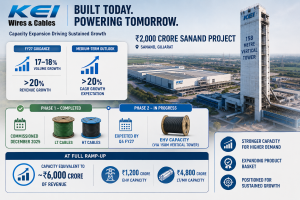
This creates an interesting operating leverage opportunity.
If data-center construction, power transmission, renewable energy and infrastructure projects all increase demand simultaneously, KEI can fill new capacity across several end markets rather than relying on one sector. That reduces concentration risk while allowing the company to push more aggressively into technically complex cables.
The result could be a virtuous cycle: higher demand supports capacity utilisation, better utilisation supports margins, and stronger margins generate internal cash for the next phase of capacity expansion.
Can Sanand Actually Deliver The Margin Expansion?
KEI expects EBITDA margins of 10.5-11% in FY27, followed by around 0.5 percentage point of improvement in FY28 as Sanand ramps up, with a further 1-1.5 percentage points possible once the project stabilises.
The underlying logic is sound: greater utilisation should spread fixed costs over a larger production base, while increasing HT/EHV volumes could improve product mix.
But the margin expansion is not automatic.
The first risk is underutilisation. Sanand is expected to support around ₹6,000 crore of revenue capacity at full ramp-up. If demand grows slower than expected, depreciation and other fixed costs could arrive before the corresponding revenue.
Second, cable pricing is competitive. Polycab’s scale and RR Kabel’s expansion mean strong industry demand does not necessarily translate into stronger pricing power for KEI.
Third, copper and other raw-material movements can create temporary margin pressure when input costs move faster than customer price adjustments.
Finally, the expected improvement depends on achieving a richer HT/EHV mix. If growth is driven disproportionately by lower-value or aggressively priced institutional contracts, revenue can rise without delivering the anticipated margin expansion.
The key question, therefore, is not whether KEI can add capacity. It is whether Sanand can achieve high utilisation while improving the mix without sacrificing pricing discipline.
KEI vs Polycab, RR Kabel and Finolex: Where Does It Stand?
KEI’s data-centre positioning looks stronger when viewed against its peers but it is not the clear leader.
- Polycab currently has the strongest visible positioning. It has already supplied data-centre projects, including Vodafone Idea facilities, and has built relationships through both direct and distribution channels. Its much larger Wires & Cables business also gives it greater scale to absorb large institutional orders.
- RR Kabel is earlier in the curve. Its management has identified data centres as a medium-term opportunity, but current contribution remains small and the company is still largely leveraging its existing cable portfolio. This makes KEI’s growing HT/EHV exposure more differentiated.
- Finolex Cables brings a different strength: its combination of power cables and optical-fibre capabilities gives it exposure to both the electricity and connectivity layers of data-centre infrastructure. KEI, by contrast, is more directly positioned around the power-delivery side.
KEI therefore sits between the larger, more established Polycab and the earlier-stage RR Kabel opportunity. Polycab has the clearest current advantage in data-centre execution and scale, while Finolex has an additional optical-fibre angle. KEI’s differentiation lies elsewhere: its growing HT/EHV capability, established institutional channel and Sanand expansion give it a credible route into the power-intensive layer of data-centre infrastructure.
The trade-off is scale. KEI does not have Polycab’s size or demonstrated data-centre traction, so it may have to compete more aggressively for large institutional orders. Its opportunity is therefore less about dominating the data-centre market and more about capturing a meaningful share of the higher-value power-cable opportunity as capacity expands.
The Data-Center Opportunity Comes With a Catch
There is an important limitation investors should not overlook: KEI does not disclose data-center revenue separately. Management has described the contribution as substantial, but the company has not provided a precise figure. The PDF estimates data-center revenue to be in the single-digit percentage range of consolidated revenue, but that is an estimate rather than a reported company metric.
That makes it difficult to directly measure how much of KEI’s growth is coming from data centers.
There is also a broader risk. The same capacity being positioned for data centers can serve power T&D, renewable energy, infrastructure, oil and gas, construction and other industries. This diversification is positive for the business, but it means investors should be careful about attributing every increase in HT/EHV cable demand to data centers.
The more useful metric may therefore be institutional cable growth, capacity utilisation, EHV/HT mix and margin expansion. These indicators capture the economic benefits of the data-center boom without pretending that the company reports a number it currently does not. Check our latest video for more details.
The Bigger Strategic Shift
KEI’s stated ambition is to reach ₹25,000 crore of revenue within five years, against ₹11,748 crore in FY26. Achieving that would require more than the traditional dealer-led wires business.
The company is consequently building capacity across Sanand, Chinchpada, Salarpur and other locations while funding a substantial portion of expansion through internal accruals. The newly approved ₹700 crore Salarpur expansion is expected to become operational by September 2028 and will add cable and GI-wire capacity.
This points to a broader transformation: KEI is becoming less dependent on simply selling more wires and increasingly positioned to capture the infrastructure spending behind India’s electrification and digitalisation cycle.
Data centers are one piece of that transition. Renewable power requires transmission infrastructure. EVs require charging networks. Industrial expansion requires power distribution. Digital infrastructure requires increasingly reliable electricity and cabling.
The common denominator is not the end industry. It is electricity-intensive infrastructure.
What Investors Should Watch Next?
The most important question is no longer whether data centers will create demand for KEI. They almost certainly form part of the company’s expanding opportunity set. The more important question is how efficiently KEI converts that demand into higher-value revenue and returns on capital.
Three indicators will reveal that progress: the ramp-up of Sanand’s HT/EHV capacity, growth in institutional and export sales, and whether the expected margin expansion materialises as new capacity matures.
If those three move together, the data-center boom could prove more valuable than its direct revenue contribution suggests. It would be helping KEI utilise a larger manufacturing base, move into technically demanding products, deepen institutional relationships and expand internationally, all while serving multiple infrastructure themes at once.
The bigger opportunity for KEI is therefore not becoming a “data-center company.” It is becoming a more sophisticated power-infrastructure company at exactly the moment when India and global markets are demanding more electricity, more transmission capacity and more reliable digital infrastructure. Data centers may be the visible catalyst, but the larger investment story is the infrastructure intensity building underneath them.
The Bear Case: What Could Break the Thesis?
The biggest risk is not that data-centre investment disappears. It is that the timing and economics fall short of expectations.
A slower-than-expected data-centre construction cycle would reduce near-term demand for HT/EHV cables just as KEI brings new capacity online. Delays in project approvals, power availability or customer capex could therefore create a mismatch between capacity addition and actual utilisation.
The second risk is weaker institutional demand more broadly. Data centres are only one part of KEI’s growth opportunity; the company is simultaneously relying on transmission, renewables, infrastructure and industrial projects. If several of these investment cycles slow together, Sanand’s ramp-up could take longer than planned.
There is also a mix risk. The bullish case assumes increasing demand for HT/EHV cables translates into better margins. But intense competition or price-sensitive institutional contracts could limit the benefit.
This creates a simple downside scenario: slower data-centre capex + delayed Sanand utilisation + weaker HT/EHV mix could leave KEI with strong installed capacity but weaker-than-expected returns on that investment.
That is why Sanand utilisation and margin conversion deserve as much attention as the headline data-centre opportunity.
Conclusion
KEI’s data-centre opportunity is ultimately a test of how well the company can convert a broader infrastructure cycle into higher-quality growth. The demand coming from data centres matters not only because it adds cable volumes, but because it can accelerate the shift toward HT/EHV products, institutional customers and larger infrastructure projects.
The opportunity, however, will be defined by execution rather than industry growth alone. Sanand needs to ramp up efficiently, higher-value cables need to become a larger part of the mix, and margin gains must hold even as competition and raw-material volatility test pricing power.
If KEI can achieve that balance, its ₹2,000-crore Sanand investment could become more than a capacity expansion. It could strengthen the company’s position across several long-duration themes from data centres and renewable power to transmission and industrial electrification.
The bigger opportunity is not simply selling cables to data centres. It is positioning KEI at the centre of an economy that will need substantially more power and increasingly sophisticated infrastructure to deliver it.