Persistent Systems- Business Model Explained – How do they Make Money?
For decades, most IT services companies have generated revenue by supplying engineers to clients. While Persistent Systems follows the same broad model, its business has evolved far beyond traditional outsourcing. Today, the company helps enterprises build digital products, modernise legacy systems, adopt cloud technologies, and integrate artificial intelligence into their operations, services that command higher value and foster long-term client relationships.
This shift has transformed Persistent from a niche software engineering firm into one of India’s fastest-growing digital engineering companies. Understanding how Persistent Systems makes money requires looking beyond billable hours. Its business model is built on multiple revenue engines, including digital engineering, cloud transformation, AI services, managed services, and strategic technology partnerships, all of which work together to create recurring revenue and sustainable growth.

Persistent Systems at a Glance
| Particular | Details |
| Founded | 1990 |
| Founder & Chairman | Anand Deshpande |
| CEO & Executive Director | Sandeep Kalra |
| Headquarters | Pune, Maharashtra, India |
| Employees | Over 27500 globally |
| Global Presence | Operations across North America, Europe, Asia-Pacific, India, Australia and the Middle East, serving clients in more than 20 countries. |
| Primary Business | Digital Engineering, Cloud Transformation, AI, Data & Analytics, Enterprise Modernisation, Intelligent Automation and Managed Services |
| Major Industries Served | Banking & Financial Services, Healthcare & Life Sciences, Software, Hi-Tech & Emerging Industries |
| FY25 Revenue | US$ 1.409 billion (₹12,223 crore), up 18.8% YoY |
| Market Capitalisation | ~₹75,225 Crore (varies with the share price). |
Why Investors Value Persistent Systems Differently?
Despite generating significantly lower revenue than India’s largest IT services companies, Persistent Systems consistently commands one of the highest valuation multiples in the sector. In mid-2026, the company’s shares traded at a price-to-earnings ratio of 39.6x, well above peers such as Wipro (13x) and Tech Mahindra (28x). The premium reflects investor confidence that Persistent’s engineering-led business model can deliver faster growth and higher-quality earnings than traditional outsourcing firms.
The difference lies in revenue quality rather than company size. While many legacy IT companies still depend heavily on application maintenance and labour-intensive outsourcing, Persistent generates an increasing share of revenue from digital engineering, AI, cloud transformation, and long-term managed services. These businesses typically offer stronger pricing power, higher switching costs, and deeper client relationships, giving investors confidence that the company’s growth can outpace the broader IT services industry.
The Evolution of Persistent Systems’ Business Model
When Persistent Systems was founded in 1990, its core business was software product engineering. Unlike many Indian IT firms that focused on maintaining enterprise systems or providing low-cost application development, Persistent specialised in helping independent software vendors (ISVs) design and build technology products. This engineering-first approach allowed the company to develop deep expertise in complex software development, long before digital transformation became a corporate priority.
However, enterprise technology spending has changed dramatically over the past decade. Businesses are no longer looking only for software developers; they need partners that can modernise legacy infrastructure, migrate applications to the cloud, harness artificial intelligence, and continuously improve digital platforms. Recognising this shift early, Persistent gradually expanded beyond product engineering into cloud computing, data analytics, cybersecurity, intelligent automation, and AI-powered enterprise solutions.
Today, the company positions itself as a digital engineering and enterprise transformation partner rather than a conventional IT outsourcing provider. Instead of generating revenue solely from coding projects, Persistent earns money across the entire technology lifecycle from strategy and consulting to application development, cloud migration, AI implementation, and long-term managed services. This diversification has made its revenue base more resilient while allowing it to participate in some of the fastest-growing segments of the global IT services industry.
How Persistent Systems Makes Money: The Five Revenue Engines
Persistent Systems does not earn revenue from a single service. Instead, its business model is built around five interconnected revenue engines that allow it to participate in every stage of an enterprise’s digital transformation journey. From designing software products to managing cloud infrastructure and deploying artificial intelligence, the company generates income through a combination of project-based engagements and long-term service contracts.
This diversified approach not only creates multiple revenue streams but also strengthens client relationships, making it easier to secure repeat business and cross-sell additional services.
1. Digital Engineering
Digital engineering remains the foundation of Persistent Systems’ business model and its largest source of revenue. Unlike traditional IT outsourcing firms that primarily maintain existing software, Persistent helps enterprises and software companies build entirely new digital products and modernise legacy applications. These projects include designing cloud-native applications, developing SaaS platforms, integrating APIs, modernising enterprise software, and creating customer-facing digital experiences.
The company typically works with clients over several months or even years, charging for engineering expertise, project delivery, and ongoing enhancements. Because these projects involve complex architecture and specialised technical skills rather than routine maintenance, they command higher billing rates and generate better margins than conventional application support services.
Digital engineering also offers superior economics compared to conventional outsourcing. Rather than competing solely on hourly billing rates, Persistent increasingly monetises specialised expertise, reusable engineering frameworks, automation, and proprietary intellectual property.
For example, its SASVA™ platform helps accelerate software development and testing, improving delivery efficiency while preserving premium pricing. This shift has supported EBIT margin expansion to 15.7%, demonstrating that productivity improvements, not simply cost reduction, are becoming an increasingly important driver of profitability.
2. Cloud Transformation and Enterprise Modernisation
As businesses increasingly move their operations to the cloud, simply maintaining legacy IT systems is no longer enough. Enterprises need to migrate decades-old applications, modernise data infrastructure, improve cybersecurity, and optimise cloud costs without disrupting daily operations. This has made cloud transformation one of the fastest-growing segments of the global IT services industry and a major revenue driver for Persistent Systems.
Rather than selling cloud infrastructure itself, Persistent earns revenue by helping organisations plan, execute, and manage their cloud journeys. The company works closely with leading cloud providers such as Microsoft Azure, Amazon Web Services (AWS), and Google Cloud to assess existing IT environments, migrate applications, modernise databases, redesign software for cloud-native architectures, and optimise performance after deployment. Clients typically pay for consulting, implementation, system integration, migration, testing, and ongoing optimisation services.
One of the biggest advantages of this business is that cloud migration rarely ends once applications are moved. After deployment, enterprises continue to rely on partners like Persistent for infrastructure monitoring, security management, performance optimization, compliance, disaster recovery, and regular upgrades. As a result, what begins as a large transformation project often evolves into a multi-year managed services engagement, creating predictable recurring revenue while deepening customer relationships.
Persistent has strengthened this revenue engine through strategic acquisitions, including MediaAgility, a Google Cloud specialist acquired in 2023. The acquisition significantly expanded the company’s cloud consulting capabilities and brought deep expertise in data analytics, artificial intelligence, and Google Cloud technologies. By combining acquisitions with long-standing partnerships across the cloud ecosystem, Persistent has positioned itself to benefit from the continued global shift toward cloud-first enterprise IT.
Why This Revenue Engine Matters?
Cloud transformation is attractive because it generates revenue at multiple stages of the customer lifecycle. Persistent can begin with a consulting engagement, execute a large migration project, integrate AI and data platforms, and then provide long-term cloud management and support. This “land-and-expand” model increases customer lifetime value while reducing dependence on one-off implementation projects, making cloud services one of the company’s most scalable and resilient sources of revenue.
3. AI, Data and Intelligent Automation
Artificial intelligence has become one of the biggest technology spending priorities for enterprises, but most organisations lack the in-house expertise to deploy AI at scale. Rather than buying AI as a standalone product, businesses often need a technology partner to integrate AI into existing systems, modernise data infrastructure, and ensure solutions are secure, compliant, and aligned with business objectives. This has created a significant growth opportunity for Persistent Systems.
The company generates revenue by helping clients develop AI-powered applications, deploy generative AI solutions, build enterprise copilots, modernise data platforms, and automate business processes. Its services span the entire AI lifecycle from data engineering and model integration to deployment, governance, and ongoing optimisation. These engagements are typically customised for each client, allowing Persistent to charge premium consulting and engineering fees while creating opportunities for long-term support contracts.
Persistent’s investments in AI are reinforced by its partnerships with leading technology companies, including Microsoft, Google Cloud, AWS, Salesforce, IBM, and NVIDIA. These partnerships provide early access to AI technologies, specialised certifications, and joint go-to-market opportunities, enabling the company to deliver advanced AI solutions across industries such as banking, healthcare, insurance, manufacturing, and software.
The growing demand for AI is also increasing the size and complexity of enterprise technology projects. A cloud modernisation engagement, for example, may now include building AI-powered customer service agents, implementing predictive analytics, or deploying intelligent automation to streamline operations. By embedding AI into broader digital transformation programmes rather than treating it as a separate service, Persistent increases the value of each client engagement and creates additional cross-selling opportunities.
Why This Revenue Engine Matters?
Unlike traditional software development, AI projects require continuous refinement as business requirements evolve and models are updated. Clients often return for additional data integration, model optimisation, governance, security, and performance improvements, creating recurring revenue beyond the initial implementation. As enterprise AI adoption accelerates globally, this positions Persistent to benefit not only from rising technology spending but also from deeper, longer-lasting client relationships.
4. Managed Services: Building Recurring Revenue Beyond Project Delivery
Winning a digital transformation project is only the beginning of Persistent Systems’ revenue journey. Once a new application is deployed, a cloud migration is completed, or an AI solution goes live, clients still need continuous support to keep these systems secure, reliable, and up to date. This is where managed services become one of the company’s most valuable and predictable revenue streams.
Persistent provides a wide range of post-implementation services, including application maintenance, cloud infrastructure management, cybersecurity monitoring, performance optimisation, software updates, technical support, compliance management, and incident response. Instead of charging a one-time fee, these services are typically delivered under multi-year contracts, with clients paying recurring monthly or annual fees based on agreed service levels.
This recurring revenue model benefits both parties. Clients gain a trusted technology partner that understands their systems and can proactively manage them, while Persistent enjoys greater revenue visibility and more stable cash flows. Long-term contracts also reduce dependence on constantly winning new projects, making earnings less volatile than businesses that rely solely on project-based work.
Managed services create another strategic advantage: they strengthen customer relationships and open the door to additional business. As Persistent manages a client’s technology environment, it gains a deeper understanding of operational challenges and future requirements. This often leads to new opportunities, such as cloud optimisation, cybersecurity upgrades, AI integration, or application modernisation, increasing the lifetime value of each customer.
Why This Revenue Engine Matters?
Recurring revenue is one of the most attractive characteristics of the IT services business. While project revenue can fluctuate with enterprise technology spending, managed services provide a steady stream of income that supports profitability even during slower market conditions. As Persistent continues to expand its installed client base through digital engineering, cloud, and AI engagements, its managed services business grows alongside it, creating a compounding effect where every successful implementation has the potential to generate years of follow-on revenue.
5. Technology Partnerships and Ecosystem Revenue
Persistent Systems has built strong strategic partnerships with some of the world’s largest enterprise technology companies, including Microsoft, Amazon Web Services (AWS), Google Cloud, Salesforce, IBM, ServiceNow, and NVIDIA. While these partnerships do not generate revenue in the same way as software licensing, they play a crucial role in expanding the company’s deal pipeline, strengthening its technical capabilities, and accelerating business growth.
When an enterprise decides to adopt platforms such as Microsoft Azure, Salesforce, or ServiceNow, the technology vendor often recommends certified implementation partners to help customers deploy and customise these solutions. Persistent earns revenue by providing consulting, system integration, migration, application development, AI integration, testing, and ongoing support around these platforms. As enterprises continue to upgrade and expand their technology environments, these engagements frequently evolve into long-term managed services contracts.
The partnerships also reduce customer acquisition costs. Instead of relying solely on its own sales force, Persistent benefits from joint go-to-market initiatives, co-selling opportunities, and client referrals from global technology leaders. This not only expands its addressable market but also improves the quality of opportunities, as referred projects are often large-scale enterprise transformation programmes with higher revenue potential.
Another advantage is access to emerging technologies. Close collaboration with companies like Microsoft, Google Cloud, and NVIDIA allows Persistent’s engineers to gain early expertise in rapidly evolving areas such as generative AI, advanced data analytics, cloud-native development, and intelligent automation. This enables the company to deliver cutting-edge solutions sooner than many competitors, strengthening its competitive position and supporting premium pricing.
Why This Revenue Engine Matters?
Technology partnerships create a powerful multiplier effect across Persistent’s business model. They help the company win new clients, increase the value of existing engagements, and stay aligned with the latest enterprise technology trends. Rather than competing with cloud and software providers, Persistent complements them by enabling customers to successfully adopt their platforms. As enterprise spending on cloud computing, AI, and digital transformation continues to grow, these ecosystem relationships are likely to remain a key driver of the company’s long-term revenue growth.
Why Industry Specialisation Gives Persistent Competitive Advantage?
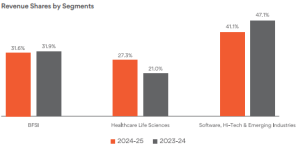
Rather than serving every industry equally, Persistent Systems focuses on sectors where technology has become a strategic differentiator. In FY25, Software, Hi-Tech & Emerging Industries contributed 41.1% of revenue, Banking, Financial Services & Insurance (BFSI) about 31.6%, and Healthcare & Life Sciences 27.3%. These industries continue to invest heavily in cloud computing, AI, cybersecurity, and digital transformation, creating a steady pipeline of high-value projects.
This focus enables Persistent to build deep domain expertise instead of offering generic IT services. Banks require secure, compliant digital platforms, while healthcare providers need interoperable systems that protect sensitive patient data. By understanding these industry-specific challenges, Persistent can deliver specialised solutions that command premium pricing and differentiate it from traditional outsourcing providers.
Industry expertise also strengthens customer relationships. A client that initially hires Persistent to modernise a banking platform may later expand the engagement to include cloud migration, AI implementation, cybersecurity, or managed services. This “land-and-expand” approach increases customer lifetime value while reducing the cost of acquiring new business, making industry specialisation an important competitive advantage.
How Persistent Wins New Clients and Expands Existing Accounts?
Persistent Systems combines direct enterprise sales with strategic partnerships to win new business. A significant share of its projects originates through collaborations with technology leaders such as Microsoft, AWS, Google Cloud, Salesforce, and ServiceNow, which often recommend certified partners for large digital transformation initiatives. The company also strengthens its capabilities through targeted acquisitions, allowing it to enter new markets and broaden its service portfolio.
However, winning a client is only the first step. Persistent follows a “land-and-expand” strategy, where an initial engagement such as cloud migration or application modernisation creates opportunities to sell additional services like AI integration, cybersecurity, data analytics, and managed services. This increases the lifetime value of each customer while reducing reliance on constantly acquiring new clients.
The strategy is reflected in the company’s strong client relationships. Persistent continues to grow its number of high-value customers generating over US$1 million, US$5 million, and US$10 million in annual revenue, demonstrating its ability to deepen engagements with existing clients rather than relying solely on new business. This combination of partner-led sales, cross-selling, and long-term enterprise relationships forms a key pillar of its growth strategy.
Acquisitions: Scaling Through Strategic Expansion
Persistent Systems has historically used acquisitions to strengthen niche capabilities in cloud computing, AI, and digital engineering. However, its proposed acquisition of Nagarro SE marks a fundamentally different stage in the company’s evolution. Valued at approximately €1.27 billion, the transaction is designed not merely to add new capabilities but to significantly expand Persistent’s global scale, industry expertise, and customer base.
Once completed, the combined organisation is expected to generate an annual revenue run rate of nearly US$2.9 billion with a workforce of more than 46,000 professionals. The acquisition also substantially increases Persistent’s European presence, reducing its dependence on North America and providing greater access to enterprise customers across Germany and other key European markets.
Beyond size, the strategic rationale is to create a stronger digital engineering platform capable of competing for larger, more complex transformation programmes. By combining complementary client portfolios and engineering expertise, Persistent aims to accelerate cross-selling opportunities while strengthening its position in AI, cloud transformation, and enterprise consulting.
The Economics Behind Persistent’s Business Model
Persistent’s profitability is driven by more than just revenue growth. Like most IT services companies, its financial performance depends on factors such as employee utilisation, billing rates, delivery efficiency, and the mix of high-value services. As the company shifts toward digital engineering, AI, cloud consulting, and managed services, it benefits from higher pricing power than traditional application maintenance or staff augmentation work.
Another important advantage is its global delivery model. Persistent combines on-site consulting with offshore development centres in India and other locations, allowing it to optimise costs while serving clients across North America, Europe, and Asia-Pacific. This model helps improve operating margins without compromising service quality.
Recurring managed services and long-term enterprise contracts further strengthen the business by providing predictable revenue and improving cash flow visibility. Together, these factors create operating leverage as revenue grows, a larger share of incremental income can translate into profits, making the business more scalable over time.
Financial Performance Validates the Business Model
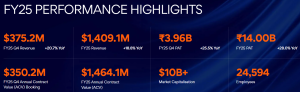
Persistent Systems’ financial performance demonstrates how its strategy has translated into tangible business results. In FY25, the company crossed $1,409.1 Million in annual revenue while maintaining healthy profitability, with EBIT margins of approximately 14.7% . The business has also continued to expand its base of high-value customers, reflecting its success in deepening relationships with existing enterprise clients rather than relying solely on new customer acquisition.
The market has recognised this transformation. Persistent continues to trade at a meaningful valuation premium to many traditional IT services companies because investors increasingly view it as a digital engineering and AI-led growth company rather than a conventional outsourcing provider. Sustaining this premium, however, will depend on the company’s ability to continue delivering faster growth, maintaining healthy margins, and successfully integrating future acquisitions.
Why Persistent Has Outperformed Many Traditional IT Services Companies?
Persistent Systems has consistently grown faster than many traditional IT services companies because it has positioned itself in faster-growing segments of enterprise technology. While many outsourcing firms still depend heavily on application maintenance and labour-based contracts, Persistent derives a larger share of its business from digital engineering, cloud transformation, AI, and data services- areas where enterprise spending continues to rise.
| Traditional IT Services | Persistent Systems |
|---|---|
| Focus on application maintenance | Focus on digital engineering and innovation |
| Competes mainly on cost | Competes on technical expertise and business outcomes |
| Lower exposure to AI and cloud | Strong presence in AI, cloud, and data services |
| More project-based work | Higher mix of recurring managed services |
| Generalist industry approach | Deep expertise in BFSI, healthcare, and software |
This positioning has enabled Persistent to win larger transformation deals, deepen relationships with enterprise clients, and improve profitability over time. As businesses continue investing in AI, cloud computing, and digital modernisation, the company remains well placed to benefit from these long-term technology trends.
Risks to Persistent Systems’ Business Model
Persistent’s biggest near-term challenge is successfully integrating Nagarro into its operations. Large cross-border acquisitions often involve cultural integration issues, overlapping business functions, employee retention challenges, and execution risks. If integration takes longer than expected, the anticipated revenue and cost synergies may not fully materialise.
Financing the acquisition also introduces new financial considerations. Following the announcement, ICRA placed Persistent’s credit rating on ‘Rating Watch with Negative Implications’, reflecting concerns that higher debt levels and increased leverage could temporarily weaken the company’s financial profile. Although management expects long-term strategic benefits, investors will closely monitor how quickly the business generates returns from this investment.
Persistent also occupies a unique position within the IT services industry. It is considerably smaller than giants such as TCS, Infosys, and Accenture, limiting its ability to compete for some of the world’s largest outsourcing contracts. At the same time, it faces growing competition from specialised AI-native consulting firms that are targeting the same high-growth digital engineering opportunities. Maintaining technological leadership while preserving pricing power will therefore remain essential to sustaining its premium valuation.
Future Growth Drivers
Persistent Systems is well positioned to benefit from several long-term technology trends that continue to reshape enterprise IT spending. The rapid adoption of generative AI, cloud-native applications, data analytics, and intelligent automation is increasing demand for the company’s digital engineering expertise. As organisations move from AI experimentation to large-scale deployment, the size and complexity of transformation projects are expected to grow.
Another major opportunity lies in expanding relationships with existing clients. Persistent can cross-sell AI, cybersecurity, cloud management, and managed services to enterprises that already use its digital engineering capabilities, increasing customer lifetime value without proportionately increasing acquisition costs. Strategic partnerships with Microsoft, AWS, Google Cloud, Salesforce, and NVIDIA are also likely to generate more enterprise opportunities as these platforms gain wider adoption.
The company is further supported by targeted acquisitions, continued investments in specialised talent, and growing technology spending across key sectors such as banking, healthcare, and software. If it continues executing this strategy effectively, Persistent is well positioned to capture a larger share of the global digital transformation market in the years ahead.
Conclusion
Persistent Systems has evolved from a software product engineering company into a global digital engineering and enterprise transformation partner. Instead of relying on traditional IT outsourcing, it generates revenue through a diversified mix of digital engineering, cloud transformation, AI solutions, managed services, and strategic technology partnerships. This combination enables the company to earn both project-based and recurring revenue while building long-term relationships with enterprise clients.
Persistent Systems has built a business model that is structurally different from many traditional IT services companies. By combining digital engineering, AI, cloud transformation, strategic partnerships, and recurring managed services, it has shifted away from labour-intensive outsourcing towards higher-value technology solutions. This evolution has strengthened pricing power, improved margins, and earned the company a valuation premium in the public markets.
Looking ahead, the company’s long-term success will depend on its ability to scale complex AI capabilities, integrate transformative acquisitions such as Nagarro, and continue winning larger enterprise transformation programmes. If it executes effectively, Persistent is well positioned to remain one of the fastest-growing digital engineering companies in the global IT services industry.