Marine Electricals’ Data Center Business & Role in the Ecosystem?
India’s data center boom is usually discussed in terms of cloud companies, hyperscalers, server capacity and rising digital consumption. But none of these facilities can function without one basic requirement: reliable electricity and the infrastructure needed to distribute it safely inside the facility.
This is where Marine Electricals operates.
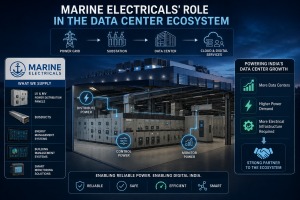
Marine Electricals does not build or operate data centers. Instead, it supplies the electrical power distribution systems that form the backbone of these facilities. Its portfolio includes low- and medium-voltage power distribution panels, busducts, energy management systems, building management systems and smart monitoring solutions. In simple terms, the company helps move, control and monitor electricity once power reaches a data center.
That position makes Marine Electricals an interesting part of India’s data-center ecosystem. It does not need to own the servers or the buildings to benefit from the growth of digital infrastructure. Its opportunity comes from the increasing amount of electrical equipment required as data centers become larger, more power-intensive and more complex.
The Power Infrastructure Opportunity
A data center is ultimately a power-intensive facility. Servers, cooling systems and networking equipment all depend on a stable electrical supply, but that power also has to be distributed, protected and monitored across the facility. This creates a large infrastructure layer between the electricity grid and the computing equipment.
Marine Electricals operates in this layer. Its data-center offering includes low- and medium-voltage switchboards, power-distribution systems, busducts, power distribution units and energy-management solutions. It also provides monitoring and connectivity capabilities through its digital platforms.
The distinction is important because the company is not simply selling electrical panels as standalone products. Its role can extend across supply, installation, testing and commissioning of power-distribution infrastructure. As data centers become larger and their electricity requirements increase, the value of reliable and scalable distribution systems rises with them.
This gives Marine Electricals exposure to a structural part of data-center capex without requiring it to invest in servers, land or data-center operations itself. The investment question, therefore, is not just how quickly India’s data-center capacity grows, but how much electrical infrastructure spend Marine can capture and how profitably it can execute those orders.
The Cash Flow Test Comes First
Marine Electricals’ data-center story starts with a strong order pipeline, but the more important question for investors is whether those orders can actually generate cash. In electrical infrastructure businesses, revenue growth can require significant upfront spending on raw materials, manufacturing and project execution, while payments may arrive only after milestones are completed.
FY2026 highlights this gap. Consolidated PAT increased to ₹58.6 crore from ₹38.1 crore in FY2025, while operating income rose to ₹876.9 crore from ₹767.4 crore. Yet operating cash flow turned negative at around ₹16 crore, compared with positive operating cash flow of ₹55.4 crore in FY2025. At the same time, trade receivables increased from about ₹331 crore to ₹428 crore, while inventory rose from ₹79 crore to ₹85 crore.
This means Marine’s ₹1,254 crore order book cannot be judged by size alone. The quality of growth will depend on how quickly those orders convert into revenue and how quickly that revenue converts into cash.
The issue is particularly relevant because Marine supplies large EPC contractors and data-center operators. Project delays, milestone-based payments and retention amounts can keep cash tied up even when reported revenue and profit are growing.
For investors, three indicators therefore matter as much as order inflows: receivable days, operating cash flow and debt used to fund working capital. If Marine can reduce the amount of cash locked in receivables while maintaining growth, its order book becomes significantly more valuable. If revenue continues to rise but operating cash flow remains weak, the company may have to fund its expansion through additional borrowing or working capital.
That makes cash conversion the first test of Marine Electricals’ data-center thesis not an afterthought.
How Large Is the Data Center Opportunity?
The biggest limitation in assessing Marine Electricals’ data-center business is that the company does not disclose data-center revenue separately. Data centers sit within the broader Industry segment alongside semiconductors, pharmaceuticals, automobiles, steel, cement and chemicals. This means investors cannot directly calculate the data center business’s contribution to revenue or profit.
However, the order book provides a useful proxy for the scale of the opportunity. Marine had a consolidated order book of ₹1,254 crore as of March 2026, with around 63% coming from the Industry/Building segment. That implies roughly ₹790 crore of orders were linked to Industry/Building activities, including data centers and semiconductor projects.
Data centers are clearly a meaningful part of this pool. Marine has disclosed multiple orders from Princeton Digital Group, STT Global Data Centres and Digital Edge DC, along with Siemens orders for hyperscaler projects. These include a ₹284.39 crore Digital Edge order, several PDG orders above ₹70 crore and a ₹376.22 crore Siemens order linked to a hyperscaler project.
The important point is that ₹790 crore should not be treated as Marine’s data-center order book. It is the Industry/Building pool, of which data centers are only one component. But the disclosed project flow shows that data centers are large enough to materially influence the segment.
This is also why the absence of separate data-center revenue disclosure matters. As the business grows, investors will eventually need greater visibility into how much revenue, margin and cash generation actually comes from data centers versus other Industry projects. Check our latest video for more details.
The Order Book Is Strong, but Its Quality Matters
Marine’s ₹1,254 crore order book provides meaningful revenue visibility, but its composition deserves closer attention. Around 63% comes from the Industry/Building segment, while 37% comes from Marine/Defence. FY2026 order inflows were approximately ₹1,606 crore, showing that the company is replenishing its pipeline rather than simply executing older contracts.
However, the order book is not risk-free. Data-center projects are large-ticket contracts, and a small number of major projects can have a noticeable impact on annual revenue. Marine’s disclosed customer list includes several large operators, but the company does not provide a detailed customer-wise percentage of its order book. Therefore, the exact level of customer concentration cannot be calculated from the available disclosure.
There is nevertheless evidence of concentration around large projects. The company has received sizeable orders from Digital Edge, PDG, STT and Siemens, including a ₹284.39 crore Digital Edge order and a ₹376.22 crore Siemens order for a hyperscaler project.
This creates two opposing effects. Large hyperscaler-linked projects can accelerate growth quickly, but they also make execution timing more important. A delayed commissioning or milestone payment can shift revenue between financial periods and increase working-capital pressure.
Therefore, the key metric is not simply order-book-to-revenue, but order-book conversion without deterioration in cash conversion or margins.
Siemens Is a Customer, Not a Direct Rival
Marine Electricals and Siemens occupy different positions in the data-center value chain. Siemens is a global industrial company with a much broader technology and infrastructure portfolio, while Marine focuses more narrowly on power-distribution equipment and system integration, including LV/MV (Low Voltage/Medium Voltage) switchgear, panels and busducts.
The relationship is therefore commercially important. Marine Electricals supplies power-distribution systems to Siemens for large hyperscaler projects, making Siemens a customer and project partner rather than simply a competitor. The July 2026 Siemens order of ₹376.22 crore and the November 2025 order of ₹174.60 crore demonstrate how Marine can enter projects through a larger EPC player.
This model gives Marine access to projects that may otherwise be difficult to win directly. But it also means that Marine’s bargaining power is not comparable with that of a global OEM. Its competitive advantage has to come from specialised engineering, execution, customisation and the ability to deliver certified systems at scale.
Technical Capability Is the Real Entry Barrier
The data-center electrical market is not simply about fabricating a metal enclosure and installing breakers. Reliability, safety and testing are critical because a failure in the power-distribution system can affect the availability of the entire facility.
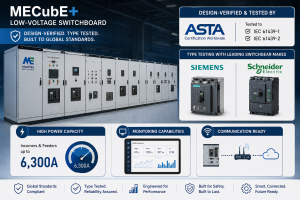
Marine Electricals’ MECubE+ low-voltage switchboard has been tested by ASTA against IEC 61439 standards, which set safety and performance requirements for electrical switchboards. For data centers, this matters because even a power-distribution failure can disrupt critical computing operations. The system can handle up to 6,300A of electrical current and includes monitoring and communication features, allowing operators to manage and track power more effectively. This makes it suitable for the high-power and reliability requirements of data centers and other critical facilities.
That certification does not make Marine comparable to Siemens or Schneider in overall scale, but it does raise the technical bar for competitors that want to supply mission-critical projects. In a data center, customers are paying for predictable performance, tested designs and the ability to integrate equipment into a larger electrical system.
Busducts are another relevant part of the proposition. Unlike conventional cable-heavy distribution, the busway uses enclosed conductors and modular tap-off points to distribute power. Its compact design, easier expansion and ability to add or relocate power points make it useful in facilities where rack layouts and power requirements can change. Schneider and Legrand both highlight these characteristics for modern data-center applications.
As AI workloads push data centers toward higher power densities, the value of compact, modular and scalable power distribution should increase. This is an opportunity for Marine, but the company still has to prove that its technical capability translates into repeat orders, strong margins and reliable execution.
What Is Marine Electricals’ Competitive Moat?
Marine Electricals is unlikely to win against Siemens, ABB or Schneider simply on scale or technology breadth. Its competitive advantage is more likely to come from specialised execution, custom engineering, integration capability and an established customer network.
The company’s products are not generic electrical components. Its LV/MV switchboards, busducts and power-distribution systems have to be designed, tested, integrated and commissioned according to the requirements of a specific facility. Marine’s MECubE+ LV switchboard has been design-verified and tested by ASTA against IEC 61439-1 and IEC 61439-2 standards, supporting the certification and reliability requirements expected in critical applications.
This creates a practical barrier to entry. A data-center operator or EPC contractor is unlikely to change electrical suppliers purely to save a small amount on equipment if doing so creates reliability or commissioning risks. Once a supplier has demonstrated that it can deliver a project on schedule and meet technical specifications, repeat orders can become an important source of competitive advantage.
The company’s order history supports this relationship-based model. Marine has received repeat business from PDG, STT Global Data Centres, Equinix India, Digital Edge and Siemens-linked hyperscaler projects.
Marine’s moat, therefore, is better described as execution-led rather than technology-led. Siemens, ABB and Schneider possess greater global technology and manufacturing scale. L&T has greater EPC scale. Marine’s opportunity is to win specialised packages by combining local manufacturing, customisation, project execution and customer familiarity.
The risk is that this moat may remain relatively narrow if larger OEMs decide to compete more aggressively for the same packages. Marine will need to convert its current project relationships into repeat business and higher-value integrated solutions to make its position more defensible.
Data Centers Are Helping Change The Company’s Revenue Mix
Marine Electricals does not separately disclose data-center revenue. Its data-center business is included within the broader Industry segment, which also covers areas such as semiconductors, pharmaceuticals, automobiles, steel and other industrial applications.
Even without a separate data-center revenue number, the broader mix shows where the company is moving.
Standalone Industry revenue increased from ₹267.93 crore in FY2024 to ₹371.04 crore in FY2025, a growth of 38.5%. Its share of standalone revenue also increased from 50.2% to 53%. Over the same period, Marine & Defence revenue grew 24%.
At the consolidated level, Industry revenue raised its contribution from 43.1% to 48.4%.
This shift is important because it reduces the idea that Marine Electricals is simply a marine-electrical company with a small data-center business attached to it.
The company is becoming increasingly diversified toward industrial electrical infrastructure, with data centers emerging as one of the most important growth drivers inside that segment.
Data Centers Are Part of a Wider Industrial Strategy
The data-center opportunity matters, but Marine Electricals is not dependent on a single end market. Its Industry segment also covers semiconductor, pharmaceutical, automotive, steel, cement and chemical projects.
This diversification is important because many of these industries need similar capabilities: power distribution, automation, monitoring and project execution.
The financial mix is already moving in this direction. Standalone Industry revenue increased 38.5% from ₹267.93 crore in FY2024 to ₹371.04 crore in FY2025, taking its contribution to 53% of standalone revenue from 50.2%. At the consolidated level, Industry revenue reached ₹371.04 crore, or 48.4% of revenue, in FY2025.
That makes the data-center story more credible from a portfolio perspective. Marine is building capabilities that can serve multiple capital-spending cycles rather than betting entirely on one technology trend. The key, however, remains whether this broader Industry mix can generate better margins and stronger cash conversion.
Beyond Data Centers: Building a Critical-Power Platform
The long-term opportunity for Marine Electricals may be larger than the data-center market itself. Data centers are helping the company build capabilities in power distribution, automation, monitoring and system integration that can be applied across other power-intensive industries.
That is already visible in the Industry segment. Marine serves semiconductor, pharmaceutical, automotive, steel, cement and chemical projects in addition to data centers. The ₹115 crore order from L&T for the Tata Semiconductor facility in Dholera is an example of how the same electrical-infrastructure capabilities can be deployed in another emerging capital-spending cycle.
This suggests that Marine is gradually evolving from a company historically associated with marine electrical systems into a broader critical-power infrastructure and industrial electrical solutions provider.
That shift could be more important than the data-center opportunity by itself. If Marine can use the same engineering base across data centers, semiconductors and other power-intensive industries, it reduces dependence on any single capital-spending cycle and increases the potential size of its addressable market.
The next stage of the story, therefore, is not simply about winning more data-center orders. It is about whether Marine can turn its data-center and semiconductor credentials into a repeatable platform for critical-power infrastructure across multiple industries.
Growth Is Strong, but Margin and Cash Conversion Matter More
Marine Electricals has clearly entered a higher-growth phase. Consolidated operating income increased from ₹442.9 crore in FY2023 to ₹876.9 crore in FY2026, while PAT increased from ₹16.8 crore to ₹58.6 crore. Over the same period, OPBDIT margin improved from 8.7% to 10.8%.
The improvement in profitability is particularly relevant to the data-center thesis. ICRA has attributed part of the margin expansion to improved profitability from semiconductor and data-center projects.
The order book provides further visibility. At ₹1,254 crore as of March 2026, it was equivalent to roughly 1.4 times FY2026 consolidated operating income, with around 63% coming from the Industry/Building segment. FY2026 order inflows of approximately ₹1,606 crore also point to strong demand.
But investors should avoid treating the order book as guaranteed future earnings. The real test is whether Marine can execute these projects at or above its current margin profile while reducing the cash trapped in receivables.
That creates three numbers worth monitoring: order-book conversion, operating margin and operating cash flow. If all three improve together, the data-center opportunity becomes a stronger quality-of-growth story. If revenue grows while cash conversion weakens, the benefit to shareholders will be less compelling.
What Would Make the Thesis Work?
The bull case is not simply that India builds more data centers. It is that Marine converts its current position into a broader critical-power platform. Rising data-center and AI power requirements increase demand for electrical distribution, while semiconductor and other industrial projects provide additional avenues for growth. If Marine converts its ₹1,254 crore order book efficiently, maintains margins around or above its current 10.8% OPBDIT level and improves operating cash flow, the business could move toward a higher-quality growth profile.
The bear case is more operational. Large projects can create customer concentration, execution delays and working-capital requirements. Raw-material price volatility can pressure project margins, while delayed commissioning can postpone both revenue recognition and cash collection. FY2026’s negative operating cash flow despite higher PAT makes this risk particularly relevant.
For investors, the most important signals over the next few years are therefore clear: falling receivable days, consistently positive operating cash flow, stable or improving margins and continued order inflows from a broader customer base.
If those metrics improve together, Marine would be demonstrating that its growth is becoming more cash-generative and less dependent on individual projects. If order growth remains strong but cash conversion deteriorates, the data-center opportunity could create scale without creating equivalent shareholder value.
The central question is therefore not whether Marine can win large data-center orders. It is whether the company can turn those orders into a diversified, cash-generative critical-power business.
Conclusion
Marine Electricals is entering an important transition. Data centers are providing large orders and improving the company’s position in the Industry segment, but the bigger opportunity is to use those capabilities to build a broader critical-power infrastructure business across data centers, semiconductors and other power-intensive industries.
The near-term test is financial rather than narrative: can Marine convert its ₹1,254 crore order pipeline into revenue, cash and sustainable returns? The answer will depend on execution, working-capital discipline and its ability to turn customer relationships into repeat business.
If it succeeds, Marine could evolve from a specialised electrical supplier into a more diversified critical-power infrastructure company. That is ultimately the more interesting investment thesis.