Can Ratnaveer’s New CCL Business Transform Its Growth Story?
Ratnaveer Precision Engineering is preparing to enter a business that could change its growth profile. Ratnaveer's stainless steel operations generated ₹1,068.74 crore in FY26. Its proposed copper clad laminate (CCL) business offers exposure to India's electronics industry.
CCL is a key material used to manufacture printed circuit boards (PCBs), which are essential to electronics, telecommunications, automotive systems and other applications. Ratnaveer's presentation estimates India's domestic CCL demand at ₹5,000 crore, with imports meeting more than 90% of that demand.
The company plans to establish five production lines, with a scaled-case revenue target of ₹750 crore or more and an EBITDA margin of 20%. Management has also outlined a broader ambition of ₹2,500 crore in consolidated revenue, combining growth in the existing business with the planned CCL contribution.
However, Ratnaveer must commission the facility, secure customer approvals, convert potential demand into commercial orders and fund the working capital required for production.
The key question for investors is whether CCL can become a profitable, cash-generating business rather than simply adding a large revenue target to the company's growth plans.
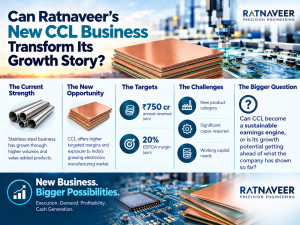
The ₹750 Crore CCL Target Could Generate ₹150 Crore in EBITDA
Ratnaveer's Q1 FY27 Investor Presentation outlines a scaled CCL case of ₹750 crore or more in annual revenue by FY31. At exactly ₹750 crore in revenue and a 20% EBITDA margin, the business would generate ₹150 crore in annual EBITDA.
The presentation also gives a Phase 1 financial case:
- Revenue: ₹108 crore.
- EBITDA: ₹22 crore.
- EBITDA margin: 20%.
- PAT: ₹12 crore.
- Annual capacity: 15.84 lakh sheets.
Across five production lines, the planned annual capacity is 79.2 lakh sheets. The company expects the scaled facility to generate ₹83 crore in PAT at an 11% margin.
These are projections, not achieved financial results. During its earlier Q4 FY26 earnings call, management outlined a more ambitious timeline and suggested that the CCL business could generate ₹750 crore in revenue within two years. The latest Q1 FY27 presentation places the scaled case in FY31.
Investors should use the latest presentation's FY31 timeline as the primary reference point and treat the earlier earnings-call target as management's more ambitious estimate.
Investors should track the actual commissioning schedule and sales ramp-up before assuming that the targeted revenue and profits will materialise on time.
The ₹650 Crore Requirement Includes Working Capital, Not Just Construction
Ratnaveer's CCL expansion involves a broader funding requirement than the cost of manufacturing equipment and facilities alone.
During its Q4 FY26 earnings call, management explained the expected requirement as follows:
- CCL project cost: ₹351 crore.
- Solar investment: ₹46 crore.
- Working capital: ₹250 crore.
- Total funding requirement: ₹647 crore, rounded to ₹650 crore.
The company separately disclosed ₹338 crore of investment associated with its ECMS-approved CCL project. It also received in-principle approval under Gujarat Electronics Policy for a proposed ₹472.34 crore CCL project.
These figures come from different disclosures, and the company has not explained how the ₹472.34 crore figure relates to the detailed cost breakdown in the earnings call. They should not be treated as interchangeable amounts.
Management also discussed raising ₹330 crore through a QIP, rights issue or equivalent funding route, alongside proceeds expected from previously issued warrants. The latest Q1 FY27 presentation states that the company has received in-principle approval for a rights issue of up to ₹330 crore to fund CCL and other growth initiatives.
The funding plan matters because the company must finance both the facility and the cash tied up in raw materials, inventory and customer receivables.
Investors should monitor the actual amount raised, the use of proceeds, further capital requirements and the working capital consumed as production increases. A large revenue target will be less valuable if it requires repeated fundraising or generates weak cash flow. Check our latest video to know more.
Customer Interest Exists, but Binding Orders Remain Unproven
India's domestic CCL market is valued at ₹5,000 crore in Ratnaveer's presentation, and more than 90% of demand is met through imports. The presentation also cites demand exceeding 3 lakh sheets per month.
This creates an opportunity for domestic manufacturing. However, the size of the market does not establish how much business Ratnaveer can secure.
During the Q4 FY26 earnings call, management said it had received soft confirmations from PCB manufacturers. Management also said that one or two companies were prepared to buy the first line's production, but it had not yet secured firm purchase confirmations.
This is more informative than market-size figures alone, but soft confirmations are not binding orders. The company still needs to demonstrate that potential customers complete the approval process and begin purchasing its products commercially.
Ratnaveer expects its technology partner to support installation, operating procedures, training and quality management. The arrangement also includes assistance with customer approvals for 18-24 months after commissioning.
This support may help the company establish its production processes, but customer acceptance and repeat orders remain important milestones.
Investors should look for firm order disclosures, customer qualification progress, production volumes and repeat purchases. Until these become clearer, the ₹5,000 crore market should be viewed as an addressable opportunity rather than revenue that Ratnaveer has already secured.
Five Production Lines Must Deliver the Revenue Ramp-Up
Ratnaveer's first production line is the starting point for its CCL ambitions. In the Q1 FY27 presentation, the company reported that the machinery had been ordered and inspected at the vendor's works, with shipment and installation underway. The project was approximately 60% complete, and commercial production remained targeted for November 2026.
The first line has an annual capacity of 15.84 lakh sheets and projected revenue potential of ₹108 crore. The five-line facility is designed for 79.2 lakh sheets annually, with a scaled-case revenue target of ₹750 crore or more.
Ratnaveer plans to install the remaining four lines in phases. However, the latest presentation does not provide a complete line-by-line commissioning schedule or separate revenue contributions for each additional line.
This makes the speed of the production ramp-up difficult to assess. A delay in commissioning, slower customer approvals or lower utilisation could push revenue further into the future.
The timeline also needs careful interpretation. Management's May 2026 earnings call suggested that the company could establish the CCL business and reach ₹750 crore in revenue within two years. The latest Q1 FY27 presentation identifies FY31 as the year for its scaled case.
Investors should therefore avoid assuming that all five lines will reach the targeted production and sales levels immediately after the first line starts operating.
The first line's actual commissioning, customer acceptance and revenue contribution will provide the earliest evidence of whether the broader expansion plan is on track.
The ₹2,500 Crore Target Is for the Overall Company
Ratnaveer's ₹2,500 crore revenue ambition should not be interpreted as a CCL-only target.
During the Q4 FY26 earnings call, management explained the broader plan as approximately ₹1,800 crore from the existing stainless steel business and ₹750 crore from CCL. These figures total ₹2,550 crore, which management presented as a consolidated revenue target of ₹2,500 crore.
The distinction matters because the target depends on two growth drivers. The existing business must continue expanding while the new CCL operation is commissioned and scaled up.
The existing business generated ₹1,068.74 crore in revenue in FY26. Management's ambition to grow this to ₹1,800 crore over approximately three years depends on continued expansion of its established product lines.
CCL, meanwhile, must progress from its initial production line to the five-line operation needed to support the ₹750 crore revenue potential.
Neither contribution should be treated as guaranteed. Slower growth in the existing business or delays in CCL could prevent the company from reaching its consolidated target within the intended period.
The ₹2,500 crore figure is therefore best understood as management's overall growth ambition, supported by both businesses, rather than a forecast of CCL revenue alone.
Can Ratnaveer Achieve a 20% EBITDA Margin?
Ratnaveer's CCL business targets a 20% EBITDA margin, compared with the 11.40% margin reported by the existing business in FY26.
At the scaled revenue target of ₹750 crore, a 20% EBITDA margin implies ₹150 crore in annual EBITDA. The Phase 1 projection similarly indicates ₹22 crore in EBITDA on ₹108 crore of revenue.
However, the margin target has not yet been demonstrated through commercial production. The available disclosures do not provide a sufficiently detailed CCL cost breakdown to independently test the assumptions behind the projected margin.
Investors need to understand the contribution of raw materials, energy, production yields, labour, pricing and capacity utilisation. These factors will influence how much profit the company retains from each sheet it sells.
Ratnaveer's technology partner is expected to provide installation, training and quality-management support. This may help the company establish production processes, but it does not eliminate the risks of lower utilisation or inefficiencies during the initial ramp-up.
The presentation also states an ROI of 29% for both Phase 1 and the scaled case, but it does not explain the calculation in the disclosed figures. That percentage should not be treated as an independently verified cash return or ROCE.
Investors should compare actual sales, EBITDA and production volumes against the projections once operations begin. Until then, the 20% margin remains a target rather than a proven advantage.
Conclusion
Ratnaveer's CCL project offers a potential route into India's import-dependent electronics materials market. Its scaled case targets ₹750 crore or more in annual revenue, while management's broader plan aims for ₹2,500 crore in consolidated revenue from CCL and the existing business.
The funding requirement also needs to be understood correctly. Management's earlier breakdown puts the broader requirement at approximately ₹650 crore, including manufacturing investment, solar expenditure and working capital. The ₹338 crore ECMS-related investment and ₹472.34 crore Gujarat Electronics Policy proposal are separate disclosures whose relationship requires further clarification.
For investors, the most important evidence will be the first line's commercial performance, firm customer orders, the schedule for the remaining production lines, achieved margins and cash generation.
CCL could become a meaningful growth engine for Ratnaveer, but its contribution will depend on the company's ability to turn projected capacity into customer sales, profits and cash flow.