Beyond Iron Ore: NMDC’s Aggressive Pivot into Coal and Strategic Minerals
For decades, NMDC has been one of India’s biggest iron ore success stories. But relying heavily on a single commodity comes with an obvious risk: when iron ore prices fluctuate, so do earnings.
That is why NMDC’s recent entry into coal mining deserves attention. Through the Tokisud North and Rohne coal blocks in Jharkhand, the company is taking its first major step toward building a diversified mining portfolio that extends beyond iron ore.
The move is about more than adding another commodity. It gives NMDC exposure to both thermal and coking coal while laying the groundwork for a broader push into strategic minerals such as lithium, copper, nickel, and cobalt. The bigger question is whether these new businesses can eventually become meaningful enough to reduce the company’s dependence on iron ore and create a more balanced growth profile.
In this article, we will examine NMDC’s coal expansion strategy, its revenue implications, and whether diversification can become the company’s next growth engine.
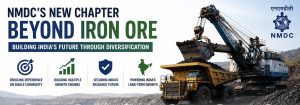
Why NMDC Needs to Look Beyond Iron Ore
Iron ore has been the foundation of NMDC’s success for decades. The company recently became the first miner in India to cross 50 million tonnes of annual iron ore production, highlighting its dominant position in the sector.
However, this strength also creates a challenge. A large portion of NMDC’s earnings remains tied to a single commodity whose prices are influenced by steel demand, economic activity, and global market cycles.
As the company grows, simply producing more iron ore does little to reduce this dependence. Any slowdown in the steel sector or weakness in iron ore prices can still have a significant impact on earnings.
This is where diversification becomes important. By expanding into coal and other minerals, NMDC can create additional revenue streams and reduce its exposure to a single commodity cycle.
The objective is not to replace iron ore. Instead, it is to build multiple growth engines that can support the business even when one market faces pressure.
The Coal Expansion Strategy
NMDC’s diversification plans took a major step forward with the launch of mining operations at the Tokisud North coal block in Jharkhand. The project marks the company’s formal entry into the coal sector and the beginning of its expansion beyond iron ore.
Tokisud North Coal Block
Located in the Barkagaon region of Jharkhand’s Hazaribagh district, the Tokisud North mine has an annual production capacity of 2.3 million tonnes of thermal coal. Mining operations officially began on January 23, 2026, although commercial production is expected to commence after operational stabilization and statutory approvals.
Thermal coal is primarily used for power generation, making Tokisud North a direct play on India’s long-term energy demand. While the mine may not immediately transform NMDC’s financial profile, it establishes the company’s operational presence in the coal sector and provides a platform for future expansion.
Rohne Coal Block
The second asset, Rohne, could prove even more strategically important. Unlike Tokisud North, which focuses on thermal coal, Rohne is a coking coal block. Coking coal is a critical raw material in steel manufacturing and remains one of India’s most import-dependent mineral resources.
This distinction matters because coking coal generally carries greater strategic value than thermal coal. As India’s steel production capacity expands, securing domestic sources of coking coal could become increasingly important for the country’s industrial ecosystem.
Building a Second Mining Vertical
Viewed individually, these coal assets may appear modest compared to NMDC’s vast iron ore operations. Viewed collectively, however, they represent the foundation of an entirely new business vertical.
The company’s coal ambitions are not simply about producing another mineral. They are about creating a second resource platform that can generate revenue, diversify earnings, and position NMDC for future expansion into other minerals. The success of this strategy will ultimately depend not on entering coal, but on scaling coal production into a meaningful contributor to the overall business.
The Real Economics: Can Coal Become NMDC’s Second Engine?
The launch of new coal mines sounds significant, but investors should focus on a simpler question: can coal become large enough to influence NMDC’s earnings?
Today, NMDC remains overwhelmingly dependent on iron ore. In FY25, the company reported revenue of ₹25,499 crore and net profit of ₹6,539 crore, with iron ore contributing the vast majority of both. This means coal starts from a very small base.
That may disappoint investors expecting an immediate financial transformation. Even after production ramps up, coal is unlikely to rival the scale of NMDC’s iron ore business anytime soon.
However, the strategy is not about replacing iron ore. It is about reducing dependence on a single commodity cycle. By adding thermal and coking coal assets, NMDC gains exposure to different demand drivers and creates another avenue for future growth.
The real metric to watch is coal’s share of revenue over the next several years. If the business scales successfully, it could gradually evolve into a meaningful second pillar alongside iron ore rather than remain a small diversification effort.
Financial Perspective: How Big Could Coal Become?
NMDC’s coal ambitions are substantial, with Tokisud North targeted at 2.32 MTPA and Rohne at 8 MTPA, taking total planned coal capacity to roughly 10 MTPA.
Tokisud North began operations in January 2026 and is expected to produce around 0.75-1.0 MTPA in FY27. Rohne is scheduled to commence operations in Q3 FY27 and could take another 1.5-2 years to reach peak capacity.
Management estimates that the coal business could eventually generate annual revenue of ₹5,000-8,000 crore. This would represent a meaningful contribution to NMDC’s overall revenue base rather than a small diversification effort.
The company has also guided for EBITDA margins of 30-40% in the coal business, implying a potential EBITDA contribution of roughly ₹1,500-3,200 crore at maturity. While iron ore will remain NMDC’s core business, coal has the potential to emerge as a significant second growth driver over the coming years.
The 100 MTPA Production Roadmap
To evaluate NMDC’s transition, investors must compare coal milestones against the massive capacity expansion occurring simultaneously within its core iron ore business.
Mid-2026: Tokisud North Begins Commercial Production
- Commercial extraction begins at the Tokisud North thermal coal block.
- Management has guided for an initial production of 0.75 - 1.0 MTPA.
- The mine marks NMDC’s formal entry into the coal sector.
Q2–Q3 FY27: Rohne and Deposit 13 Come Online
- The Rohne coking coal block is expected to commence operations, with a long-term peak capacity of 8 MTPA.
- During the same period, Iron Ore Deposit 13 is expected to begin production.
- Deposit 13 is projected to contribute around 0.5 million tonnes in FY27, with an ultimate peak capacity of 10 MTPA.
FY27–FY28: Logistics Expansion
- NMDC plans to commission the downhill conveyor system at Deposit 5.
- Additional railway investments beyond Jagdalpur are expected to strengthen evacuation infrastructure.
- These projects could increase evacuation capacity from 28-30 MTPA to 40 MTPA.
By 2030: The 100 MTPA Target
- NMDC aims to double its iron ore production capacity to 100 MTPA.
- This highlights a key reality of the diversification story: while coal creates a new growth avenue, iron ore expansion remains the company’s primary growth driver.
- Even at full scale, iron ore volume growth is expected to outpace coal growth by roughly 5-to-1.
Coking Coal vs Thermal Coal: Why Rohne May Matters More?
While Tokisud North gives NMDC exposure to thermal coal used in power generation, Rohne could prove to be the more strategically valuable asset because of its coking coal reserves.
The difference is important. Thermal coal is primarily used by power plants, whereas coking coal is an essential raw material in steelmaking. India remains heavily dependent on imported coking coal despite being one of the world’s largest steel producers.
This gives Rohne a significance that goes beyond simple coal production. As domestic steel capacity expands, reliable access to coking coal could become increasingly valuable for the industry.
The asset also fits naturally within NMDC’s broader position in the steel value chain. By adding coking coal to its portfolio, the company strengthens its exposure to a resource that remains critical for India’s long-term industrial growth.
For that reason, Rohne may ultimately become the most strategically important asset in NMDC’s coal diversification strategy.
Strategic Synergies with NMDC Steel: Opportunity or Overstated Narrative?
At first glance, the Rohne coking coal asset appears to create an obvious strategic advantage for NMDC’s steel operations. Since coking coal is a key raw material in steelmaking, investors may assume the company can seamlessly integrate mining and steel production.
The reality is more complicated.
Following the demerger of the Nagarnar steel plant, the business now operates as a separately listed entity under NMDC Steel Ltd (NSL). This structural separation means transactions between the two companies must be conducted on an arm’s-length basis rather than through preferential internal allocations.
In practice, this limits the extent of any direct cost advantage. Coal supplied to NMDC Steel would need to be priced in a manner that protects minority shareholders and complies with corporate governance requirements.
There is also a financial consideration. Some analysts have highlighted rising receivables from the steel entity, suggesting that supply relationships between the two companies currently create a degree of cash-flow collection risk for NMDC until NSL achieves greater financial stability.
This does not eliminate the strategic value of the Rohne asset. However, it suggests that investors should be cautious about assuming immediate or frictionless synergies between NMDC’s coal assets and its steel operations.
Beyond Coal: The Strategic Minerals Ambition
Coal may be grabbing the headlines today, but it is unlikely to be the final destination of NMDC’s diversification strategy.
The company has expressed interest in minerals such as lithium, copper, nickel, cobalt, and gold- resources that are expected to play a critical role in electric vehicles, renewable energy systems, batteries, and industrial manufacturing.
This shift reflects a broader global trend. As countries invest in energy transition technologies, demand for several strategic minerals is expected to grow much faster than traditional commodities.
For NMDC, the attraction is clear. These minerals offer an opportunity to participate in some of the fastest-growing segments of the global mining industry while reducing reliance on iron ore.
Viewed from this perspective, coal appears less like a standalone expansion and more like the first step in a much larger transformation from a single-commodity miner into a diversified natural resources company.
Unpacking the Critical Minerals Hype: The Mt Bevan Strategy
NMDC’s ambitions in critical minerals often attract attention because of their exposure to lithium, copper, and cobalt- commodities expected to benefit from the global energy transition. However, investors should look beyond the headlines and examine how these assets are actually being developed.
Unlike its domestic mining operations, NMDC’s critical mineral exploration efforts are being pursued through its Australian-listed subsidiary, Legacy Iron Ore Ltd. This makes the business highly long-term and inherently speculative.
The company’s flagship exposure comes through the Mt Bevan project in Western Australia. Rather than funding high-risk exploration activities entirely on its own balance sheet, NMDC has adopted a risk-sharing approach by partnering with Hancock Prospecting, one of Australia’s largest mining groups.
Under the arrangement, Hancock funds the exploration capital expenditure in exchange for an equity stake in the project. This allows NMDC to retain exposure to a potentially significant lithium resource while limiting the financial burden of early-stage exploration.
That said, investors should keep expectations realistic. The project still faces a lengthy development and environmental approval process. As a result, critical minerals are unlikely to contribute meaningful revenue before 2029–2030.
For now, Mt Bevan should be viewed as a long-term strategic option rather than a near-term earnings driver.
Risks Investors Should Watch
Like any diversification strategy, NMDC’s coal expansion comes with risks.
The first is execution risk. Developing and scaling new mining operations takes time, and delays in production ramp-up can affect expected returns.
The second is regulatory and environmental risk. Mining projects require multiple approvals and must operate within evolving environmental frameworks, which can impact timelines and costs.
Commodity prices also remain a key variable. While diversification reduces dependence on iron ore, coal itself is subject to cyclical price movements that can affect profitability.
Finally, there is the risk that coal remains too small to materially influence earnings.
Diversification only creates value if new businesses achieve sufficient scale to make a meaningful contribution to revenue and cash flows.
Conclusion
For decades, iron ore has been the foundation of NMDC’s growth story. The launch of the Tokisud North and Rohne coal blocks signals the company’s intention to build beyond that foundation.
The immediate financial impact of these projects may be limited, but their strategic significance is much larger. Coal provides NMDC with a new growth avenue, exposure to different commodity markets, and an opportunity to reduce its dependence on iron ore over time.
More importantly, the coal expansion fits into a broader ambition that includes strategic minerals such as lithium, copper, nickel, and cobalt. If executed successfully, this could gradually reshape NMDC from an iron ore-focused miner into a diversified natural resources company.
The key question for investors is no longer whether NMDC can mine coal. It is whether coal and future mineral businesses can become large enough to emerge as meaningful contributors to the company’s next phase of growth.