IHCL Hotel Expansion Strategy: Doubling Capacity with 32,000 New Rooms
India's hospitality industry is entering a multi-year growth cycle. Rising domestic tourism, improving infrastructure, increasing business travel, spiritual tourism, weddings, and premium leisure experiences are creating demand that extends well beyond the country's metro cities.
Rather than simply benefiting from this demand, The Indian Hotels Company Limited (IHCL) is attempting to shape the future of India's hotel industry through one of its most ambitious expansion plans ever.
Under its Accelerate 2030 strategy, IHCL aims to expand its portfolio to 700+ hotels by 2030, while doubling consolidated revenue, maintaining industry-leading margins, and generating a 20% Return on Capital Employed (ROCE).
Behind this vision lies a massive development pipeline of more than 250 hotels representing approximately 32,000 new rooms, making it one of the largest expansion plans in the Indian hospitality sector.
The key question for investors is not whether IHCL can sign more hotels - it already has. The real question is whether it can successfully execute this pipeline while maintaining profitability.
Accelerate 2030: IHCL's Long-Term Vision
In November 2024, IHCL unveiled its Accelerate 2030 strategy, setting clear financial and operational targets.
The company plans to:
- Expand to 700+ hotels
- Double consolidated revenue to ₹15,000 crore
- Maintain industry-leading margins
- Deliver approximately 20% ROCE
- Increase the contribution of new businesses to over 25% of total revenue
Unlike many expansion plans that focus solely on opening more properties, IHCL's strategy combines growth with profitability. Management has repeatedly emphasized that expanding room inventory should not come at the expense of returns.
That distinction is important because hotel companies often face a trade-off between rapid expansion and capital efficiency. IHCL is trying to achieve both simultaneously.
Understanding the 32,000+ Room Expansion
One headline figure that stands out is IHCL's development pipeline.
As of the latest official disclosures, the company has expanded its portfolio to more than 620 hotels in which more than 250 hotels are in the pipeline representing approximately 32,000 rooms awaiting completion over the coming years.
This pipeline alone is equivalent to building multiple luxury hotel chains from scratch.
More importantly, these rooms are spread across different price segments rather than being concentrated only in luxury hotels.
The strategy allows IHCL to participate in every major travel category - from premium luxury vacations to affordable business travel.
Why Does IHCL Need 32,000 More Rooms?
Hotels have one of the longest capacity creation cycles in any consumer-facing industry. A hotel signed today often takes five to six years before welcoming its first guest due to land acquisition, approvals, construction, and fit-outs.
This is precisely why IHCL is aggressively building its pipeline today. Rather than waiting for demand to become obvious, management is creating room inventory years in advance so that capacity is available when India's tourism cycle becomes significantly larger towards the end of the decade.
In other words, the current pipeline is less about today's demand and more about securing tomorrow's revenue.
Why does management believe demand will continue growing?
IHCL's long-term optimism is supported by several structural trends that are expected to increase travel demand across India.
These include:
- Higher disposable incomes, allowing more families to spend on leisure travel.
- Rapid airport and highway expansion, making more destinations accessible.
- Growth of Tier-2 and Tier-3 cities, where branded hotel supply is still relatively limited.
- Recovery in business travel as corporate activity continues to normalize.
- Rising religious tourism, supported by government investment in pilgrimage destinations.
- Growing preference for premium leisure experiences, where travellers are willing to pay more for branded hospitality.
- Increasing international tourist arrivals, creating additional demand for premium hotel rooms.
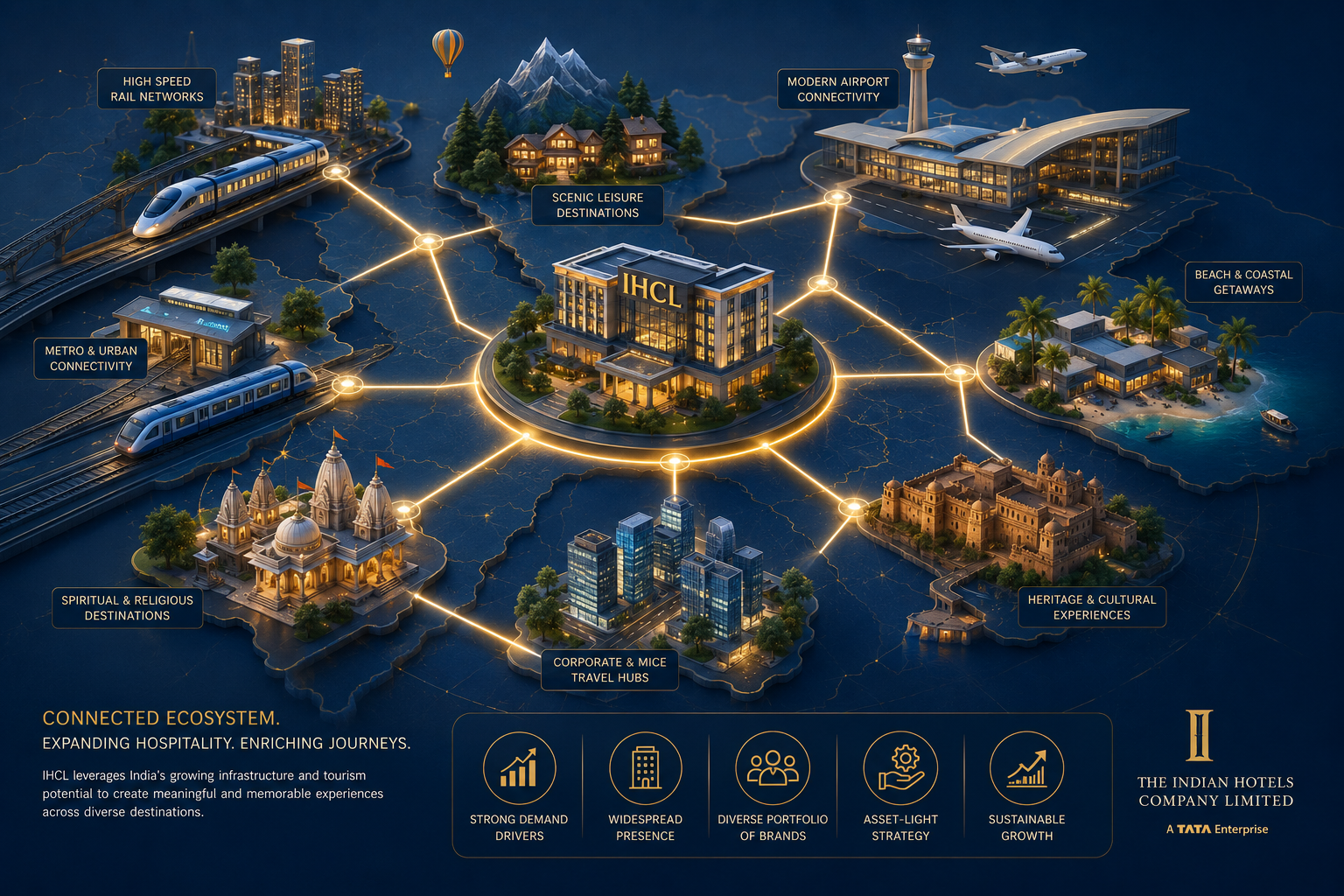
Each of these trends may appear small individually, but together they create a powerful long-term demand engine.
For IHCL, the objective is not simply to build more hotels. It is to ensure that when these demand drivers mature over the next decade, the company already has enough rooms to capture that opportunity.
Investor Insight:
A hotel room is a perishable asset. If a room remains vacant tonight, that revenue is lost forever - it cannot be sold tomorrow. By expanding its room inventory before demand peaks, IHCL increases the number of "revenue-generating assets" available every single day in the future.
The Asset-Light Expansion Strategy
Expanding to more than 700 hotels sounds incredibly capital intensive. Naturally, many investors assume IHCL will have to spend tens of thousands of crores constructing hundreds of new hotels.
In reality, that is not how modern hotel companies expand.
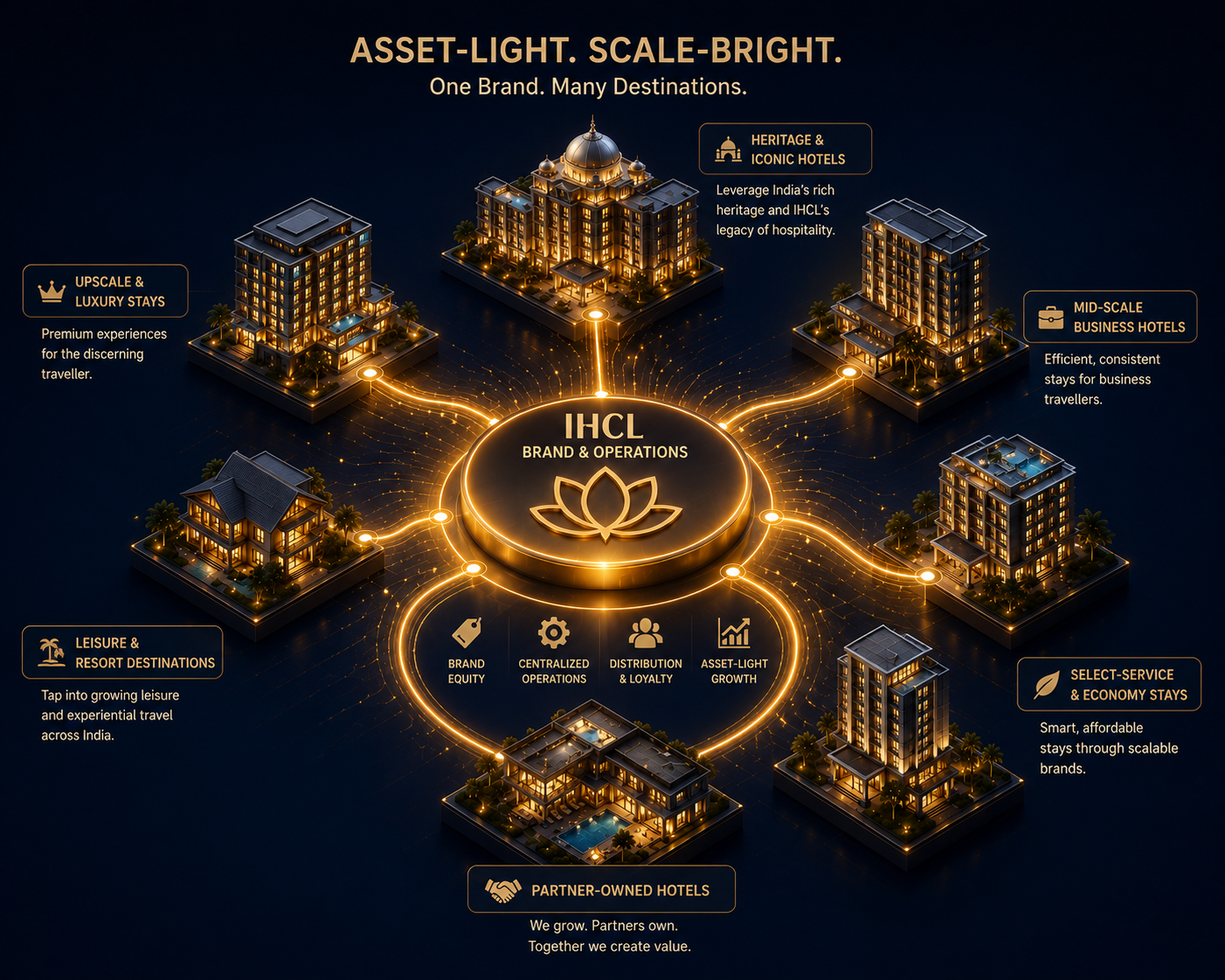
Instead, IHCL is increasingly following an asset-light model, where the company focuses on operating hotels rather than owning the underlying real estate.
This distinction is important because, in the hospitality industry, owning a hotel and operating a hotel are two completely different businesses.
For IHCL, the asset-light model fundamentally changes how the business compounds. Instead of tying up large amounts of capital in land and construction, the company increasingly earns management and brand fees by operating hotels owned by developers.
This means every new management contract expands IHCL's earnings base without requiring proportionate investment on its balance sheet.
Over time, this improves capital efficiency, supports higher ROCE, and allows the company to scale much faster than a traditional hotel ownership model.
Rather than investing in every building itself, the company partners with real estate developers, institutional investors, or property owners who finance the hotel. Once the property is completed, IHCL manages day-to-day operations under one of its brands, such as Taj, Vivanta, Gateway, or Ginger.
In return, IHCL earns recurring management fees and brand fees, while the property owner receives the majority of the hotel's operating profits after expenses.
This model allows both parties to focus on what they do best.
- The developer invests capital and owns the real estate.
- IHCL contributes its brand, operational expertise, reservation systems, loyalty network, and decades of hospitality experience.
As a result, IHCL can expand its presence across multiple cities without having to finance every new property on its own balance sheet.
Why Does an Asset-Light Model Create More Value?
The real advantage of this model is not that IHCL earns more revenue per hotel - it usually doesn't. Instead, it earns significantly higher returns on the capital it actually invests.
Management has made capital efficiency a central objective under Accelerate 2030, targeting approximately 20% ROCE while expanding to more than 700 hotels.
That would be difficult to achieve through an ownership-led expansion strategy. Asset-light growth therefore isn't simply a financing decision; it is the mechanism that allows IHCL to pursue aggressive expansion without materially weakening shareholder returns.
Why does this matter for shareholders?
An asset-light strategy provides several long-term advantages:
- Faster expansion: Lower capital requirements allow IHCL to add more hotels simultaneously.
- Higher Return on Capital Employed (ROCE): Less capital invested can translate into stronger shareholder returns.
- Lower financial risk: The company avoids taking on excessive debt to fund construction.
- Steady fee income: Management and brand fees provide recurring revenue with relatively low capital investment.
- Greater flexibility: Capital can be redirected toward renovating flagship properties, investing in technology, or pursuing strategic acquisitions instead of being locked into new construction.
Investor Insight:
The real asset that IHCL is scaling is no longer just hotel buildings - it is its brand and operating platform. Every additional management contract allows the company to monetise these intangible assets across more properties, creating a business that becomes increasingly scalable over time.
I believe this version is much stronger because it constantly answers the reader's next question instead of simply presenting facts. It also shifts the focus from "IHCL is opening hotels" to "IHCL is building a scalable, capital-efficient hospitality platform," which the investment thesis management is communicating through its official strategy.
How Does IHCL Compare with Competitors?
IHCL's strategy also compares favourably with both domestic and global peers. International operators such as Marriott, Hilton, and InterContinental have spent years shifting almost entirely towards management and franchise contracts because these models generate higher returns on capital and more predictable fee income.
IHCL is adopting a similar direction while retaining ownership of several iconic assets such as Taj Mahal Palace and other flagship luxury hotels. This creates a balanced portfolio where owned hotels continue generating strong operating profits while management contracts provide capital-light growth.
Compared with Indian peers, IHCL also operates one of the widest brand portfolios - from Taj in luxury hospitality to Ginger in the lean luxury segment - allowing it to capture demand across multiple customer segments rather than relying on a single travel category.
Expansion Beyond Metro Cities
Traditionally, premium hotels in India were concentrated in metropolitan cities such as Mumbai, Delhi, Bengaluru, and Chennai. However, improving infrastructure and rising domestic tourism are creating strong demand in smaller cities and emerging travel destinations.

Recognizing this shift, IHCL is expanding across:
- Tier-2 and Tier-3 cities
- Religious destinations
- Wildlife and leisure locations
- Industrial corridors
This strategy allows IHCL to establish an early presence in underpenetrated markets while reducing its dependence on a few major cities. As domestic tourism continues to grow, these regions could become important drivers of future occupancy and revenue.
International Expansion Remains Selective
While India remains IHCL's primary growth market, the company is also expanding internationally in a disciplined manner. Rather than pursuing aggressive global expansion, management is focusing on markets where:
- The Taj brand already has strong recognition.
- Indian outbound travel is increasing.
- Luxury hospitality demand remains attractive.
Unlike several hospitality companies that pursue aggressive global expansion, IHCL appears focused on markets where the Taj brand already enjoys recognition and where Indian outbound travel continues to increase.
This disciplined approach reduces execution risk while improving the probability of generating attractive returns on invested capital rather than simply increasing international presence.
Capital Allocation Remains Disciplined
Despite its ambitious expansion plans, IHCL is not aiming to own every new hotel. Instead, the company is investing capital selectively in areas that can generate the highest long-term returns, including:
- Renovating premium owned hotels.
- Strengthening digital capabilities.
- Expanding its brands.
- Pursuing strategic acquisitions where appropriate.
Most new hotels are being added through the asset-light model, enabling IHCL to expand its footprint while maintaining a strong balance sheet. For investors, this disciplined capital allocation should support sustainable growth without compromising profitability or returns on capital.
This disciplined capital allocation is one of the defining characteristics of Accelerate 2030. Instead of maximizing the number of owned hotels, management appears focused on maximizing long-term shareholder returns.
Investors should therefore judge the strategy not by how many hotels IHCL signs, but by whether those hotels improve earnings, ROCE, and free cash flow over time.
The Biggest Challenge: Execution
Signing a hotel is only the beginning - the real challenge is opening it on time and making it profitable. A pipeline of over 32,000 rooms will create value only if these hotels are completed as planned, attract guests, and generate healthy returns.
Several factors can delay or impact execution, including:
• Pipeline conversion risk: Signing hotels is easier than opening them. Delays could postpone revenue generation.
• Asset-light dependency: Since many projects are owned by developers, construction delays outside IHCL's control can slow growth.
• Luxury concentration: Premium brands such as Taj contribute disproportionately to profitability. Weak luxury demand would affect margins.
• RevPAR normalization: Current pricing benefits from favourable demand-supply dynamics. Future hotel supply additions could moderate pricing power.
• Execution risk under Accelerate 2030: Maintaining service quality across more than 700 hotels becomes increasingly difficult as scale expands.
However, IHCL has demonstrated strong execution in recent years by consistently increasing both hotel signings and openings while maintaining healthy profitability.
What Should Investors Track?

To judge whether the expansion strategy is succeeding, investors should monitor:
- Hotel openings - Are signed hotels becoming operational on time?
- Pipeline conversion - Is the development pipeline translating into revenue-generating properties?
- Management fee growth - Are more asset-light hotels contributing recurring fee income?
- RevPAR (Revenue Per Available Room) - Are new hotels maintaining strong occupancy and room rates?
- EBITDA margins - Is the company expanding without sacrificing profitability?
Investor Insight: A large hotel pipeline is a promise of future growth, not a guarantee. The real measure of success will be IHCL's ability to convert these planned hotels into profitable, high-performing assets that generate sustainable shareholder value.
Source Used - IHCL Pressroom
Whether you're a long-term investor or someone who prefers short-term opportunities, understanding different investing styles can improve your overall returns. If swing trading interests, you. here is my video you can go and have a look on it
Final Verdict
The real investment case for IHCL extends well beyond adding another 32,000 hotel rooms. Accelerate 2030 represents a structural shift towards a business model that generates an increasing share of earnings from brands, management contracts, and operating expertise rather than solely from owned real estate.
If executed successfully, this should improve both the scale and quality of earnings while allowing the company to maintain attractive returns on capital despite aggressive expansion.
However, investors should recognise that today's valuation already reflects significant optimism. Future shareholder returns will therefore depend less on announcing new hotel signings and more on converting the existing pipeline into profitable operations, sustaining growth, maintaining industry-leading margins, and achieving the targeted 20% ROCE.
In other words, the next phase of value creation will come from execution—not ambition. If management delivers on Accelerate 2030, IHCL could emerge not only as India's largest hospitality company but also as one of its highest-quality compounding businesses.