Yash Highvoltage: Understanding the Business & How It Makes Money
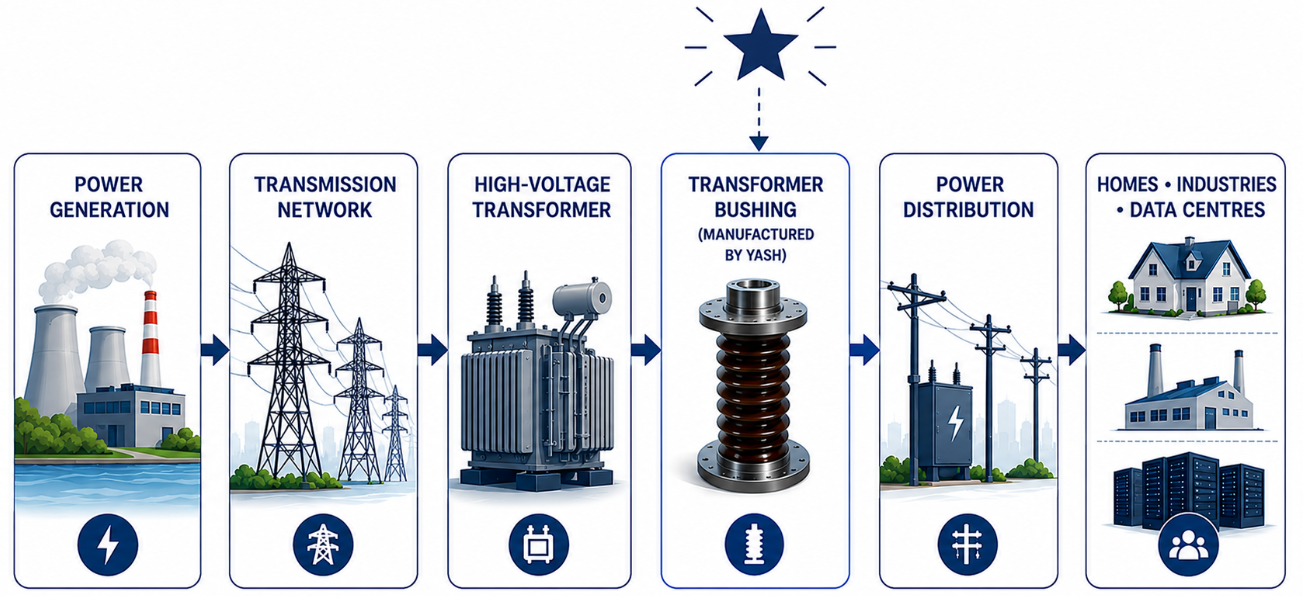
When people think about the power industry, they usually think of power plants or transformers. However, a small component inside every transformer is equally important. It is called a transformer bushing.
Yash Highvoltage operates in this niche segment. The company manufactures condenser-graded high-voltage and high-current transformer bushings. These products serve the power transmission and generation industry. Since its incorporation in 2002, Yash has supplied more than 45,000 transformer bushings worldwide. Today, it is one of the few independent transformer bushing manufacturers globally and the only independent manufacturer in India.
Unlike transformer manufacturers, Yash does not build complete transformers. Instead, it manufactures one of their most critical components. A transformer bushing creates a safe and insulated path for electricity to enter and exit the transformer. Without it, electricity cannot safely pass through the transformer's metal body. As a result, the transformer cannot operate reliably.
This places Yash in a highly specialized part of the power equipment value chain. Every high-voltage transformer requires multiple bushings. According to the company, there is no substitute for this component. Demand for bushings therefore grows with new transformers. As power grids expand, utilities install more transformers. That directly creates demand for Yash's products.
Rather than generating electricity or manufacturing complete transformers, Yash earns its revenue by supplying these mission-critical components to transformer manufacturers, power utilities, and international customers. Understanding the role of a transformer bushing is the first step to understanding Yash Highvoltage's business model.
What Is a Transformer Bushing?
A transformer bushing is a specialized electrical insulation component. It creates a safe path for electricity to enter and exit a transformer.
At first glance, a bushing looks like a simple porcelain or polymer cylinder. In reality, it is a highly engineered component designed to handle extremely high voltages and currents.
To understand its importance, imagine a high-voltage cable carrying 220 kV, 400 kV, or even 765 kV electricity. This cable must pass through the transformer's grounded metal tank to reach the windings inside. If the conductor touches the metal body directly, it can cause a short circuit, damage the transformer, and even lead to catastrophic failure.
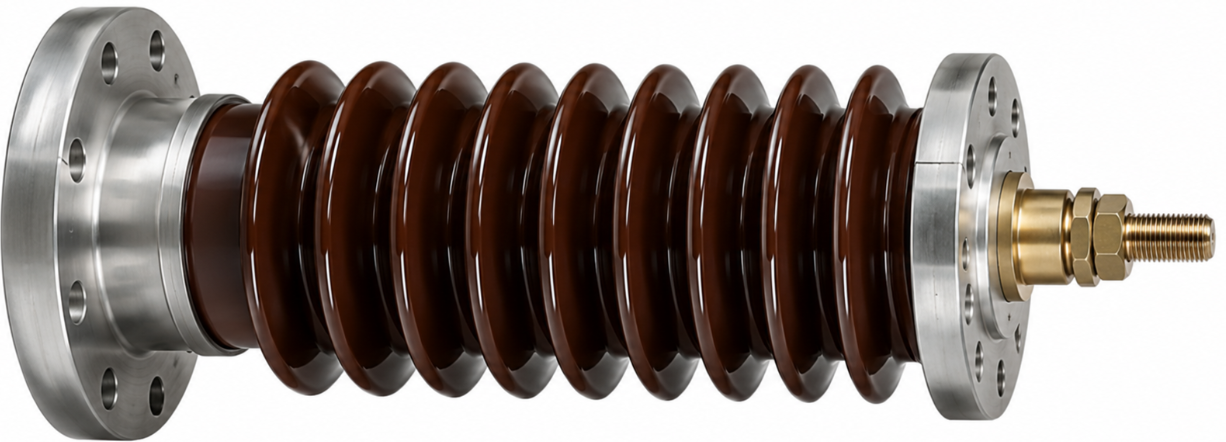
A transformer bushing prevents this. It electrically insulates the live conductor from the grounded transformer body while allowing electricity to flow safely through it. In simple terms, it acts as a high-voltage gateway between the outside power network and the transformer's internal electrical system.
Because every power transformer needs multiple bushings, they are an essential part of the power transmission network. According to Yash Highvoltage, there is no substitute for transformer bushings, making them an indispensable component in every high-voltage transformer.
Why Are Transformer Bushings So Important?
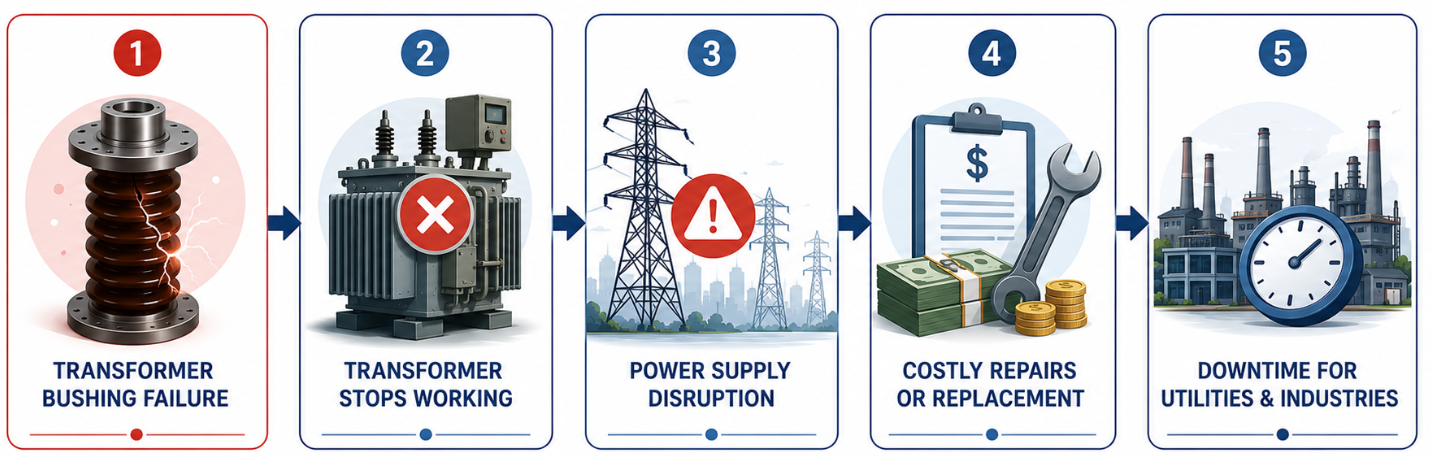
A transformer bushing may look like a small component, but it performs a critical function. Its failure can bring an entire transformer out of service.
Power transformers operate under extreme conditions. They handle very high voltages, heavy electrical loads, lightning surges, heat, pollution, and moisture. The bushing must continue to insulate the live conductor under all these conditions. Even a small insulation failure can damage the transformer and interrupt power supply.
A failed transformer is expensive to repair or replace. It can also disrupt electricity transmission, delay industrial operations, and increase maintenance costs. For utilities and transformer manufacturers, reliability is therefore more important than the cost of the bushing itself.
This is one reason why customers prefer proven suppliers with a long operating history. According to Yash Highvoltage, transformer bushings are mission-critical components with no substitute, making quality, testing, and long-term performance essential factors during supplier selection.
Since a single transformer usually requires multiple bushings, demand for these components grows alongside transformer installations. Every new transmission project, substation expansion, or transformer replacement creates fresh demand for bushings.
Yash Highvoltage's Product Portfolio
Yash Highvoltage manufactures a range of high-voltage and high-current transformer bushings used in power generation, transmission, and distribution networks. Each product is designed for specific voltage levels, current ratings, and operating conditions. This enables the company to serve transformer manufacturers, power utilities, EPC contractors, and industrial customers.
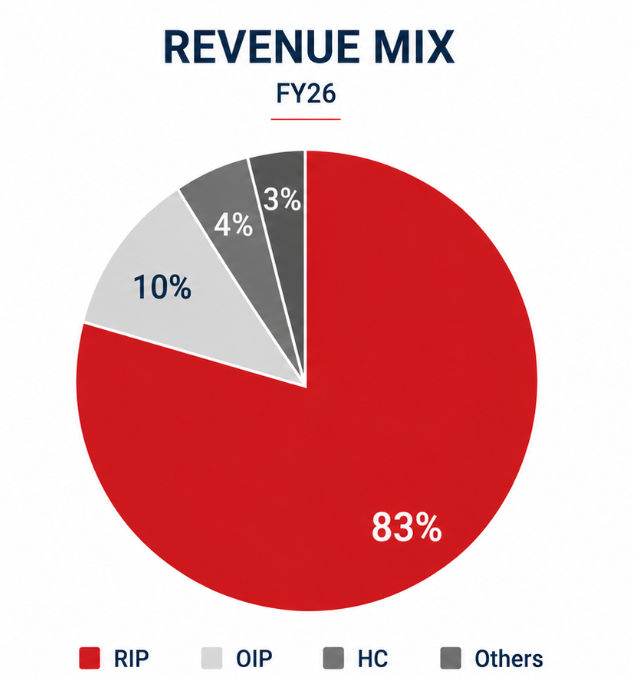
Although Yash offers multiple products and aftermarket services, its business is heavily concentrated in three core product categories. In FY26, RIP Bushings contributed 82% of revenue, followed by OIP Bushings at 10% and High Current Bushings at 5%. The remaining 3% came from other products and service-related activities.
1. Resin Impregnated Paper (RIP/RIS) Bushings
Revenue Contribution: 82% (FY26)
RIP/RIS Bushings are Yash Highvoltage's flagship products and the company's largest revenue driver. These bushings use resin-impregnated paper or resin-impregnated synthetic insulation, eliminating the need for insulating oil. As a result, they require less maintenance, reduce the risk of oil leakage, and offer higher operational reliability.
The company manufactures RIP/RIS bushings for a wide range of voltage classes and is expanding into 245 kV, 420 kV, and 550 kV products to address higher-value market segments. It is also setting up localized manufacturing of RIP/RIS cores, which were previously imported. This is expected to strengthen backward integration and support export growth.
RIP/RIS Bushings generate more than four-fifths of Yash's revenue. This makes them the company's primary growth engine and the most important product to track.
2. Oil Impregnated Paper (OIP) Bushings
Revenue Contribution: 10% (FY26)
OIP Bushings use oil-impregnated paper as the insulation medium. They are widely used in conventional power transformers and continue to serve a large installed base across transmission and distribution networks.
While this is a mature product category, it remains an important part of Yash's portfolio. The company continues to develop new OIP products for specialized applications, including STATCOM systems and international markets.
OIP Bushings provide stable demand from existing transformer installations. They also generate replacement and refurbishment opportunities throughout a transformer's operating life.
3. High Current Bushings
Revenue Contribution: 5% (FY26)
High Current Bushings are designed for applications that require extremely high current-carrying capacity while maintaining reliable electrical insulation. These products are used in specialized industrial equipment and high-capacity power systems where performance and reliability are critical.
Although this segment contributes a smaller share of revenue, it demonstrates Yash's engineering expertise in manufacturing technically demanding products.
High Current Bushings strengthen Yash's presence in niche applications and diversify its product portfolio beyond conventional transformer bushings.
4. Supporting Products & Services
Besides its three core product categories, Yash manufactures several specialized bushings, including Wall Bushings and Oil-to-Oil Bushings. The company also provides a range of aftermarket services such as:
- Repair and refurbishment
- Retrofitting and replacement
- Technical testing
- On-site and off-site diagnostics
These services help customers improve transformer reliability and extend equipment life. The company does not disclose individual revenue contributions for these activities. Collectively, they accounted for the remaining 3% of FY26 revenue under the Others category.
Manufacturing Capacity
Yash Highvoltage manufactures its products at an integrated facility in Vadodara, Gujarat. The facility houses in-house manufacturing, testing, and quality assurance infrastructure to ensure products meet global quality standards.
Following recent capacity expansion, the company's annual installed manufacturing capacity has increased to approximately 9,000 transformer bushings. In addition, Yash is setting up a new greenfield facility to manufacture RIP/RIS Bushings and RIP/RIS condenser cores, strengthening its backward integration capabilities and supporting future growth.
Manufacturing Capacity
| Product | Annual Installed Capacity |
|---|---|
| Transformer Bushings (All Categories) | ~9,000 Units |
FY26 Product Mix
| Product Category | FY26 Revenue Share |
|---|---|
| RIP/RIS Bushings | 82% |
| OIP Bushings | 10% |
| High Current Bushings | 5% |
| Others (Wall Bushings, Oil-to-Oil Bushings & Services) | 3% |
Key Insight
At first glance, Yash appears to have a diversified product portfolio. However, the business is highly concentrated around RIP/RIS Bushings, which contributed 82% of FY26 revenue. This reflects the industry's growing preference for advanced dry-type insulation technology.
The company is further strengthening this segment by expanding into 245 kV, 420 kV, and 550 kV RIP/RIS Bushings, while also localizing RIP/RIS condenser core manufacturing. These initiatives are expected to reduce import dependence, improve value addition, and support long-term growth in both domestic and export markets.
Customer Base
1. Transformer Manufacturers (OEMs)
Transformer manufacturers are Yash's largest customer group. These companies purchase bushings and integrate them into new transformers before supplying the finished equipment to utilities and industrial customers.
As investments in transmission infrastructure increase, transformer manufacturers receive more orders. This directly increases the demand for transformer bushings.
2. Power Utilities
Power utilities purchase bushings for replacement, refurbishment, and maintenance of transformers already operating in the power grid.
Unlike new transformer sales, this demand is recurring. Bushings require periodic replacement during a transformer's operating life. This creates a steady aftermarket opportunity for the company.
The company is an approved vendor for several central and state power utilities, allowing it to participate in replacement and maintenance projects across India.
3. Export Customers
Yash also exports transformer bushings to customers across multiple international markets.
According to the latest investor presentation, the company has supplied products to more than 25 countries, including the United States, Italy, Australia, South Korea, Brazil, Spain, Saudi Arabia, Israel, Bangladesh, Nepal, Oman, and Tanzania.
To strengthen its international presence, Yash has also established overseas subsidiaries and distribution channels, supporting its long-term export strategy.
Revenue Mix
Although Yash exports to more than 25 countries, its business remains predominantly domestic.
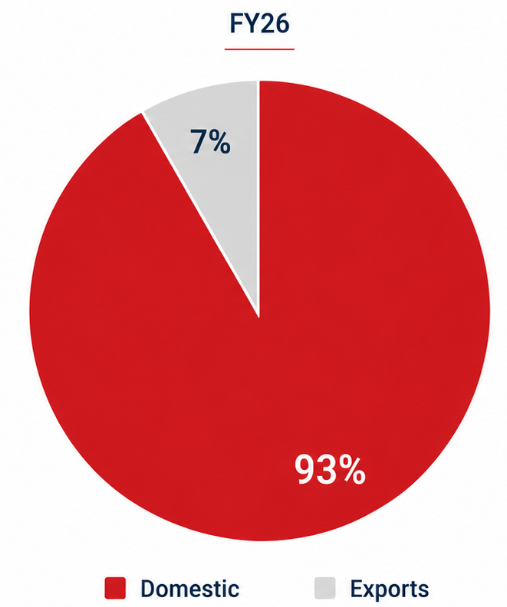
The company continues to focus on expanding exports through higher-voltage RIP/RIS Bushings, localized core manufacturing, and overseas subsidiaries. However, the domestic market remains its primary revenue source.
Conclusion
Yash Highvoltage operates in a highly specialized niche of the power equipment industry. Instead of manufacturing transformers, it supplies transformer bushings—a mission-critical component that ensures the safe and reliable operation of high-voltage transformers. The company's business is driven by RIP/RIS Bushings, which contribute 82% of FY26 revenue, positioning it to benefit from the industry's gradual shift toward advanced insulation technology.
Looking ahead, the company's growth will depend on its ability to scale production, commercialize higher-voltage products, expand exports, and execute its backward integration strategy. At the same time, investors should monitor customer concentration, execution of expansion projects, and capacity utilization. If management executes well, Yash is well positioned to benefit from India's long-term investments in power transmission and grid modernization.