Drones and Anti-Drone Warfare: The Growth of Paras Aerospace
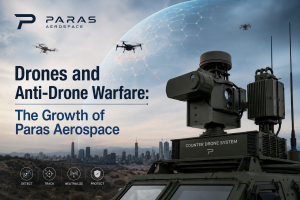
The global defence landscape is undergoing a structural transition where unmanned systems are no longer auxiliary assets but central battlefield infrastructure. Drones now operate across intelligence, surveillance, precision targeting, logistics, and electronic warfare layers, while parallel investment in counter-drone systems has created an entirely new defensive market.
Within India’s defence manufacturing ecosystem, Paras Defence and Space Technologies is positioning itself not as a pure drone manufacturer, but as a vertically embedded systems participant across UAV subsystems, payload technologies, and counter-UAV infrastructure. The real story, however, is not strategic intent, it is execution backed by order visibility, global partnerships, and a sharply defined niche within the defence value chain.
FY26 Reality Check
The macro narrative around drones suggests exponential growth, but defence manufacturing operates on a different cadence- long procurement cycles, staggered delivery schedules, and concentrated quarterly execution risk.
As of FY26, Paras Defence reported revenue of ₹476.57 crore, up 30.69% YoY, reflecting sustained demand across its defence electronics and optics businesses.
However, the structure of defence execution introduces a critical nuance: revenue realization is heavily back-ended, with a disproportionate share of deliveries typically occurring in the final quarter. This creates volatility in quarterly performance, even when underlying demand remains stable. In other words, the drone opportunity is structurally strong, but financially uneven in realization.
From Capability Building to Tech Transfer
Where most domestic defence players remain at subsystem or assembly level, Paras Defence is actively using global collaborations to compress technology gaps and accelerate capability acquisition.
Key partnerships include:
- HevenDrones Joint Venture
Focused on introducing hydrogen-fueled, long-endurance UAV platforms capable of 12+ hours flight time, significantly expanding India’s high-persistence surveillance and logistics drone capability. This shifts the focus from short-range tactical drones to strategic endurance platforms.
- MicroCon Vision Collaboration
Focused on advanced EO/IR payloads and surveillance imaging systems, directly addressing one of the highest-margin segments in UAV architecture, mission-critical sensing.
- CERBAIR Tie-up
Focused on counter-UAV systems, including RF detection and neutralization technologies that form the backbone of modern anti-drone defence grids.
These alliances are strategically important because they move Paras from a “component supplier” narrative into an IDDM-aligned technology integrator, where indigenous manufacturing is paired with imported high-end defence IP. This reduces R&D latency while improving entry into high-value defence procurement programs.
Competitive Architecture: Where Paras Actually Competes
The UAV ecosystem is best understood as a layered value stack rather than a single competitive market. Paras Defence’s positioning becomes clearer when mapped against peers:
UAV & Counter-UAV Value Chain Mapping
| Layer | Market Function | Key Indian Competitors | Paras Defence Positioning |
| Airframes & Flight Systems | Drone bodies, propulsion, flight control systems | ideaForge Technology, Zen Technologies | High-endurance hydrogen UAV platforms via HevenDrones JV |
| Mission Payloads | EO/IR cameras, thermal imaging, targeting optics | Bharat Electronics Limited, Data Patterns | High-margin infrared optics and precision imaging systems |
| Detection & Neutralization | RF jamming, radar detection, anti-drone weapons | Zen Technologies, Adani Defence | Integrated counter-UAV systems anchored by CERBAIR CHIMERA 200 export validation |
Strategic Positioning: The Shift from Optics to System Engineering
The most important structural insight in Paras Defence’s evolution is not its participation in drones, it is its transition in revenue logic.
Historically, precision optics drove most of the company’s business. However, FY26 segment behavior shows a clear pivot: systems engineering is now the dominant growth engine, while optics has become a stable but slower-growth legacy base.
This shift matters because systems engineering carries:
- Higher integration complexity
- Stronger defence procurement defensibility
- Greater multi-year contract visibility
- Better positioning within integrated UAV and counter-UAV tenders
However, it also increases dependency on large integrator-led programs, meaning Paras must continuously deepen its role within system architectures to avoid commoditization pressure.
India’s Defence Budget Transmission
Many analysts overstate India’s UAV and counter-UAV opportunity by linking it directly to rising defence budgets. In practice, capital allocation moves through a slow, multi-stage procurement system involving technical trials, inter-service approvals, and L1-based awards, creating a structural lag between budget intent and revenue realization.
Even with rising allocations toward modernisation and unmanned systems, conversion into executable contracts remains staggered and uneven. For Paras Defence and Space Technologies, the ₹900-₹950 crore order book should therefore be read as phased execution visibility rather than near-term revenue certainty.
Defence demand is not weak, it is absorption-constrained, and that gap defines execution volatility more than demand risk.
Technology Bottleneck Layer
Despite strong narrative momentum around indigenisation, India’s UAV ecosystem remains partially constrained by imported high-end subsystems that define system performance.
Three bottlenecks stand out: high-resolution thermal and infrared imaging sensors critical for night surveillance; AI-enabled autonomous flight and swarm coordination software; and electronic warfare-grade RF and signal processing modules used in both drone resilience and counter-drone systems.
This structural gap explains Paras Defence’s positioning. Rather than pursuing full-stack UAV autonomy, Paras Defence and Space Technologies is concentrated in precision optics, electro-optical systems, and integration-led partnerships, where domestic capability aligns more closely with global technology availability. Its role is therefore less platform-builder and more system enabler bridging imported subsystems with indigenous defence architectures.
Program Dependency Risk
Despite strong order visibility, defence manufacturing carries an underappreciated structural risk: program concentration. Revenue is typically anchored to a limited set of large contracts rather than a diversified, recurring commercial base.
For Paras Defence and Space Technologies, this creates inherent execution volatility. UAV and counter-UAV deployments often occur in batch procurement cycles, meaning delays in trials, staggered rollouts, or phased approvals can materially shift quarterly revenue without altering long-term demand fundamentals.
The result is a dual structure- strong strategic visibility through a growing order book, but non-linear revenue conversion driven by program timing rather than demand strength. In defence systems, order books signal relevance, not predictability.
Conclusion
The UAV and counter-UAV market is shifting from standalone platforms to integrated defence systems, where value is increasingly concentrated in sensor-driven, AI-enabled architectures rather than basic airframes.
Within this transition, Paras Defence and Space Technologies is moving from an optics-led supplier toward a systems engineering player, supported by FY26 growth in Defence Engineering and a ₹900–₹950 crore order book. Global partnerships further reinforce this shift toward integrated capabilities.
However, execution remains uneven due to back-ended defence cycles, partial technology dependence, and program-linked revenue concentration. This makes the growth story structurally strong but financially non-linear.
The key inflection ahead is integration depth, whether Paras can move from subsystem participation to mission-critical system ownership in India’s evolving drone warfare stack.