NMDC’s New Dedicated Rare Earths & Critical Minerals Subsidiary – Unlocking the Future
NMDC has long been viewed as a simple iron ore proxy- a low-cost miner whose earnings rise and fall with India’s steel cycle. That identity is now beginning to change.
Its entry into rare earths and critical minerals signals a broader repositioning from a commodity-focused producer to a participant in India’s long-term resource security strategy.
These minerals support the infrastructure of the next industrial era, including EVs, renewables, and advanced electronics.
While iron ore continues to fund the business, NMDC is gradually directing capital toward higher-risk, longer-duration mineral opportunities that the market has yet to price in.
Strategic Context: Why Critical Minerals Matter Now?
Global growth is entering a structurally mineral-intensive phase driven by electrification, decarbonisation, and digital infrastructure expansion.
Technologies such as electric vehicles, wind turbines, grid-scale storage systems, and semiconductor ecosystems rely heavily on critical minerals. These include rare earth elements, lithium, cobalt, nickel, and graphite.
The defining feature of this supply chain is extreme concentration. China dominates a significant share of global refining and processing capacity, making upstream availability only part of the challenge. The real bottleneck lies in midstream and downstream conversion.
For India, this creates a structural asymmetry. Demand for critical minerals is expected to rise sharply, yet domestic control over mining, refining, and processing infrastructure remains limited.NMDC’s entry therefore reflects more than industrial expansion. It represents an attempt to strengthen India’s upstream resource security.
Corporate Shift: From Iron Ore Monopoly to Multi-Mineral Platform
NMDC’s diversification has moved beyond intent and into execution.
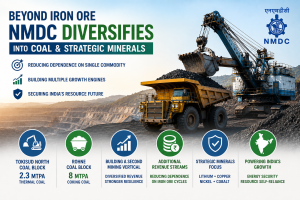
Alongside its core iron ore operations, the company has begun coal production through the Tokisud mine in Jharkhand. It is also developing the Rohne coal block, which is expected to commence operations in FY27.
Internationally, NMDC is repositioning its Australian operations under Kovaree from active gold production toward near-mine exploration. The longer-term objective is to establish downstream processing capability once resource visibility improves.
This marks NMDC’s first meaningful expansion beyond iron ore in decades. The shift signals a transition from a single-commodity producer to a multi-mineral portfolio operator.
Domestic Resource Strategy: Partnership-Led Expansion Model
A key structural pillar of NMDC’s growth strategy is the expansion of iron ore capacity through joint ventures and state-level collaboration. The NMDC - CMDC joint venture at Bailadila represents a major milestone, with Deposit 4 expected to ramp up commercial production from FY27 and achieve peak capacity of around 7 MTPA over time.
Deposit 13 is also scheduled for commissioning in FY27, subject to regulatory clearances, adding incremental near-term volumes.
This dual-deposit expansion strengthens NMDC’s core iron ore base at a time when diversification into new minerals is also accelerating. The structure highlights a balanced approach where traditional mining assets continue to scale while new mineral categories are simultaneously developed.
International Strategy: Overseas Critical Mineral Asset Scouting
NMDC is increasingly positioning itself in overseas mineral markets through structured capital allocation and early-stage asset negotiations. Management has indicated that ₹2,000-₹3,000 crore has been earmarked in FY27 specifically for overseas acquisitions, reflecting a clear shift toward global resource positioning.
Multiple overseas asset discussions are currently in advanced stages and are expected to be concluded within FY27. These investments are focused on securing exposure to critical and strategic minerals across Africa, Australia, and other resource-rich geographies.
The Kovaree gold operation in Australia is also being strategically repositioned. Instead of prioritised production, the focus has shifted toward near-mine exploration to identify additional reserves, with downstream processing feasibility under evaluation for the longer term.
Financial & Capital Allocation
NMDC has entered a sharply higher capital deployment phase, fully funded through internal accruals with no incremental debt.
FY26 capex stood at ₹3,300 crore (excluding land acquisition), marking a record level of investment. For FY27, capex guidance rises significantly to ₹5,000-₹6,000 crore, with ₹2,000-₹3,000 crore specifically allocated toward overseas acquisitions, signalling a clear shift toward global diversification.
Management has also outlined a medium-term capex trajectory of ₹7,000-₹10,000 crore annually for FY28-FY29, implying a total investment envelope of ₹30,000-₹50,000 crore over three years. Additionally, ₹3,000 crore has been earmarked for the Vizag blending yard project aimed at premium iron ore output.
On the operating side, NMDC achieved record production of 53 million tonnes in FY26 and guided 60 million tonnes for FY27, including initial contributions from the NMDC - CMDC JV. Long-term production guidance remains at 100-110 million tonnes by 2030.
FY26 revenue stood at ₹31,554 crore, with standalone EBITDA margins at 42%. Consolidated margins moderated to 33% due to a one-time low-margin steel trading arrangement linked to NMDC Steel Limited, which management has clarified as temporary and expected to normalize in FY27.
Receivables from NMDC Steel have declined from ₹2,500 crore to ₹1,800 crore, with structured monthly recovery of ~₹100 crore underway. Management has also confirmed that the critical minerals subsidiary is operational and that multiple overseas acquisitions are in advanced stages, expected to close within FY27.
Execution Bottlenecks & Structural Risks
Despite strategic clarity, execution remains the most critical constraint in NMDC’s critical minerals expansion. Domestic exploration is still in an early stage of maturity, and geological uncertainty remains high, particularly in rare earth and lithium segments.
Even if upstream resources are identified, India’s midstream and downstream ecosystem remains underdeveloped. Without refining and processing capacity, value capture will remain limited, and dependence on external processing hubs may persist.
On the global front, China’s entrenched dominance across refining and supply chain integration creates a structural barrier that cannot be solved through mining alone. This limits the standalone value of upstream asset ownership unless integrated supply chains are developed.
Overseas expansion introduces additional geopolitical and capital allocation risks, where asset security, regulatory frameworks, and long-term monetisation pathways may vary significantly across jurisdictions.
Valuation Implications: How the Market May Re-rate NMDC?
Currently, NMDC is valued almost entirely as a cyclical iron ore proxy. This means the market assigns valuation weight primarily to near-term earnings derived from iron ore operations, while attributing minimal value to critical minerals initiatives.
At this stage, the critical minerals strategy remains largely unpriced as embedded optionality rather than a contributing earnings stream. This is typical in early-stage strategic transitions where execution visibility remains limited.
For meaningful re-rating to occur, three conditions need to emerge.
- First, there must be visible capital allocation toward critical minerals without compromising core iron ore stability.
- Second, joint ventures and partnerships must transition from memorandum-level agreements to operational or near-production assets.
- Third, early but tangible revenue contributions from non-iron ore minerals must begin to appear, signalling that the strategy is moving from intent to execution.
If these conditions are met, NMDC could evolve into a dual-valuation construct where stable iron ore cash flows form the base layer, while critical minerals contribute a long-duration strategic premium.
Strategic Roadmap (2026-2035)
- Phase 1: Foundation Building (2026–2028)
Focus on exploration, geological surveys, and identification of viable rare earth and critical mineral blocks in India. Expansion of initial partnerships with state entities and setting up of the dedicated subsidiary structure.
- Phase 2: Domestic Execution & JV Conversion (2027–2030)
Transition from MoUs to operational joint ventures, especially with state mining corporations like GMDC. Pilot projects begin, with early-stage extraction and testing of economic viability.
- Phase 3: Overseas Asset Positioning (2028–2032)
Acquisition or strategic stakes in mineral-rich geographies such as Africa, Australia, and Latin America. Focus on securing long-term supply access and building optionality through early-stage global assets.
- Phase 4: Commercial Scaling (2030–2035)
Movement toward scalable production, integration into global supply chains, and potential linkage with India’s EV and renewable energy ecosystem. Early revenue contribution from non-iron ore minerals begins to materialize.
- Phase 5: Strategic Integration (Beyond 2035)
NMDC evolves into a multi-mineral strategic resource platform with diversified geographic exposure and partial integration into global critical mineral value chains.
Conclusion
NMDC’s entry into rare earths and critical minerals represents a structural redefinition of its role within India’s industrial ecosystem. The company is transitioning from a cyclical iron ore producer into a strategic resource platform, supported by strong internal cash flows and aligned with national supply chain objectives.
However, the transformation remains early-stage and execution dependent. In the foreseeable future, NMDC will continue to be primarily driven by iron ore earnings, while critical minerals function as a long-duration strategic optionality portfolio.
If successfully executed, this shift has the potential to reposition NMDC as a foundational node in India’s critical resource security architecture, bridging domestic industrial ambition with global supply chain realities.