How Does SIKA Interplant Make Money? A Deep Dive into Its Aerospace & Defence Business
SIKA Interplant Systems Ltd is an engineering-driven company serving the aerospace, defence & space (A&D) and automotive sectors in India.
The company operates across four main businesses -
- Engineering Services
- Aerospace Products
- Systems Integration
- MRO
In other words, SIKA provides the specialised design, parts, and integration work that aircraft OEMs and defence organisations need. This article explains exactly how SIKA’s business model works: its services, products, customers, growth drivers, risks, and what metrics matter.
The company’s annual reports (FY2025, FY2024, FY2023) and investor materials make clear that SIKA offers “design, development, manufacturing, assembly, testing, certification, supply and integration of systems” for aerospace projects. It holds key certifications (AS9100, CEMILAC, DGAQA) and a government defence license, enabling it to participate in military contracts. As India’s defence indigenisation gathers pace and “Make in India” expands, SIKA’s role as a domestic technology partner is poised to grow. Investors and readers should note that revenue growth alone doesn’t tell the whole story, one must watch revenue mix (services vs products vs MRO), order backlog, and margin trends, as these indicate movement up the value chain.
What Exactly does SIKA Interplant do?
SIKA Interplant is not a manufacturer of aircraft. Instead, think of it as a specialist engineering and technology supplier for aerospace and defence. According to the company’s management discussion, it is “actively involved in four main areas”:
- Engineering (Design & Development): Providing advanced design, structural and systems engineering support.
- Manufacturing, Assembly & Testing: Building and testing aerospace components and assemblies.
- Projects & Systems Integration: Combining multiple parts and technologies into complete subsystems or solutions.
- Maintenance, Repair & Overhaul (MRO): Servicing and upgrading equipment throughout its life.
Its core focus is on the Aerospace, Defence & Space sector (about 80–90% of revenues) and secondarily on Automotive capital equipment. SIKA has in-house capabilities and international partnerships to handle complex aerospace projects. For example, it can undertake end-to-end work on defence programs – designing and developing parts, fabricating them, assembling systems, conducting certification tests, and integrating the final equipment. Its facilities include dedicated workshops for helicopter rescue hoists (in partnership with OEM Breeze-Eastern) and landing gear/MRO units.
In short, SIKA sits in the middle of the aerospace supply process. It does not build jets or engines, but it helps build and maintain them.
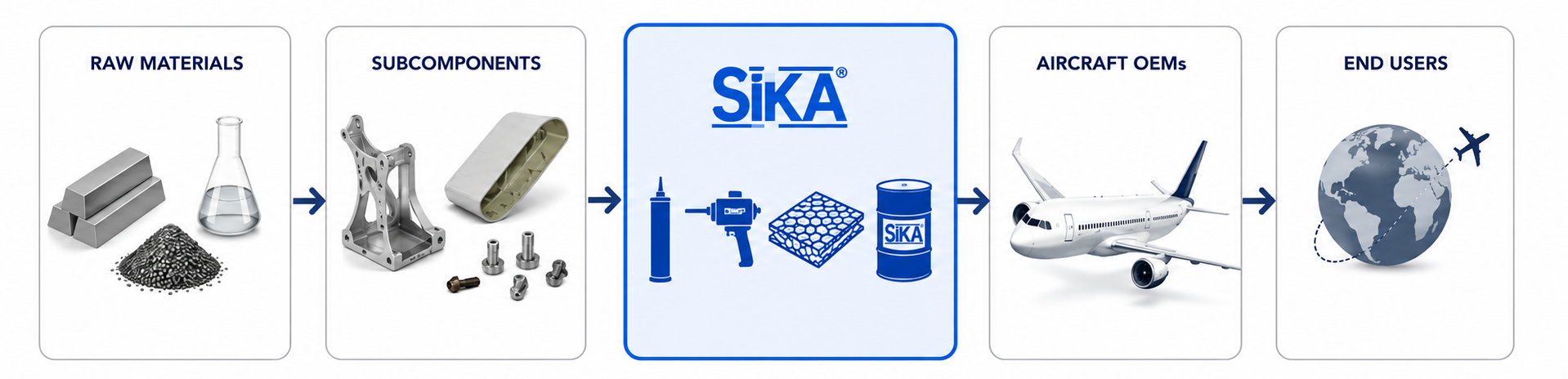
The Four Businesses that Generate Revenue for SIKA
SIKA’s revenue comes from four interconnected activities. We break these down to see how each contributes to revenue.
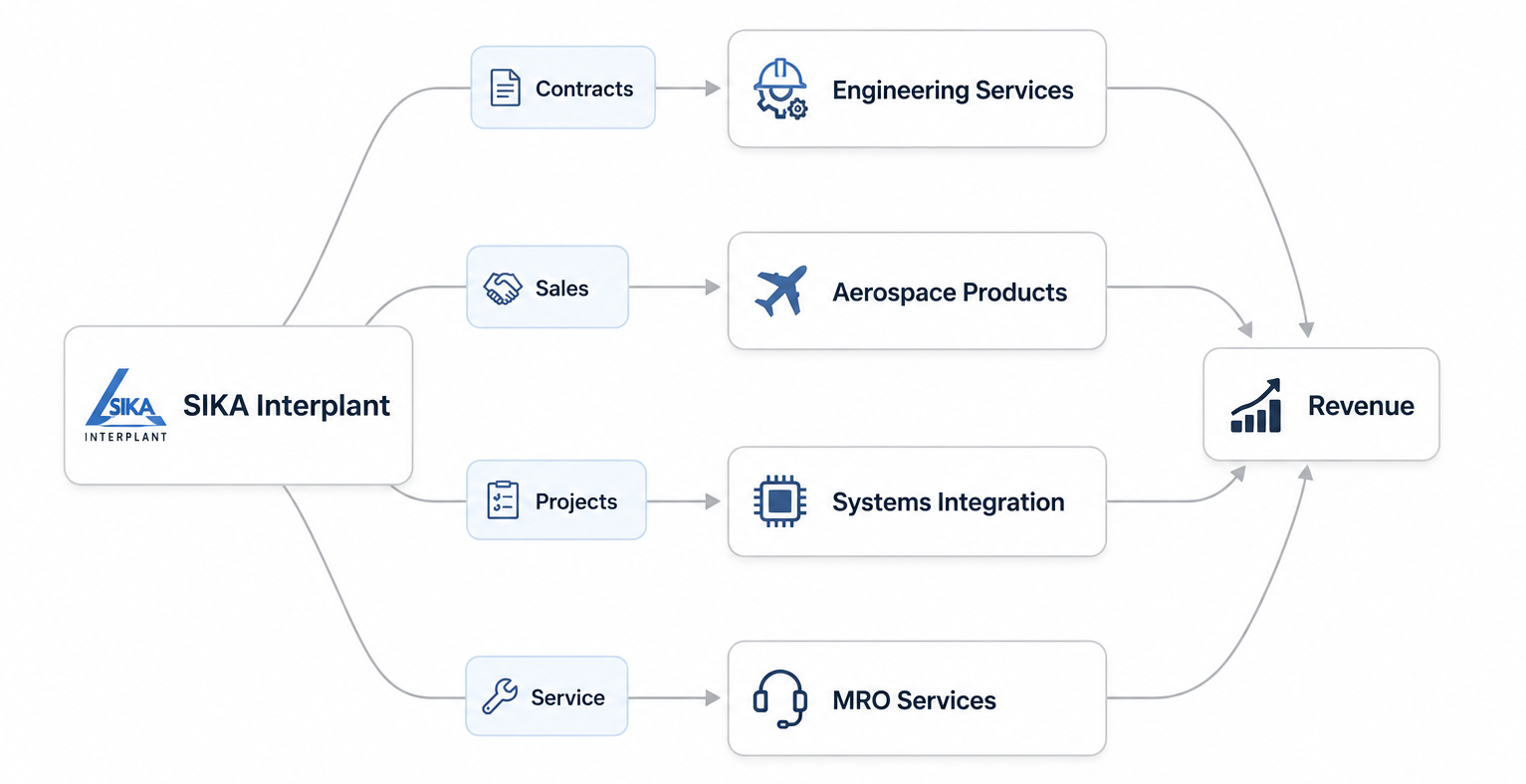
1. Engineering Services
Engineering Services form the foundation of SIKA's business. The company provides technical expertise to aerospace and defence customers across the product development lifecycle, from initial design to certification and deployment.
Key services include:
- Design Engineering – Developing detailed designs for aircraft structures, mechanical systems, aerospace equipment, and defence components based on customer requirements.
- Structural Analysis – Assessing how components perform under real-world operating conditions such as vibration, pressure, temperature, and mechanical stress.
- Manufacturing Engineering – Designing production processes, improving manufacturing efficiency, and ensuring components can be produced reliably at scale.
- Certification Support – Assisting customers with testing, compliance documentation, and regulatory approvals required before aerospace and defence systems can be deployed.
- Technical Documentation – Preparing engineering drawings, assembly instructions, maintenance manuals, specifications, and other critical technical records.
Revenue Model
SIKA typically works on project-based contracts or long-term engineering engagements. Customers outsource specific engineering tasks, and the company earns revenue by providing technical expertise and delivering project milestones.
Engineering services generate recurring business opportunities and help SIKA build deep relationships with aerospace and defence customers. These engagements can also position the company to participate in larger manufacturing, integration, and support contracts in the future.
2. Aerospace Products
Beyond engineering services, SIKA also develops and supplies specialized aerospace and defence products. This allows the company to participate not only in the design phase but also in the manufacturing and supply chain of aerospace programs.
Key product categories include:
- Search & Rescue Systems – Rescue hoists and winches used on helicopters for emergency evacuation, disaster relief, and rescue operations.
- Air Ambulance Modules – Specialized medical cabin systems that convert aircraft or helicopters into airborne emergency healthcare units.
- Landing Gear & Hydraulic Components – Critical parts used in aircraft landing systems and hydraulic mechanisms that support safe aircraft operations.
- Handling Equipment – Cargo hooks, winches, and sonar-handling systems used in military, naval, and helicopter applications.
- Interconnect Solutions – Wiring harnesses, cable assemblies, and electrical integration systems that connect various aircraft subsystems.
- Module Integration – Assembly and integration of electronic and avionics modules into complete functional systems ready for deployment.
Revenue Model
Unlike engineering projects that generate revenue through service contracts, aerospace products generate revenue through product sales. Customers place orders for equipment, assemblies, or systems, and SIKA earns revenue on each unit supplied.
In addition, successful products can create recurring opportunities through replacement parts, upgrades, repairs, and long-term support contracts.
Products can be more scalable than engineering services. Once a product is developed and qualified, it can potentially be sold to multiple customers without repeating the entire development effort. This creates opportunities for repeat orders, higher value addition, and stronger long-term revenue growth.
For this reason, increasing product sales could become an important driver of SIKA's future growth and profitability.
3. Systems Integration
This is one of SIKA's most important capabilities. Rather than supplying individual components, the company helps customers deploy complete, ready-to-use aerospace and defence systems.
Modern aircraft and defence platforms contain numerous subsystems, including electronics, hydraulics, mechanical structures, software, and communication equipment. Managing multiple vendors can be complex, so customers often prefer a single company that can integrate everything into one functional system.
Key activities include:
- System Design & Engineering – Designing how various components and subsystems will work together within the final platform.
- Procurement & Assembly – Sourcing required components and assembling them into a complete operational system.
- Testing & Validation – Conducting performance, safety, and reliability testing to ensure the integrated system functions as intended.
- Certification Support – Assisting with regulatory approvals and certifications required before deployment.
Revenue Model
System integration projects are typically larger and higher-value than standalone engineering assignments. Revenue is earned through project milestones such as design completion, prototype development, testing, certification, and final delivery.
System integration moves SIKA higher up the value chain. Instead of supplying a single component, the company becomes responsible for delivering a complete solution. This can lead to larger contract values, longer project durations, and deeper customer relationships.
Once a customer adopts an integrated system built by SIKA, future upgrades, modifications, maintenance, and support work are also more likely to flow through the company, creating stronger long-term business opportunities.
4. Maintenance, Repair & Overhaul (MRO)
MRO is one of SIKA's less visible but potentially important business segments. Aerospace equipment requires regular maintenance, inspections, repairs, and upgrades throughout its operational life, creating demand long after the initial product sale.
SIKA operates an OEM-approved MRO facility for helicopter rescue hoists and provides maintenance support for specialized aerospace systems and equipment.
Key services include:
- Maintenance Services – Regular inspection and servicing to ensure equipment remains operational and compliant with safety standards.
- Repair & Overhaul – Restoring worn or damaged equipment to original performance specifications.
- Spare Parts Support – Supplying replacement components required during maintenance and repair activities.
- Upgrades & Refurbishment – Enhancing existing systems with newer technologies and performance improvements.
Revenue Model
MRO revenue is generated through maintenance contracts, overhaul projects, spare-part sales, and repair services. Unlike product sales, which may occur only once, MRO creates recurring revenue opportunities throughout the equipment's lifecycle.
MRO can provide a more stable revenue stream than new equipment sales because maintenance remains necessary regardless of whether customers are purchasing new systems. As SIKA's installed base of products grows, demand for servicing, repairs, and upgrades can also increase, creating long-term recurring business opportunities and supporting cash-flow stability.
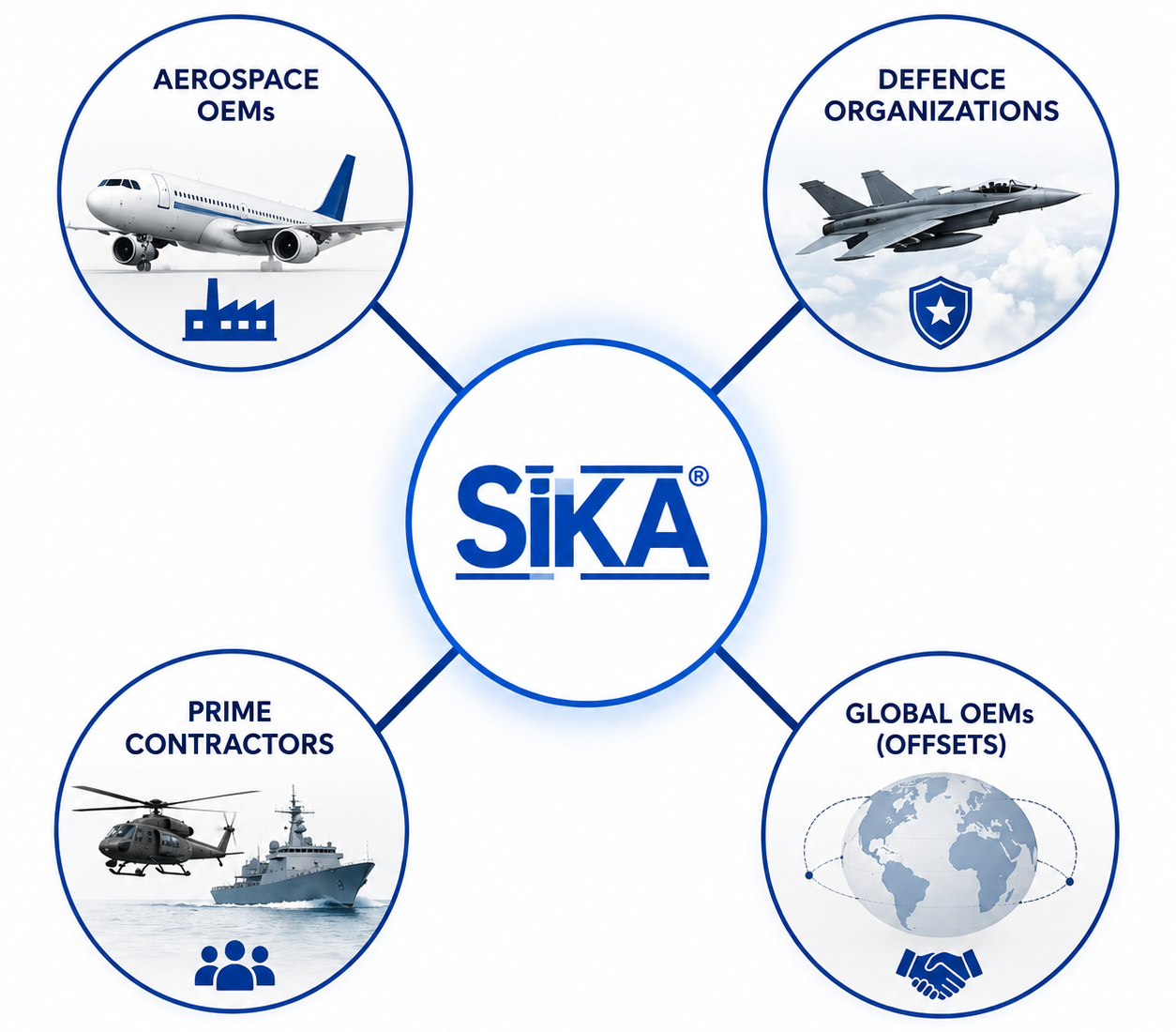
Who are SIKA’s Customers?
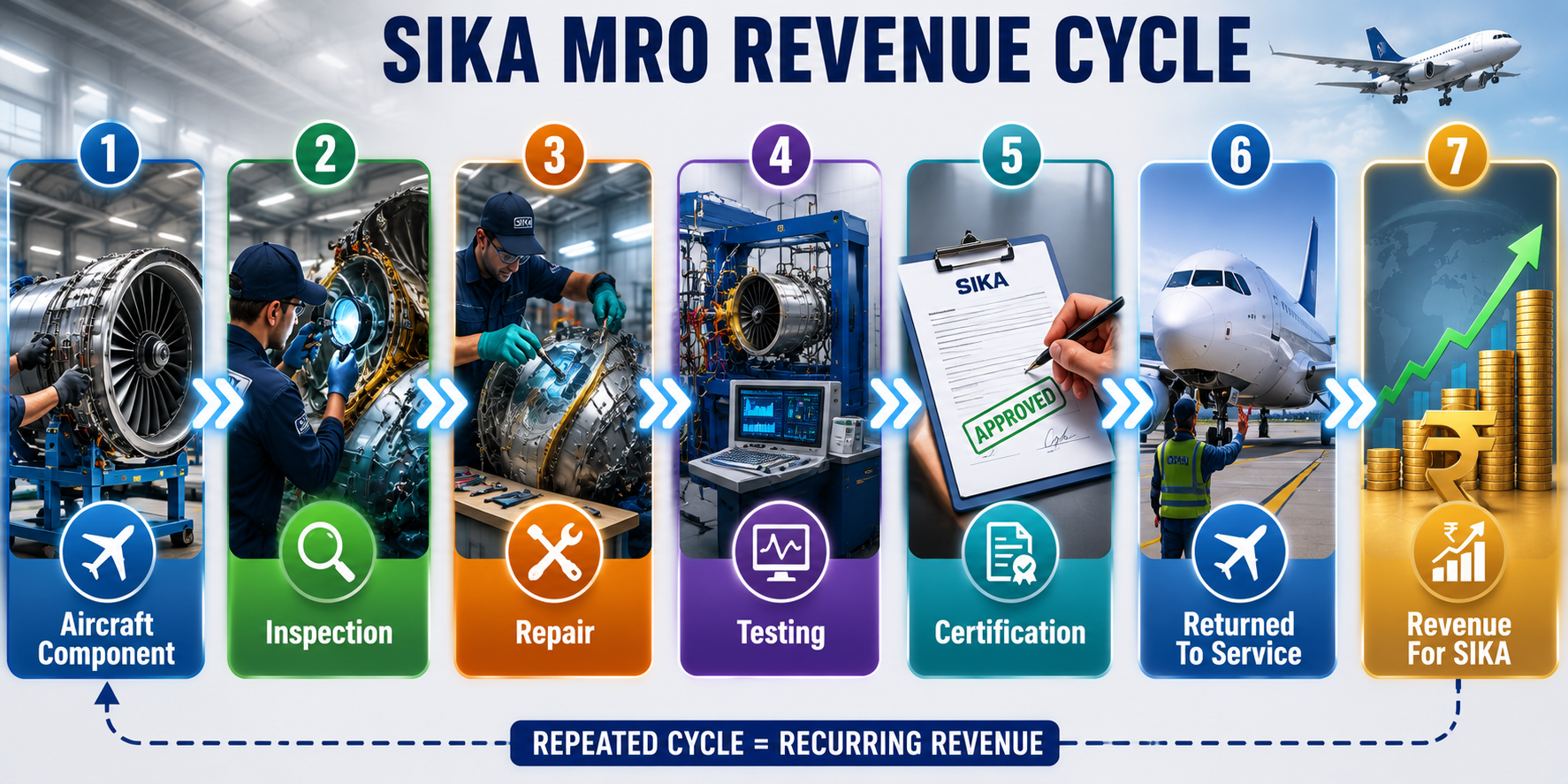
When a component requires maintenance, SIKA performs:
- Inspection
- Fault diagnosis
- Repair
- Testing
- Certification
After the repair is completed, the component is returned to service and SIKA earns revenue for the maintenance work performed.
The Collins Aerospace partnership highlights an important aspect of SIKA's business model.
SIKA is not manufacturing these Airbus components or designing them from scratch. Instead, it is providing specialized aerospace services that airlines and OEMs require after the component has entered service.
In simple terms:
- Collins Aerospace provides the product and repair know-how.
- SIKA provides the repair capability, engineers, testing infrastructure, and maintenance services.
- Airlines pay for keeping those components operational and airworthy.
This example shows how SIKA generates revenue by leveraging its technical expertise, certifications, and aerospace repair capabilities rather than solely through manufacturing products.
What Could Increase Demand for SIKA’s Services?
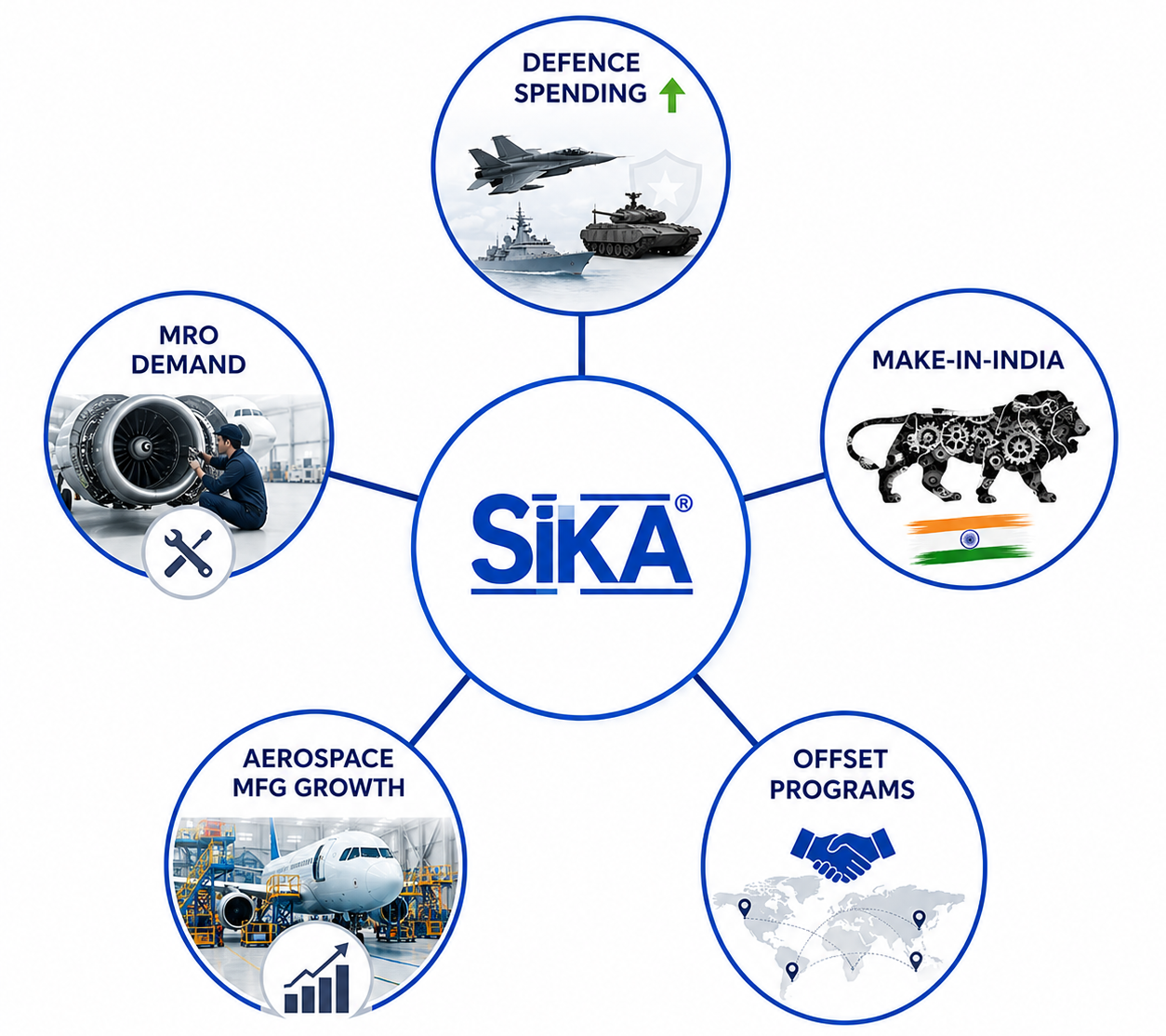
Looking ahead, several trends and policies in India could boost SIKA’s business:
- Defence Indigenization: The government’s push for “Aatmanirbhar Bharat” in defence means more projects where domestic suppliers must be used. SIKA, with its licenses and engineering know-how, stands to gain as the country substitutes imports with local production.
- Rising Defence Spending: India’s defence budget continues to grow and prioritize modernization. The FY2025-26 outlook explicitly notes “continued increase in domestic defence spending” as a growth driver. As big-ticket projects (new aircraft, ships, weapons) materialize, SIKA can participate in multiple subcontracts.
- Offset Opportunities: Foreign OEMs buying equipment for India must invest in local industry. SIKA’s qualification as an “Indian Offset Partner” makes it eligible for such projects. AR commentary predicts “considerable” opportunity from outstanding offset obligations.
- Expanding Aerospace Manufacturing: With new factories (aircraft, helicopters, UAVs) coming up in India, there will be more work for specialist suppliers. SIKA’s recent facility expansions position it to serve these customers.
- Aftermarket & MRO Growth: As India’s fleet of aircraft and rotorcraft grows, so does need for MRO. SIKA’s investments in MRO infrastructure allow it to capture a share of this recurring market.
- Export Potential: Success in domestic programs and offsets could open export doors. International operators of platforms SIKA works on might seek local support, or SIKA could tie up with foreign partners for co-development (similar to other Indian SMEs).
Industry observers note that India’s big defence deals and modernization programs “provide significant opportunity” for SMEs and Indian companies. For example, several global OEMs have announced multi-billion-dollar projects in India in recent years (fighter jets, helicopters, missiles), all requiring supply chains that include firms like SIKA.
Business Risks and Considerations
No business is risk-free. For SIKA, key challenges include:
- Government Dependence: Much of SIKA’s revenue comes from defence projects that rely on government budgets and decisions. If defence spending is cut or projects delayed, SIKA’s revenue could be hit. (The company itself cautions that any MoD delays or shortfalls in defence outlays would impact its revenues.)
- Project Delays: Aerospace/defence programs are long and complex. Regulatory approvals (from CEMILAC/DGAQA, etc.) can take time. If projects slip schedules, SIKA’s sales get “uneven and skewed”.
- Concentration Risk: While SIKA has many products, a few large contracts can dominate sales in any year. Overexposure to one project or customer could be a concern.
- Competition & Pricing Pressure: As defence indigenization picks up, competition may rise. Additionally, being an SME, SIKA must contend with global suppliers (some now setting up in India for offsets). Margins can be squeezed if clients drive hard bargains.
- Technical Execution Risk: Integration projects carry execution complexity. If SIKA fails to deliver a mission-critical system on time, it could face penalties or reputational damage.
- Macroeconomic/FX Risk: The company mentions that international operations carry foreign exchange risk. Global economic slowdowns or currency volatility could affect costs or new export deals.
- Supply Chain: Many components used may be imported. Any disruption (e.g. chip shortages, geopolitics) could delay SIKA’s production.
SIKA tries to manage these by keeping low debt, focusing on long-term relationships, and maintaining essential certifications. However, investors should be aware that volatility in government defense planning is largely outside SIKA’s control.
Key Metrics for Investors to Watch
How can shareholders gauge SIKA’s progress? Beyond topline growth, watch these:
- Revenue Mix: Ideally, product and MRO revenue should grow faster than basic engineering fees. If disclosures are available, track the share of total revenue from Products/Systems vs pure Services. (SIKA currently reports as one segment, so analysts look for clues in MD&A and announcements.)
- Order Book / Backlog: New orders indicate future revenue. Although not publicly broken down, management often announces wins for systems projects or MRO contracts. Growing announcements suggest momentum.
- Exports & Offsets: The proportion of business tied to international OEMs or foreign collaborations. A rising share implies global competitiveness (and also exposure).
- Customer Diversification: Check if any single customer or program dominates revenue. Greater diversification (e.g., multiple armed forces, private aerospace companies, exports) reduces risk.
- Margins (EBITDA/PAT): Expanding margins could signal a shift toward higher-value products/systems. If SG&A remains controlled and gross margins improve, it may reflect a move up the value chain.
- R&D/Capex: Investments in new facilities (for MRO or manufacturing) show commitment to growth areas. The company’s spending on technology/plant gives hints about future capabilities.
- Working Capital Efficiency: SIKA is project-driven, so receivables and inventory levels matter. The FY2025 report notes improvements in receivables turnover, which freed up cash.
Conclusion
SIKA Interplant’s business model is that of a specialist engineering & aerospace supplier. It makes money by contracting its engineering expertise, selling niche aerospace products, integrating complex systems, and providing MRO services – all tailored to the defence and aerospace industries. The company’s strategy is to “move up the value chain” from pure services toward higher-margin products and systems integration.
For investors, the key is to look beyond headline revenue growth and examine the mix of business and its alignment with industry trends. With India expanding its aerospace capabilities and defence procurement, SIKA is well-positioned as a domestic supplier. However, the company’s fortunes closely track government budgets and project timelines. Understanding the aerospace projects in India and SIKA’s role in them is essential to assessing how the company makes money. In short, SIKA is not building planes – it’s empowering those who do, through engineering, products, and integration.