Kavach and Railway Modernization: How Technology is Transforming Indian Railways?
For decades, Indian Railways has been the backbone of the country’s transportation network. However, managing one of the world’s largest railway systems comes with challenges related to safety, efficiency, and capacity utilization.
To address these challenges, Indian Railways is increasingly adopting advanced technologies. Among these initiatives, Kavach has emerged as one of the most significant modernization projects, aimed at making train travel safer while accelerating the digital transformation of the railway network.
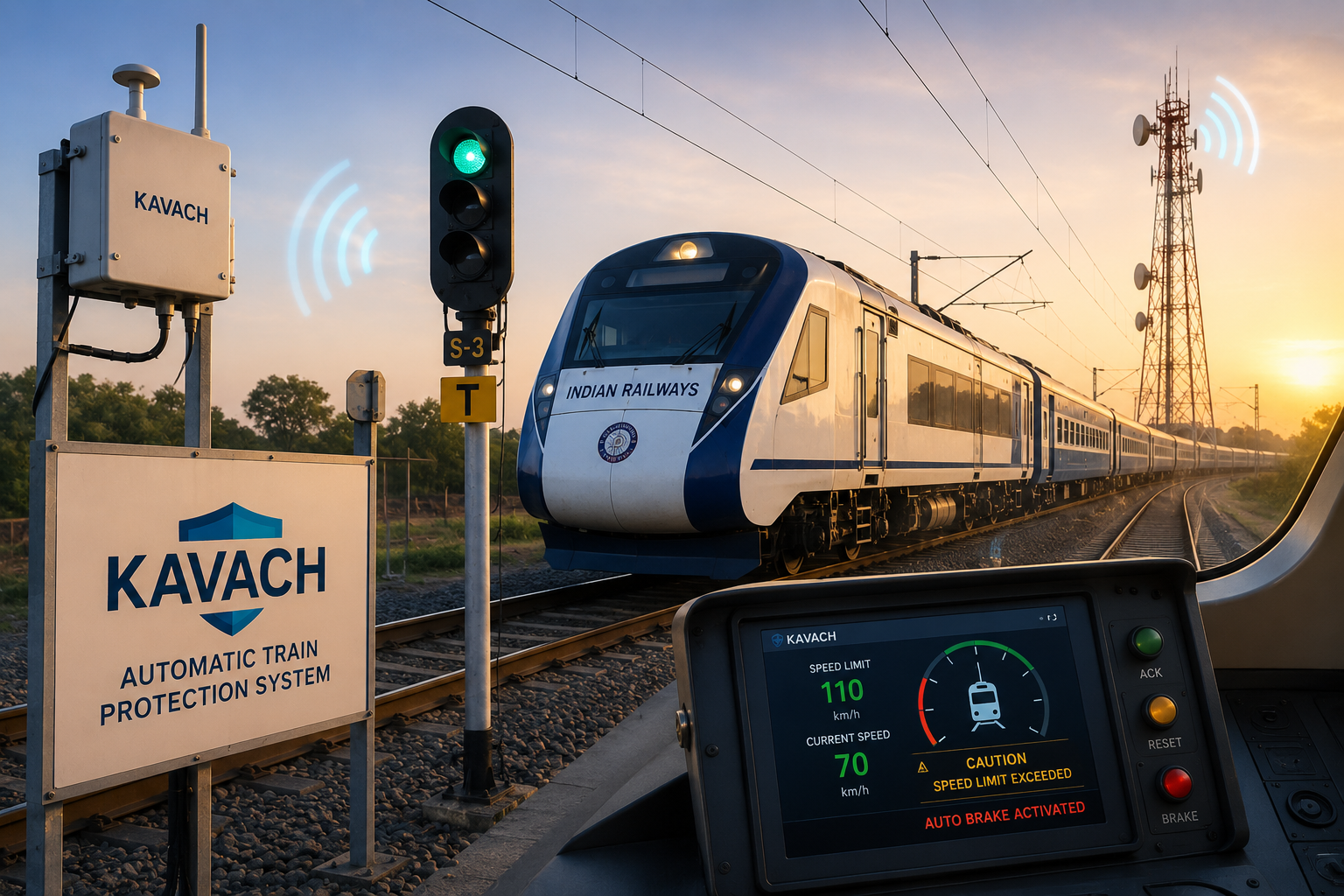
What is Kavach?
- Kavach is an indigenous Automatic Train Protection (ATP) system developed to improve railway safety and prevent train collisions.
- It uses a combination of radio communication, onboard locomotive equipment, signaling systems, and real-time monitoring to regulate train movements.
- The system continuously monitors train speed and operational conditions to ensure compliance with safety protocols.
- If a loco pilot fails to respond to warnings or exceeds the permitted speed limit, Kavach can automatically apply brakes to prevent accidents.
- By reducing dependence on human intervention, Kavach helps minimize the risk of collisions caused by human error and improves overall railway safety.
Why Indian Railways Need Modernization?
India operates thousands of trains daily across an extensive network carrying millions of passengers and large volumes of freight. As railway traffic continues to grow, traditional systems face increasing pressure.
Modernization is necessary not only to improve passenger safety but also to increase network capacity, reduce delays, and support future economic growth. Technology enables railways to operate more efficiently without requiring proportionate increases in infrastructure.
How Kavach Improves Railway Safety?
The primary objective of Kavach is accident prevention. The system continuously monitors train speed and location while communicating with signaling infrastructure on the track.
By automatically intervening during potentially unsafe conditions, Kavach creates an additional layer of protection beyond human supervision. This helps minimise the collision risks and improves confidence in railway operations.
Kavach 4.0: A Major Milestone for Indian Railways
India’s railway modernization journey received a significant boost in July 2024 when the Research Designs and Standards Organisation (RDSO) approved Kavach Version 4.0.
The upgraded system brings improved location accuracy, better signal visibility in complex railway yards, direct integration with electronic interlocking systems, and enhanced station-to-station communication through optical fiber networks.
The scale of implementation is already becoming visible. As of February 2025, Kavach has been deployed across 3,727 route kilometers, installed at 664 railway stations, equipped on 795 locomotives, supported by 5,743 kilometers of optical fiber cable, and connected through 540 telecom towers. These numbers highlight that Kavach is moving beyond pilot projects and entering large-scale deployment.
The Road Ahead for Kavach
Indian Railways has already finalized plans to equip 10,000 locomotives with Kavach and prepared 69 locomotive sheds for installation activities. In addition, bids have been invited for approximately 15,000 route kilometers of track-side deployment, covering key railway corridors across the country.
To support this expansion, Indian Railways is increasing manufacturing capacity and workforce readiness. More than 20,000 technicians, engineers, and operators have already received specialized Kavach training.
With over ₹1,950 crore spent on the project so far and continued budget allocations, Kavach is gradually becoming one of the largest railway safety technology deployments in India’s history.
Beyond Safety: The Digital Transformation of Railways
Railway modernization extends far beyond accident prevention. Indian Railways is increasingly adopting digital technologies for signaling, traffic management, predictive maintenance, and asset monitoring.
The integration of data-driven systems allows operators to make faster decisions, optimize train movements, and reduce operational inefficiencies. Over time, these improvements can lead to better service quality and lower operating costs
Opportunities for Indian Manufacturing Companies
The rollout of Kavach has created significant opportunities for domestic technology and electronics manufacturers. The system requires specialized electronic components, communication equipment, signaling hardware, and software integration.
Companies involved in railway electronics, embedded systems, and safety solutions stand to benefit from long-term expansion of railway modernization projects. This aligns with India’s broader focus on indigenous manufacturing and technological self-reliance. This has been explained in detail in our latest video.
Companies Benefiting from the Kavach Ecosystem
Kavach deployment involves multiple technologies including signaling systems, onboard locomotive equipment, telecom networks, and electronic control systems. As Indian Railways expands implementation, several companies are positioned to benefit across the value chain.
- Direct Kavach suppliers include HBL Engineering, Kernex Microsystems, and Medha Servo Drives, which provide core Kavach systems.
- Companies such as Siemens India and Alstom India contribute through signaling and rail automation.
- Kaynes Technology and Bharat Electronics (BEL) can benefit from increased demand for railway electronics and embedded systems.
- RailTel Corporation supports the communication and optical fiber infrastructure required for deployment.
Challenges in Large-Scale Implementation
While the benefits are substantial, implementing Kavach across India’s vast railway network is a complex task. Installation requires coordination across tracks, locomotives, signaling systems, and operational teams.
Budget allocations, infrastructure upgrades, and execution timelines can influence the pace of deployment. As a result, modernization is expected to be a gradual process rather than an overnight transformation.
What it Means for the Future?
Kavach represents more than just a safety system. It symbolizes the broader shift of Indian Railways toward a technology-driven future focused on automation, efficiency, and reliability.
As adoption expands, railway modernization could improve passenger safety, enhance freight movement, and create new opportunities for Indian technology companies. The long-term impact may extend well beyond railways, strengthening India’s position as a global manufacturing and engineering hub.
Conclusion
The modernization of Indian Railways is no longer a future ambition- it is already underway. Kavach stands at the center of this transformation, offering a practical solution to one of the industry’s most important challenges: safety
While implementation will take time, the direction is clear. As technology becomes increasingly integrated into railway operations, Indian Railways is gradually evolving into a smarter, safer, and more efficient transportation network for the decades ahead.