Kaynes Tech ODM Business Explained
India’s electronics manufacturing industry is changing rapidly. Earlier, most Indian electronics companies were only involved in assembling products designed by foreign brands. But now, some companies are trying to move higher in the value chain by not just manufacturing products, but also designing them. One such company is Kaynes Technology.
We recently, made a video on our YouTube Channel about Kaynes Tech and ODM was the most sought after business growth drivers.
Kaynes Technology is no longer positioning itself as just an electronics manufacturing company. Over the last few years, the company has been steadily moving toward a design-led business model through its growing ODM segment. This shift is important because ODM allows Kaynes to not only manufacture electronic products but also design and develop them for customers across sectors like industrial electronics, EVs, railways, aerospace, and smart devices.
As the company increases its focus on ODM, it is gradually moving higher in the electronics value chain, where margins, customer dependency, and long-term business opportunities are much stronger. In this article, we will understand how Kaynes Tech’s ODM business works, why it is becoming a key growth driver for the company, and why this segment is gaining so much attention among investors and industry participants.
What is ODM?
ODM stands for Original Design Manufacturing. This is a business model where the company does not only manufacture products, but also designs them. In a traditional manufacturing model, the customer gives the complete design to the manufacturer but in an ODM model, the customer only gives requirements.
For example
If a customer needs a smart energy meter, then the ODM company will design the actual product from scratch. This will include electronics design, PCB layout, testing systems and product architecture.
So, the company becomes both a designer and a manufacturer.
How Kaynes Tech’s ODM Business Works
To understand Kaynes Tech’s ODM business properly, let us break down the process deeply and let us take a practical example of an EV Battery Monitoring System and follow the complete journey from customer requirement to final manufacturing.
Customer Requirement
The process starts when a customer approaches Kaynes with a requirement. The customer may not have a ready product design.
Instead, they may simply explain what kind of product they want. This can include a smart industrial device, an EV electronic module, a railway electronics system, or a smart meter.
Let us understand this through a practical example for better understanding – a customer needs a Smart EV Battery Monitoring System for electric two-wheelers so it can monitor battery status, battery health, charging status, provide safety alerts and work in Indian weather conditions
Here, the customer has only provided the product expectations and required features. Now the ODM process starts.
Requirement Analysis
At this stage the engineering team will deeply study the requirements and then they analyze: product functionality, operating environment, voltage requirements, compliance standards and durability needs.
This stage is critical because incorrect requirement understanding can lead to product failure later. And according to our example at this stage the engineers have analyzed that the product must continuously monitor EV battery condition, survive heat, dust, vibration and fit inside compact EV systems.
Product Design
Product Design is one of the most important and highest-value activities. This is the stage where a customer’s idea is converted into a real electronic product. The company’s engineering and R&D teams begin designing the product.
For a company like Kaynes Technology, product design means much more than simply drawing a product layout. It involves engineering, electronics architecture, embedded systems, PCB development, firmware, mechanical design, testing preparation and manufacturability planning.
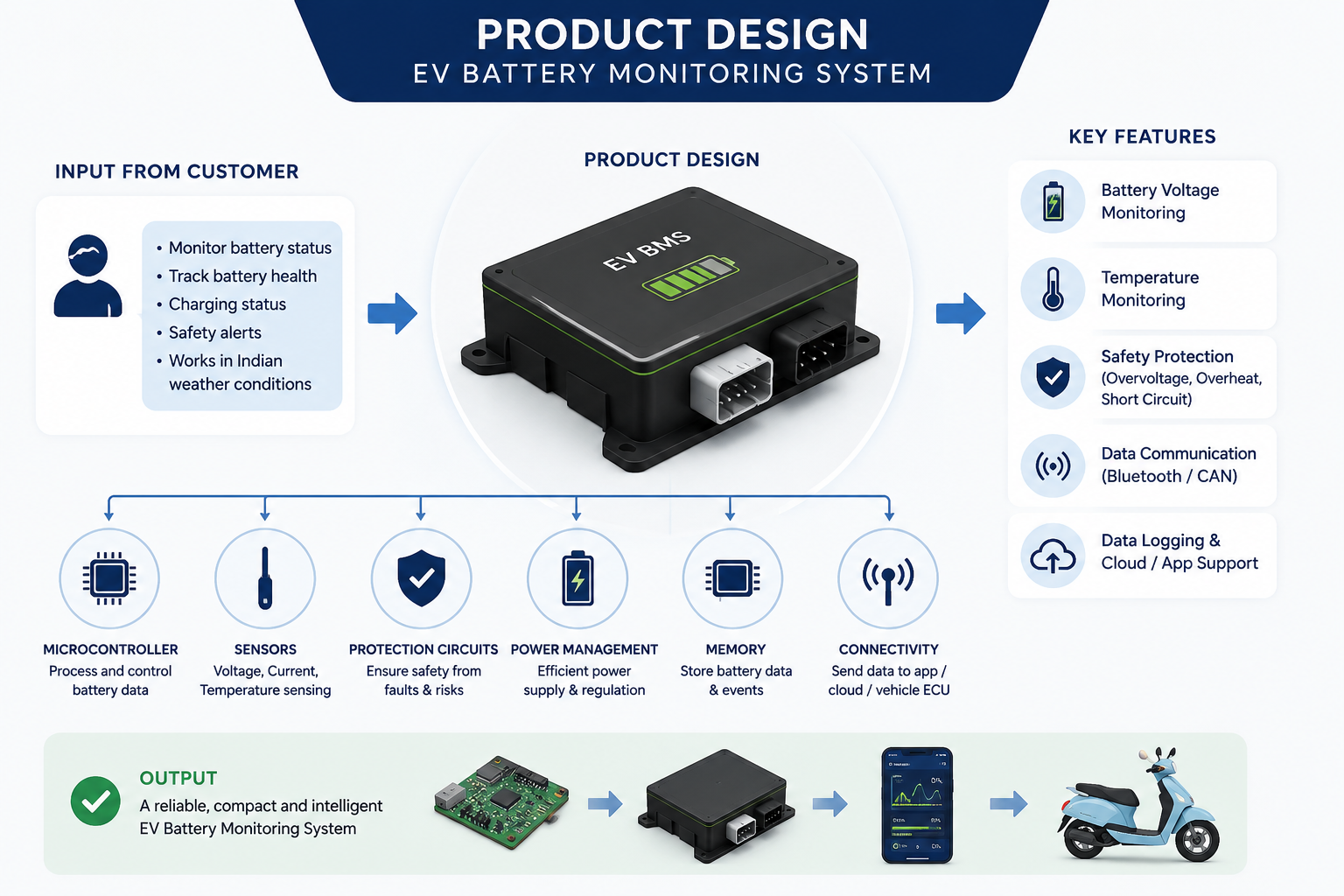
If we continue with our example here, the engineering team decides the system will contain - microcontroller, temperature sensors, voltage monitoring IC, power management circuit and memory unit to store battery data.
Electronic Circuit Design
At this stage the engineers will design the electronic circuits required to perform the desired functions. The activities included in the electronic circuit design stage are - component selection, power supply design, signal conditioning, protection circuits, etc.
If the engineers want to design an EV battery monitoring system they will design - sensor circuits, voltage regulations, protection circuits and charging detection systems. This stage defines how electricity flows inside the product.
PCB design
Once the circuit design is finalized, engineers convert it into a physical Printed Circuit Board (PCB). The PCB team determines where each component will be placed, how signal paths will be routed, and how heat dissipation will be managed.
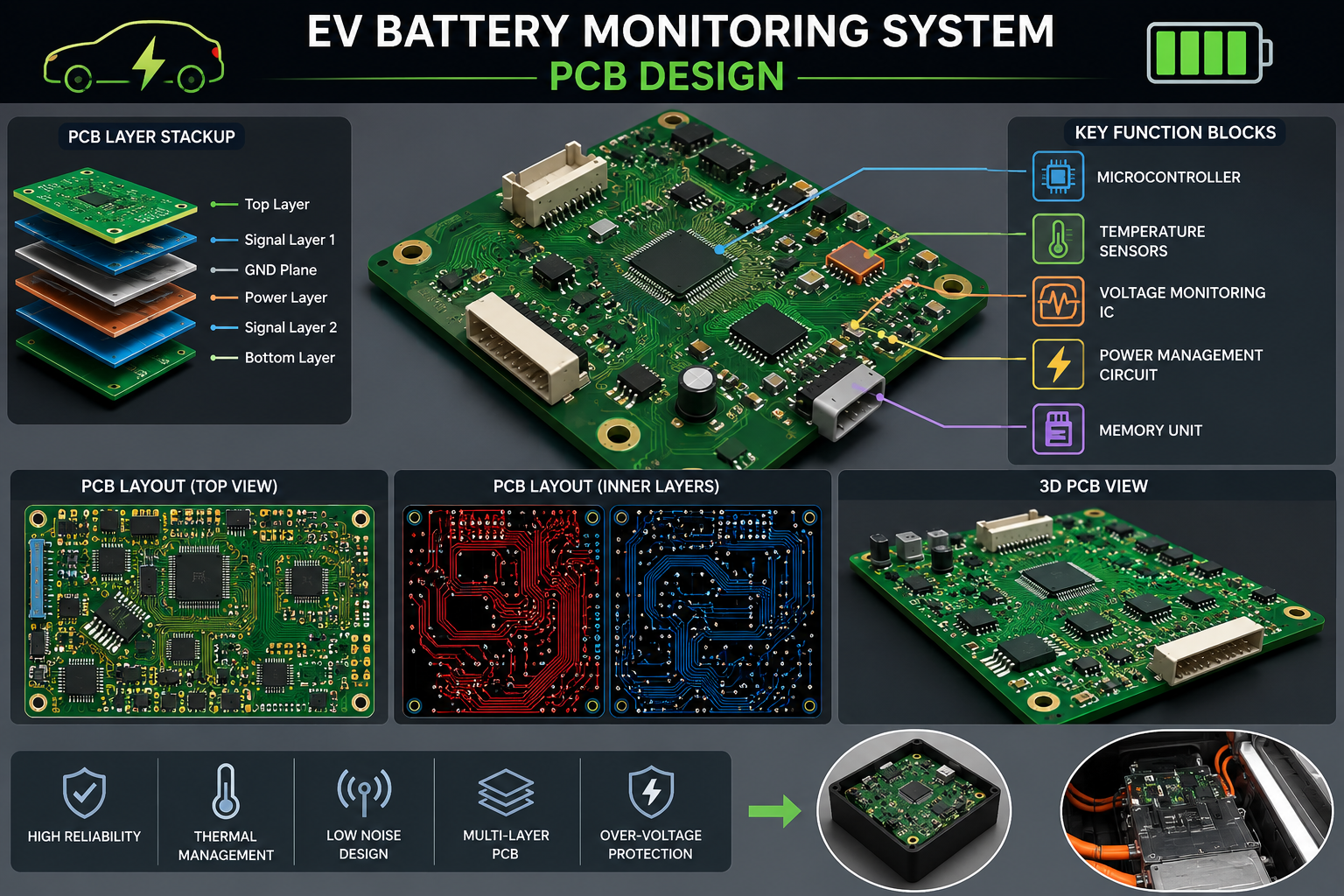
Since EV batteries generate heat the PCB must handle high temperatures, reduce electrical noise and prevent overheating. The PCB layout is optimized for stable signal performance and reliability.
Embedded Software / Firmware Development
Hardware alone cannot perform complex operations. Firmware is developed to control the hardware or we can say that to make the hardware functional and intelligent.
If the battery temperature crosses a safe limit, the firmware triggers a warning signal and initiates protective actions to safeguard the battery system.
Hence, the software becomes the “brain” of the device.
Mechanical Design
At this stage the mechanical engineers will design the physical structure of the product. This includes - product enclosure, structural parts, heat dissipation arrangements, mounting systems and protection against environmental factors.
For the EV battery monitoring system the team will design the outer enclosure, mounting structure, cooling vents and waterproof casing because this product goes inside EVs, the enclosure must: resist vibration, tolerate heat, survive dust and moisture.
Prototype Development
A prototype is the first working version of the product. At this stage Prototype PCBs are fabricated, Components are assembled, Initial firmware is loaded, Mechanical parts are produced. The goal is to create a functional sample.
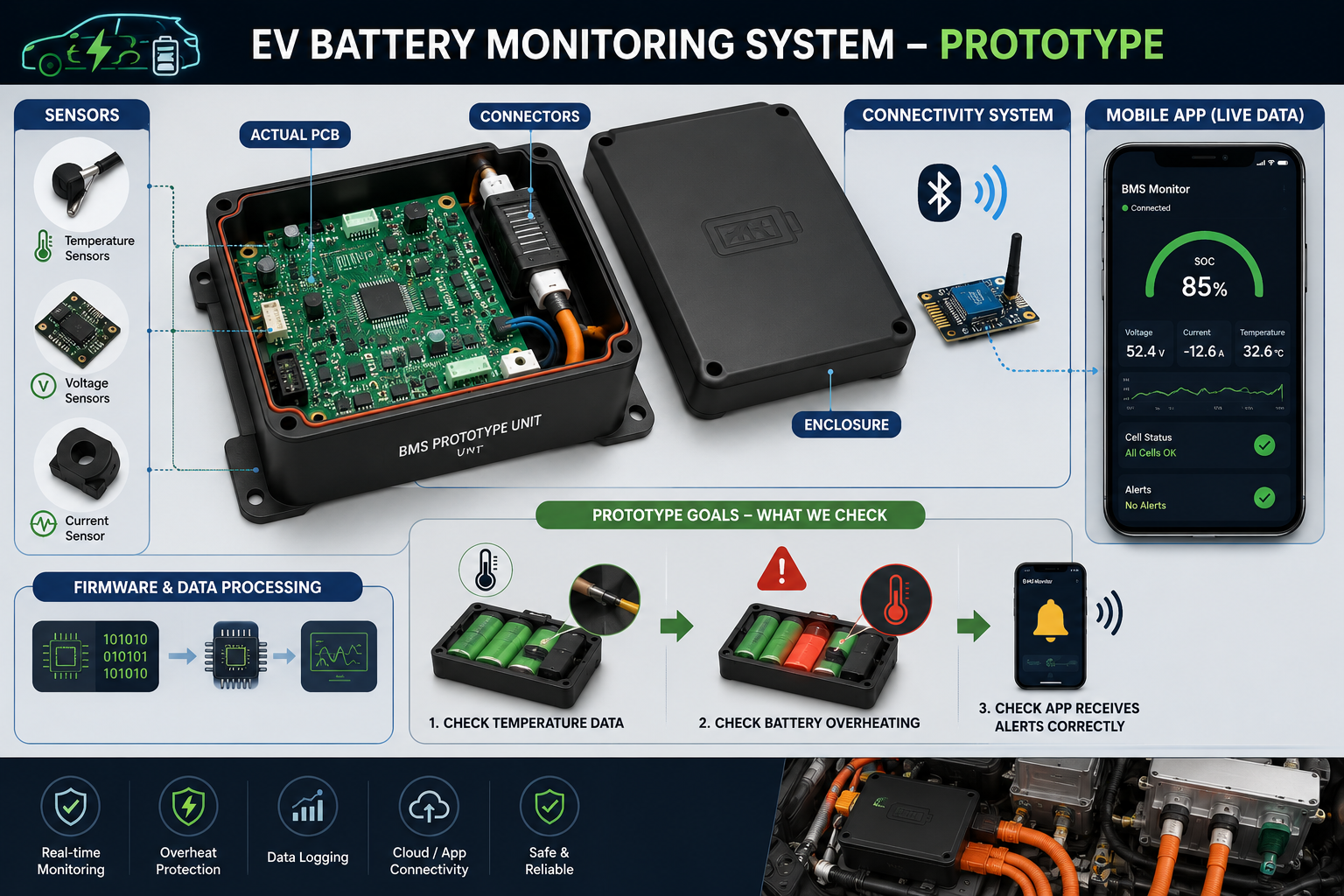
In the context of EV battery the prototype will include - actual PCB, sensors, enclosures, firmware and connectivity systems. The prototype goal for the team will be to check - temperature data, battery overheating and whether the app receives alerts correctly.
Testing & Validation
The prototype undergoes extensive testing. This can include functional testing, electrical testing, thermal testing, vibration testing, environmental testing and reliability testing. Any design flaws are identified in this stage. The only purpose is to ensure the product meets design specifications and customer requirements.
Design Optimization
After the testing is done improvements are made. Optimization may focus on: Performance improvement, Cost reduction, Power efficiency, Reliability enhancement and Manufacturability improvement.
In the EV Battery Monitoring System the findings can be - The PCB becomes too hot or the enclosure cooling is insufficient. Now engineers will redesign heat flow and strengthen the enclosure.
Component Sourcing
Once the design is finalized, all required components must be procured. This involves: supplier selection, cost negotiations, quality verification, lead time planning and supply chain risk management. The goal is to ensure uninterrupted availability of components.
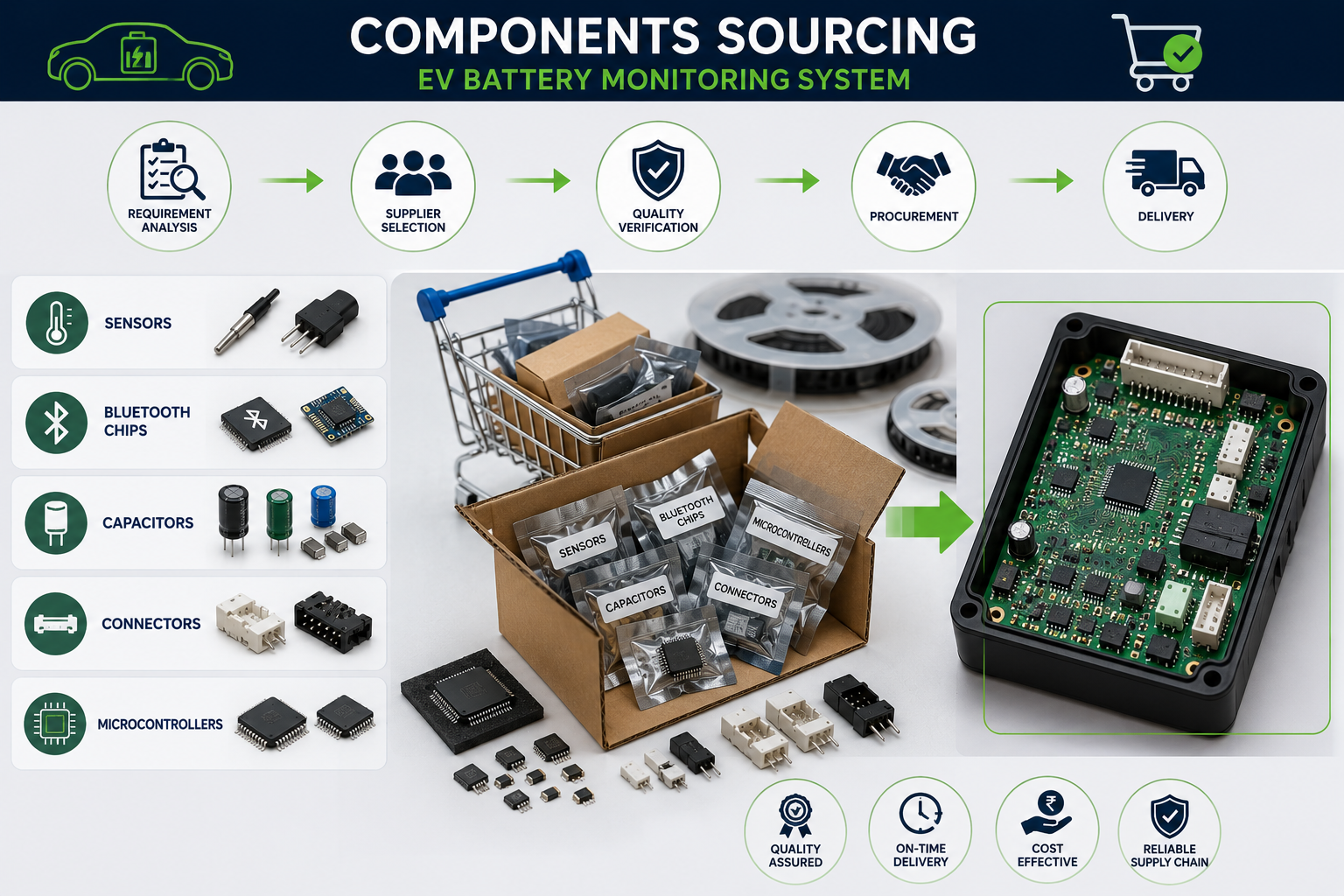
In the EV Battery Monitoring System the procurement team will source components like - sensors, bluetooth chips, capacitors, connectors and microcontrollers.
PCB Assembly & Manufacturing
The production version of the PCB is manufactured.
SMT assembly - tiny components are mounted automatically onto the PCB
Soldering - Components are permanently attached.
Now Automated Optical Inspection (AOI) is performed, where machines check component alignment, solder quality, and missing components.
Final Product Assembly
During the assembly stage, all the individual components and sub-systems are brought together to create the final product. This process includes PCB installation, mechanical assembly, wiring and harness integration, battery installation (where required), and loading the software or firmware onto the device.
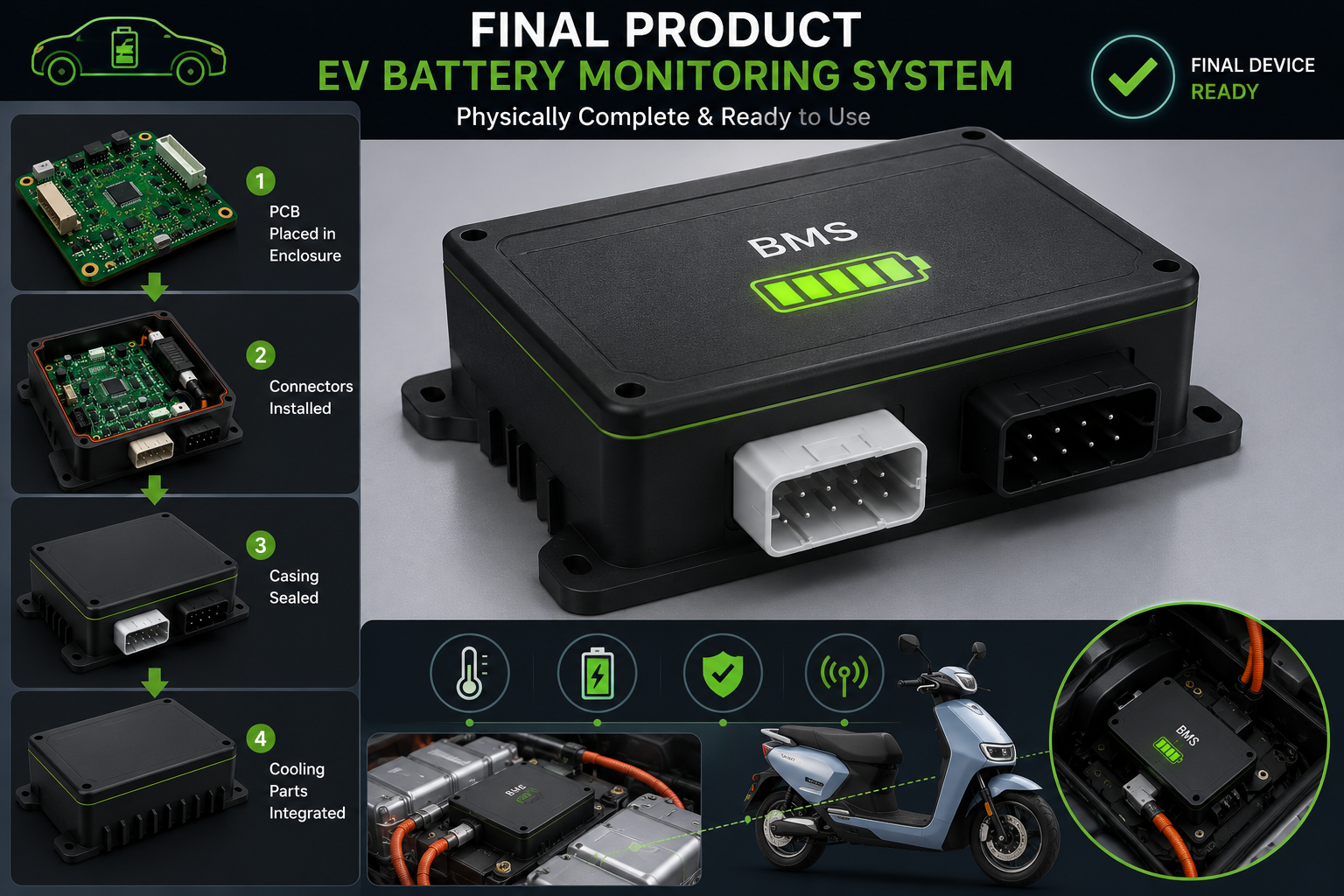
In the EV battery monitoring system the team will place PCB into the enclosure – install connectors – seals the casing – integrates cooling parts. Now the final EV battery monitoring device is physically complete.
Quality Testing
Once the product assembly is completed, every manufactured unit undergoes a series of quality checks to ensure it meets the required standards and specifications. These checks typically include functional verification to confirm that all features operate correctly, safety testing to ensure reliable and secure operation.
In the quality testing of EV battery monitoring system the company will check - battery readings, firmware stability, sensor accuracy and charging alerts.
Delivery to Customers
After passing quality inspections, products are packed and shipped. Packaging, documentation, Certification records, Logistics management and Customer support preparation these types of activities are done under delivery to customers stage.
The EV battery monitoring system is shipped to the EV company – The EV company installs it into electric scooters and sells the final vehicles under its own brand.
Conclusion
Kaynes Technology’s ODM business represents a significant step up from traditional electronics manufacturing. Instead of simply assembling products designed by customers, the company participates in the entire product development cycle—from understanding customer requirements and designing the product architecture to developing prototypes, validating performance, and manufacturing the final product at scale.
As demonstrated through the EV Battery Monitoring System example, ODM is a highly integrated process that combines engineering expertise, electronics design, embedded software development, mechanical design, testing capabilities, and manufacturing excellence. Every stage of the process adds value and helps transform a customer’s idea into a commercially viable product.
This design-led approach is strategically important because it allows Kaynes Technology to move higher in the electronics value chain, where customer relationships are deeper, switching costs are higher, and margins are generally better than pure manufacturing services. It also strengthens the company’s position across high-growth sectors such as electric vehicles, industrial electronics, railways, aerospace, and smart devices.
As India continues to expand its domestic electronics ecosystem and reduce dependence on imported technology, companies with strong ODM capabilities are likely to play an increasingly important role. For Kaynes Technology, the ODM business is not just another service offering—it is a key driver of technological capability, long-term customer partnerships, and future growth.