How Vulnerable Is Pondy Oxides to Imported Scrap and Commodity Prices?
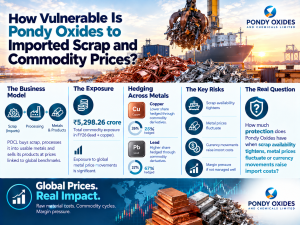
Pondy Oxides and Chemicals Ltd (POCL) depends heavily on imported scrap to manufacture recycled metals. Around 97% of its lead raw material and 98% of its copper scrap are imported, according to the research notes. This exposes the company to international supply disruptions, shipping costs, currency movements and metal-price volatility.
POCL uses commodity derivatives and foreign-exchange contracts to manage some of these risks. However, its FY26 annual report shows a difference in commodity-hedging coverage: 17% of reported lead exposure was hedged, compared with 55% for copper.
The important question is not simply how much scrap POCL imports or how much exposure it hedges. It is whether the company can preserve its processing margins, maintain production and generate cash when commodity markets become volatile.
How Much Could Lower Hedging Coverage Expose POCL To?
POCL reported total commodity exposure of ₹5,298.26 crore in FY26. Lead accounted for ₹4,074.16 crore, while copper accounted for ₹1,224.10 crore. The company hedged 17% of its lead exposure and 55% of its copper exposure through commodity derivatives.
The difference matters because a larger share of lead exposure remained outside reported derivative hedging coverage.
Illustrative commodity-price sensitivity
| Commodity | Reported exposure | Hedged | Not covered by reported hedging | 5% adverse movement on the uncovered amount |
| Lead | ₹4,074.16 Cr | 17% | ₹3,381.55 Cr | ₹169.08 Cr |
| Copper | ₹1,224.10 Cr | 55% | ₹550.85 Cr | ₹27.54 Cr |
Under this simplified calculation, a 5% adverse movement applied to the portion not covered by reported hedges produces a notional exposure of approximately ₹169.08 crore for lead and ₹27.54 crore for copper. These figures are sensitivity illustrations, not forecasts of losses or estimates of the actual impact on profit.
There is an important qualification: POCL states that its reported lead exposure includes purchases and sales without netting them off. The table also excludes the natural hedge created when imported material supports export sales. Consequently, gross exposure is not the same as net economic risk.
Actual earnings depend on the direction and timing of metal-price movements, purchase and sale contracts, inventory positions, natural hedges and derivative settlements. The relatively low reported lead-hedging percentage is therefore a risk indicator, not proof that the company will lose the calculated amount.
Can Scrap-Price Volatility Compress Processing Margins?
POCL's business depends on the difference between the cost of scrap and the value of the recovered metal and processing services. Higher metal prices can increase selling prices, but they do not automatically improve profitability. If scrap prices rise faster than selling prices adjust, or if inventory is purchased at unfavourable prices, margins can come under pressure.
POCL's historical financial performance provides some context. Its reported EBITDA margin increased from 5.6% in FY22 to 5.6% in FY23, declined to 5.1% in FY24, recovered to 5.3% in FY25 and reached 7.4% in FY26. Gross margin moved from 11.3% in FY22 to 12.0% in FY23, 11.5% in FY24, 10.5% in FY25 and 11.7% in FY26.
These figures show that profitability has changed over time, but they do not establish that commodity-price volatility caused those movements. The reported margins also reflect product mix, operating costs and other business factors.
The available disclosures do not provide a consistent year-by-year series of processing spreads or EBITDA per tonne alongside metal-price movements. Therefore, they cannot establish precisely how much of POCL's margin movement came from changes in scrap prices or how consistently it protected its processing spread during volatile periods.
For investors, the key measure is not revenue growth alone. It is whether POCL can maintain the spread between material costs and selling prices while processing higher volumes.
Does Heavy Dependence on Imported Scrap Create a Supply Risk?
The research notes indicate that approximately 97% of POCL's lead raw material and 98% of its copper scrap are imported. This makes access to international scrap supplies central to the company's operating model.
Such dependence creates several potential risks. Disruptions at overseas suppliers, shipping delays, higher freight costs, changes in import availability or unfavourable procurement conditions could delay material arrivals or increase the cost of maintaining production. If POCL cannot pass these additional costs through to customers, its processing margins could weaken.
The annual report identifies foreign-currency payables for imported raw materials, capital goods and other supplies as sources of currency risk. It also describes the use of commodity-price monitoring and hedging arrangements.
However, the available disclosures do not establish the annual imported tonnage or the procurement value attributable specifically to imported lead scrap and copper scrap. Without those figures, it is not possible to calculate how much a particular increase in freight costs or a supply disruption would add to POCL's annual expenses.
The distinction matters. A high import percentage demonstrates dependence on overseas supply, but it does not by itself quantify the financial damage from a disruption. The effect would depend on the volume affected, the duration of the interruption, available inventory, alternative suppliers and the company's ability to pass higher costs to customers.
Investors should therefore treat imported-scrap dependence as an operational vulnerability whose financial impact remains unquantified by the available disclosures. Check our latest video for more details.
Do Currency Hedges Fully Protect POCL Against Rupee Depreciation?
Imported scrap creates a second exposure beyond metal prices: the exchange rate at which foreign-currency purchases translate into rupees. If the rupee weakens, the rupee cost of imported material can rise unless the company has sufficient natural or financial hedging.
POCL's stated policy is to use forward foreign-exchange contracts for specified foreign-currency borrowings and anticipated purchase and sales transactions, taking natural hedging into account. The annual report also identifies imported raw-material payables as a source of currency risk.
The standalone financial statements provide a useful year-end snapshot. On March 31, 2026, the company reported USD-denominated monetary liabilities equivalent to ₹35.22 crore, of which approximately ₹35.12 crore was covered through derivatives or natural hedging, leaving a net liability exposure of around ₹0.10 crore. Its reported foreign-currency monetary assets were also covered in the disclosed table. These are year-end monetary balances, not a measure of every future import payment.
That distinction limits what can be concluded. A small unhedged balance-sheet exposure at year-end does not necessarily mean all future imported-scrap purchases are protected. Anticipated transactions, the timing of contracts and changes in procurement volumes can create exposures after the reporting date.
The available disclosures do not provide a single comprehensive percentage showing how much of all future imported-scrap payments remains unhedged. Therefore, the adequacy of currency protection cannot be established from the year-end monetary-exposure table alone.
The relevant investor question is whether POCL can align its currency hedges and natural export receipts with the timing and value of its imported-material payments, not simply whether it uses forward contracts.
Could Higher Metal Prices Increase Working-Capital Requirements?
Commodity-price risk can affect cash flow even when processing margins remain stable. When metal prices rise, the company may need more money to purchase the same physical quantity of scrap. If it must also hold inventory while waiting for production or customer delivery, more cash can become tied up in working capital.
POCL's FY26 standalone balance sheet shows that inventory increased from ₹232.18 crore at March 31, 2025, to ₹268.81 crore at March 31, 2026, an increase of ₹36.63 crore, or approximately 15.8%. Raw-material inventory rose from ₹174.55 crore to ₹191.72 crore, while finished goods increased from ₹17.04 crore to ₹53.51 crore. The inventory figures include stock in transit within raw materials.
The cash-flow statement reinforces the importance of working capital. In FY26, the increase in inventory absorbed approximately ₹36.63 crore of cash, while the increase in trade receivables absorbed approximately ₹136.23 crore. Net cash from operating activities remained negative at approximately ₹53.92 crore.
These figures do not prove that higher commodity prices caused the inventory increase or the negative operating cash flow. They do show that inventory and receivables can place substantial demands on cash.
If metal prices rise, POCL may need additional funds to purchase scrap before it receives payment for finished products. Even where selling prices eventually adjust to preserve the processing spread, the timing gap can increase working-capital requirements and financing needs.
For investors, this creates a second test of resilience alongside margins: whether POCL can convert higher sales into operating cash without allowing inventory and receivables to absorb an excessive share of the money generated by the business.
Conclusion
POCL's exposure to imported scrap creates three connected risks: international supply disruption, commodity-price movements and currency fluctuations. Its FY26 disclosures show materially different commodity-hedging coverage for lead and copper, while its working-capital figures demonstrate that inventory and receivables can place pressure on cash generation.
However, the reported gross commodity exposure should not be interpreted as the amount at risk of being lost. Purchases, sales, natural hedges and derivatives interact, and the available information does not provide a complete calculation of net commodity-price sensitivity.
Likewise, the company's use of foreign-exchange contracts does not by itself establish that every future import payment is protected. A comprehensive assessment would require transaction-level hedge coverage, import procurement values, processing spreads and the financial effect of adverse price movements.
The central issue for investors is whether POCL can protect its processing margins and cash conversion when metal prices, exchange rates and overseas supply conditions move against it. Until the disclosures provide a clearer bridge from gross exposure to net earnings and cash-flow sensitivity, the scale of the risk can be identified more confidently than its precise financial cost.