Can Ratnaveer Sustain 15% Growth in Its Existing Business?
Ratnaveer Precision Engineering’s existing stainless-steel business has grown through higher production volumes, capacity additions and a wider product portfolio. Revenue reached ₹1,068.74 crore in FY26, up 19.83% from ₹891.88 crore in FY25. EBITDA grew faster, rising 34.79% to ₹121.88 crore, while the EBITDA margin improved to 11.40%.
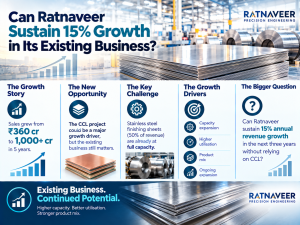
But sustaining 15% annual revenue growth is a different challenge from achieving it during an expansion phase. Finishing sheets account for 52.38% of revenue, and the company has indicated that this product line is already operating at full capacity. A ₹67 crore expansion is expected to increase overall capacity, but the company must also demonstrate that the additional output can be sold at profitable realisations.
The key question is whether the existing business can maintain growth through FY29 without relying on the new Copper Clad Laminate (CCL) business.
What Would 15% Growth Look Like by FY29?
Ratnaveer reported ₹1,068.74 crore in FY26 revenue. Applying annual growth rates of 10%, 15% and 20% provides a useful view of the revenue path, although these scenarios are calculations rather than management guidance.
| Financial year | 10% growth | 15% growth | 20% growth |
| FY26 actual | ₹1,068.7 Cr | ₹1,068.7 Cr | ₹1,068.7 Cr |
| FY27 scenario | ₹1,175.6 Cr | ₹1,229.1 Cr | ₹1,282.5 Cr |
| FY28 scenario | ₹1,293.2 Cr | ₹1,413.4 Cr | ₹1,539.0 Cr |
| FY29 scenario | ₹1,422.5 Cr | ₹1,625.4 Cr | ₹1,846.8 Cr |
At 15% annual growth, existing-business revenue would reach approximately ₹1,625 crore by FY29. That would add around ₹557 crore to the FY26 revenue base.
The important question is where this increase would come from. Capacity expansion can support higher production, but it cannot automatically generate sales. Ratnaveer needs sufficient demand across finishing sheets, fasteners, washers, tubes, pipes and other products to absorb the additional output.
The 10% scenario provides a more moderate benchmark, while the 20% scenario requires stronger growth than the company achieved in FY26. These figures show the scale of the opportunity, not the probability of achieving it. To know more, check our latest video.
Can Other Products Compensate for the Finishing-Sheet Constraint?
Finishing sheets account for 52.38% of Ratnaveer’s revenue, equivalent to approximately ₹560 crore based on FY26 revenue. The company has indicated that this product line is already operating at full capacity.
The market for finishing sheets is projected to grow at around 6% annually. However, market growth does not automatically translate into higher company revenue when production capacity is constrained.
Consider the implications for the 15% growth target. If finishing-sheet revenue remains flat, revenue from all other products would need to increase from approximately ₹509 crore in FY26 to ₹1,065 crore by FY29 to achieve total revenue of ₹1,625 crore.
That would require the remaining business to grow at roughly 28% annually for three years.
Even if finishing-sheet revenue grew at 6% annually, the other product categories would still need to grow at approximately 23.5% annually to achieve the same consolidated revenue target.
These are analytical scenarios, not forecasts. They demonstrate that 15% overall growth cannot be justified by the finishing-sheet market outlook alone.
The company must either expand finishing-sheet capacity, improve the output of existing facilities, or generate much faster growth from other products. The available disclosures do not quantify how much additional capacity is allocated to each product category, so the extent to which the ₹67 crore expansion resolves this bottleneck remains uncertain.
What Could the ₹67 Crore Capacity Expansion Earn?
Ratnaveer’s reported capacity is approximately 67,000 tonnes, with an expansion intended to increase it to around 89,000 tonnes. The project adds approximately 21,700 tonnes of capacity.
FY26 revenue of ₹1,068.74 crore against production of approximately 46,600 tonnes implies revenue of roughly ₹2.29 lakh per tonne. This provides a starting point for assessing the expansion, provided realisations and product mix remain unchanged.
Illustrative economics of the additional 21,700-tonne capacity:
- 50% utilisation: Approximately ₹249 crore in incremental annual revenue and ₹28 crore in EBITDA.
- 60% utilisation: Approximately ₹299 crore in incremental annual revenue and ₹34 crore in EBITDA.
- 70% utilisation: Approximately ₹348 crore in incremental annual revenue and ₹40 crore in EBITDA.
- 80% utilisation: Approximately ₹398 crore in incremental annual revenue and ₹45 crore in EBITDA.
These estimates assume the additional capacity achieves the FY26 revenue per tonne and the existing 11.40% EBITDA margin. They are not management forecasts, and actual results will depend on product mix, selling prices, input costs and demand.
At 80% utilisation of the additional capacity, the implied annual EBITDA would equal roughly 68% of the ₹67 crore investment. This is an EBITDA-to-capex comparison, not ROCE or a cash-payback estimate. It excludes taxes, interest, depreciation, working capital and ramp-up costs.
The expansion therefore has the potential to be financially meaningful, but the key test is how quickly Ratnaveer can fill the new capacity with profitable orders.
Has Ratnaveer Reduced Its Dependence on Large Customers?
Customer concentration is an important risk when a company is attempting to sustain double-digit growth.
Ratnaveer’s earlier disclosures showed revenue from a large domestic customer rising from ₹87 crore in FY23 to ₹244 crore in FY24. That increase helped drive the company’s historical growth, but it also raises a question: how much of the business depends on a small number of buyers?
The FY26 annual report describes a broader customer network, with 219 active customers and exports reaching 31 countries. The company also reports a network of 89 global distribution partners. These figures indicate the breadth of its commercial reach, but they do not establish how evenly revenue is distributed among customers.
The latest disclosures reviewed do not provide a comparable current revenue share for the largest customer or a breakdown of revenue across the top five or ten customers. It is therefore not possible to conclude that concentration has declined since FY24.
Investors should distinguish between having many customers and having a diversified revenue base. A company may serve hundreds of customers while still deriving a substantial share of revenue from a few large buyers.
For Ratnaveer, the most useful evidence would be the latest top-customer revenue shares, repeat-order trends and the contribution of newly added customers. Until those figures are available, customer diversification remains an encouraging possibility rather than a demonstrated reduction in risk.
Can Value-Added Products Sustain Margin Improvement?
Ratnaveer’s EBITDA margin improved from 6.8% over the earlier period cited in the company analysis to 11.40% in FY26. In the latest financial year, revenue increased 19.83%, while EBITDA grew 34.79%. The margin also improved from 10.13% in FY25 to 11.40% in FY26.
The annual report attributes the improvement to several factors, including higher sales volumes, a better product mix, improved capacity utilisation, operating efficiencies and cost optimisation.
This matters because these factors have different implications for future growth. Higher utilisation can improve fixed-cost absorption, but the benefit may weaken once capacity approaches its practical limits. Cost efficiencies may continue, although they cannot be assumed to repeat at the same rate every year. A better product mix could support margins for longer, but only if higher-value products maintain their pricing and profitability.
Ratnaveer offers a broad range of products, including precision fasteners, washers, tubes, pipes, finishing sheets and sheet-metal components. Finishing sheets themselves involve value-added surface treatments, and they account for 52.38% of FY26 revenue.
However, the latest disclosures reviewed do not separately quantify the revenue contribution or EBITDA margin of each value-added product category. That makes it difficult to determine how much of the margin improvement came specifically from higher-value products rather than utilisation or cost efficiencies.
There is also a mathematical test. If revenue grows by 15% annually and EBITDA grows by 18–20%, the EBITDA margin must rise from 11.40% to approximately 11.70–11.90% over one year. That is a modest improvement, but it still requires evidence that product mix, operating efficiency or cost control can deliver it.
Conclusion
Ratnaveer’s existing business has demonstrated strong growth, with FY26 revenue reaching ₹1,068.74 crore and EBITDA margin improving to 11.40%. The planned capacity expansion could support further growth, while the company’s broad product portfolio and customer network provide opportunities beyond finishing sheets.
However, the 15% growth target is not yet fully established by the available operating data. If finishing-sheet revenue remains flat, the other product categories would need to grow at approximately 28% annually through FY29 to deliver the target. The ₹67 crore expansion could add meaningful revenue and EBITDA, but the outcome depends on utilisation, product mix and customer demand.
Three indicators deserve close attention:
- Capacity: How quickly the additional 21,700 tonnes reach profitable utilisation, and whether finishing-sheet capacity also increases.
- Customers: Whether the company discloses updated top-customer revenue shares and demonstrates broader repeat-order growth.
- Margins: Whether the EBITDA margin stays near or above 11.40% as sales expand, with evidence of continuing benefits from product mix, utilisation and cost efficiencies.
The conclusion is not that 15% growth is unattainable. It is that the target requires more than capacity expansion alone. Ratnaveer must demonstrate that its other product categories can grow rapidly enough to offset the finishing-sheet constraint while preserving margins.