Can International Ports Become Adani Ports’ Next Growth Engine?
The key question for Adani Ports and Special Economic Zone (APSEZ) is no longer just how much cargo its Indian ports can handle. It is whether its international operations can become a meaningful source of growth, profitability and diversification.
The company’s Q1 FY27 performance offers an interesting starting point. International operations recorded 80% revenue growth and 256% EBITDA growth, while domestic port revenue grew 12% against cargo volume growth 2%.
That difference deserves attention. International operations are growing much faster, but growth alone does not establish that they can become the company’s next growth engine. Investors also need to understand what is driving that growth, whether it can be sustained and how much capital the business requires.
International ports could expand APSEZ’s growth opportunities, but their long-term value will depend on converting rapid growth into durable earnings and attractive returns on capital. The distinction matters because expanding across countries also introduces different operating, regulatory and execution risks.
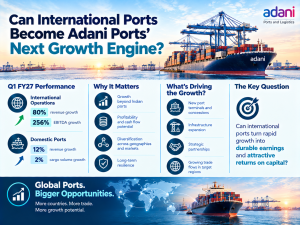
International Ports Are Growing Fast, but What Is Driving the Growth?
Adani Ports and Special Economic Zone (APSEZ) reported international ports revenue of ₹1,747 Cr in Q1 FY27, up 80% year-on-year. EBITDA increased 256% to ₹730 Cr. However, the growth came from a combination of newly consolidated Australian operations and the ramp-up of Colombo, rather than solely from existing ports.
The disclosed operating figures provide a clearer picture:
- Australia (NQXT): Handled 10 MMT of cargo in Q1 FY27. Its results entered APSEZ's consolidated accounts from Q4 FY26, making year-on-year comparisons sensitive to the consolidation effect.
- Colombo: Handled 6.9 MMT. Revenue increased fivefold year-on-year as operations scaled up.
- Tanzania: Handled 3.7 MMT, with revenue increasing 36% year-on-year.
- Israel (Haifa): Handled 2.2 MMT of cargo.
These figures show that Australia and Colombo were important contributors to the quarter's growth. Tanzania also recorded revenue growth, while Haifa continued operating amid geopolitical uncertainty.
However, APSEZ has not disclosed a complete asset-wise revenue and EBITDA breakdown for these four ports in its Q1 FY27 results. The individual contribution of each asset to the ₹774 Cr increase in international revenue therefore cannot be calculated reliably.
The next test is whether existing assets can grow earnings independently of acquisitions and initial ramp-ups.
Can International Ports Close the Return-on-Capital Gap?
International ports generated an EBITDA margin of 28.6% in FY26, yet their return on capital employed (RoCE) was only 8%. Domestic ports delivered RoCE of 23%.
This difference raises an important question: why is a business generating substantial operating profit still delivering comparatively modest returns on capital?
EBITDA measures operating earnings before interest, tax, depreciation and amortisation. RoCE measures the return generated on the capital employed. A capital-intensive port can have a healthy EBITDA margin but a lower RoCE if its investment base is large relative to the operating earnings it generates.
The return hurdle can be expressed mathematically:
- At 12% RoCE: Operating profit would need to equal 12% of international ports' capital employed.
- At 15% RoCE: Operating profit would need to equal 15% of capital employed.
Moving from 8% to 12% requires an additional four percentage points of return on the existing capital base. Reaching 15% requires seven additional percentage points.
APSEZ's published FY26 results do not provide the international segment's absolute capital-employed figure alongside its RoCE. Consequently, the additional rupee operating profit required to achieve either target cannot be calculated accurately from these disclosures.
The priority is to increase earnings from existing investments, improve asset utilisation and avoid committing new capital faster than returns improve.
Can International Operations Fund Their Own Expansion?
APSEZ's international growth must be assessed alongside its investment requirements and balance-sheet capacity.
Colombo West International Terminal represents a substantial infrastructure commitment. APSEZ announced a total investment of US$750 million for the Colombo terminal project. In September 2026, the company announced that the terminal's capacity had doubled to 3.2 million TEUs.
The expansion increases the terminal's ability to handle containers, but higher capacity creates value only when sufficient cargo volumes and operating earnings follow.
At the group level, APSEZ reported FY26 capital expenditure of ₹15,320 Cr, exceeding its original guidance of ₹11,000-12,000 Cr. FY27 capex guidance stands at ₹12,000-14,000 Cr.
Its Q1 FY27 financial position provides context for funding flexibility:
- Gross debt stood at ₹56,776 Cr.
- Cash balance stood at ₹12,428 Cr.
- Net debt-to-EBITDA was 1.9 times.
These figures indicate that APSEZ has access to financial capacity for expansion, but they do not establish whether international ports can fund their own investments.
The company has not disclosed a complete international-port-wise breakdown of operating cash flow, capital expenditure and funding requirements in the cited results. Therefore, the extent to which overseas operations can finance further investment internally cannot be quantified reliably.
The key measure is whether international operating cash generation increasingly covers maintenance and expansion spending without weakening consolidated leverage or returns. Check our latest video for more details.
Does International Diversification Reduce Risk or Create New Exposure?
APSEZ's international portfolio spreads its operations across Australia, Sri Lanka, Tanzania and Israel. This broadens its market presence, but geographical diversification does not eliminate operational or geopolitical risk.
Haifa Port in Israel illustrates this distinction. APSEZ holds a 70% stake in the Haifa Port Company consortium. The port has an installed capacity of 26 MMT and handled 9.4 MMT of cargo in FY26. The company has reported maintaining operational continuity despite the conflict affecting the region.
The Q1 FY27 results show that Haifa handled 2.2 MMT of cargo. This provides a measurable indication of its operating scale, although the company has not disclosed a separate Q1 revenue or EBITDA figure for the asset in the results used here.
Cargo concentration also matters. In Q1 FY27, NQXT handled 10 MMT, Colombo 6.9 MMT, Tanzania 3.7 MMT and Haifa 2.2 MMT. These four disclosed figures account for the reported international-port volume of 22.8 MMT.
The portfolio is geographically spread, but the financial impact of a disruption at any individual port cannot be determined from cargo volumes alone. Asset-level revenue, EBITDA, insurance costs and cash-flow exposure would be needed to quantify that impact.
The investor question is whether diversification produces stable group earnings through different market cycles, not simply whether APSEZ operates in several countries.
Conclusion
International ports are becoming an important growth contributor for APSEZ. Q1 FY27 revenue reached ₹1,747 Cr and EBITDA reached ₹730 Cr, supported by NQXT's consolidation, Colombo's ramp-up and growth in Tanzania.
The financial challenge is equally clear. International ports delivered 8% RoCE in FY26, compared with 23% for domestic ports. That gap means rapid revenue and EBITDA growth alone cannot establish that international expansion is creating comparable shareholder value.
Three developments would strengthen the investment case: sustained growth from existing assets, improving returns on capital already committed, and stronger evidence that overseas cash generation can support future investment.
Until asset-level capital employed, cash flows and profitability are disclosed in greater detail, the precise return hurdle and funding contribution of international ports remain unquantified.
International ports have the potential to become APSEZ's next growth engine. Their long-term success, however, will depend on whether the company can turn its expanding global footprint into durable earnings and better returns on capital.