Max Healthcare’s Bhubaneswar Bet: Turnaround or Long Wait?
A ₹298 crore acquisition is easier to justify when a hospital already generates strong profits. Max Healthcare’s Bhubaneswar purchase presents a different challenge: the hospital has an established patient base, 250 beds and annual revenue of ₹154 crore, but it generated only ₹7 crore in EBITDA before a stricter provision for doubtful debts affected the reported figure.
The opportunity lies in improving utilisation, attracting more specialists and moving towards a more profitable patient and payer mix. But how much can these changes realistically add to earnings? And what level of profitability would make the acquisition worthwhile?
The numbers suggest that Bhubaneswar has room to improve. They also show why higher revenue alone will not be enough.
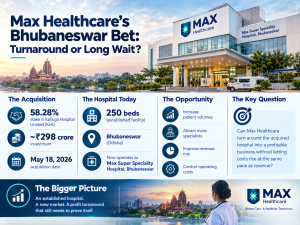
The ₹298 Crore Acquisition Needs a Meaningful Earnings Improvement
Max Healthcare acquired a controlling 58.28% stake in Kalinga Hospital Limited on May 18, 2026, for approximately ₹298 crore. The hospital, now operating as Max Super Speciality Hospital Bhubaneswar, reported FY26 revenue of approximately ₹154 crore and EBITDA of around ₹7 crore before an ₹8 crore impact from a stricter policy for providing for doubtful debts.
On the pre-provision EBITDA figure, the acquisition price works out to approximately 43 times annual EBITDA. This is a demanding starting point if earnings remain close to their previous level.
The following scenarios illustrate what different annual EBITDA levels would require, assuming revenue improves to ₹185 crore or ₹212 crore through better utilisation. These revenue levels are modelled separately in the next section.
| Annual revenue | Margin for ₹15 Cr EBITDA | Margin for ₹25 Cr EBITDA | Margin for ₹35 Cr EBITDA |
| ₹154 Cr | 9.7% | 16.2% | 22.7% |
| ₹185 Cr | 8.1% | 13.5% | 18.9% |
| ₹212 Cr | 7.1% | 11.8% | 16.5% |
Analyst calculations. Revenue and EBITDA figures are illustrative, not management guidance.
At ₹15 crore of annual EBITDA, the hospital would generate an EBITDA yield of about 5% against the ₹298 crore acquisition price. At ₹25 crore, this rises to 8.4%, and at ₹35 crore, to 11.7%.
These are operating-earnings yields, not investment returns. They do not account for Max’s ownership percentage, financing costs, taxes, additional capital expenditure, working capital or the time required to reach those earnings.
The implication is clear: Bhubaneswar needs to move beyond its existing earnings base. The investment case becomes more compelling if revenue grows while margins improve, rather than if growth is achieved by adding costs at a similar pace.
How Much Revenue Can Higher Occupancy Generate?
The hospital reported occupancy of approximately 60% in FY26, with average revenue per occupied bed (ARPOB) of ₹29,000. With 250 beds, this leaves scope to increase patient utilisation without relying entirely on additional bed capacity.
A simple model helps quantify that opportunity.
Assume all 250 beds are available throughout the year, occupancy applies consistently across the year, and ARPOB remains at ₹29,000. The calculation is:
Annual revenue = 250 beds × 365 days × occupancy × ₹29,000 ARPOB.
| Occupancy | Modelled annual revenue | Increase over 60% scenario |
| 60% | ₹158.8 Cr | — |
| 70% | ₹185.3 Cr | ₹26.5 Cr |
| 80% | ₹211.7 Cr | ₹52.9 Cr |
Analyst model using a constant ARPOB of ₹29,000. The model excludes Max Lab revenue and is a sensitivity analysis, not a forecast. Actual revenue may differ because of bed availability, patient mix, pricing and other operating factors.
The 60% model produces revenue slightly above the reported FY26 figure of approximately ₹154 crore. That difference is a reminder that the model simplifies actual hospital operations and should not be treated as an exact revenue prediction.
Nevertheless, the direction is useful. Moving from 60% to 70% occupancy could add approximately ₹26 crore in annual revenue under these assumptions. Reaching 80% could add approximately ₹53 crore.
But these increases do not translate directly into EBITDA. More patients require nursing staff, clinical support, consumables, housekeeping and other operating resources. Consultant fees and treatment costs can also rise with volumes. If the additional revenue comes from lower-realisation procedures or less favourable payer arrangements, the profit contribution may be limited.
The real test is therefore not whether Max can fill more beds. It is whether the hospital can fill them with patients and procedures that generate adequate contribution after the associated costs.
Why the First Post-Acquisition Numbers Need Careful Interpretation?
In Q1 FY27, Max Healthcare reported that Bhubaneswar contributed ₹19 crore in revenue and approximately ₹2 crore in EBITDA during the post-acquisition period. Occupancy was 50%, while ARPOB stood at ₹35,000.
These figures should not be compared directly with FY26 as though both periods covered a full three months or a full year.
FY26 revenue of approximately ₹154 crore covers the hospital’s entire financial year before the acquisition. Max acquired the controlling stake on May 18, 2026, so the ₹19 crore reported for Q1 FY27 represents only the period after the acquisition, rather than the full April-June quarter.
The periods also reflect different operating circumstances. FY26 occupancy was approximately 60%, compared with 50% during the post-acquisition reporting period. ARPOB increased from ₹29,000 to ₹35,000, but that increase alone does not establish a lasting improvement in pricing or patient mix. A shorter reporting window and changes in the patients treated can influence the figure.
The reported ₹2 crore EBITDA is encouraging as an initial contribution, but it is not sufficient to establish a sustainable margin trend. Nor should the ₹19 crore revenue figure be mechanically annualised: a short period may not represent the hospital’s normal operating pattern.
Investors need several subsequent quarters of comparable data to assess whether occupancy is recovering, ARPOB remains higher and EBITDA improves after the costs of integration and expansion.
The Cost of Turning Around Bhubaneswar Is Still Unclear
Max has identified several priorities for the hospital: expanding the consultant base, improving occupancy, enhancing case and payer mix, upgrading infrastructure and medical technology, and introducing operating efficiencies.
These measures can improve the hospital’s competitive position, but they are not cost-free.
Hiring senior specialists may involve fixed salaries, retainers or minimum guarantees before patient volumes reach the levels needed to support those costs. Additional nurses and clinical staff may also be required as occupancy increases. Infrastructure and technology upgrades can add capital expenditure, while changes to procurement, digital systems and clinical processes may create implementation costs.
The available acquisition disclosures do not specify a separate Bhubaneswar capex budget or quantify the additional cost of consultant expansion. It would therefore be misleading to assign a precise investment requirement or payback period to the turnaround.
The timing of costs matters as much as their eventual size. Salaries and support expenses can increase before newly hired consultants build their patient base. Technology spending can occur before the upgraded facilities generate additional procedures. During that period, revenue may rise while EBITDA margins remain under pressure.
The hospital’s new hospital information system was rolled out on August 1, 2026. Max is also standardising clinical protocols, quality systems, procurement, finance, human resources and digital processes. These steps can create long-term benefits, but investors should look for evidence that efficiencies are beginning to offset the costs.
A credible turnaround will require both growth and cost discipline. Without disclosed site-level investment and cash-flow targets, investors must track the actual results rather than assume that integration will automatically improve profitability.
Can a Better Patient Mix Improve Margins?
Occupancy measures how much of the hospital’s capacity is being used. It does not reveal the profitability of the patients occupying those beds.
Max reported that institutional patients accounted for approximately 43% of Bhubaneswar’s bed share during the post-acquisition period in Q1 FY27. The hospital’s medium-term plan includes improving its case and payer mix, alongside expanding the consultant base.
These priorities are connected. A broader specialist network can help attract more complex procedures, while a stronger referral base may improve access to patients seeking advanced treatment. The hospital’s existing capabilities include a 128-slice CT scanner, a 1.5T MRI and a catheterisation laboratory, with specialities spanning cardiology, neurology, orthopaedics, gastroenterology, renal sciences and oncology.
However, equipment and specialities create value only when they attract sufficient patient volumes and generate an appropriate contribution.
Payer mix also matters because different arrangements can affect realised revenue, billing terms and collection cycles. A higher-revenue patient does not necessarily produce better cash flow if collection takes longer or the treatment carries high costs.
Investors should therefore look beyond ARPOB. A sustained improvement in EBITDA, together with timely cash collection, would provide stronger evidence that the hospital is attracting a more profitable mix of patients and procedures.
What Should Progress Look Like by FY29?
Max has not disclosed a Bhubaneswar-specific FY27–FY29 target for occupancy, revenue, EBITDA margin or cash generation in the available presentations. The following scorecard is therefore an analyst framework for tracking progress, not management guidance.
| Milestone | FY27 | FY28 | FY29 |
| Occupancy | Stabilise and recover towards 55-60% | Progress towards 65-70% | Progress towards 70-75% |
| Revenue | Establish a comparable full-year baseline | Move towards ₹172-185 Cr | Move towards ₹185-198 Cr |
| EBITDA margin | Demonstrate improvement from the low FY26 base | Work towards 12-15% | Work towards 15-18% |
| Cash generation | Track collections and turnaround spending separately | Seek evidence that operating cash generation is improving | Demonstrate sustainable cash generation after working-capital needs and routine capex |
Analyst milestones, not company forecasts. Revenue ranges use the 250-bed model at a constant ₹29,000 ARPOB: roughly ₹172 crore at 65% occupancy, ₹185 crore at 70%, ₹198 crore at 75%. The margin ranges are proposed monitoring hurdles, not disclosed targets. Cash-generation milestones are qualitative because site-level cash-flow data and capex requirements have not been disclosed.
FY27 should primarily establish whether the hospital can stabilise operations under Max’s ownership. FY28 should provide clearer evidence of whether consultant hiring and patient-mix changes are producing operating leverage. By FY29, investors should be able to judge whether the hospital has converted its existing infrastructure into stronger margins and recurring cash generation.
The scorecard should not be treated as a rigid forecast. If occupancy improves but margins remain weak, the turnaround may be costing more than expected. If EBITDA rises but cash collection deteriorates, accounting earnings may overstate the economic benefit. If capex requirements increase materially, the acquisition’s overall return could remain modest despite better operating performance.
The Final Test Is Not Revenue Growth, but Profitable Growth
Max Healthcare has acquired an operating hospital rather than building a new facility from scratch. Bhubaneswar already has 250 beds, established clinical infrastructure and a revenue base. The opportunity is to improve the performance of those assets through stronger clinical teams, better utilisation, a more attractive patient mix and tighter operating processes.
Max also has experience integrating hospitals such as BLK and Nanavati, as well as more recent acquisitions. That experience provides a relevant operating advantage, but it does not guarantee the same outcome in Bhubaneswar.
At the current earnings base, the approximately ₹298 crore acquisition price is difficult to justify through existing EBITDA alone. The scenarios show that annual EBITDA of ₹25-35 crore would represent a substantially stronger operating outcome, particularly if the hospital can achieve it without disproportionate additional investment.
The next few years will determine whether that improvement is achievable. Occupancy must rise, ARPOB gains must prove sustainable, and EBITDA must grow faster than the costs required to support the hospital.
Bhubaneswar’s turnaround will be proven when higher patient volumes translate into durable profits and cash generation not simply when the hospital reports higher revenue.