The “Super Speciality” Margin Story: Can Himadri Turn 6,000 Tonnes Into a High-Value Business?
Himadri Speciality Chemical is making a bet that could change the economics of its carbon black business: selling a more specialised product to earn significantly more from each tonne produced. The company plans to convert 6,000 MTPA of its existing carbon black capacity into Super Speciality Carbon Black (SSCB), a high-purity material used in lithium-ion batteries, engineering plastics, conductive inks and fibres. The project involves an investment of ₹170 crore, with commissioning expected by Q4 FY28.
The attraction is the potential margin improvement. Management has said that the value addition from SSCB is “multi-fold” compared with existing speciality products, suggesting that the opportunity goes beyond simply selling carbon black at a higher price. But the investment raises five important questions: how much incremental profit would justify the ₹170 crore outlay, how quickly can the facility reach meaningful utilisation, and has Himadri disclosed enough about customer demand to support the opportunity? The answers will determine whether SSCB becomes a genuine earnings driver or remains a promising product-development story.
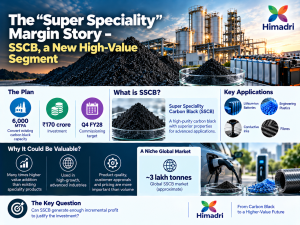
Why Himadri Is Moving Into Super Speciality Carbon Black?
Carbon black is used across industrial applications, but different grades serve different performance requirements. Conventional grades are used extensively in rubber and other industrial products, while speciality grades are developed for more specific applications involving properties such as colour, conductivity and material performance.
SSCB targets applications requiring more specialised material characteristics, including high purity and carefully controlled morphology. These properties can matter in engineering plastics, conductive fibres, coatings, inks and energy-storage applications.
The commercial opportunity comes from solving a more demanding customer problem. When a material must meet precise technical specifications, consistent quality and application performance can become important purchasing criteria. This can create room for premium pricing, although the actual premium depends on the product grade, competing suppliers and customer requirements.
Management has described the economics in unusually strong terms: “the value addition is multi-fold of the existing speciality” and there is “no comparison between speciality margins and super speciality margins.”
These statements explain the strategic direction, but they do not quantify the margin Himadri will earn. A higher selling price does not automatically translate into a proportionately higher operating profit. Production costs, yields, quality control, customer-specific requirements and the level of utilisation will determine how much additional value the company retains.
The real investment question is whether Himadri can establish a commercially accepted product that consistently earns a higher contribution per tonne than the carbon black grades it replaces.
A 3 Lakh-Tonne Market With a Clear Capacity Constraint
Management puts the global SSCB market at approximately 300,000 MT. Himadri plans to manufacture 6,000 MTPA, equivalent to approximately 2% of that stated market when comparing annual capacity with annual market volume.
That comparison provides a useful starting point, but it should not be interpreted as a forecast of market share. Installed capacity does not guarantee production, and production does not guarantee sales. Himadri will need to demonstrate that its specific grades can meet customer requirements and compete successfully in the markets it is targeting.
The relatively small market makes customer adoption particularly important. At full utilisation, the proposed facility would produce 6,000 tonnes annually. That volume is manageable relative to the stated global market, but Himadri still needs to secure sufficient demand for its particular products.
An important disclosure gap remains: the information available for this analysis does not establish named SSCB customers, completed qualification milestones, committed purchase volumes or binding offtake agreements. This does not mean customer discussions or trials are absent; it means their status and commercial scale cannot be quantified from the available disclosures.
Investors should therefore distinguish between the existence of a global market and evidence that Himadri has secured access to it. Customer approvals, initial commercial sales and repeat orders will provide stronger evidence than the market-size figure alone.
The ₹170 Crore Investment: What Return Must Himadri Earn?
Himadri plans to invest ₹170 crore to convert 6,000 MTPA of existing carbon black capacity into SSCB. That works out to approximately ₹2.83 lakh of capital expenditure per tonne of annual capacity.
To judge whether the investment is worthwhile, investors need a financial hurdle. One simple approach is to calculate the annual incremental contribution required to equal different percentages of the ₹170 crore investment.
Simplified investment-return hurdle
| Target annual contribution as a percentage of capex | Required annual incremental contribution |
| 10% | ₹17 crore |
| 15% | ₹25.5 crore |
| 20% | ₹34 crore |
These are simplified hurdle calculations, not a formal return on capital employed (ROCE) calculation. They do not account for depreciation, taxes, working capital, additional fixed costs, the timing of cash flows or the possibility that the project takes time to reach full utilisation.
Still, they establish a useful benchmark. At full utilisation of 6,000 tonnes, Himadri would need an incremental contribution of approximately ₹28,333 per tonne to generate ₹17 crore annually. For ₹25.5 crore, the requirement rises to ₹42,500 per tonne; for ₹34 crore, it reaches approximately ₹56,667 per tonne.
The word incremental is critical here. The relevant contribution is the additional amount SSCB earns over the contribution that the same capacity could have generated from its existing alternative use. It is not simply SSCB's total contribution.
How utilisation and contribution interact
The following sensitivity shows the annual incremental contribution under different utilisation levels and assumed incremental contribution per tonne.
| Utilisation | Annual output | ₹25,000 per tonne | ₹50,000 per tonne | ₹75,000 per tonne |
| 50% | 3,000 tonnes | ₹7.5 Cr | ₹15 Cr | ₹22.5 Cr |
| 70% | 4,200 tonnes | ₹10.5 Cr | ₹21 Cr | ₹31.5 Cr |
| 100% | 6,000 tonnes | ₹15 Cr | ₹30 Cr | ₹45 Cr |
All contribution figures are illustrative analyst scenarios, not company guidance or disclosed SSCB margins. They assume the stated contribution is incremental to the alternative product's contribution and exclude additional fixed costs, depreciation, interest and tax.
The comparison reveals how dependent the project is on both pricing economics and customer adoption.
At ₹25,000 of incremental contribution per tonne, even full utilisation would generate ₹15 crore annually, below the ₹17 crore hurdle corresponding to 10% of capex, at ₹50,000 per tonne, full utilisation would generate ₹30 crore, exceeding the 15% hurdle of ₹25.5 crore but remaining below the ₹34 crore hurdle for 20%, at 70% utilisation and ₹50,000 of incremental contribution per tonne, annual contribution would be ₹21 crore. That exceeds the 10% hurdle but falls short of the 15% hurdle.
These comparisons are not forecasts. They demonstrate why a premium product is not enough on its own: the contribution premium must be large enough, and sufficient tonnes must be sold, for the investment to meet the desired return threshold.
The Hidden Cost of Converting Existing Capacity
One of the most important details in this project is that Himadri is converting existing carbon black capacity rather than adding 6,000 MTPA to its overall production capacity. The company has indicated that its total carbon black capacity remains 2,50,000 MTPA, with the proposed SSCB production coming from within that base.
This strategy could improve the product mix without increasing total installed capacity. However, it also creates an opportunity cost: the capacity being converted would otherwise have been available to manufacture other grades.
Suppose the existing grade earns a contribution of ₹X per tonne and SSCB earns ₹Y per tonne after variable costs. The economic benefit of the conversion would be based on the difference between the two, multiplied by the volume sold, and adjusted for additional costs associated with producing and selling SSCB.
If the new product earns a contribution of ₹50,000 per tonne but the existing grade already earns ₹20,000, the incremental contribution would be ₹30,000 per tonne—not ₹50,000. At 6,000 tonnes, that difference would generate ₹18 crore annually before additional fixed costs and other expenses.
This is an illustration of the opportunity-cost calculation, not an estimate of Himadri's existing or SSCB margins.
The available information does not disclose comparable contribution per tonne for the existing grades that would be displaced. Consequently, the project's true incremental return cannot yet be calculated reliably. Any investment-return model that treats the entire SSCB contribution as additional profit would overstate the benefit if the converted capacity was already generating a meaningful contribution.
This is the most important missing number in evaluating the project. Investors need the contribution from the alternative product, the expected SSCB contribution and the additional operating costs before the true financial benefit can be established. Check our latest video for more details.
Commissioning Is Not the Same as Meaningful Earnings
Himadri expects to commission its SSCB facility by Q4 FY28. However, commissioning will mark the start of the commercial journey, not necessarily the point at which the project begins making a meaningful contribution to earnings.
After the facility is commissioned, the company will need to establish that its SSCB grades meet customer specifications and can be produced consistently at commercial scale. Customer approvals and initial orders will then need to translate into repeat purchases before utilisation can build sustainably.
The challenge is that Himadri has not disclosed a detailed timeline for these stages. The available information identifies Q4 FY28 as the commissioning target but does not establish when customer qualifications will be completed, when initial commercial sales will begin, or how quickly the facility is expected to reach its intended utilisation.
This makes the period following commissioning an important uncertainty in the investment case. If customer approvals and repeat orders develop quickly, the company could begin realising the benefits of higher-value production sooner. If adoption takes longer, the ₹170 crore investment may take more time to generate meaningful incremental earnings.
Investors should therefore watch for three developments: confirmation that the facility has been commissioned, evidence of commercial sales and repeat orders, and disclosures showing how utilisation and incremental contribution are progressing. These indicators will provide a more reliable picture of the project's earnings potential than the commissioning date alone.
Until Himadri provides greater visibility on customer approvals, sales volumes and the ramp-up schedule, the time required to reach meaningful earnings remains unknown.
What Investors Should Watch?
The SSCB project offers Himadri a route to move further up the carbon black value chain. It targets a niche market, requires conversion of only a small part of the company's total carbon black capacity, and carries management's stated expectation of significantly higher value addition.
But the investment case still depends on evidence that has not yet been quantified in the available disclosures.
First, investors need to see whether the company can secure customer approvals and convert them into repeat sales. Second, actual contribution per tonne must be compared with the contribution from the existing grades being displaced. Third, utilisation must rise sufficiently to generate annual incremental contribution that justifies the ₹170 crore outlay.
The hurdle analysis provides a practical way to track progress. At full utilisation, ₹50,000 of incremental contribution per tonne would generate ₹30 crore annually, while ₹75,000 would generate ₹45 crore. At lower utilisation, the contribution falls proportionately. These scenarios show what the project could deliver under different assumptions, but they do not establish what Himadri will actually earn.
The Bottom Line
Himadri's SSCB opportunity is a bet on earning more from the same carbon black capacity. The ₹170 crore investment could support a meaningful product-mix upgrade, but the return depends on the incremental contribution over existing grades, the pace of customer qualification and the utilisation achieved after commissioning. Until those numbers become visible, the margin story remains a credible strategic ambition, not yet a demonstrated earnings outcome.