What Went Wrong with Unimech’s Management?
Unimech is entering a more complicated phase of its growth story, but its latest management disclosure raises a question that is different from whether its expansion strategy will work: are its management and reporting systems keeping pace with the company’s changing structure?
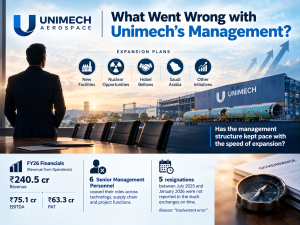
The September 7, 2026 filing revealed five senior-management cessations and one new senior-management designation. Four of the five departures were resignations that had already taken place between July 2025 and January 2026 but were disclosed only in September 2026. The company attributed the delay to an “inadvertent error.”
The episode deserves attention because these were not peripheral roles. They included technology and IT, business development and projects, operations and business-unit leadership. At the same time, Unimech was expanding its manufacturing base, entering nuclear applications, acquiring Hobel Bellows and developing its Saudi joint venture.
However, the evidence does not show that these departures have already disrupted execution. Q4 FY26 revenue from operations increased 143% sequentially to ₹81.8 crore, while Q1 FY27 revenue from operations reached ₹107.6 crore, up 31.5% sequentially.
Therefore, the real issue is narrower but more measurable: why did the company fail to report four senior-management resignations within the prescribed framework, and can it demonstrate that the resulting control weakness has been fixed?
The Five Departures Need To Be Examined Individually
The September filing provides a clearer picture than simply saying “six senior executives left.” Five people ceased to hold senior-management positions, while Jagadeesha HC was added to the senior-management structure.
| Person | Role | Cessation | What is disclosed |
| Ramesh Jaiswara | Business Unit Head | July 7, 2025 | Resignation |
| Ravi Bangalore Ramarao | Head & VP - Technology & IT | July 25, 2025 | Resignation |
| Ravi Kumar Vaddeswaram | AVP - Unimech SBU 2 | November 6, 2025 | Resignation |
| Sudhindra Vasantarao Kulkarni | AGM - Business Development, Projects & Customer Accounts | January 29, 2026 | Resignation |
| Sheshadri Nagaraja Nittoor | SCM Head & Business Unit Head | September 7, 2026 | Internal restructuring |
The four resigned executives had all been appointed as Senior Management Personnel on February 14, 2025. Their profiles show substantial relevant experience: Ramarao had more than 25 years in technology and digital transformation; Vaddeswaram had more than 28 years across operations, materials management, supply chain and quality; Kulkarni had more than 20 years covering nuclear, aerospace, defence and oil and gas; while Jaiswara had 27 years of multinational senior-management/CXO experience across aerospace, space, defence and advanced composites.
The company’s FY25 annual report also records Jaiswara joining on February 5, 2025 and Kulkarni on December 16, 2024.
For the individual reasons, the filing identifies the four cases simply as resignation. The attached correspondence gives more context for Ramarao: in his July 3, 2025 resignation email, he said there were gaps between Unimech’s expectations and his approach, noting that his entrepreneurial background had made him accustomed to faster, independent decision-making that did not always fit the company’s established frameworks.
For the other three resignations, the public filing does not provide a substantive individual reason beyond “resignation.” That distinction matters: investors should not infer a common cause when the disclosures do not establish one.
The Important Point: There Is No Evidence Yet of an Execution Breakdown
The earlier version of this article went too far by linking the departures directly to potential order or project delays. The available operating data does not establish that connection.
In fact, Unimech’s reported numbers point in the opposite direction over the most recent quarters.
Revenue from operations in Q4 FY26 rose to ₹81.8 crore from ₹33.7 crore in Q3 FY26, a 143% sequential increase. The company attributed the recovery to normalization in customer ordering and execution of the order book.
The improvement continued into Q1 FY27. Revenue from operations reached ₹107.6 crore, up 31.5% sequentially and 70.9% year-on-year. EBITDA increased to ₹39.25 crore, while the consolidated order book stood at ₹280.3 crore as of June 30, 2026.
The company also said the June-quarter order book was marginally lower than the earlier level because of strong execution during the quarter and customer pull-ins, rather than because of execution problems.
That makes the management issue more precise.
There is currently no disclosed evidence of orders being delayed because of these exits, capacity being stranded, customers being lost or projects being disrupted.
The concern is therefore not “management exits have already hurt execution.” It is whether the organisation can maintain this execution performance while replacing experienced people in functions that matter to technology, operations, projects, customer accounts and supply chain.
That distinction makes the analysis more defensible.
The Disclosure Delay Is More Serious Than the Word “Inadvertent” Suggests
The clearest governance issue is the reporting timeline.
Under Regulation 30 and Para A(7) of Part A of Schedule III of the SEBI LODR framework, changes involving senior management are required to be disclosed. For a resignation, the resignation letter and detailed reasons must also be disclosed within seven days from the date the resignation comes into effect. SEBI’s industry standards further clarify that the effective date for this purpose is the person’s last date with the listed entity.
The four relevant dates were:
- Ramesh Jaiswara: July 7, 2025 → disclosed September 7, 2026
- Ravi Bangalore Ramarao: July 25, 2025 → disclosed September 7, 2026
- Ravi Kumar Vaddeswaram: November 6, 2025 → disclosed September 7, 2026
- Sudhindra Vasantarao Kulkarni: January 29, 2026 → disclosed September 7, 2026
That means the disclosure did not merely miss the seven-day requirement; the September filing came more than a year after the earliest two cessations.
The company itself acknowledged the delay in each of these four cases and said it resulted from an “inadvertent error” that had since been identified and rectified through the September filing.
But the filing does not publicly describe a detailed root-cause analysis, a board-identified internal-control failure, disciplinary action or a specific new compliance mechanism. Therefore, it would be premature to say that the company has demonstrated a comprehensive remediation.
The investor question is straightforward: what changed inside the disclosure process after the error was identified? To know more, check our latest video.
The Sequence Also Shows Why Governance Monitoring Matters
There is another important detail in the timeline.
Unimech appointed all five of these people as Senior Management Personnel on February 14, 2025.
Within roughly five months, Jaiswara and Ramarao had ceased their roles. Vaddeswaram followed in November, and Kulkarni in January 2026. Nittoor remained until September 2026 before being removed from the senior-management category as part of an internal restructuring.
That does not establish that the organisation was unstable. But it does show a relatively rapid change in a management layer that had itself been formalised only in February 2025.
There is also evidence that Unimech has continued to strengthen the organisation. On September 7, 2026, it designated Jagadeesha HC as a member of senior management. He was already Senior Manager- Projects and has more than 25 years of experience spanning project management, manufacturing, procurement, supply chain, operations, engineering, tooling and production planning.
That appointment is particularly relevant because it provides a direct replacement within the project/operations skill set rather than leaving the filing as a simple list of departures.
Similarly, Nittoor’s cessation was explicitly linked to internal restructuring, not resignation. Nittoor had been the SCM Head and Business Unit Head and had more than 24 years of experience across engineering, manufacturing, quality, projects and supply-chain management.
The picture is therefore one of significant management change, but not enough evidence to attribute that change to one underlying problem.
Hobel Makes the Management Test More Concrete
Hobel Bellows is where management execution becomes particularly important.
The acquisition adds capabilities in metallic bellows, tubing, metal forming, hydroforming, tube bending and related manufacturing solutions. It also brings a separate customer and operating structure into Unimech.
The integration question is therefore not simply whether Hobel adds revenue. It is whether Unimech can preserve Hobel’s existing customer relationships while using its capabilities to expand the combined platform.
Management said in its acquisition update that Hobel integration had progressed well, while Q1 FY27 disclosures showed ₹100.1 crore of the ₹280.3 crore consolidated order book coming from Hobel.
That makes Hobel integration one of the clearest measurable tests for the next year.
Investors should watch:
- Hobel order-book conversion into revenue;
- capacity utilisation at the acquired business;
- retention of key customers and employees;
- cross-selling between Unimech and Hobel;
- margins after integration; and
- whether management changes occur without disrupting customer programmes.
This is more useful than repeatedly asking whether Unimech has enough “management bandwidth.” The numbers can show whether the integration is actually working.
What Should Investors Track in FY27-FY28?
The management story can now be tested using operating evidence rather than assumptions.
- Order-book conversion
The consolidated order book stood at ₹280.3 crore at June 30, 2026. Unimech said execution during Q1 had been strong. Future quarters need to show that the larger backlog continues converting into revenue without a deterioration in margins.
- Capacity utilisation
FY26 capacity utilisation was around 50-55%, according to the annual report, leaving significant installed capacity relative to current output. The key question is whether utilisation rises as qualification programmes move into serial production.
- Senior-management retention
The company needs to demonstrate that the September 2026 restructuring produces a stable management layer rather than another cycle of rapid exits.
- Hobel integration
The acquired business already accounted for ₹100.1 crore of the June 2026 order book. Its revenue conversion, utilisation and customer retention will provide a concrete test of integration quality.
- Disclosure discipline
This is the easiest governance metric to monitor. If future senior-management changes are disclosed within the required timelines and accompanied by the required resignation documentation and reasons, investors will have evidence that the process weakness has been corrected.
These indicators can tell investors far more than simply counting executive departures.
So, What Actually Went Wrong?
Based on the available disclosures, the strongest conclusion is not that Unimech’s management has failed.
The evidence does not support that claim.
The company delivered a sharp sequential recovery in Q4 FY26, followed by another strong Q1 FY27, and reported strong order-book execution.
What the September filing does establish is a management-reporting weakness: four senior-management resignations were not disclosed to the exchanges within the prescribed timeline, and the company subsequently attributed the lapse to an “inadvertent error.”
There is also a significant organisational transition underway. Four senior executives resigned, one senior executive was removed from the senior-management structure through internal restructuring, and a new senior-management member was designated on the same day.
The important unanswered question is therefore not why every executive left. Public disclosures simply do not establish a common reason.
It is whether Unimech’s controls, leadership succession and operating structure can support the next stage of growth.
That can be tested.
If order-book conversion remains strong, capacity utilisation improves, Hobel integrates without customer disruption, senior-management turnover stabilises and future disclosures are timely, the September episode may remain an isolated control weakness.
If those metrics deteriorate alongside further management churn or repeated disclosure lapses, the significance of the September filing would become much greater.
For now, the evidence points to a governance and management-control issue that requires monitoring, rather than proof of an execution failure.