Data Centers VS Water: The Hidden Crisis behind the AI Boom
Artificial intelligence is often described as a digital revolution. But the infrastructure powering it is anything but digital.
Behind every AI model are thousands of servers, massive data centres, electricity networks, cooling systems and increasingly, water infrastructure.
India is rapidly expanding its data-centre capacity as cloud computing and AI drive demand for computing power. But this expansion is happening in a country where water is already under severe pressure. Several of India’s largest data-centre hubs are located in cities that have experienced groundwater stress, municipal shortages or major water crises.
This creates a question that goes beyond environmental sustainability: can India build AI infrastructure at scale without turning water into another infrastructure bottleneck?
The answer will not simply depend on how much water data centres consume. It will depend on where they are located, how they are cooled, whether treated wastewater is available and who builds the infrastructure needed to make that water usable.
That is where the AI boom could create an unexpected opportunity for India’s water-treatment industry.
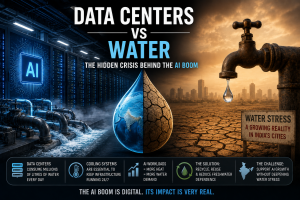
India’s AI Boom Is Creating a New Category of Water Demand
India’s operational data-centre capacity grew from about 0.4 GW in 2020 to about 1.5 GW in 2025. The expansion is expected to accelerate as hyperscalers, cloud companies and enterprises build infrastructure for AI workloads.
CBRE projected around 500 MW of new data-centre supply in 2026, with India’s capacity expected to reach 1.7-2.0 GW by the end of the year.
The longer-term projections vary widely. Base-case scenarios in the source material place India’s capacity at 4-5 GW by 2030, while AI-accelerated scenarios reach 8-9.2 GW.
This variation itself is important. Nobody knows exactly how quickly AI infrastructure will scale.
But every scenario points in the same direction: India will operate significantly more computing capacity than it does today.
That means more electricity, more heat and more cooling infrastructure.
The traditional discussion around this expansion focuses on power availability. But a data centre is not simply a building connected to the electricity grid. In India’s climate, keeping servers operating at the required temperature can create a substantial water-management requirement.
The AI boom is therefore creating a new form of infrastructure demand, one that sits at the intersection of digital infrastructure and water infrastructure.
Why the Water Numbers Look Conflicting and What They Actually Measure
Data-centre water figures can look contradictory because different estimates measure different facilities, cooling systems and definitions of water use.
The source material contains several figures:
- Karnataka’s IT Minister stated in March 2026 that each MW of data-centre capacity requires about 25 million litres of water annually.
- Another estimate places a 1 MW facility at about 68,500 litres per day.
- CEEW cited a typical 100 MW hyperscale facility consuming about 20 lakh litres per day for cooling.
- India’s data centres were estimated to consume 150 billion litres in 2024-25.
The first two numbers are essentially the same measure expressed differently. 25 million litres annually per MW equals about 68,493 litres per day, almost identical to the separate 68,500-litre figure.
The 100 MW example is lower on a per-MW basis because water consumption varies according to:
- Cooling technology
- Local temperature
- Facility design
- Operating utilisation
- Water-efficiency systems
- Whether the number measures direct cooling water or a broader footprint
There is therefore no universal number for “water consumed per MW.”
This is an important conclusion because India’s future data-centre fleet will not have identical cooling designs.
The real problem is not finding one perfect water-consumption number. It is the lack of standardised reporting that would allow investors, cities and regulators to compare facilities properly.
That is why Water Usage Effectiveness, or WUE, could eventually become as important to data-centre sustainability reporting as energy efficiency.
The Real Crisis Is Where India’s Data Centres Are Being Built
Water consumption becomes a serious infrastructure problem when it is concentrated in regions where water is already under pressure.
More than 65% of India’s data-centre capacity is concentrated in major hubs including Mumbai, Chennai, Hyderabad, Bengaluru and Noida, according to the source material.
Several of these regions have already experienced serious water challenges.
- Bengaluru experienced a major water crisis in 2024.
- Chennai faced its “Day Zero” crisis in 2019.
- Hyderabad faces a projected 870 MLD municipal water shortfall by 2027.
- Groundwater pressure has emerged as a concern around expanding development in Greater Noida.
This does not mean a data centre cannot be built in these cities.
That distinction matters.
Operators can install more efficient cooling systems, purchase treated wastewater or invest in dedicated treatment infrastructure. But each alternative introduces additional infrastructure requirements and costs.
Water therefore becomes a location constraint only under specific conditions: when municipal supply is constrained, groundwater cannot be relied upon and adequate treated-water infrastructure does not exist.
This makes water fundamentally different from a simple environmental metric.
A city may have strong fibre connectivity, available land and electricity, yet still become a more expensive location if operators must build extensive infrastructure to secure a reliable non-potable water supply.
Why AI Makes the Cooling Problem More Important
The water challenge is becoming more significant because AI changes the nature of computing infrastructure.
AI workloads rely on highly intensive computing systems. Dense clusters of advanced processors generate substantial heat, increasing the importance of cooling infrastructure.
More computing density means more thermal management.
In India’s climate, where ambient temperatures can be high, cooling becomes particularly important. Many facilities use cooling systems where water plays a direct role, including evaporative cooling. According to the source material, roughly 80% of water used in evaporative cooling systems evaporates.
That creates a fundamental distinction between electricity and water. Electricity can increasingly be generated from renewable sources. But renewable power alone does not solve the water problem created by cooling. A data centre could theoretically reduce its carbon footprint while continuing to depend heavily on freshwater.
This means the next phase of AI infrastructure has two separate resource challenges:
- How efficiently does it use electricity?
- How efficiently does it use water?
India has focused heavily on the first question because power is an obvious infrastructure constraint.
The second question is becoming equally important because AI infrastructure is increasingly concentrated in cities where water demand is already rising from households, industry and urbanisation.
India’s Untreated Wastewater Could Become a Strategic Resource
India’s water problem is not simply one of insufficient water. It is also a problem of insufficient water recycling infrastructure.
According to the CPCB baseline in the source material, India generates 72,368 MLD of urban sewage.
But:
- Installed STP capacity is 31,841 MLD.
- Operational capacity is 26,869 MLD.
- Actually utilised treatment capacity is only 20,235 MLD.
This leaves approximately 52,133 MLD of urban sewage untreated.
For the data-centre industry, this gap represents an important opportunity.
Data centres do not necessarily require drinking-quality water for every operational use. Cooling applications can potentially use treated water when the required quality standards are achieved. But the opportunity is often misunderstood. The existence of wastewater does not automatically mean it can be used by a data centre.
The water must first be:
Collected → treated → upgraded to the required quality → transported → stored → monitored
This is where India’s wastewater deficit becomes directly connected to the AI boom. India is simultaneously building more water-intensive digital infrastructure while leaving a large volume of potentially reusable wastewater underutilised.
The long-term solution is therefore not simply finding more freshwater for AI. It is building the infrastructure that turns wastewater into a reliable industrial resource.
How Much Data-Centre Water Can Realistically Be Replaced?
The idea that data centres can simply replace freshwater with recycled water is too simplistic.
A cooling system requires water of specific quality. Poor-quality water can cause scaling, corrosion and biological growth, potentially damaging expensive cooling infrastructure.
The actual process is therefore more complex than:
Freshwater → Recycled water
A typical reuse chain can involve:
Municipal sewage → STP → tertiary treatment → transmission → storage → additional polishing or RO → cooling application
The amount of freshwater that can be replaced depends on:
- Cooling technology
- Quality of available treated wastewater
- Distance between the treatment source and the data centre
- Transmission infrastructure
- Additional treatment requirements
- Reliability of supply
The source material notes that systems can recover 70-90% of cooling-tower blowdown and RO reject, while closed-loop systems can return 90-95% of withdrawal.
These figures show what advanced water-management systems can achieve. They should not be interpreted as meaning that every Indian data centre can automatically eliminate 90-95% of its freshwater requirement.
The practical opportunity is more specific: reduce freshwater dependence wherever treated water can be made technically reliable and economically viable.
That distinction is crucial because the infrastructure required to achieve this substitution is where the commercial opportunity begins.
The Real Opportunity Is the Infrastructure Between the Sewage Plant and the Data Centre
The AI boom does not create demand only for water.
It creates demand for an entire water-management ecosystem.
A large data-centre campus shifting towards treated-water reuse may require:
- Sewage treatment capacity
- Tertiary treatment
- Pipelines connecting treatment plants to the facility
- Storage reservoirs
- RO and membrane systems
- Cooling-water treatment chemicals
- Water-quality monitoring
- Automation systems
- Long-term O&M services
This creates a much broader opportunity than conventional water EPC.
A treatment plant may generate one-time construction revenue. But operating a water-reuse system creates continuing demand for chemicals, membranes, maintenance and monitoring.
That difference is important for investors.
India’s conventional water EPC industry has been heavily dependent on government contracts, where payment delays and receivable cycles have damaged the financial performance of several companies.
Data centres represent a different type of customer.
Water infrastructure becomes directly linked to the operation of an expensive commercial asset. A failure in cooling or water quality can affect the availability of computing infrastructure worth far more than the treatment system itself.
That could make water treatment for data centres a higher-quality opportunity than simply another government-funded construction contract.
Who Pays for the Water Infrastructure?
The economics of data-centre water infrastructure are fundamentally different from municipal water projects.
In a government EPC project, a contractor may construct infrastructure and then wait for payments from state agencies or local authorities.
In a data-centre project, the operator has a direct commercial incentive to secure reliable water infrastructure because computing capacity cannot operate without effective cooling.
The cost can therefore be borne through several layers:
- The data-centre developer can build on-site infrastructure.
- A water-treatment company can design and operate the system.
- A municipal body can supply treated wastewater through dedicated infrastructure.
- A specialised operator can provide water through a long-term service arrangement.
The source material does not provide a standardised India-wide rupee cost for installing data-centre water-reuse infrastructure. Therefore, it would be inaccurate to invent a national capex figure.
But the economic opportunity can still be understood clearly.
Every additional GW of data-centre capacity potentially creates demand not only for initial treatment infrastructure but also for recurring services throughout the facility’s operating life.
The revenue opportunity is therefore spread across:
Capex + equipment + consumables + chemicals + membranes + monitoring + O&M
This makes the AI-water opportunity potentially more attractive to companies with recurring technology and service businesses than to companies dependent entirely on one-time EPC revenue.
Which Indian Companies Could Actually Benefit?
The opportunity will not be distributed equally across India’s water sector.
Ion Exchange: The Most Direct Technology Fit
Ion Exchange has explicitly identified data centres as a target customer segment alongside semiconductors, solar and green hydrogen.
Its positioning extends across:
- Water treatment
- Ion-exchange resins
- RO systems
- Industrial water management
- Chemicals and consumables
This gives it exposure not only to the initial installation of treatment systems but potentially to recurring requirements for resins, chemicals and maintenance.
That recurring component is important because data centres operate continuously.
VA Tech Wabag: Large-Scale Treatment and Reuse
VA Tech Wabag operates across water and wastewater treatment, reuse, desalination and zero-liquid-discharge systems.
Its potential opportunity could emerge at the infrastructure level, particularly if cities develop common treated-water systems serving large industrial and data-centre clusters.
Wabag’s broader customer strategy is also relevant. The company has focused on sovereign, multilateral and central-agency-backed projects rather than state-paymaster JJM-style contracts.
The Bigger Opportunity May Be Beyond EPC
Traditional EPC companies can benefit from constructing treatment plants.
But recurring-value businesses could potentially benefit more from:
- Membranes
- Resins
- Water-treatment chemicals
- Automation
- Monitoring
- O&M
AI infrastructure operates 24 hours a day. The water infrastructure supporting it must do the same.
That makes recurring technologies potentially more valuable than simply winning the largest construction order.
Water Can Become a Data-Centre Location Constraint But Not Automatically
The claim that water will become a location constraint needs to be made carefully.
Water will not prevent every data centre from being built in a stressed region. Operators have alternatives.
They can:
- Use treated wastewater
- Build on-site treatment systems
- Deploy different cooling technologies
- Invest in water recycling
- Secure dedicated water infrastructure
But alternatives are not free.
Water becomes a genuine economic constraint when the cost and complexity of securing a reliable supply begin to change the attractiveness of a location.
Three factors are particularly important:
- Local municipal water stress
Hyderabad’s projected 870 MLD shortfall by 2027 demonstrates how rapidly urban demand can exceed available supply.
- Groundwater limitations
Groundwater cannot be treated as an unlimited backup for expanding industrial infrastructure.
- Availability of treated-water infrastructure
This may ultimately be the most important factor.
A city can generate large volumes of sewage but still be unable to support industrial reuse if it lacks adequate treatment plants, tertiary treatment and transmission infrastructure.
This creates a new competitive equation.
A city with reliable treated-water infrastructure may become a more attractive data-centre location than one with cheaper land but no dependable water-reuse ecosystem.
That is how water can become a location constraint not because a city literally runs out of water overnight, but because securing reliable cooling water becomes increasingly expensive and complex.
Where the Economic Opportunity Actually Sits
The AI-water opportunity should not be viewed as one giant market for water-treatment EPC companies.
The value is spread across the infrastructure chain.
One-time capital expenditure
This includes:
- STPs
- Tertiary treatment
- RO systems
- Membranes
- Pipelines
- Storage systems
Recurring operating expenditure
This includes:
- Water-treatment chemicals
- Membrane replacement
- Resins
- Testing
- Monitoring
- Maintenance
- O&M
The second category could ultimately be more important from a business-quality perspective.
A traditional EPC contractor benefits when a project is constructed. A company selling consumables and operating services can remain connected to the customer throughout the life of the facility. This is also where data centres differ from the government water cycle.
The source material shows how India’s water EPC sector has suffered from delayed government payments, with sector-wide dues estimated at ₹30,000- 35,000 crore during the JJM funding disruption.
Data centres potentially offer the opposite customer profile: commercially financed private infrastructure where water treatment is operationally necessary.
The AI boom could therefore improve not only the quantity of demand for water companies, but also the quality of the customer base.
The Real Test for India’s AI Boom
India does not have to choose between becoming an AI powerhouse and protecting its water resources. But it cannot treat water as an afterthought. The next generation of data-centre development will increasingly require three things.
First: Measure water properly
India needs more consistent disclosure of water use and Water Usage Effectiveness.
Without comparable data, it is impossible to identify which facilities are efficiently managing water and which are simply shifting pressure onto local resources.
Second: Build reuse infrastructure
The critical infrastructure is not only inside the data centre.
Cities need:
- More treatment capacity
- Better tertiary treatment
- Pipelines for treated-water distribution
- Reliable industrial reuse systems
Third: Include water in location planning
Power, land and fibre connectivity already influence where data centres are built.
Water availability and, increasingly, the availability of treated water, needs to become part of the same planning process.
The irony is that India already has the raw material for a large reuse economy. It generates 72,368 MLD of urban sewage, while only 20,235 MLD of treatment capacity is actually utilised according to the CPCB baseline in the source material.
India’s AI challenge may therefore be less about finding new water and more about building the systems required to use existing water more intelligently.
Conclusion: AI’s Next Infrastructure Problem May Be Invisible
The AI boom is usually measured in megawatts, chips and billions of dollars of investment.
But its next major infrastructure challenge may be measured in litres.
India’s data-centre capacity is expanding rapidly, while many of its most important digital hubs already face pressure on water resources. The conflict becomes more serious as AI increases computing density and cooling requirements.
Yet the story is not simply one of data centres consuming too much water.
The deeper issue is whether India can build the infrastructure required to separate AI growth from freshwater consumption.
That means connecting two industries that have historically been discussed separately:
Data centres need reliable cooling.
Cities generate wastewater.
Water-treatment infrastructure can potentially connect the two.
For India’s water industry, this could create a new private-sector demand engine across treatment systems, membranes, chemicals, automation and long-term O&M.
But the opportunity will not automatically go to every water EPC company.
The likely winners will be those with technology, recurring revenue capabilities and the ability to deliver reliable water quality, rather than simply the largest order books.
The AI revolution may be digital.
But whether India can scale it sustainably could increasingly depend on one of the country’s oldest infrastructure problems: what it does with its water.