Steps Aarti Industries Is Taking To Make India Less Dependent On China
China’s dominance in chemicals is not only about finished products. The bigger dependence can sit deeper in the supply chain; in intermediates, feedstocks and specialised chemistries that Indian manufacturers may still need to source from overseas.
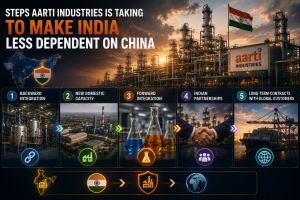
Aarti Industries is trying to address this from the manufacturing side. Its strategy involves backward integration, new domestic capacity, forward integration, Indian partnerships and long-term contracts with global customers.
The important point is that Aarti is not trying to eliminate China from its supply chain overnight. Instead, it is building Indian manufacturing capabilities that give global customers an alternative to Chinese supply.
How Much Of The China-Substitution Opportunity Can Aarti Actually Capture?
India’s chemical import dependence is large, but it would be misleading to treat the entire opportunity as Aarti Industries’ addressable market. Aarti’s FY25 annual report notes that India imports about 45% of its petrochemical intermediates, while the company operates across a much narrower set of speciality and intermediate chemicals.
The more useful question is therefore what Aarti’s identified projects can add to the business.
| Project | Investment / contract value | What it can contribute |
| Backward integration project | ₹200-250 crore capex | No material top-line increase; Aarti expects EBITDA-margin improvement |
| PEDA | 4,000 TPA capacity | New downstream revenue opportunity; company has not disclosed project revenue |
| Aarti-UPL JV | ₹300 crore total investment | Peak annual revenue potential of ₹400-500 crore, according to Aarti |
| Global agrochemical contract | US$150 million through March 31, 2030 | Contracted revenue visibility; no significant incremental capex |
The financial significance is therefore different for each project.
The US$150 million contract is the clearest revenue contributor because the customer has already committed to a multi-year supply arrangement. The UPL JV has a disclosed revenue potential, but that revenue is expected to build over 2-3 years after commercialisation, rather than appearing immediately.
The ₹200-250 crore backward-integration project is different. Aarti explicitly says it is not expected to materially increase revenue; its benefit should instead come through better EBITDA margins over the residual 15-year contract period.
That distinction matters. These projects should not be added together and presented as one giant “China replacement” opportunity. They affect Aarti’s financials through different channels- revenue growth, margin expansion and capacity utilisation. Check our latest video to know more.
Backward Integration Is More About Margins Than Revenue
Aarti’s ₹200-250 crore backward-integration project is one of the clearest examples of why “China substitution” should not automatically be equated with additional sales.
Under its long-term agreement with a global chemical company, Aarti previously received one critical feedstock from the customer. It will now manufacture a significant share of that feedstock itself at Dahej SEZ, Gujarat. The company expects the project to be completed over the next two years.
The financial logic is explicit: Aarti does not expect material top-line growth from this project. Instead, it expects higher EBITDA margins through lower external sourcing, freight and operating costs, with the benefit potentially extending across the residual 15-year agreement.
That makes this a margin-and-capital-efficiency project rather than a revenue project.
There is, however, an important limitation. Aarti has not disclosed the incremental EBITDA expected from the ₹200-250 crore investment. Therefore, it is not possible to calculate a project-specific ROCE from the company’s public disclosure without making assumptions.
That is worth highlighting rather than hiding.
The project can strengthen Aarti’s economics because it removes an external step from the manufacturing chain. But whether the investment ultimately creates attractive returns will depend on the cost savings achieved and the utilisation of the new facility.
In other words, the project strengthens the moat only if the integration translates into measurable cost and margin advantages.
PEDA Gives Aarti a More Direct China-Substitution Opportunity
Among Aarti’s new projects, PEDA provides one of the clearest links between new Indian capacity and Chinese supply.
Aarti is commissioning a 4,000-tonne-per-annum PEDA (2-Phenyl Ethyl Diethyl Aniline) facility at Dahej SEZ. The company describes it as forward integration of its existing commercial 2,6 Diethyl Aniline business and says it expects to become a key domestic supplier for the product.
The China connection is unusually direct. India’s Directorate General of Trade Remedies investigated imports of PEDA and pretilachlor from China and concluded that the products imported from China were causing injury to the domestic industry. India subsequently imposed anti-dumping duties on the Chinese products for five years.
That makes PEDA more than a generic capacity-expansion story: there is already documented Chinese import competition in the product chain.
But the financial opportunity needs to be treated carefully. Aarti has disclosed the 4,000 TPA capacity, but it has not publicly disclosed the project’s revenue, EBITDA or expected ROCE. Therefore, it would be inaccurate to convert the capacity into a revenue number without assuming a selling price and utilisation rate.
The stronger conclusion is narrower: PEDA gives Aarti an identifiable product-level opportunity to replace part of China’s supply in an area where India has already taken trade-remedial action.
The UPL JV Gives Aarti a Route to Scale Without Building the Entire Chain Alone
Aarti’s partnership with UPL is financially more tangible than simply calling it a China+1 initiative.
The two companies established a 50:50 joint venture, committing ₹150 crore each, taking the total investment to ₹300 crore. The JV manufactures downstream derivatives of amines used in agrochemicals and paints. Commercial supplies were scheduled to begin in Q1 FY27, with the companies stating a peak annual revenue potential of ₹400-500 crore in the 2-3 years following commercialisation.
That gives the project a potential revenue scale equivalent to roughly 4.4%-5.5% of Aarti’s FY26 revenue of ₹9,018 crore but this is a comparison of the disclosed potential with current revenue, not a forecast of Aarti’s own revenue contribution.
The more interesting advantage is how the JV is structured. Aarti and UPL both provide key raw materials, allowing the partners to combine their existing capabilities rather than building an entirely new supply chain independently.
This can improve the economics of competing with established Chinese suppliers because the JV starts with two companies that already have manufacturing infrastructure, chemistry expertise and customer relationships.
However, the ₹400-500 crore figure is a peak annual revenue potential, not revenue already earned. The real test will be how quickly the JV ramps up, what margins it earns and whether its return on the ₹300 crore investment clears Aarti’s stated group-level ROCE objective.
Securing Indian Feedstock Through Long-Term Domestic Supply Infrastructure
Not every supply-chain risk should be solved through backward integration.
Aarti has also chosen long-term partnerships to secure critical raw materials.
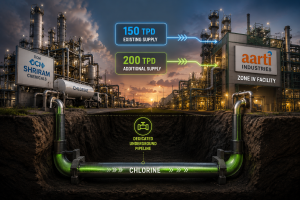
In September 2025, Aarti and DCM Shriram agreed on a long-term chlorine supply arrangement for Aarti’s upcoming Zone IV downstream facility. Once fully operational, Aarti is expected to purchase an additional 200 tonnes of chlorine per day, over and above the 150 tonnes per day it already purchases from DCM Shriram Chemicals. A dedicated underground pipeline is being established between the facilities.
This is significant because the objective is not simply to “buy chlorine.”
Aarti is creating a predictable domestic feedstock link directly into its manufacturing facility.
That reduces exposure to the logistics and availability risks associated with transporting critical chemicals over long distances or depending on uncertain external sourcing.
It is another way of making Indian production more reliable: secure the raw material first, then scale the downstream chemistry.
The $150 Million Contract Is the Clearest Revenue Visibility
Aarti’s US$150 million multi-year supply agreement with a global agrochemical innovator is arguably the clearest financial link between its manufacturing capabilities and global supply-chain diversification.
The agreement runs through March 31, 2030 and covers a critical agrochemical intermediate used in crop-protection formulations. Aarti says the contract will generate approximately US$150 million of revenue over the contract period, with significantly higher volumes than the earlier annual engagement. Importantly, the company says this does not require significant incremental capex.
That combination matters.
Unlike the ₹200-250 crore backward-integration project, this contract is primarily a revenue-visibility opportunity. Unlike the UPL JV, the company has already secured a customer commitment for the specified contract period.
There is also a capital-efficiency angle: additional revenue from an existing manufacturing platform without significant incremental capital expenditure can improve asset utilisation and potentially support returns on capital.
But the contract should not be presented as ₹150 million of pure China-replacement revenue. Aarti has not disclosed that the entire contract represents business directly shifted from China.
The defensible conclusion is that the agreement demonstrates something more important: a global agrochemical company is willing to commit multi-year volumes to Aarti for a critical intermediate. That is evidence that Aarti can win business in the same global supply chains where China has historically been a major manufacturing base.
What Actually Gives Aarti an Edge Over Chinese Suppliers?
Aarti’s advantage over Chinese suppliers cannot simply be described as “backward integration”. That capability is valuable only if it translates into lower delivered cost, consistent quality or lower switching risk for customers.
There are four more tangible advantages.
- Scale and breadth: Aarti says it has 16 manufacturing facilities in India, 100+ products and customers across 60+ countries, giving it a broader manufacturing base than a single-product speciality chemical company.
- Complex-chemistry capability: Aarti has spent four decades developing process chemistry and scale-up expertise. Its FY25 report highlights the commercialisation of fluorination, photochemistry and the Balz-Schiemann reaction, while its manufacturing model covers multiple chemistry platforms.
- Customer qualification: The strongest evidence of competitiveness is not an internal claim about technology; it is customer behaviour. A global chemical company has extended a long-term arrangement with Aarti into backward integration, while another global agrochemical innovator has committed US$150 million through 2030.
- Integrated supply: Aarti can combine upstream feedstocks, process chemistry, manufacturing and customer-specific products. Its own manufacturing-partnership material also highlights flexible multipurpose plants, complex-chemistry expertise, scale and global regulatory compliance.
These are genuine competitive advantages but not an impenetrable moat.
Chinese manufacturers retain a major advantage in scale and can cut prices when domestic demand is weak. Aarti’s FY25 annual report itself acknowledges that increased Chinese imports created pricing pressure and affected margins.
Therefore, Aarti’s competitive test is not whether it can produce a chemical in India. It is whether it can produce it consistently enough, cheaply enough and with sufficient customer qualification to make a global buyer stay with Aarti even when Chinese prices fall.
What Could Stop the China-Substitution Thesis From Working?
The China-substitution story is attractive, but it is not guaranteed to translate into superior returns for Aarti.
- Chinese price competition is the biggest risk. Aarti’s FY25 annual report explicitly says low-cost Chinese imports pressured prices and segment margins. If Chinese producers reduce prices aggressively again, Indian manufacturers may gain volumes without gaining adequate margins.
- Demand recovery is another variable. Aarti’s end markets include agrochemicals, polymers and other industrial applications. Weak downstream demand can delay customer orders even when Aarti has new capacity available.
- Capital intensity also matters. Aarti has been investing heavily in expansion. CRISIL reported that Aarti’s capex during FY25-FY27 was expected to be around ₹2,800 crore, partly debt-funded, while Aarti has targeted a group-level ROCE of more than 15% alongside its longer-term EBITDA target.
That makes execution critical. A delayed plant, slow customer qualification or lower-than-expected utilisation can keep capital tied up without generating the expected returns.
And there is a final risk: not every new Aarti project is China substitution. The ₹200–250 crore backward-integration project, for example, is primarily a margin-improvement initiative rather than a top-line growth project.
The China+1 thesis therefore has to clear two tests: Can Aarti win business from alternative suppliers? And can it earn an adequate return on the capital required to win it?
Conclusion
Aarti Industries is not reducing India’s dependence on China through one large import-substitution project. Its approach is more incremental: manufacture more inputs internally, move further downstream into products such as PEDA, create new speciality-chemical capacity with partners such as UPL, and secure long-term contracts with global customers.
The financial opportunity is already becoming measurable. The UPL joint venture has a stated peak annual revenue potential of ₹400-500 crore, while the US$150 million agrochemical contract provides revenue visibility through March 2030. The ₹200–250 crore backward-integration project, meanwhile, is designed primarily to improve margins rather than materially increase revenue.
But the bigger test is still ahead. Aarti has to commission its new capacity on schedule, secure customer qualifications, achieve sufficient utilisation and protect margins when Chinese suppliers compete aggressively on price.
That makes the China+1 opportunity a potential competitive advantage, not a guaranteed moat. If Aarti can turn its integrated manufacturing, complex-chemistry capabilities and global customer relationships into consistently profitable capacity, it can help shift more chemical production towards India. The real measure of success, however, will be the returns generated on that capacity not simply how much capacity is added.