Kaynes Technology: Decoding the Receivables Problem Behind the Stock Fall
Kaynes Technology is growing fast but its cash is struggling to keep up.
Revenue surged, orders remain strong, and the company is aggressively expanding into semiconductors, PCBs and smart metering. Yet behind that growth sits a balance-sheet warning that investors can no longer ignore: trade receivables jumped to ₹1,527.62 crore in FY26, while consolidated operating cash flow turned negative at ₹600.4 crore.
The bigger question is not whether Kaynes can book revenue. It is whether the company can convert that revenue into cash quickly enough to fund its next phase of growth.
And the answer may lie in one business in particular: smart metering.
The Stock Fell Despite 40% Revenue Growth, That Is The Real Clue
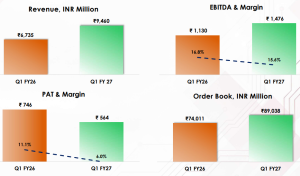
Kaynes Technology’s recent stock reaction is difficult to explain if revenue growth is viewed in isolation. In Q1 FY27, consolidated revenue increased 40.5% year-on-year to ₹946.02 crore, while EBITDA rose 31% to ₹147.6 crore. Yet PAT fell 24.4% to ₹56.43 crore and the EBITDA margin declined from 16.8% to 15.6%.
The market’s concern, however, goes deeper than the quarterly profit decline. Kaynes has a cash-conversion problem at a time when it is simultaneously spending heavily on capacity expansion.
The warning signs were already visible in FY26:
- Consolidated trade receivables rose from ₹574.58 crore in FY25 to ₹1527.62 crore in FY26.
- The increase of ₹953.04 crore was far faster than the 33.2% increase in revenue, which reached ₹3626.4 crore.
- The company’s consolidated operating cash flow turned negative at ₹600.4 crore in FY26, compared with negative ₹82.3 crore in FY25.
- Q1 FY27 did not completely solve the issue: management disclosed that rolling net working capital stood at 163 days, compared with 125 days at FY26-end.
That explains the stock reaction better than revenue growth does. Investors are not questioning whether Kaynes can generate sales. They are questioning how quickly those sales can become cash.
The Receivables Problem Is Bigger Than Normal Growth
The rise in Kaynes’ receivables cannot be explained by revenue growth alone.
Consolidated revenue increased from ₹2,721.8 crore in FY25 to ₹3,626.4 crore in FY26, an increase of ₹904.6 crore. Over the same period, consolidated trade receivables increased from ₹574.58 crore to ₹1,527.62 crore, a rise of ₹953.04 crore.
The important point is not simply that receivables increased. It is that the increase in receivables was larger than the increase in annual revenue.
That deterioration showed up clearly in Kaynes’ efficiency ratios. Trade receivables turnover fell from 5.85 times in FY25 to 3.45 times in FY26, with the company attributing the decline to an increase in its receivables cycle.
The consequence was visible in cash flow. Consolidated operating cash flow deteriorated to negative ₹600.4 crore in FY26 from negative ₹82.3 crore in FY25, as higher working-capital requirements absorbed cash.
But this is where the analysis needs to go beyond the headline numbers.
The problem does not appear to be spread evenly across Kaynes’ businesses. Q1 FY27 management commentary suggests that smart metering, not the core EMS business is driving most of the collection pressure.
That distinction changes the nature of the investment debate.
Smart Metering Is Where The Problem Concentrates
The Q1 FY27 numbers provide a much clearer picture of where Kaynes’ working-capital pressure is coming from.
At the beginning of the quarter, total receivables stood at ₹1,765 crore. By the end of the quarter, they had increased to ₹1,925 crore.
But the increase was not coming from the entire business.
EMS receivables were broadly stable, moving from ₹606 crore to ₹613 crore. Smart-metering receivables, however, increased from ₹1,158 crore to ₹1,311 crore.
That means ₹153 crore of the ₹160 crore increase in total receivables during the quarter came from the metering business.
The contrast with EMS is important. Management said the EMS business generated ₹854 crore of revenue, including GST, during the quarter and collected ₹847 crore. Smart metering generated around ₹240 crore of sales but collected only ₹88 crore during the quarter, although management said around ₹200 crore was subsequently collected in the first week of July.
This suggests Kaynes does not have a uniform collection problem.
Its core EMS business is converting sales into cash far more efficiently than the smart-metering business.
Management’s response also reflected this reality. Kaynes slowed supplies in the metering business despite having orders, prioritising collections over further growth.
That is a significant shift.
The company is effectively recognising that, at the current stage, adding more metering revenue without improving collections would increase pressure on the balance sheet rather than strengthen it.
Why Smart Meter Growth Is So Demanding on Cash?
The smart-metering business explains why Kaynes’ revenue growth and cash generation are telling two very different stories.
A traditional EMS business has a relatively straightforward cycle: components are procured, products are manufactured, delivered and eventually paid for.
Smart metering is more complicated.
Kaynes is involved in a longer project cycle that extends beyond manufacturing. The business includes equipment deployment, installation and service commitments, which means cash collection can depend on the progress of the wider project rather than simply on the production of a meter.
That difference matters because Kaynes may have to commit capital well before the full cash associated with the project is collected.
The Q1 FY27 numbers illustrate the gap. Smart metering generated around ₹240 crore of sales during the quarter, while the business carried ₹1,311 crore of receivables at quarter-end.
These two numbers should not be used to calculate a permanent “capital required per ₹100 of revenue,” because the receivables balance includes dues from earlier periods and ongoing contracts. But they clearly show that the business is carrying a far heavier cash burden than its current quarterly revenue would suggest.
This is the central risk in the metering model.
Revenue can grow rapidly while cash remains locked up in the business.
For Kaynes, that creates an uncomfortable possibility: the faster smart metering grows, the more capital the company may initially need to fund that growth.
That is fundamentally different from growth in a business where higher sales quickly translate into higher operating cash flow.
The Real Issue Is the Payment Cycle
The slow collection cycle is closely linked to the structure of the smart-metering business.
Unlike a conventional product sale, smart-meter projects involve multiple stages between manufacturing and final cash collection. Meters have to be supplied and deployed, projects have to move through installation and operational stages, and payments can depend on the contractual structure of the project.
This means Kaynes’ cash conversion is influenced by more than its own manufacturing efficiency.
The company can produce and supply meters on time and still face delays in converting that activity into cash if the broader project cycle moves slowly.
That creates a collection dependency that does not exist to the same extent in the core EMS business.
The result is visible in the receivables numbers. By the end of Q1 FY27, smart-metering receivables had reached ₹1,311 crore, more than twice the ₹613 crore of EMS receivables disclosed by management.
The important question is therefore not whether Kaynes has customers.
It clearly does. The question is how quickly those customers and projects convert into cash once revenue is generated.
This is also why management’s decision to slow metering supplies matters. It suggests the company is no longer willing to keep expanding the business without first improving the collection cycle. That may temporarily slow revenue growth. But if it reduces the amount of capital trapped in receivables, it could ultimately improve the quality of Kaynes’ growth.
Q1 FY27 Shows Why Investors Are Still Unconvinced
The June quarter provided some evidence of improvement but not enough to remove the concern.
Management said consolidated operating cash flow was negative ₹259 crore in Q1 FY27. Inventory consumed ₹177 crore and receivables accounted for a ₹68 crore cash shortfall in the management’s initial bridge.
At the same time, the company deliberately increased inventory because component shortages and long lead times were becoming more severe. Management said inventory days increased from 96 to 105 days and described the additional inventory as a strategic decision.
This creates a difficult balancing act.
On one side:
- EMS growth is strong.
- Q1 revenue rose 40.5%.
- Order book reached ₹890.38 crore.
- EMS collections were substantially better than metering collections.
On the other:
- Rolling net working capital reached 163 days.
- Consolidated receivables increased during Q1.
- Smart-metering receivables reached ₹1,311 crore.
- Operating cash flow remained negative.
This explains why a strong revenue quarter did not reassure the market.
The stock fell as much as 8.33% intraday on August 10 after the Q1 results, eventually closing at ₹3,735.10, down 3.14%.
The market was effectively saying: growth is visible; cash conversion is not yet proven. Check our latest video for more details.
The Bigger Risk Is Receivables, Inventory and Capex Happening Together
Receivables would be easier for Kaynes to manage if they were the company’s only major demand on cash.
They are not.
The company is simultaneously dealing with three large uses of capital: receivables, inventory and expansion capex.
Receivables remain the biggest concern. Consolidated trade receivables stood at ₹1,527.62 crore at the end of FY26, while management disclosed total receivables of ₹1,925 crore at the end of Q1 FY27.
Inventory is also consuming more capital. Management said inventory days increased from 96 to 105 during Q1 FY27 as the company built inventory to manage component shortages and longer supply-chain lead times.
At the same time, Kaynes remains in the middle of a major capacity-expansion cycle.
Management disclosed FY27 capex plans of:
- ₹300 crore for OSAT
- ₹300 crore for PCB
- ₹250 crore for EMS
That is ₹850 crore of planned FY27 capital expenditure.
The pressure becomes clear when these demands are viewed together.
Kaynes is investing cash before production through inventory, after sales through receivables, and outside working capital through new factories and technology capacity.
This does not mean the company faces an immediate funding crisis. Its balance sheet remains relatively lightly leveraged, and the earlier ₹1,600 crore QIP strengthened its financial position.
But it does raise a more important question:
Can future growth be funded increasingly through internal cash generation or will Kaynes need external capital to keep supporting both working capital and expansion?
What Investors Need to See Next
The receivables problem will not be resolved by another quarter of strong revenue growth.
Kaynes has already demonstrated that demand remains strong. The next test is whether that demand begins producing cash.
There are three numbers investors should watch closely.
1. Smart-metering receivables
The ₹1,311 crore balance is now the most important working-capital figure in the business.
A meaningful decline would show that management’s decision to prioritise collections is working. If the balance continues rising alongside revenue, it would suggest that the underlying business model remains heavily dependent on additional working capital.
2. Working-capital days
Kaynes reported a cash-conversion cycle of 125 days in FY26 and has stated a target of 100 days by FY28. However, rolling net working capital reached 163 days in Q1 FY27.
The direction of this number will matter more than management’s long-term target.
3. Consolidated operating cash flow
This is ultimately the clearest test. FY26 consolidated operating cash flow was negative ₹600.4 crore despite strong revenue and EBITDA growth. If profits continue rising but operating cash flow remains weak, investors will have stronger reasons to question the quality of that growth.
The positive scenario is straightforward: collections improve, smart-metering receivables decline and the core EMS business continues generating cash.
The negative scenario is equally clear: revenue grows, profits grow, but more and more capital remains trapped in working capital.
That is the dividing line Kaynes now needs to cross.
So, Is This a Temporary Problem or a Structural Weakness?
The evidence so far suggests that Kaynes’ receivables problem is concentrated, but it is not yet proven to be temporary.
That is the most important distinction for investors.
The positive evidence is that the core EMS business appears to have much better collection behaviour. EMS receivables remained broadly stable during Q1 FY27, while smart metering accounted for almost the entire increase in total receivables.
But the smart-metering numbers are still too large to dismiss as a routine quarterly issue.
Receivables in the business reached ₹1,311 crore, rolling net working capital reached 163 days, and Kaynes is simultaneously entering a major capex cycle.
This is not yet a company-wide structural weakness but it could become a structural weakness within the smart-metering business if growth continues to require permanently higher levels of working capital.
The proof will come from the next few quarters.
If smart-metering receivables begin declining, working-capital days move lower and consolidated operating cash flow turns sustainably positive, the current problem can reasonably be viewed as a growth-related spike.
If the opposite happens, revenue continues growing while receivables remain elevated and cash flow stays weak, the market will have to treat the problem differently.
At that point, the concern would no longer be delayed collections.
It would be the economics of the business itself.
Kaynes has already proved that it can grow revenue.
The next challenge is more difficult:
proving that growth can generate cash without demanding ever-increasing amounts of capital.