Real Stocks vs Tokenized Stocks: Ownership, Trading Hours and Investor Rights
Quick Answer
Real stocks represent an equity interest in the issuing company, normally held as beneficial ownership through a regulated broker, though direct registration is sometimes available.
A "tokenized stock" is not one product. It can mean an issuer-sponsored share recorded onchain, a token backed by shares held in custody, or a derivative that simply tracks a stock's price. Blockchain backing, 24/7 trading and dividend-like payments don't automatically make a token holder a shareholder — that depends on the legal structure behind the token.
Key Takeaways
- Ownership depends on the contract, not the label. A token called a "stock" isn't necessarily equity.
- Rights differ sharply. Real shareholders typically get voting, dividend and corporate-action rights; token holders get only what the issuer promises.
- Round-the-clock trading has trade-offs: better access, but often thinner liquidity and less reliable pricing outside U.S. market hours.
- "1:1 backed" describes collateral, not a legal claim. Ask who holds the shares and what happens if that entity fails.
Tokenization has moved past experimental crypto products and into regulated market infrastructure. The SEC's 2026 framework distinguishes issuer-sponsored tokenized securities from products created by third-party platforms, treating them as materially different in structure and holder rights.
That distinction has real consequences: in March 2026, the SEC approved a Nasdaq rule change permitting certain eligible securities to trade in tokenized form through a DTC pilot program, a sign that "tokenized stock" now spans multiple legal models, not one category.
This article applies one test throughout: what does the investor legally own, what rights follow, and what happens if an intermediary fails?
Real Stocks vs Tokenized Stocks: What Is the Main Difference?
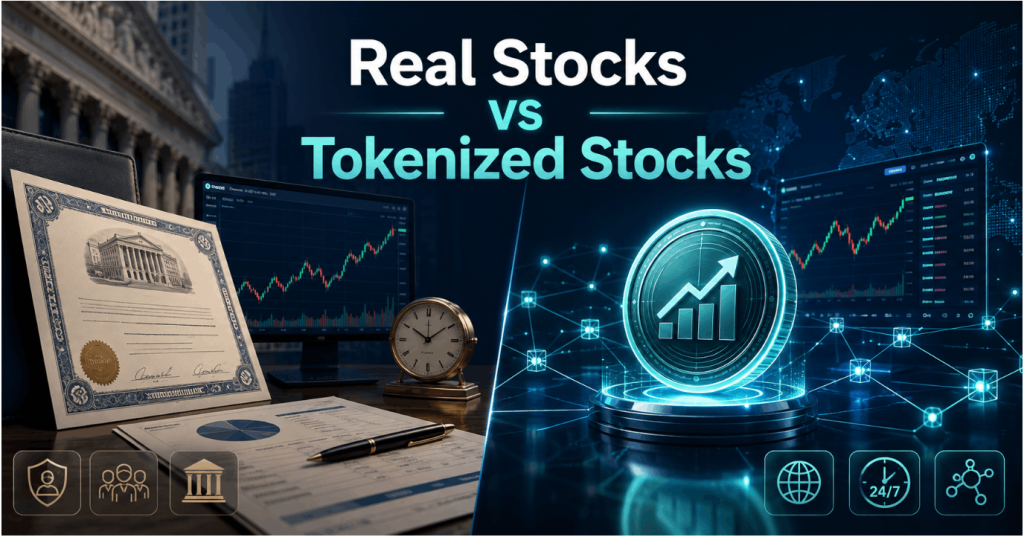
A real stock is an equity security issued directly by a company. A tokenized stock is a blockchain-based instrument whose relationship to that equity ranges from legally equivalent ownership to nothing more than price exposure.
- Real stocks represent a direct interest in the issuing company. The investor is either a registered owner or, more commonly, a beneficial owner holding through a broker. Investors looking to invest in US stocks from India should understand this ownership structure before comparing tokenized alternatives.
- Tokenized stocks describe a technology, not a single legal structure. Three models dominate: issuer-sponsored or native tokenized shares recorded onchain by the company itself; custodial or wrapped tokens issued by a third party against shares it holds; and synthetic tokens or derivatives that track a stock's price without conferring ownership.
Comparison point | Real stock | Tokenized stock |
Instrument issuer | Public company | Company, broker, token issuer or platform |
Legal ownership | Equity ownership | Depends on product structure |
Voting rights | Usually available | Often absent |
Dividend treatment | Cash or reinvestment | Cash, stablecoin, token rebase or no entitlement |
Trading access | Exchange and broker hours | Often 24/5; sometimes marketed as 24/7 |
Custody | Broker, bank or transfer agent | Platform, custodian or self-hosted wallet |
Main additional risk | Broker and market risk | Issuer, custodian, contract, blockchain and liquidity risk |
What Do Investors Actually Own With Each Product?
Investors need to identify which entity owes them an obligation, and whether their interest appears, directly or through an intermediary, in the company's actual shareholder records.
- Real shares are held through a brokerage account. Retail investors are usually beneficial, not registered, owners: the broker records the customer's interest while the shares remain registered under the broker, nominee, or depository. This is still genuine ownership, not a price-tracking contract. Some crypto-native platforms now offer this same real-ownership model through a licensed broker partner rather than a token, MEXC's RealStocks is one example, giving users actual share ownership and dividend rights funded through the platform's existing account rather than a separate brokerage relationship.
- Issuer-sponsored tokenized shares are recorded partly or fully on blockchain infrastructure by the company or an authorized agent. If they carry substantially the same rights as conventional shares, they may represent the same class of security in tokenized form.
- Third-party custodial tokens are issued by a company that holds underlying shares and creates tokens against them. The investor's claim is generally against the issuer, custodian, or segregated asset pool rather than the public company. "1:1 backed" claims should be assessed for asset segregation, audits, and insolvency protections.
- Synthetic or derivative stock tokens only track a share's price and do not confer ownership. Robinhood Europe, for example, states its Classic Stock Tokens are derivative contracts with no shareholder rights in the referenced companies.
Do Tokenized Stocks Provide Dividends, Voting Rights and Corporate-Action Benefits?
Some tokens replicate dividends and stock splits. Many provide no voting rights, no access to company information, and no claim on assets in a liquidation.
Voting
Real shareholders generally can vote on directors and other matters, with beneficial owners submitting instructions through their broker. Third-party token holders often cannot vote, because the custodian or token issuer, not the retail holder, is the legal holder of the underlying shares. This matters most to long-term or concentrated investors.
Dividend treatment varies by product
Direct cash into a brokerage account (real shares), stablecoin or fiat-equivalent distributions, automatic reinvestment as a larger token balance, or promotional "dividend matches" that are contractual payments rather than actual dividends. Kraken's xStocks illustrates this: holders don't get direct distribution entitlements, and dividend value is instead reflected through a token-balance adjustment.
Splits, mergers and liquidation
Check whether token balances adjust after a split, what happens if the company merges or delists, and whether holders receive replacement securities, cash, a token adjustment, or forced redemption. Also check for a protected claim to backing shares if the token issuer becomes insolvent. Replicating corporate actions is a contractual service, not evidence of shareholder status.
Are Tokenized Stocks Really Tradable 24/7?
A token may be transferable around the clock, but that doesn't guarantee continuous exchange liquidity, redemption, or reliable pricing.
Conventional U.S. shares
Trade during the regular session, generally 9:30 a.m. to 4:00 p.m. Eastern Time, with some brokers offering pre-market or after-hours sessions that carry fewer orders, wider spreads and fragmented pricing.
"24/5" or "24/7" for stock tokens
Bundles have three capabilities that don't share a schedule: the blockchain can process transfers anytime; a platform can match buyers and sellers anytime; but the issuer or market maker can create, redeem or hedge tokens only when it chooses, often tied to the underlying exchange's hours.
Why off-hours prices diverge
The underlying exchange may be closed while the token market stays open, and market makers can't always hedge immediately. News or crypto volatility can move a token's price before the stock reopens, creating a premium or discount that converges sharply once U.S. markets resume. Limit orders and spread checks are the practical safeguard.
How Do Custody, Settlement, Transfers and Redemption Differ?
- Real shares settle through established rails: most U.S. stock transactions clear on a T+1 cycle, with brokers, clearing firms and transfer agents maintaining records. Eligible assets at a SIPC-member broker may be protected if securities or cash go missing following the broker's failure, subject to SIPC's rules and limits, though SIPC does not cover market losses.
- Tokens split into platform custody (simpler recovery, concentrated counterparty risk) and self-custody (wallet control, but exposure to lost keys, malicious approvals and smart-contract failures). Some permissioned tokens only move between verified wallets.
- Redemption matters more than transferability. Before buying, verify who can legally redeem the token, whether retail holders redeem directly or must sell through the platform, what settlement asset is used, what fees apply, and what happens if the custodian, issuer or blockchain becomes unavailable.
Which Costs and Risks Matter Beyond the Advertised Trading Fee?
"Zero commission" or "24/7 access" shouldn't be the only factors in a decision.
- Real-stock costs typically include broker commissions, the bid-ask spread, foreign exchange conversion, deposit or withdrawal charges, dividend withholding tax, and transfer fees.
- Tokenized-stock costs can include platform spread or markup, minting and redemption charges, blockchain gas and wallet fees, stablecoin conversion, tracking difference from hedging, and DeFi liquidity-pool slippage where relevant.
- Amplified risks in tokenized products include token-issuer and custodian insolvency, smart-contract exploits, blockchain outages, stablecoin and bridge risk, thin off-hours liquidity, forced redemption, geographic restrictions, and uncertain tax treatment. Kraken's xStocks disclosures illustrate the layering: distinct risks tied to the platform, the token issuer, depositary institutions, the technology, and market liquidity, each a separate point of failure.
Which Option Is Better for Different Types of Investors?
Investor priority | Usually better aligned | Reason |
Long-term company ownership | Real shares | Clearest voting, dividend and legal ownership framework |
Participation in shareholder votes | Real shares | Token products commonly omit governance rights |
Around-the-clock access | Tokenized stocks | More trading and transfer flexibility, subject to liquidity |
Self-custody or DeFi use | Transferable stock tokens | Can move onchain, but introduces blockchain risks |
Maximum regulatory clarity | Regulated brokerage shares | More established custody and investor-protection framework |
Access without a local U.S. broker | Carefully structured tokenized product | May improve availability but isn't automatically equivalent to a share |
Five questions to answer before buying:
- What exact legal instrument am I purchasing?
- Who holds the underlying shares?
- Can I vote, receive dividends and participate in corporate actions?
- Can I redeem, and what would I receive?
- What claim do I have if the issuer or custodian fails?
Conclusion: Ownership Should Come Before Convenience
Real stocks remain the stronger choice when legal ownership, shareholder rights and long-term protection are the priority. Tokenized stocks can genuinely improve accessibility, fractional trading and onchain flexibility for investors who value those features.
But convenience shouldn't be traded for clarity. The decisive question isn't whether a product uses blockchain; it's whether its legal structure delivers the rights an investor expects. Reading the fine print on custody, redemption and voting matters more than the trading hours advertised on the homepage.
FAQ
Are tokenized stocks the same as real stocks?
Only an issuer-sponsored or legally equivalent token may offer similar ownership. Many retail stock tokens are third-party instruments with a different legal claim.
Does 1:1 backing mean I own the underlying share?
No. It means the issuer claims to hold corresponding collateral. Ownership depends on the holder's contractual claim against that issuer or custodian.
Do tokenized stocks pay dividends?
Some distribute cash or stablecoins directly; others increase the token balance instead, and some provide no entitlement at all.
Can tokenized-stock holders vote?
Often not — voting rights must be expressly passed through by the product's structure, and most third-party models omit them.
Can I convert a tokenized stock into a brokerage share?
Only if the issuer explicitly offers in-kind redemption or a transfer path into a brokerage account.
Are tokenized stocks safer because they use blockchain?
No. Blockchain can improve transferability and transparency, but it adds its own risks, including smart-contract and infrastructure failures.