What Is MTF in Stock Market? How Margin Trading Facility Works
In the stock market, MTF, also known as Margin Trading Facility, is a broker-provided facility that helps investors buy shares by paying only a portion of the total value upfront.
As per SEBI, MTF is a regulated facility where a broker is allowed to provide funds so that investors can buy more shares than their available capital. Since it is regulated, it is important to understand that this product runs as per SEBI rules, brokers cannot decide everything on their own.
For example, brokers cannot randomly decide things like:
- Who should get MTF
- Which shares are eligible
- How much margin is required
These rules are defined under the facility. The main flexibility a broker has is deciding the interest rate, meaning the broker is allowed to decide how much interest they will charge on the funded amount.
In MTF, interest is calculated daily and continues until the funded portion is cleared.
Also, an important part of MTF is that shares are still bought in your name, not in the broker's name. The only difference is that these shares are kept under a pledged status, because funding is involved.
What makes MTF different from normal share buying?
In normal delivery trading, when you buy shares, you pay the full amount and the shares become freely available in your Demat account. In MTF, the buying process includes broker funding, so the shares are kept in a pledged state. This pledge is not a separate action done by you manually, it is part of the MTF system.
As per the depository pledge mechanism, pledged shares remain in your demat account but are blocked, so they cannot be used for any other transaction.
This pledge/re-pledge system is carried out inside the Depository System as per SEBI's framework.
The pledge ensures one main thing:
The shares cannot be used to take another loan elsewhere, and the same securities cannot be misused or "reused" for additional borrowing. So even though the shares are in your Demat account, they remain locked in pledged status until the funded amount is cleared.
In short: With ownership stays you, but the pledge acts like a security lock because broker funding is involved.
How MTF Works Step by Step?
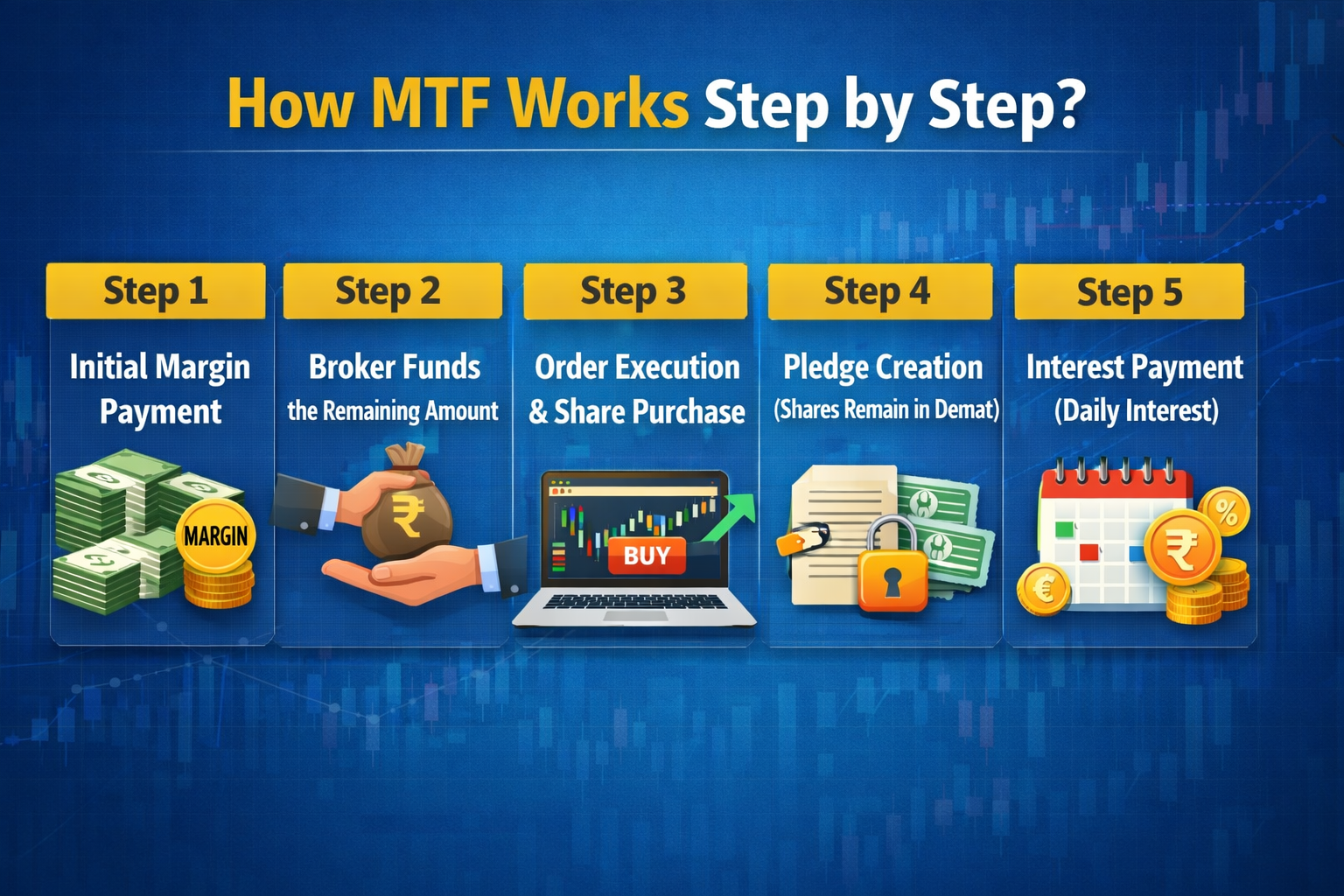
Below is the complete MTF process in 5 simple steps, exactly as it happens while buying shares using Margin Trading Facility.
Step 1: Initial Margin Payment
The first step in MTF is the margin payment. Margin means the amount you contribute from your own funds.
Example:
- Total value of shares to be purchased: ₹1,00,000
- Margin required: ₹20,000
In this case, you will pay ₹20,000 from your side.
This margin works like the initial payment in any loan arrangement. Just like a typical loan requires a down payment, in MTF your down payment is the margin you pay first.
Also, this margin requirement is not random. MTF follows a defined structure under SEBI regulations, and brokers cannot decide margin rules arbitrarily.
Watch Our MTF Explained for Beginners Video
Step 2: Broker Funds the Remaining Amount
After you pay the margin, the broker provides the remaining amount required to complete the purchase.
Continuing the same example:
- Total purchase value: ₹1,00,000
- Your contribution (margin): ₹20,000
- Broker funded amount: ₹80,000
So the broker will fund ₹80,000 for the transaction. This broker-funded amount is the "loan" portion in MTF.
This broker funding is the reason why MTF is treated like a loan-based facility. And because this amount is funded by the broker, it comes with daily interest.
A key point from the MTF structure is that brokers generally have flexibility mainly is that they are allowed to decide how much interest they will charge on the funded amount.
Step 3: Order Execution and Share Purchase
Once the margin and broker funding are arranged, the order is executed.
After execution:
- Shares are purchased in your name
- Transfer of shares starts into your Demat account
This is an important clarity point: using MTF does not mean the broker owns the shares. The shares are still yours.
Step 4: Pledge Creation (Shares Remain in Demat)
After purchase, the shares remain in your Demat account but are marked as pledged. This pledge is created because MTF includes broker funding.
It acts like a security lock:
- Shares remain in your Demat
- But they are tagged as pledged
- So they cannot be misused by anyone
This structure also ensures that the same shares cannot be pledged elsewhere to create additional borrowing.
A major point here is:
Shares remain in your Demat account, but they are moved into pledged status so they cannot be used to take another loan elsewhere.
This is exactly why pledge exists in MTF - it is a safeguard so that shares involved in a funded purchase remain controlled and protected.
Step 5: Interest Payment (Daily Interest)
Since the broker has funded a portion of the purchase, interest is charged on the broker-funded amount.
Important clarification: Interest is charged only on the broker-funded amount, not on the full trade value.
Example:
- Total trade value: ₹1,00,000
- Broker funded amount: ₹80,000
In this case, interest will apply only on: ₹80,000
Interest is calculated daily. The broker may deduct it daily, weekly, or monthly but the calculation remains daily.
A key point from MTF is that the interest keeps adding up daily until the funded portion is cleared. So as long as broker funding exists, interest continues.
Conclusion
MTF is a regulated facility that increases buying power by combining your margin contribution with broker funding. And since it operates under SEBI structure, brokers cannot set random rules-they mainly decide the interest rate.

Check Other Post Posts
-

-
What is CNC and MIS in Zerodha?
June 24, 2024
-
Best Bond Investment Platforms in India 2025
April 17, 2025