India’s Solar Sector Explained: Manufacturing Stages and Capacity
India's transition toward clean energy is no longer just a policy vision, it has become a large-scale industrial transformation. At the center of this shift is the India solar sector, a fast-growing ecosystem that spans everything from raw material processing to large-scale power generation. Understanding how this sector functions is essential for investors, businesses, and anyone closely watching India's energy future.
The Solar Manufacturing Chain: From Raw Material to Power
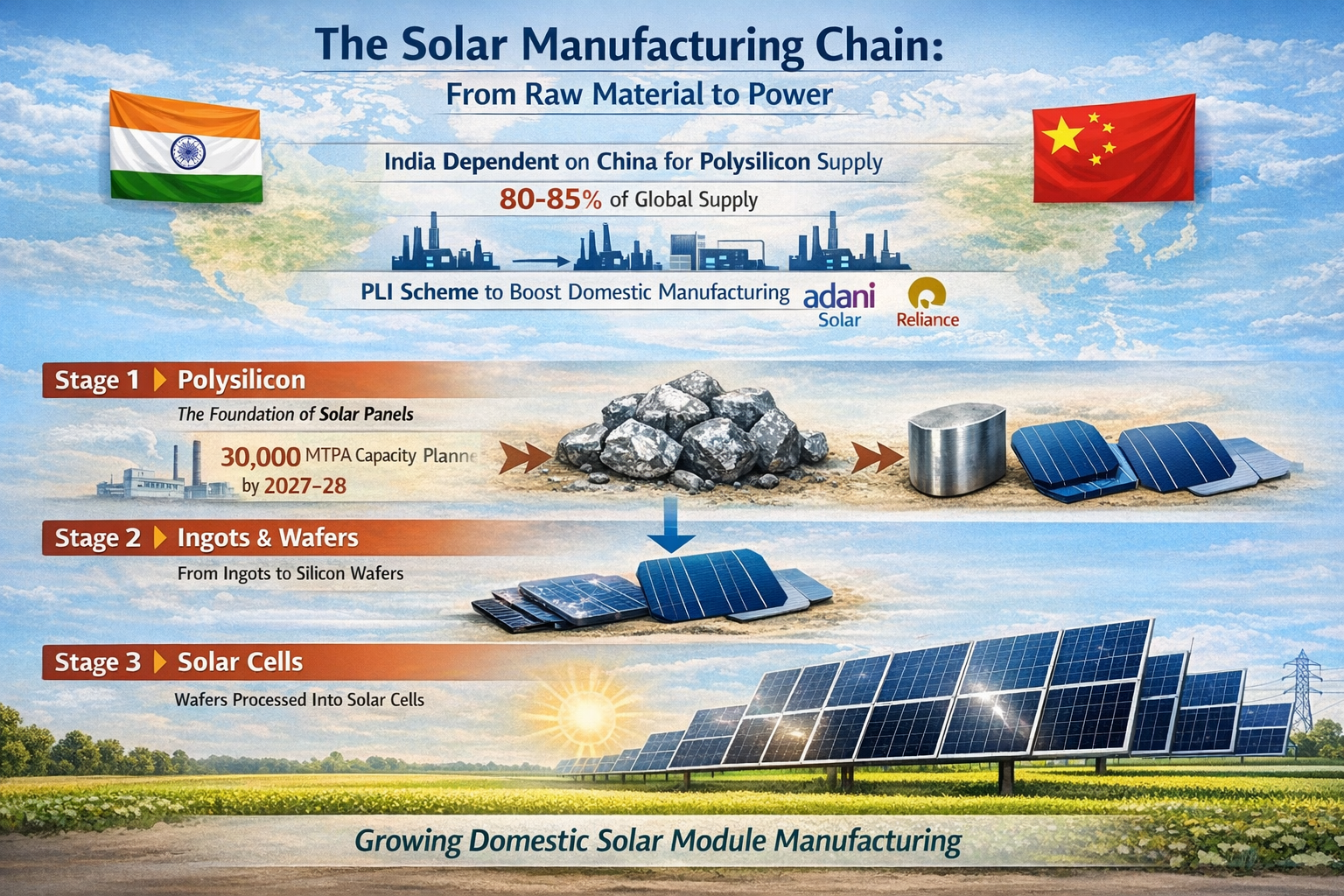
Stage 1: Polysilicon - The Foundation of Solar Panels
The journey of a solar panel begins with polysilicon, the most important raw material in solar manufacturing. It contributes roughly 30% of a finished solar panel's cost. The challenge? India currently has negligible polysilicon production capacity and depends heavily on imports - mainly from China, which controls around 80-85% of global supply.
To reduce this dependency, the Indian government has introduced the Production Linked Incentive (PLI) Scheme to boost domestic solar manufacturing. Major companies are stepping in. Adani Solar is developing a polysilicon plant with a planned capacity of about 30,000 MTPA, expected around 2027-28, though much of this output will serve internal demand. Reliance Industries is also building capacity, but again, initial production is likely for in-house use rather than industry-wide supply.
Stage 2: Ingots and Wafers
Polysilicon is melted and shaped into ingots, which are sliced into wafers. This segment, too, has historically been dominated by Chinese manufacturers. However, Indian players like Adani Solar, Tata Power Solar, Websol, and Premier Energies are entering this space to localize the supply chain.
Stage 3: Solar Cells
Wafers are then processed into solar cells, the units that actually convert sunlight into electricity. Until recently, India imported most of its solar cells, but domestic cell manufacturing capacity is expanding rapidly thanks to government incentives and rising demand.
Stage 4: Solar Modules (Panels)
Solar cells are assembled into solar modules, commonly known as solar panels. This is where India is relatively strong. Domestic module manufacturing has grown significantly, and Indian firms now supply a large share of the local market.
Beyond Manufacturing: EPCs and Power Producers
Manufacturing is only half the story. Once panels are ready, EPC companies design and build solar power plants. They source modules, inverters, transformers, cables, and other components, then construct full solar projects.
These projects are handed over to power generation companies, which sell the electricity produced. In some cases, EPC firms themselves operate plants and sell power, acting as Independent Power Producers.
So, India's solar ecosystem includes:
- Solar Manufacturers
- EPC Companies
- Power Generators
India's Solar Capacity Today
India's total installed power capacity stands at roughly 510-515 GW. The mix looks like this:
- Thermal Power: ~48%
- Solar Power: ~26% (~133 GW)
- Wind & Hydro: ~10-11% each
- Nuclear: ~2%
Solar is now the second-largest source of installed power capacity in the country.
Watch Our Video on India’s Solar Sector
India's 2030 Solar Target: The Big Leap
India has set an ambitious renewable energy goal of 500 GW by 2030, with solar expected to contribute around 280 GW. Considering current solar capacity is about 133 GW, the country must add roughly 140-145 GW in the next few years , essentially doubling solar installations.
This target is central to India's climate commitments and energy security strategy.
Power Capacity vs Power Generation: A Crucial Difference
A common misunderstanding is equating installed capacity with actual electricity produced. Capacity (measured in GW) is the maximum power plants can generate at any moment. Actual energy produced over time is measured in kilowatt-hours (kWh).
Solar plants do not run at full capacity all the time - they only generate power during sunlight hours. That's why, although renewables make up over 50% of installed capacity, they account for only about 28-30% of actual electricity generation.
In FY25, India's total installed capacity was around 475 GW, but actual electricity consumption was about 1,821 billion units, meaning plants operated at roughly 45% of theoretical capacity.
What This Means for India
India's solar sector is expanding fast, but key challenges remain - especially in raw material self-reliance and scaling manufacturing. At the same time, massive capacity targets create opportunities across manufacturing, EPC services, and power generation.
Understanding the four-stage manufacturing chain and the difference between capacity and generation is essential to see where India stands today - and how big the solar opportunity really is.

Check Other Post Posts
-
 Types of Stock Brokers in Share Market
December 26, 2024
-
How to Check Balance in Pragathi Krishna Gramin Bank?
April 30, 2025
-