Why do AMC Companies have high dividend Yields?
Among India’s financial companies, asset management companies (AMCs) stand out for an unusual reason, they are both high-growth businesses and generous dividend payers. While most fast-growing companies retain earnings to fund expansion, listed AMCs regularly return a large share of their profits to shareholders through dividends.
This isn’t because they’ve run out of growth opportunities. India’s mutual fund industry continues to expand as equity participation rises and SIP inflows hit new highs. Instead, high dividends are a reflection of a business model that generates far more cash than it needs to grow.
But not every AMC deserves the same valuation simply because it offers an attractive dividend yield. Some have built scalable, capital-efficient businesses that can sustain high payouts for years, while others face slower growth, fee pressure, or weaker competitive positioning.
By analysing companies such as HDFC AMC, Nippon Life India AMC, and UTI AMC, this article explores why the industry generates so much surplus cash, why dividend payouts remain consistently high, and what investors should look beyond before chasing dividend yields.

HDFC AMC Shows Why High Dividends Are No Accident
If one company explains why AMCs consistently pay high dividends, it's HDFC Asset Management Company (HDFC AMC). In FY26, the company managed an average AUM of ₹8.9 lakh crore, generated ₹4,119 crore in revenue, and reported ₹2,859 crore in net profit. Despite operating in one of India’s fastest-growing financial sectors, it continued returning a significant share of its earnings to shareholders through dividends.
The reason lies in how the business is built. Unlike banks, HDFC AMC doesn’t lend money from its own balance sheet, and unlike manufacturers, it doesn’t need to build new factories to grow. Its primary asset is investor trust. As more money flows into its mutual funds through SIPs, lump-sum investments, or market appreciation, the company earns higher management fees without requiring proportionately higher investments.
This creates a business with exceptional capital efficiency. HDFC AMC consistently delivers ROE above 30%, operates with virtually no financial debt, and converts a large portion of its earnings into free cash flow. Since expanding the business requires relatively little incremental capital, management has few opportunities to reinvest billions of rupees at comparable returns.
This highlights an important investing principle: high dividends are not a sign that HDFC AMC has stopped growing, they are evidence that its business generates more cash than it needs to sustain that growth.
How SIPs Have Made AMC Earnings More Predictable?
A decade ago, an AMC’s earnings were largely driven by market cycles. Bull markets boosted AUM and profits, while prolonged corrections often led to slower inflows and declining fee income. Today, that dynamic has changed.
Monthly SIP contributions of over ₹30,000 crore have created a recurring source of inflows that continues regardless of short-term market volatility. Even when equity markets correct, millions of investors keep investing through SIPs, giving AMCs a steady stream of fresh assets to manage. This has made earnings far more predictable than they were a decade ago.
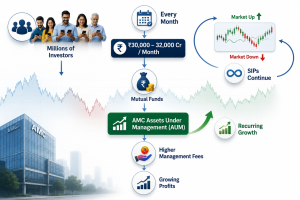
Nippon Life India Asset Management illustrates this shift. In FY26, it became the first Indian AMC to cross 4 crore investor folios,reaching 4.02 crore folios and 2.41 crore unique investors. This recurring participation helps stabilise fee income and reduces dependence on market rallies alone.
The result is a business model that increasingly resembles a subscription business. While market movements still influence AUM, recurring SIP inflows provide a stable foundation for revenue, improving earnings visibility and making dividend payouts more sustainable over the long term.
Why HDFC AMC Commands a Premium Over Its Peers?
Although HDFC AMC, Nippon Life India AMC, and UTI AMC all operate in the same industry, the market values them very differently. The reason lies not in the size of their dividends but in the quality of their earnings.
- HDFC AMC has consistently commanded a premium valuation because of its strong equity-oriented AUM, industry-leading profitability, and ability to earn higher fee income from every rupee of assets it manages. It also benefits from a powerful distribution network and one of the most trusted brands in India’s mutual fund industry.
- Nippon Life India AMC has carved out a different strength. Its leadership in retail participation, expanding investor base, and growing passive investment business have supported steady earnings growth while maintaining healthy profitability.
- UTI AMC, despite its strong legacy and regular dividend payouts, has faced slower growth in higher-margin equity assets and greater dependence on institutional and debt-oriented assets. As a result, its profitability and valuation have generally lagged behind its larger peers.
The key lesson is simple: investors don’t assign premium valuations to AMCs because they pay higher dividends. They reward companies that consistently generate higher fee income, stronger margins, and better returns on capital. To know more, check our latest video.
What Separates the Best AMCs From the Rest?
While the AMC business model is capital-light, not every company converts that advantage into superior shareholder returns.
The biggest differentiator is fee yield, the revenue an AMC earns from every rupee of AUM. Fund houses with a larger share of equity assets typically earn significantly higher fees than those focused on debt or liquid funds. This directly influences margins, profitability, and dividend-paying capacity.
Distribution is another key advantage. HDFC AMC’s long-standing brand and extensive distribution network have helped it attract consistent inflows across market cycles. Nippon Life India AMC has strengthened its position through deep retail penetration and one of the country’s largest investor bases. UTI AMC, while still a major player, has experienced slower growth as competition intensified.
These differences are reflected in financial performance. HDFC AMC and Nippon Life India AMC consistently generate ROEs above 30%, whereas UTI AMC’s returns have remained comparatively lower. Higher profitability allows leading AMCs to distribute generous dividends while continuing to invest for future growth.
For investors, the takeaway is clear: the best AMCs are not simply those with the highest AUM, they are the ones that earn the highest profit from that AUM.
Why High Dividend Yields May Not Last Forever?
High dividends are a key strength of the AMC business model, but they are not guaranteed.
Investors should keep an eye on a few structural risks:
- Shift towards passive investing: As ETFs and index funds gain popularity, AMCs earn lower fees per rupee of AUM, which can slow profit and dividend growth.
- SEBI’s TER regulations: Periodic reductions in Total Expense Ratio (TER) limits put pressure on AMC margins, even if AUM continues to grow.
- Rise of direct investing: Platforms like Groww and Zerodha Coin have increased the adoption of direct plans, making fund performance and product innovation more important than traditional distribution.
- Higher reinvestment requirements: As competition intensifies, AMCs may choose to retain more earnings to invest in technology, ETFs, AIFs and wealth management, reducing payout ratios over time.
While these risks don’t undermine the industry’s long-term potential, they could influence how much cash AMCs are able or willing to return to shareholders in the future.
What Actually Drives AMC Valuations?
Many investors assume that a larger AUM automatically deserves a higher valuation. In reality, the market places a premium on the quality of that AUM rather than its size.
Several factors influence how an AMC is valued:
- Equity AUM mix: Equity funds earn higher management fees than debt or liquid funds, supporting better profitability.
- Fee yield: AMCs that generate higher revenue per rupee of AUM generally command stronger valuations.
- Distribution strength: A wide network of banks, distributors, and digital platforms helps sustain long-term inflows.
- Market share gains: Companies consistently attracting new investors tend to receive premium valuations.
- Profitability: Higher operating margins, ROE, and free cash flow indicate a more efficient business model.
This explains why HDFC AMC continues to trade at a premium to many peers. The market is valuing its ability to generate superior earnings and cash flows, not simply the size of its dividend or AUM.
What Should Investors Look For Instead Of Just Dividend Yield?
A high dividend yield can be attractive, but it shouldn’t be the primary reason to invest in an AMC. Instead, investors should focus on the factors that determine whether those dividends can grow sustainably over time.
Here are the key metrics that matter:
- Average AUM Growth: A consistently rising AUM indicates that the AMC is attracting new investments and expanding its fee-earning base.
- Net Equity and SIP Inflows: Steady inflows reflect strong investor confidence and provide a recurring source of future revenue, regardless of short-term market movements.
- Equity AUM Mix: Equity funds typically generate higher management fees than debt or liquid funds, making the composition of AUM as important as its size.
- Market Share Trends: An AMC that consistently gains market share is likely strengthening its competitive position and distribution network.
- Profitability Metrics: Track operating margins, return on equity (ROE), and free cash flow. High profitability with strong cash generation is what ultimately supports sustainable dividend payouts.
- Dividend Payout Ratio: A high payout is positive only if it is backed by healthy earnings and cash flows. An unusually high payout without underlying growth can be difficult to sustain.
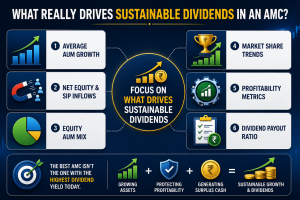
Ultimately, the best AMC is rarely the one offering the highest dividend yield today. It’s the one that can continue growing assets, protecting profitability, and generating surplus cash for years to come.
Should AMCs Really Pay Out So Much Cash?
High dividend payouts have become a defining feature of Indian AMCs, but they also raise an important capital allocation question: is returning 70-90% of profits always the best long-term strategy?
Globally, leading asset managers have evolved far beyond traditional mutual funds. Companies such as BlackRock have built leadership in ETFs, while others have expanded into private credit, alternative investments, wealth management, and technology-driven advisory businesses. These businesses generate new revenue streams and reduce dependence on mutual fund fees.
Indian AMCs are only beginning this transition. As passive investing grows and fee yields gradually decline, opportunities in ETFs, AIFs, PMS, wealth management, and digital platforms could become increasingly important. Building these businesses requires sustained investment, and that may not be possible if companies continue distributing the majority of their profits every year.
This creates an interesting trade-off for investors. A high dividend provides immediate returns, but retaining more capital to build the next phase of growth could create significantly greater long-term shareholder value. The most successful AMCs over the next decade may not necessarily be those paying the highest dividends, but those allocating capital most effectively.
Conclusion
High dividend yields are one of the biggest attractions of asset management companies, but they are ultimately a reflection of the strength of the underlying business. Because AMCs require very little capital to grow, they can generate strong cash flows while continuing to expand, allowing them to reward shareholders without sacrificing future growth.
For investors, the focus should be on the drivers of long-term value; consistent AUM growth, steady SIP inflows, strong profitability, and market share gains. Dividend yield should be viewed as the outcome of these strengths, not the reason to invest.
The best AMCs don’t create wealth by paying high dividends. They pay high dividends because they have built businesses that can keep attracting investor money and compounding earnings year after year