How PGCIL Has Managed to Pay High Dividends?
For years, Power Grid Corporation of India Ltd. (PGCIL) has been one of the most reliable dividend-paying companies in the Indian stock market. While many businesses experience volatile earnings due to changing economic cycles, PGCIL has consistently rewarded shareholders with attractive dividends year after year.
At first glance, this may seem surprising. After all, power transmission is a capital-intensive business that requires continuous investment in transmission lines, substations, and grid infrastructure. Yet, the company has managed to fund large expansion projects while maintaining a strong dividend track record.
The answer lies not in aggressive financial engineering or a lack of growth opportunities, but in the unique economics of PGCIL’s business model. Its regulated revenue framework, predictable cash flows, and disciplined capital allocation allow the company to generate substantial cash long after assets are commissioned. Understanding this model explains not only why PGCIL has paid high dividends in the past but also whether those payouts can remain sustainable in the years ahead.

Understanding PGCIL’s Business Model
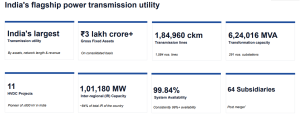
Unlike power generation companies that earn revenue by selling electricity, PGCIL primarily transports electricity across India’s national grid. It owns and operates one of the world’s largest transmission networks, connecting power plants with state utilities, industries, and distribution companies. As of FY26, the company operated 1,84,960 circuit kilometres of transmission lines, 291 substations, and 6,24,016 MVA (MegaVolt-Ampere) of transformation capacity, while handling nearly 84% of India’s inter-regional transmission capacity.
The regulated tariff framework is also more structured than many investors realise. For most transmission projects under the Regulated Tariff Mechanism (RTM), PGCIL is allowed to recover operating and maintenance expenses, depreciation, interest on debt, and a regulated return on equity. Typically, projects are financed using a 70:30 debt-to-equity structure, with the company earning a regulated return on the equity portion of the investment. This means a transmission asset starts generating predictable returns once it is commissioned and remains available for use.
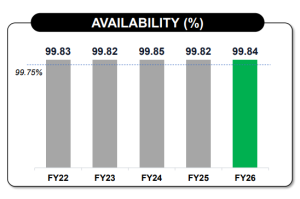
In FY26, PGCIL reported 99.84% system availability, comfortably above the regulatory benchmark for full recovery. This high operational performance ensures that its transmission assets continue generating stable cash flows year after year.
The result is a business where earnings depend more on operational efficiency than on electricity demand or power prices. This is one of the biggest reasons PGCIL has been able to generate stable cash flows and consistently reward shareholders through dividends.
Why PGCIL Generates So Much Cash?
Many companies report good profits but struggle to generate cash. PGCIL is different. Its business is designed to convert a large share of its earnings into cash, which is one of the main reasons it can pay high dividends year after year.
In FY26, PGCIL generated ₹40,935 crore in cash from its operations, much higher than its net profit of ₹15,928 crore. It also reported an EBITDA of ₹39,677 crore, reflecting the strength of its regulated transmission business.
Another reason behind PGCIL’s strong cash generation is its collection mechanism. In FY26, the company achieved a 101.2% realisation rate, meaning it collected even more cash than it billed during the year.
This isn’t by chance. The Ministry of Power’s Late Payment Surcharge (LPS) Rules have strengthened payment discipline across the sector by discouraging prolonged delays from distribution companies. Combined with PGCIL’s regulated business model, this creates one of the most predictable cash collection systems in India’s infrastructure sector.
The Real Reason PGCIL Can Pay High Dividends
Many investors assume that companies paying high dividends have limited growth opportunities. In PGCIL’s case, that’s far from the truth. The company continues to invest aggressively in expanding India’s transmission network while maintaining a healthy dividend payout. The reason lies in how its business generates cash.
Transmission projects require significant investment during the construction phase. However, once a transmission line or substation becomes operational, it starts earning a regulated return for decades with relatively low maintenance costs. As more projects are commissioned each year, they add to PGCIL’s pool of income-generating assets, creating a steady stream of cash.
This creates a virtuous cycle. Older assets continue generating cash, while newer assets gradually start contributing to earnings. Instead of relying on a few large projects, PGCIL benefits from a growing portfolio of regulated assets that collectively produce stable cash flows.
The company’s FY26 performance reflects this strength:
- Total dividend: ₹9 per share (including interim and final dividends).
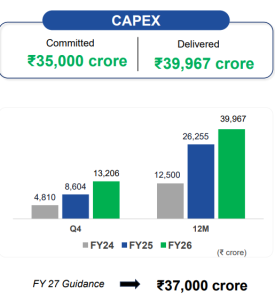
- Capex: ₹39,967 crore, exceeding management’s guidance.
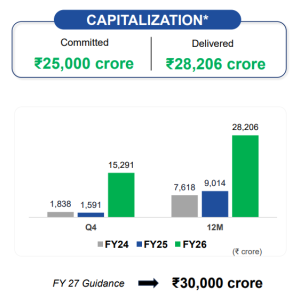
- Capitalised assets: ₹28,206 crore, adding to its future earning base.
The key takeaway isn’t that PGCIL chooses dividends over growth. It has built a business where existing assets generate enough cash to reward shareholders while new investments continue expanding the regulated asset base, making both growth and dividends sustainable over the long term. To know more, check our latest video.
Government Ownership Also Plays a Role
PGCIL’s ability to pay high dividends is supported by its strong cash flows, but there’s another important factor investors shouldn’t ignore- its ownership structure. The Government of India holds a 51.34% stake in the company, making it the majority shareholder.
As a major shareholder, the government benefits directly from every dividend PGCIL pays. This creates an incentive to maintain a consistent payout policy while ensuring the company remains financially strong enough to fund future expansion. Unlike companies that may drastically change dividends based on market conditions, PGCIL has built a track record of rewarding shareholders regularly.
Government ownership influences payout policy, but PGCIL’s financial strength allows those payouts to remain sustainable.
The combination of these two factors makes PGCIL different from many other PSUs. It isn’t paying high dividends because it lacks investment opportunities. In fact, the company continues to expand its transmission network while returning cash to shareholders.
FY26 Snapshot
- Government shareholding: 51.34%
- Total FY26 dividend: ₹9 per share (two interim dividends and one final dividend).
This balance between growth and shareholder returns is one of the key reasons PGCIL has remained a favourite among long-term income investors.
Why PGCIL Stands Out Among Dividend PSUs?
Not all high-dividend PSUs are built the same. Companies like Coal India, ONGC, and Oil India generate strong dividends largely because of favourable commodity prices. When coal or crude oil prices fall, their earnings and dividend-paying capacity can come under pressure.
PGCIL operates very differently. Its revenue is not linked to electricity prices or fuel costs but to the availability of its transmission assets under a regulated tariff framework. This makes its earnings far more predictable across economic cycles.
| Company | Main Driver of Earnings | Dividend Stability |
| Coal India | Coal Prices & Demand | Cyclical |
| ONGC | Crude Oil & Gas Prices | Cyclical |
| NPTC | Power Generation | Moderately Stable |
| PGCIL | Regulated Transmission Assets | Highly Stable |
This distinction matters because investors looking for dividend income should focus not only on dividend yield but also on the source of those dividends. PGCIL’s payouts are backed by regulated cash flows rather than commodity cycles, making them more predictable over the long term.
Can Competition Affect Future Dividends?
PGCIL’s legacy transmission assets were largely built under the Regulated Tariff Mechanism (RTM), which guarantees a fixed return on equity (RoE) of 15%-15.5% as determined by the Central Electricity Regulatory Commission (CERC). However, the landscape is shifting rapidly. Of PGCIL's ₹1.70 lakh crore works-in-hand, 81% (₹1.37 lakh crore) consists of projects awarded through Tariff-Based Competitive Bidding (TBCB).
Scenario Analysis
While TBCB projects feature market-driven pricing rather than guaranteed regulatory markups, lower project returns do not inherently jeopardize PGCIL’s dividend trajectory. To understand how this shift impacts total financial performance, consider three distinct potential execution scenarios:
| Scenario | Scenario A: Base Case (Execution Dominance) | Scenario B: High Competition (Aggressive Bidding) | Scenario C: Bear Case (Delays & Yield Compression) |
| New TBCB Project Equity IRR | 12.5%-13.5% | 11.0%-11.5% | < 10.5% |
| Blended Consolidated RoE | 14.0%-14.5% (Down from ~15.8%) | 12.5%-13.0% | 11.5%-12.0% |
| Annual Asset Additions | ₹25,000 Cr- ₹30,000 Cr | ₹20,000 Cr- ₹22,000 Cr | < ₹18,000 Cr |
| Operating Cash Flow Growth (CAGR) | 8%-10% per annum | 4%-5% per annum | 0%-2% (Flat) |
| Dividend Impact | 6%-8% Annual Growth (~₹10.5-12/share) | Maintained Payout (~₹9.0/share) | 5%-10% Cut (~₹7.5-8.0/share) |
The table below illustrates how different competitive environments could affect PGCIL’s future profitability and dividends.
- In the base case, the company continues winning projects at healthy returns, allowing dividends to grow steadily.
- In a high competition scenario, lower bidding margins may slow earnings growth, but PGCIL should still be able to maintain its dividend.
- The bear case assumes aggressive bidding, lower project returns, and execution delays, which could temporarily put pressure on dividend growth.
While these are illustrative scenarios rather than forecasts, they show that PGCIL’s dividend outlook depends not only on project returns but also on the pace of asset additions and execution.
Why PGCIL Can Handle Competitive Pressure
- Scale Advantage Supports Margins
PGCIL has several structural advantages over private competitors. Its access to low-cost funding, large procurement scale, and standardised project execution help it build transmission networks more efficiently. The company also maintains grid availability above 99.8%, ensuring stable operational performance.
- Lower Cost of Capital Creates an Edge
PGCIL enjoys borrowing costs of around 6.8%-7.3%, supported by its strong balance sheet and government ownership. This gives it an advantage in competitive bidding, where financing costs play a major role in determining project profitability.
- Asset Recycling Supports Growth
Through PGInvIT (Powergrid Infrastructure Investment Trust) , PGCIL can transfer operational assets, unlock capital, and reinvest it into new transmission projects. This reduces dependence on fresh debt and allows the company to continue expanding without significantly weakening its balance sheet.
What This Means for Dividend Investors?
Competition will likely reduce the exceptional returns PGCIL enjoyed from older regulated assets. However, the company’s dividend story depends less on maintaining peak margins and more on its ability to grow its transmission network.
With India’s renewable energy expansion requiring massive grid investments, PGCIL’s opportunity lies in converting a lower-return but much larger project pipeline into stable long-term cash flows. For investors, the risk is not a dividend collapse but a slower pace of dividend growth compared to the past.
Can PGCIL Maintain Its High Dividends?
For income investors, the biggest concern isn’t whether PGCIL has paid high dividends in the past, it’s whether it can continue doing so while expanding its business.
Based on its current growth pipeline, the outlook remains encouraging, ensuring a steady flow of new projects in the coming years.
FY26 Growth Pipeline
- Capex: ₹39,967 crore
- Works-in-hand: ₹1.70 lakh crore (Projects under execution)
- Bidding pipeline: Over ₹1.1 lakh crore (Future bidding opportunities)
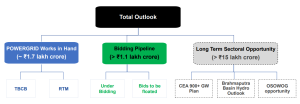
At first glance, PGCIL’s numbers may seem surprising. The company generated ₹40,930.58 crore in operating cash flow during FY26 while spending nearly ₹40,000 crore on capital expenditure. Yet, it also distributed ₹9 per share as dividends.
The explanation lies in PGCIL’s capital structure. New transmission projects are typically financed through a mix of long-term debt and equity. Since the regulated tariff framework allows the company to recover financing costs while earning regulated returns on commissioned assets, PGCIL can continue expanding its network without relying entirely on annual operating cash flows.
Rather than viewing dividends and capex as competing priorities, investors should look at the company’s overall capital allocation. As long as new projects are commissioned on schedule, operating cash flows remain strong, and debt stays within comfortable levels, PGCIL can continue balancing growth with shareholder returns.
How PGInvIT Helps Fund Growth Without Sacrificing Dividends?
One of the smartest decisions PGCIL has made in recent years is the creation of Powergrid Infrastructure Investment Trust (PGInvIT). Rather than keeping mature transmission assets on its balance sheet indefinitely, the company transfers selected operational assets into the InvIT and monetises them.
Here’s how the process works:
- PGCIL builds and operates a transmission asset.
- Once the asset has a stable operating history, it is transferred to PGInvIT.
- Investors buy units of the InvIT, providing fresh capital to PGCIL.
- The company reinvests this capital into new transmission projects.
This approach creates a capital recycling model. Instead of raising fresh equity every time it wants to expand, PGCIL unlocks value from completed projects while continuing to earn through its relationship with the InvIT.
For dividend investors, this strategy is equally important. Asset monetisation provides an additional source of liquidity that can support future expansion without putting excessive pressure on the balance sheet. As India invests heavily in renewable energy transmission and Green Energy Corridors, PGInvIT could become an increasingly important tool for funding growth while preserving dividend-paying capacity.
Risks To Keep An Eye On
No dividend is guaranteed forever, and PGCIL is no exception. While its regulated business model provides stable cash flows, a few factors could affect its ability to maintain high payouts over the long term.
- Project delays: If transmission projects are delayed, the company cannot start earning regulated returns until the assets are commissioned. This can temporarily slow earnings and cash flow growth.
- Changes in tariff regulations: PGCIL’s revenue is determined by regulatory norms. Any changes in the allowed return on equity, tariff framework, or recovery mechanisms could impact future profitability.
- Higher borrowing costs: Building transmission infrastructure requires significant capital. A sustained rise in interest rates could increase financing costs and reduce the cash available for dividends.
- Payment delays from DISCOMs: Although PGCIL has historically maintained strong collections, prolonged delays from state distribution companies could put pressure on working capital.
- Execution of renewable energy projects: India’s renewable energy expansion is a major growth opportunity for PGCIL. However, delays in renewable projects or transmission bidding could postpone the addition of new revenue-generating assets.
These risks are worth monitoring, but none of them currently appear significant enough to undermine PGCIL’s overall dividend story. The company’s regulated business model, strong execution track record, and healthy project pipeline continue to provide a solid foundation for long-term cash generation.
Final Thoughts
PGCIL’s dividend story isn’t simply about paying shareholders a large portion of its profits. It is about owning a business that consistently converts regulated infrastructure assets into predictable cash flows over decades. That structural advantage has allowed the company to expand its transmission network, maintain one of the strongest balance sheets among infrastructure PSUs, and reward shareholders at the same time.
The next phase, however, will look different. Competitive bidding, rising renewable energy investments, and evolving regulations will test whether PGCIL can maintain the same level of returns it enjoyed under the legacy transmission model. Investors should therefore look beyond the headline dividend yield.
Instead of asking “What dividend will PGCIL pay next year?”, a better question is:
“Can PGCIL continue creating transmission assets that generate reliable cash flows for the next 30 years?”
If the answer remains yes, dividend growth is likely to follow. In the long run, sustainable dividends are not created by generous payout policies, they are created by businesses that consistently generate more value than they consume.