Godrej Properties – How do they Make Money? | Revenue Structure Explained
Godrej Properties has emerged as one of India’s leading real estate developers by combining a trusted brand with a capital-efficient growth strategy. Instead of simply buying land and constructing homes, the company follows a partnership-led development model that enables it to scale across multiple cities while maintaining financial discipline.
In this article, we’ll explain how Godrej Properties generates revenue, break down its business model and revenue structure, and explore the key factors that have helped it become India’s largest residential developer by booking value.

Godrej Properties Business Model
Godrej Properties follows a capital-efficient, partnership-led real estate development model focused primarily on residential housing. The company identifies high-demand micro-markets, acquires development rights through outright purchases or partnerships with landowners, designs and develops residential projects, markets them under the trusted Godrej brand, and delivers completed homes to customers. This integrated approach enables the company to maintain control over the entire value chain from land acquisition to project delivery.
Unlike traditional developers that rely heavily on owning large land banks, Godrej Properties has increasingly adopted Joint Development Agreements (JDAs) and Development Management (DM) arrangements. Under these models, landowners contribute the land while Godrej Properties brings project planning, approvals, construction management, branding, sales, and execution expertise. In return, the company shares the project’s revenue or profits with the landowner. This allows it to expand across multiple cities without locking up significant capital in land acquisition.
The business model revolves around four key pillars:
- Strategic land acquisition through outright purchases, joint developments, and development management agreements.
- Premium project development across residential, plotted, and mixed-use developments in high-growth urban markets.
- Brand-led sales and marketing that leverage the Godrej brand to drive strong bookings and customer trust.
- Disciplined execution and capital allocation, enabling faster project monetisation, healthy cash collections, and sustainable long-term growth.
This partnership-led approach has helped Godrej Properties scale rapidly while maintaining financial flexibility, making it one of the few developers with a truly pan-India presence across India’s largest residential markets.
How Does Godrej Properties Make Money?
Godrej Properties primarily generates revenue by developing and selling residential apartments, villas, and plotted developments across India’s leading real estate markets. The company also develops mixed-use projects that combine residential, commercial, and retail spaces, creating additional revenue opportunities.
Apart from property sales, it earns a smaller stream of income from development and project management services, which contributed ₹262.8 crore in FY26, while hospitality services generated ₹119.6 crore. This highlights that residential real estate remains the company’s core revenue driver.
The company adopts different development models depending on the location, project economics, and capital requirements rather than following a one-size-fits-all approach. Some projects are fully owned, allowing Godrej Properties to retain the entire economic benefit, while others are executed through Joint Development Agreements (JDAs) or revenue-sharing partnerships, reducing upfront land acquisition costs and improving capital efficiency.
Some examples include:
- Godrej Astra (Gurugram) - 100% owned development.
- Godrej Riverine (Noida) - Fully owned residential project.
- Godrej Skyshore (Mumbai) - Developed under an 84% revenue-sharing agreement.
- Godrej Greenview Estate (Thane) - Developed under a 74.5% revenue-sharing model.
This flexible business model enables Godrej Properties to balance growth with capital discipline, choosing the ownership structure that offers the best risk-adjusted returns for each project rather than relying solely on outright land acquisitions.
Asset-Light Strategy: Why Does It Matter?
Godrej Properties’ asset-light strategy acts as a growth accelerator by allowing the company to scale without locking significant capital into land ownership. Through joint development agreements (JDAs), joint ventures, and development management (DM) contracts, the company converts land opportunities into projects by contributing its brand, execution capabilities, and sales expertise.
However, the model involves a trade-off between capital efficiency and margin potential. In an outright land purchase model, developers capture the entire economic upside but carry higher upfront capital and inventory risk. In a JDA structure, Godrej avoids large land payments but shares project economics with landowners.
| Model | Capital Intensity | Margin Potential | Risk Profile | Godrej's Share |
| Outright Purchase | High | Higher | High land & inventory risk | Retains 100% economic benefit. |
| Revenue Share JDA | Low-Medium | Moderate | Execution & partner risk | Takes 70-85% top-line share; bears construction risk. |
| Profit Share JDA | Low | Variable | Shared project economics | Charges DM fee + splits project surplus. |
| Development Management | Low | Fee-based | Lower risk, lower upside | Earns brand & management fee without land/capital risk. |
This strategy has helped Godrej Properties expand rapidly while maintaining balance sheet flexibility. However, the company sacrifices some margin upside compared with developers that own large land banks. During strong real estate cycles, land-owning developers can capture a larger share of appreciation, whereas JDA-led developers share value creation with land partners.
Why Doesn’t Every Developer Use JDAs?
On paper, Joint Development Agreements (JDAs) appear superior because they require far less upfront capital than outright land purchases. However, relatively few developers have been able to scale this model successfully.
The biggest reason is trust. In a JDA, landowners contribute their most valuable asset without receiving the full payment upfront. They therefore prefer developers with strong brands, proven execution capabilities, financial strength, and a history of delivering projects on time.
The model also demands strong sales capabilities. Since revenue is shared with the landowner, projects must achieve healthy pricing and sales velocity for both parties to benefit. Developers with weaker brands often struggle to generate enough demand, making JDAs less attractive for landowners.
Finally, managing multiple partnership projects requires expertise in legal structuring, approvals, construction management, and stakeholder coordination. As a result, JDAs are easier to describe than to execute at scale, creating a competitive advantage for established developers like Godrej Properties.
Revenue Mix
Godrej Properties’ reported revenue is a function of project execution and revenue recognition under accounting standards, which means it does not directly mirror its strong pre-sales momentum. The company’s business model is driven by bookings and collections first, while revenue is recognized progressively as construction milestones are achieved.
Key financial metrics in FY26:
- Bookings: ₹34,171 crore, up from ₹22,527 crore in FY25
Bookings indicate current customer demand and future revenue visibility.
- Revenue: ₹8,374 crore
- EBITDA: ₹2,826 crore
- PAT: ₹1,850 crore
- Customer collections: ₹19,965 crore
Collections reflect actual cash inflows from customers and determine the company’s ability to fund construction and acquire new projects without excessive borrowing.
Collections remain a critical metric for developers as they determine cash flow availability and reduce dependence on external funding. Godrej Properties’ strong collections provide visibility for execution while supporting future project launches.
The gap between bookings and reported revenue highlights the nature of the real estate business - sales momentum today creates revenue recognition over multiple years.
Therefore, investors track pre-sales growth, project pipeline, and cash collections alongside reported financials to assess the company’s underlying growth trajectory.
From Bookings To Revenue
One of the most misunderstood aspects of real estate companies is the gap between pre-sales and reported revenue. In FY26, Godrej Properties achieved ₹34,171 crore in bookings, while reported revenue stood at ₹8,374 crore. This difference does not indicate weak conversion; it reflects the accounting nature of real estate.
Under Ind AS 115, revenue is recognised based on project progress and fulfilment of performance obligations rather than when customers book apartments or make payments.
Typically, a project can take multiple years from launch to completion, creating a lag between sales momentum and reported earnings.
The real estate earnings cycle works as follows:
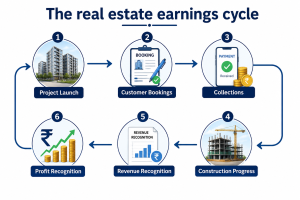
For investors, bookings provide visibility into future revenue, while collections indicate cash flow strength. Therefore, tracking only reported revenue can underestimate the growth potential of a developer with a strong launch pipeline.
What Should Investors Track?
Rather than focusing only on reported revenue, investors should monitor three operating metrics that provide an early indication of future earnings.
- Gross Development Value (GDV) Additions
GDV additions measure the future revenue potential of newly acquired projects. In FY26, Godrej Properties added projects worth approximately ₹42,100 crore of gross development value, ensuring a healthy pipeline for future launches.
- Bookings (Pre-sales)
The company achieved record bookings of ₹34,171 crore in FY26, demonstrating strong demand across its project portfolio.
- Customer Collections
Collections reached ₹19,965 crore in FY26, highlighting strong cash generation.
Together, these three metrics provide a much clearer picture of Godrej Properties’ long-term growth than reported revenue alone. Check our latest video for more details.
Why Landowners Prefer Partnering With Godrej Properties?
While customers buy homes from Godrej Properties, the company’s real competitive advantage begins much earlier - with landowners choosing Godrej as their development partner.
- Trusted Brand: The Godrej name gives landowners confidence that projects will attract buyers quickly, improving monetisation and reducing execution risk.
- Strong Sales Capability: Godrej has consistently been among India’s top developers by booking value. Faster sales translate into quicker cash flows, making the company an attractive partner.
- Execution Credibility: Timely project delivery, regulatory compliance, and professional project management reduce reputational and operational risks for landowners.
- Capital Strength: A healthy balance sheet and strong customer collections enable Godrej to execute large projects without excessive financial stress, giving partners greater confidence.
- Pan-India Platform: With operations across MMR, NCR, Bengaluru, Pune, Hyderabad, and other major cities, the company can pursue redevelopment and greenfield opportunities across multiple markets.
Together, these factors create a virtuous cycle. Strong execution attracts quality landowners, quality projects generate stronger bookings, and successful projects further strengthen the Godrej brand, making future project acquisition easier.
How Godrej Compares With Peers?
Godrej Properties operates with a different strategy compared with other large developers.
| Company | Capital Efficiency | Margin Profile | Growth Strategy |
| Godrej Properties | High (JDA-led, asset-light) | Moderate due to revenue sharing | Rapid expansion through partnerships across multiple cities |
| DLF | Lower (large owned land bank) | Highest margins from land ownership and rental assets | Monetises legacy land bank while expanding selectively |
| Macrotech (Lodha) | Moderate | Higher because of premium pricing and greater land ownership | Focused expansion with dominance in MMR and selective asset-light projects |
Each strategy involves a different trade-off. Godrej sacrifices some margins to achieve faster expansion with lower capital requirements. DLF maximises profitability by owning strategic land banks, while Lodha balances premium pricing with selective capital-light expansion.
As a result, comparing developers solely on EBITDA margins or ROE can be misleading. Investors should evaluate capital efficiency, pipeline creation, and long-term growth strategy alongside traditional financial metrics.
Key Risks To Watch
Despite its strong growth trajectory, Godrej Properties remains exposed to industry-specific and execution-related risks that could impact future growth.
- Land Partner Dependency: JDA-based growth depends on clear land titles and alignment with landowners. Delays in approvals or disputes can postpone project launches.
- Margin Trade-Off: Asset-light growth improves capital efficiency but limits upside compared with owned land models where developers capture full appreciation.
- Pipeline Replenishment: Since Godrej does not rely on a large owned land bank, continuous business development is essential to maintain growth momentum.
- Cost Inflation: Rising prices of cement, steel, labour, and construction materials can impact project profitability.
- Micro-Market Risk: Growth depends heavily on selecting the right locations, especially competitive markets such as Mumbai and Gurugram where land economics are challenging.
Financial Snapshot For FY26
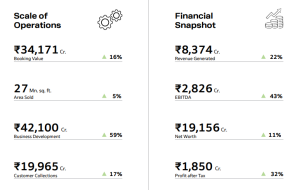
Godrej Properties delivered a strong financial performance in FY26, supported by robust booking momentum, project execution, and improved operating scale. However, as with most real estate developers, reported financials need to be viewed alongside operational metrics such as bookings and collections.
The key takeaway for investors is that Godrej Properties’ financial performance is driven by a combination of current project execution and future sales potential. While revenue and profits reflect past execution, bookings and collections provide a clearer view of the company’s future growth trajectory.
With a strong brand, expanding project pipeline, and an asset-light model, the company is positioned to benefit from the ongoing consolidation of India’s real estate sector. However, maintaining execution speed and converting its pipeline into sustainable earnings will remain critical.
Balance Sheet Strength
While Godrej Properties boasts strong operational momentum, a closer look at its balance sheet reveals a structural paradox between growth volume and equity returns.
In FY26, the company reported a Debt-to-Equity ratio of 0.83x and a Return on Equity (ROE) of 8.82%. In the middle of an Indian real estate bull cycle, an ROE below 10-12% (which typically represents a developer's cost of capital) raises an important question: Why are equity returns modest despite strong pre-sales?
Three main structural factors explain this lag:
- Accounting Lag (Ind AS 115): Because real estate profits are recognised upon project handover rather than booking, current reported net income reflects projects launched 3-4 years ago, before the current price and volume surge fully materialized.
- Margin Dilution from JDAs: Under revenue-share and joint development arrangements, Godrej shares 15-30% of the top-line or project profit with landowners. While this keeps upfront land acquisition light, it places a ceiling on net profit margins compared to land-owning peers.
- High Reinvestment Intensity (BD Capex): Unlike developers resting on legacy land banks, Godrej must continuously deploy capital into Business Development (₹42100 crore GDV added in FY26 alone) to replenish its pipeline, keeping the equity base large relative to recognized profits.
The Key Takeaway for Investors: Godrej’s 8.82% ROE is a lagging indicator. If execution speeds up and high-margin pre-sales convert into completed handovers over the next 2- 3 years, ROE should expand toward management's long-term targets. However, until those handovers hit the income statement, capital efficiency remains constrained.
Investing Takeaway
Godrej Properties is less a traditional real estate developer and more a project acquisition and execution platform. Its ability to continuously secure high-quality projects through partnerships allows it to grow without carrying one of the industry’s biggest balance sheet burdens - large land banks.
The key question for investors is therefore not whether housing demand remains strong, but whether Godrej can continue adding quality projects, convert record bookings into completed deliveries, and maintain strong customer collections. If it succeeds, the current gap between operational momentum and reported profitability should gradually narrow as projects move from bookings to revenue recognition.
In other words, the company’s biggest competitive advantage isn’t the land it owns - it’s the ability to keep acquiring land opportunities without owning them. That is what makes Godrej Properties structurally different from many traditional real estate developers and the metric investors should watch most closely.