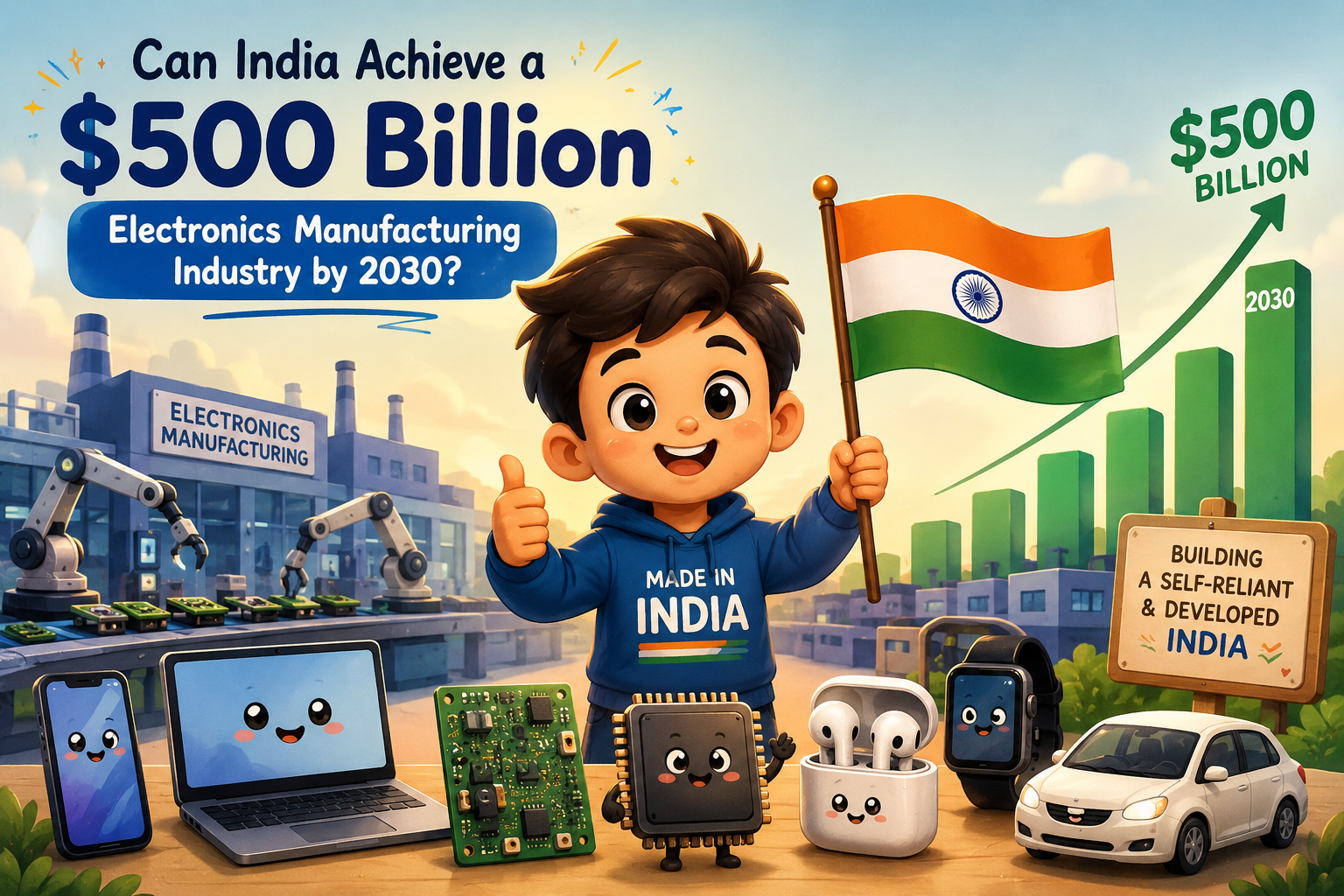
Can India Achieve a $500 Billion Electronics Manufacturing Industry by 2030?
Take a look around you- your smartphone, laptop, television, smartwatch, or even your car. Electronics power almost every aspect of modern life. Now imagine if a large share of these products were manufactured in India.
That’s the vision behind India’s ambitious goal of building a $500 billion electronics manufacturing industry by 2030. With global supply chains shifting and domestic manufacturing gaining momentum, the big question is: can India turn this ambition into reality?
Why Electronics Manufacturing Matters?
Electronics has become one of the fastest-growing industries globally, powering everything from smartphones and electric vehicles to industrial automation and defense systems.
A strong domestic electronics ecosystem can improve India’s trade balance, attract foreign investment, and generate millions of skilled jobs. It also strengthens technological self-reliance in strategically important sectors.
The Growth Story So Far
The China Plus One Opportunity
One of the biggest tailwinds supporting India’s ambitions is the global “China Plus One” strategy. Companies are increasingly diversifying their supply chains to reduce dependence on a single manufacturing destination.
India has emerged as a major beneficiary of this trend due to its large workforce, growing infrastructure, and supportive policy environment. This creates a significant opportunity for long-term manufacturing growth. This has further been explained in our video.
The Role of Semiconductors and Components
While final product assembly has grown rapidly, India’s next challenge is developing a deeper electronics ecosystem. This includes semiconductors, printed circuit boards, components, and advanced manufacturing technologies.
Projects in semiconductor packaging, chip manufacturing, and component production are expected to play a crucial role in moving India up the value chain and increasing domestic value addition.
Challenges That Cannot be Ignored
Despite strong momentum, several challenges remain. Infrastructure gaps, logistics costs, supply chain dependencies, and skill shortages continue to affect manufacturing competitiveness.
In addition, countries such as China, Vietnam, and Taiwan already possess mature electronics ecosystems. Competing with these established players will require consistent policy support and execution.
Why the Target is Achievable?
The 500$ billion target appears ambitious, but not unrealistic. India’s domestic market is expanding rapidly, export opportunities are increasing, and government support remains strong. India has transitioned from a pure import-dependent consumer market into the world’s second-largest mobile phone manufacturer, achieving a total electronics manufacturing production value of roughly $100 billion to $115 billion.
Through initiatives such as PLI, SPECS, ECMS, and the National Policy on Electronics, policymakers are actively building the foundation required for long-term manufacturing growth.
The combination of rising electronics consumption, global supply chain diversification, and strategic investments in semiconductors provides a solid foundation for long-term growth.
Government Policies Driving Growth
India’s electronics manufacturing ambitions are being supported by a series of targeted government initiatives. The Production Linked Incentive (PLI) scheme has played a crucial role in attracting investments, boosting exports, and encouraging global manufacturers to expand their presence in India.
Since FY21, the sector has attracted billions of dollars in FDI, with a significant share linked to PLI beneficiaries.
At the same time, schemes such as SPECS and the recently launched Electronics Components Manufacturing Scheme (ECMS) are helping strengthen domestic supply chains.
While SPECS focuses on encouraging component and semiconductor manufacturing, ECMS aims to accelerate investments, production, and job creation, supporting India’s broader vision of building a $500 billion electronics manufacturing ecosystem by 2030.
What it Means for Indian Companies?
The growth of the electronics sector creates opportunities across the value chain. EMS providers, component manufacturers, semiconductor companies, and industrial automation firms are all positioned to benefit.
Companies that can scale operations, maintain quality standards, and integrate into global supply chains are likely to emerge as long-term winners in India’s manufacturing transformation.
Conclusion
India’s ambition of building a $500 billion electronics manufacturing industry by 2030 is undoubtedly challenging, but the sector’s current trajectory suggests that the goal is within reach.
Success will depend on strengthening the domestic supply chain, expanding exports, and improving execution across the ecosystem. If these pieces fall into place, India could emerge as one of the world’s most important electronics manufacturing hubs by the end of the decade.