Client Concentration Risk in Kaynes Technology – Explained
Investors often focus on revenue growth, margins, and order books while overlooking an equally important factor- client concentration risk. For companies that depend heavily on a few customers, the loss of even one major client can significantly impact revenue and profitability.
Kaynes Technology recently highlighted this risk when one of its large EV customers witnessed a sharp decline in business. The incident raised an important question: how dependent is Kaynes on its key customers, and should investors be concerned?
What is Client Concentration Risk?
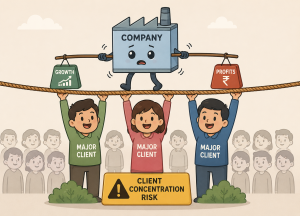
Client concentration risk arises when a significant portion of a company’s revenue comes from a small number of customers. While large customers provide stable business, they also create dependency.
If a major customer reduces orders, delays projects, or shifts to another supplier, the company’s financial performance can be affected immediately. This makes concentration risk an important metric for long-term investors
How Concentrated is Kayens’ Customer Base?
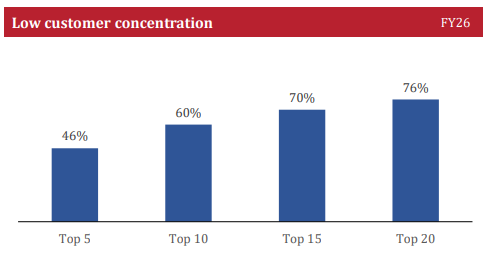
Kaynes drives nearly 60% of its revenue from its top ten countries. While this is not unusual for the EMS industry, it does mean that a few clients have a meaningful influence on the company’s performance.
In practical terms, the loss of a single large customer could impact revenue growth, capacity utilization, and profitability. As a result, investors must monitor customer concentration alongside financial metrics.
The EV Client Episode
The risks of customer concentration became visible during FY26 when one of Kaynes’ major EV customers reportedly experienced a nearly 90% decline in business activity.
Although Kaynes remained diversified across multiple sectors, the slowdown affected revenue visibility and investor sentiment. The episode served as a reminder that even strong businesses can face temporary disruptions when key customers struggle. This has been explained in detail in our Kaynes Technology Video.
Why EMS Companies Face This Risk?
Customer Concentration is common across the Electronics Manufacturing Services Industry. Large customers typically prefer working with a limited number of trusted suppliers, creating deep but concentrated business relationships.
While these partnerships provide long-term revenue visibility, they also increase dependence on customer performance. Therefore, the presence of concentration risk alone should not be viewed as a red flag.
What Reduces the Risk for Kaynes?
Kaynes has gradually diversified across Industrial, EV, Automotive, Railways, Aerospace, Medical Devices, and IoT segments. This reduces its dependence on any single industry.
The company is also expanding its higher-margin ODM business, semiconductor packaging operations, and PCB manufacturing capabilities. These initiatives can broaden the customer base and reduce concentration risk over time.
What Investors Should Watch?
Investors should focus on whether the company is reducing its reliance on its largest customers. Trends often matter more than current concentration levels.
Key indicators include new customer additions, growth in ODM revenues, export expansion, and diversification of the order book across industries and geographies.
Conclusion
Client concentration risk is a genuine factor for Kaynes Technology, but it is not currently a deal-breaker. The recent EV customer slowdown highlighted the risk, yet the company continues to diversify its business model and revenue streams.
Going forward, the key question is whether Kaynes can expand its customer base faster than its existing customers grow. If it succeeds, concentration risk is likely to become less significant in the overall investment thesis.