Exide Industries’ Recycling Strategy in the Battery Industry
In a business where raw material prices can swing sharply and margins often depend on procurement efficiency, backward integration becomes more than an operational choice - it becomes a structural advantage.
This is where the Exide lead recycling advantage becomes particularly relevant, reflecting the company's long-standing investment in integrated raw material control.
One of the most important yet under discussed strengths of Exide Industries Limited is its large scale lead recycling infrastructure, which forms a key pillar of its integrated battery manufacturing model.
A Closed-Loop Manufacturing Model
Lead acid batteries are built on a recyclable chemistry. Used batteries can be collected, processed, and refined to recover lead, which is then reused in fresh battery production.
Exide Industries has institutionalized this circular system at scale. Instead of relying solely on international metal markets or third-party suppliers, the company integrates:
- Collection of used batteries
- Lead recovery and refining
- Reintroduction of refined lead into new battery production
This creates what can effectively be described as a closed loop supply chain a model that strengthens supply security and improves cost control.
Why Recycling Scale Matters in Lead-Acid Batteries
Lead is the single largest raw material component in a lead-acid battery. Even though industry pricing mechanisms are linked to LME benchmarks, fluctuations in metal prices, currency movements, and procurement timing can materially affect profitability.
A large recycling base offers multiple strategic advantages:
1. Raw Material Security
Access to recycled lead reduces reliance on imports and external sourcing disruptions.
2. Cost Stability
Internal recycling partially buffers the impact of sharp commodity movements.
3. Working Capital Efficiency
Procurement cycles are shorter and more predictable compared to fully import-dependent models.
4. Strategic Flexibility
During tight supply environments, integrated manufacturers are structurally better positioned than pure assemblers.
Integration Within a Larger Manufacturing Ecosystem
Exide is not merely a battery assembler. The company operates 13 manufacturing plants across India and has a legacy of over 75 years in operations.
When recycling is combined with:
- A nationwide network of over 1,00,000 dealers and distributors
- A diversified product portfolio ranging from 2.5Ah to 20,200Ah
- Strong presence in automotive, industrial, and infrastructure segments

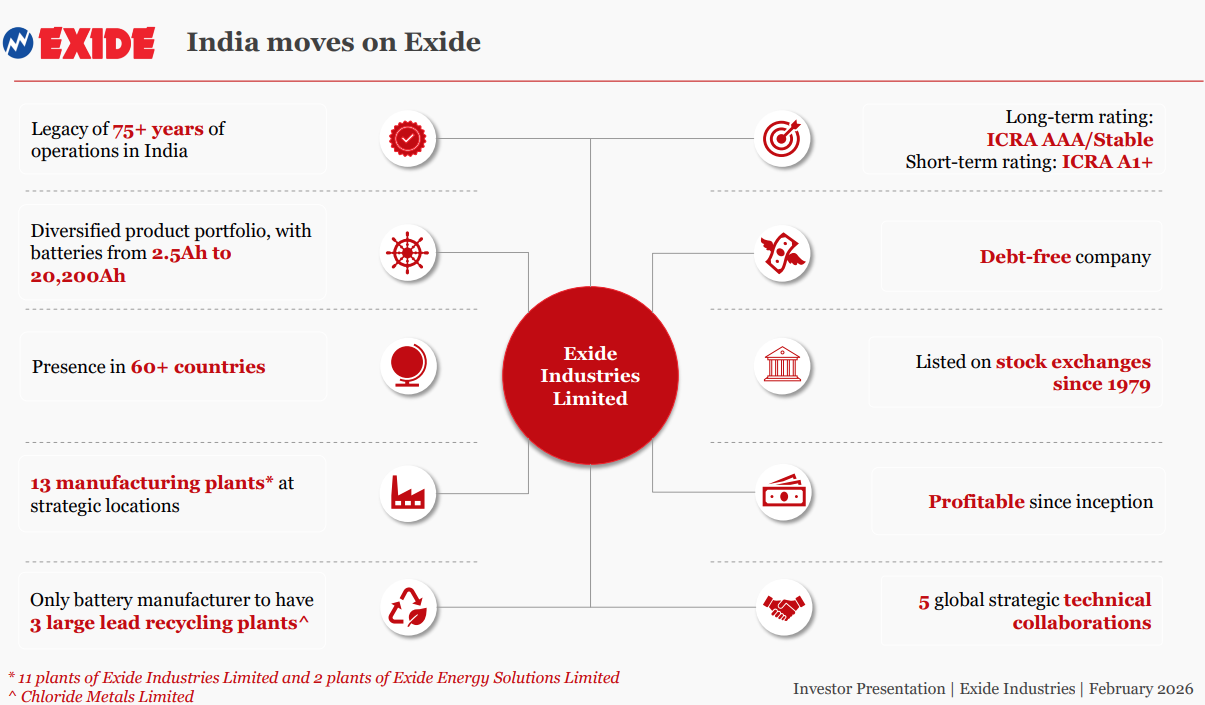
The recycling infrastructure becomes part of a broader manufacturing moat. This integration reduces structural vulnerability to raw material shocks a crucial differentiaton in a commodity linked business.
Sustainability Before ESG Became Mainstream
Lead-acid batteries are among the most recycled consumer products globally. By operating large recycling facilities, Exide aligns operational efficiency with environmental responsibility.
Recycling at scale enables:
- Reduced dependence on primary mining
- Lower environmental footprint
- Regulated handling of hazardous materials
- Traceable material lifecycle management
This strengthens regulatory compliance and enhances long-term sustainability positioning.
Also Check - Amara Raja Business Model & Capacity Expansion Explained
Financial Implications: Stability Across Cycles
While often overlooked, recycling plays a crucial role in strengthening cost efficiency and protecting margins across cycles.
Integrated recycling contributes to:
- Better absorption of commodity volatility
- Improved procurement bargaining power
- Lower exposure to import-linked disruptions
- More predictable gross margin behavior across cycles
This becomes particularly relevant in periods of metal inflation or currency depreciation. Additionally, the company maintains a debt-free balance sheet and funds expansion largely through internal accruals reinforcing overall financial resilience.
Watch Our Video on Amara Raja vs Exide Industries - Stock Analysis
Relevance in the Lithium Transition Era
Even as Exide Industries expands into lithium-ion cell manufacturing, lead-acid remains central to India's automotive replacement, inverter, railways, and industrial infrastructure segments.
The presence of large recycling plants ensures:
- The legacy business remains structurally competitive
- Cash flows from lead-acid operations stay stable
- Expansion into new technologies does not destabilize the core
In this sense, recycling infrastructure supports both present stability and future transition.
A Structural Strength Often Overlooked
In discussions about gigafactories, EV adoption, and new-age battery chemistry, recycling infrastructure often receives limited attention. Yet in a mature chemistry like lead-acid, scale of recycling defines long-term competitiveness.
Exide's integrated recycling model represents:
- A supply chain advantage
- A cost control mechanism
- A sustainability enabler
- A defensive buffer in volatile commodity cycles
It is a capability developed over decades not a short-term initiative.
As the battery industry evolves, manufacturers with integrated and circular supply chains are likely to remain structurally stronger across economic cycles. In that context, Exide's recycling infrastructure stands as one of its most important long-term advantages.
Conclusion
In a commodity driven industry where margins are closely tied to raw material volatility, structural advantages matter more than short-term fluctuations. Exide's large scale lead recycling infrastructure is not merely an operational add on it is a foundational strength embedded within its business model.
By integrating recycling with manufacturing, distribution, and diversified end-market exposure, the company has built a system that enhances supply security, improves cost discipline, and supports long-term sustainability. This closed-loop approach not only protects the legacy lead-acid business but also provides the financial and operational stability needed to navigate industry transitions, including the ongoing shift toward lithium technologies.
While new energy solutions often dominate headlines, it is this deeply integrated recycling backbone that reinforces resilience across cycles. In that sense, Exide's recycling capability is not just a support function but it is a strategic pillar underpinning its long-term competitiveness.