Swing Trading Guide: Strategies, Examples & Risk Management

Swing trading is widely recognized as one of the most popular trading styles among retail participants who seek to capture short- to medium-term price movements in financial markets. Unlike long-term investing, Swing Trading focuses on identifying short-term price "swings" that typically unfold over a few days to a few weeks.
Research published by the Corporate Finance Institute (CFI) explains that this approach emphasizes technical analysis and price momentum rather than long-term fundamental factors. It is often discussed as a style suited to individuals who prefer active market participation without continuously monitoring charts throughout the day.
Let's break it down in detail.
What is Swing Trading?
Swing trading involves identifying a trend, entering during pullbacks or breakouts, and exiting when the price completes its short-term move. Traders often use technical indicators such as RSI, moving averages, MACD, and support-resistance levels.
Securities and Exchange Board of India (SEBI) describe active trading as strategies that aim to benefit from short-term price movements rather than long-term wealth creation, a concept that closely aligns with the principles of swing trading.
Swing Trading vs Day Trading
Many beginners confuse swing trading vs day trading.
| Factor | Swing Trading | Day Trading |
|---|---|---|
| Holding Period | Days to weeks | Minutes to hours |
| Screen Time | Moderate | Very High |
| Stress Level | Medium | High |
| Overnight Risk | Yes | No |
Day traders typically close their positions before the market session ends, which means they do not carry trades overnight. In contrast, swing traders may hold positions for multiple days, including overnight, where prices can be influenced by global developments and market sentiment.
For individuals who are unable to monitor charts throughout the trading session, swing trading is often discussed as a style that requires less continuous screen time compared to day trading.
Swing Trading vs Positional Trading
Another common comparison is swing trading vs positional trading.
- Positional trading focuses on long-term trends (months to years).
- Swing trading targets shorter trend cycles (days to weeks).
Positional traders rely more on macroeconomic and fundamental analysis, while swing traders rely heavily on technical setups. Swing trading is generally characterized by shorter holding periods and more frequent trade setups compared to positional trading, which typically focuses on longer-term market movements.
Best Swing Trading Strategies
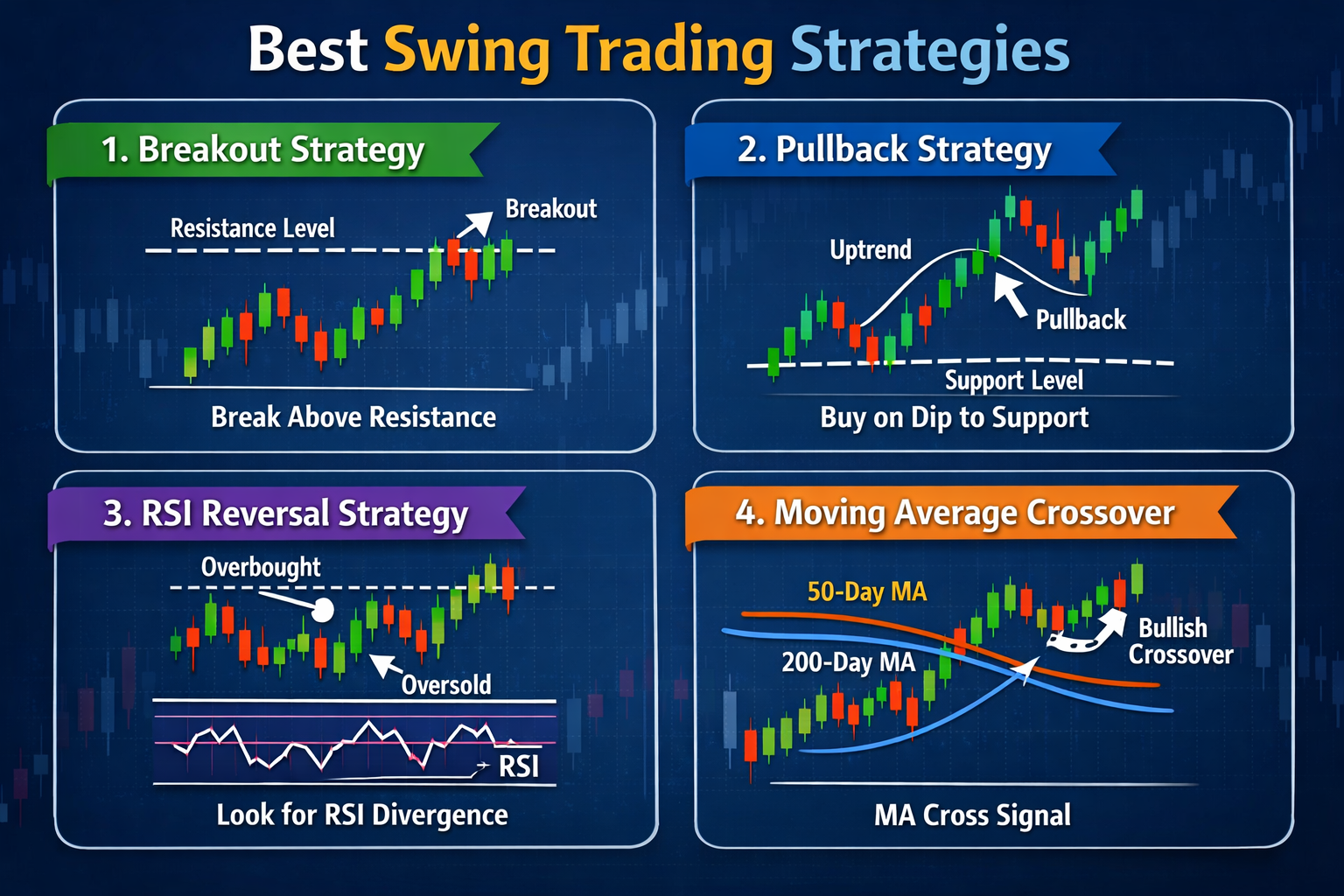
Successful traders follow disciplined swing trading strategies. Here are some proven approaches:
1. Breakout Strategy
A breakout strategy refers to observing situations where price moves above a previously established resistance level, often accompanied by increased trading volume.
2. Pullback Strategy
A pullback strategy involves analyzing temporary price re tracements that occur within a broader upward trend.
3. RSI Reversal Strategy
This approach studies instances where the Relative Strength Index (RSI) moves below 30 and begins to turn upward, which some traders interpret as a potential shift in momentum.
4. Moving Average Crossover
A moving average crossover framework examines interactions between shorter-term and longer-term averages, such as the 20 EMA and 50 EMA, to understand changes in trend direction.
How Stocks Are Commonly Evaluated in Swing Trading
When studying swing trading, market participants often analyze certain characteristics while reviewing stocks. Different securities display different trading behaviors, and not all show the same price structure or activity levels.
Some commonly observed characteristics include:
- High liquidity, which reflects active participation and ease of trade execution
- Volatility, meaning regular price movement over short periods
- Clear trend structure, where price movements show identifiable upward or downward phases
- Consistent volume patterns, which may indicate sustained market interest
Stocks that are part of major indices such as the S&P 500 or NIFTY 50 are frequently studied in trading discussions because they generally exhibit higher liquidity and broader market participation.
Swing trading examples
Here are some examples of swing trading:
Example 1: Breakout Trade
A stock is trading between ₹980 and ₹1,000 for several days.
₹1,000 acts as a strong resistance level where price has been rejected multiple times.
One day:
- The price closes above ₹1,000
- Trading volume increases significantly
- The breakout candle is strong and decisive
A swing trader identifies this as a potential breakout move.
Illustrative Setup:
- Entry around: ₹1,010
- Target zone: ₹1,100
- Stop-loss zone: ₹960
This example shows how traders attempt to capture momentum after a consolidation breakout.
Example 2: Pullback in an Uptrend
A stock moves from ₹1,500 to ₹1,750, forming a clear upward trend.
After this rally:
- The price pulls back to ₹1,650
- The stock approaches a short-term moving average support
- RSI cools down from overbought levels toward 40-45 range
- A bullish candle forms near support
This setup represents a pullback within an existing uptrend.
Illustrative Setup:
- Entry around: ₹1,670
- Target zone: ₹1,850
- Stop-loss zone: ₹1,600
Here, the focus is on continuing trend strength rather than a breakout.
Example 3: Range Reversal Setup
A stock trades between ₹400 and ₹450 for several weeks.
- ₹400 acts as support
- ₹450 acts as resistance
The price drops near ₹405 and forms a reversal pattern with improving momentum indicators.
Illustrative Setup:
- Entry around: ₹410
- Target zone: ₹445
- Stop-loss zone: ₹385
This example demonstrates how swing traders operate within price ranges rather than trends.
Risk Management in Swing Trading
Academic research in financial markets, including studies published in journals such as the Journal of Finance, has frequently emphasized the importance of disciplined risk control in trading activities over long periods.
In educational discussions around swing trading, commonly referenced risk management principles include:
- Defining a stop-loss level before entering a trade
- Maintaining a structured risk-to-reward framework, often discussed in ratios such as 1:2
- Avoiding excessive trading activity within short time frames
- Following a clearly defined trading methodology
These principles are generally presented as part of broader discussions on trading discipline and capital preservation.
Conclusion
Swing trading is often described as a style that falls between short-duration day trading and longer-term positional trading. It focuses on capturing intermediate price movements over days or weeks.
In trading literature, effective participation in swing trading is commonly associated with:
- A solid understanding of technical analysis concepts
- Emotional control during market fluctuations
- Structured risk management practices
Like all market-based activities, outcomes can vary significantly depending on market conditions, individual approach, and execution. Swing trading is widely studied as one of several trading styles used in financial markets.