ITC Hotels Stock Analysis: Revenue Mix, Growth Strategy & Risks
The Indian hotel industry is benefiting from strong structural tailwinds, but analysing a hotel company requires going beyond headline industry growth. This ITC Hotels stock analysis focuses on the company’s revenue mix, expansion strategy, growth plans, and the major risks investors should consider.
ITC Hotels Revenue Structure
Many first-time investors assume that hotel companies earn most of their income purely from room rent, but the reality is more diversified.
For ITC Hotels, room revenue contributes around 52% of total revenue. The second-largest contributor is Food & Beverages, accounting for nearly 40% of revenue. This segment includes banquets, weddings, conferences, and large events, making it a crucial and relatively stable profit driver. The remaining 8% of revenue comes from ancillary services such as parking fees, spa, laundry, and retail outlets.
The key takeaway is that all three revenue segments operate with reasonably healthy margins, which provides stability even during periods when room occupancy fluctuates.
Asset-Heavy vs Asset-Light Revenue Mix
Another important dimension is the ownership structure behind this revenue. Currently, around 40% of ITC Hotels' revenue comes from owned (asset-heavy) properties, while 60% is generated from managed (asset-light) properties.
As ITC Hotels continues to expand using an asset-light approach, the share of managed properties is expected to rise further. This strategy enables faster expansion with lower capital requirements, while still allowing the company to leverage its brand strength and operating expertise.
Segment-wise Hotel Portfolio
At present, ITC Hotels' portfolio is almost evenly split across Luxury, Premium, and Mid-Range segments. However, the company is actively upgrading several premium hotels into the luxury category.
The long-term target is to ensure that around 47% of total rooms fall under the luxury segment. This shift is driven by favourable demand dynamics: luxury hotel demand is expected to grow at nearly 10% CAGR, while room supply is increasing at only 5-6% CAGR. This demand-supply mismatch supports higher occupancy and stronger pricing power for luxury hotels.
Watch Our Video on ITC Hotel
How ITC Hotels Plans to Grow Revenue
Once the revenue mix is clear, the most important question for investors is how ITC Hotels plans to grow from here.
For any hotel chain, revenue growth comes from two core levers:
- Increasing the number of rooms
- Improving pricing and realisation from existing rooms
ITC Hotels is working on both fronts simultaneously.
On pricing, the upgrade of premium properties to luxury helps improve average room rates (ARR) over time. On expansion, the company is scaling its footprint steadily.
Currently, ITC Hotels operates 150+ hotels with approximately 14,000 rooms. Over the next five years, management aims to expand this to 220+ hotels with more than 20,000 rooms, implying around 7.5% CAGR growth in room inventory.
Investors should note that hotels take time to become profitable. A 2-3 year gestation period to reach breakeven or stable profitability is normal. As a result, while revenue impact from expansion will be visible over the next five years, the full profitability contribution from the additional 6,000+ rooms is likely to emerge after 2032.
Overall, ITC Hotels' growth vision is clear, and its execution track record has been reasonably strong so far.
Major Risks for ITC Hotels
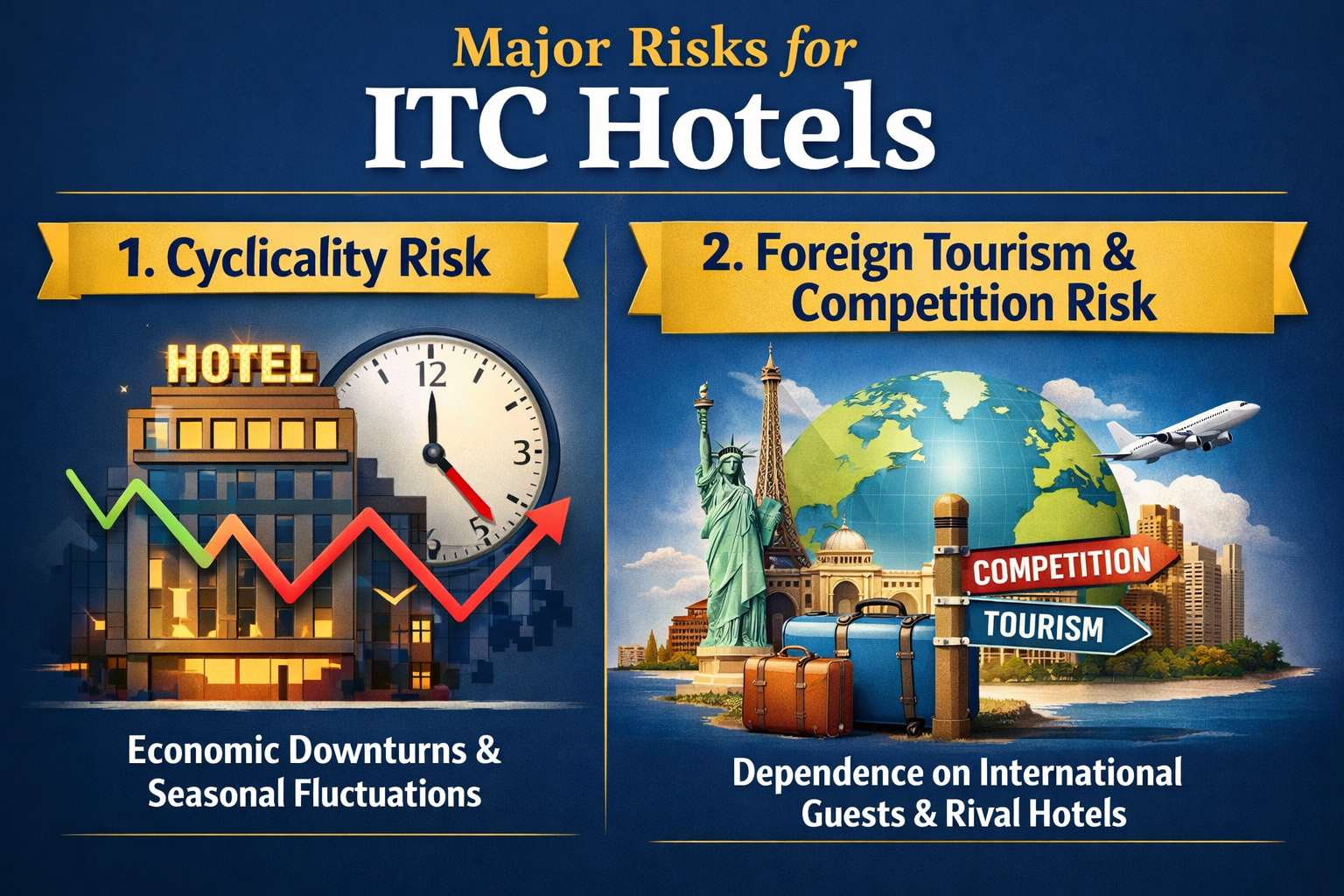
Despite favourable growth prospects, key risks must be acknowledged.
1. Cyclicality Risk
The hotel industry is highly cyclical and closely linked to economic conditions. During economic slowdowns, both corporate and leisure travel tend to decline.
Luxury hotels are most vulnerable, as luxury travel is discretionary rather than essential. At the same time, operating costs remain largely fixed including staff salaries, maintenance, and utilities-making profitability sensitive to occupancy drops. This is a meaningful risk for ITC Hotels, especially as its strategic focus shifts further toward luxury properties.
2. Foreign Tourism & Competition Risk
Foreign tourist arrivals represent another industry-wide risk. Countries such as Thailand, Vietnam, Indonesia, and Singapore are strong competitors, offering aggressive visa policies, competitive pricing, and superior tourism infrastructure.
India currently lags behind these destinations in attracting foreign tourists. While hotel companies could mitigate this by expanding in South-East Asia, ITC Hotels' expansion strategy remains focused westward, not in that region.
PE Ratio & Valuation
At present, ITC Hotels trades at a PE ratio of around 49, implying that the market is pricing in close to 20% CAGR profit growth over the next 2-3 years.
If profit growth turns out closer to 15%, a PE of around 40 would appear more reasonable. However, hotel stocks should always be analysed from a long-term perspective, as profitability improves as hotels mature.
Recent trends show around 13% revenue growth and nearly 19.5% profit growth on a TTM basis, which is encouraging. Importantly, expansion plans are often factored into hotel stock valuations, explaining higher PE multiples across the sector.
Conclusion
To summarise, ITC Hotels is operating in the right industry, at the right time, with a clearly defined strategy. Structural tailwinds such as domestic travel growth, demand-supply imbalance, low organised penetration, and government tourism push strongly support the business.
The company's asset-light expansion, increasing luxury focus, and aggressive room addition plan position it well for long-term growth. While short-term profitability may remain muted, earnings are expected to improve as new hotels mature.
The biggest risk remains cyclicality, particularly due to rising exposure to luxury travel. From a valuation perspective, the stock may appear demanding in the short term, but hotel stocks should always be evaluated over a long investment horizon.
This analysis is purely for educational purposes and does not constitute a buy or sell recommendation.