Role of Medical Tourism in the Growth of Indian Hospitals
The Indian hospital sector has emerged as one of the fastest-growing segments within the country's healthcare ecosystem. When we examine the Role of Medical Tourism in the Growth of Indian Hospitals, it becomes evident that while domestic demand driven by population growth, rising incomes, and insurance penetration remains strong, medical tourism has quietly emerged as a powerful and under-appreciated growth engine.
Over the last decade, medical tourism has played a significant role in expanding hospital revenues, improving infrastructure quality, and positioning India as a global healthcare destination. Today, India is not just catering to its own population but is also treating patients from across Asia, Africa, the Middle East, Europe, and even North America.
What Is Medical Tourism?
Medical tourism refers to patients travelling across international borders to receive medical treatment. These treatments typically include complex surgeries, elective procedures, specialty treatments, and long-term care that may be either too expensive or inaccessible in their home countries.
India has become a preferred destination for medical tourism due to a unique combination of high-quality healthcare, cost efficiency, and skilled medical professionals.
Why India Is a Global Medical Tourism Hub
Several structural advantages make India highly attractive for international patients.
First, the cost advantage is substantial. Major surgeries in India often cost 60-80% less than in developed countries like the US or UK, even when accounting for travel and accommodation. This makes India an obvious choice for uninsured or under insured patients.
Second, India has a deep pool of globally trained doctors and surgeons, many of whom have practiced or trained in the US, UK, or Europe. This builds trust among international patients seeking advanced medical care.
Third, Indian hospitals are equipped with world-class infrastructure, advanced technology, and internationally accredited facilities. Many large private hospitals meet global standards in terms of hygiene, patient safety, and clinical outcomes.
Watch Our Video on Healthcare Sector Analysis
Key Medical Treatments Driving Tourism
Medical tourists primarily travel to India for high-value and specialized treatments, which directly benefit hospital revenues.
These include:
- Cardiac surgeries such as bypass and valve replacement
- Orthopaedic procedures like knee and hip replacements
- Oncology treatments including chemotherapy and radiation therapy
- Organ transplants such as liver and kidney transplants
- Neurosurgery and spine procedures
- These treatments typically have higher ARPOB (Average Revenue Per Occupied Bed) and better margins compared to routine procedures, making medical tourism financially attractive for hospitals.
Impact of Medical Tourism on Indian Hospitals
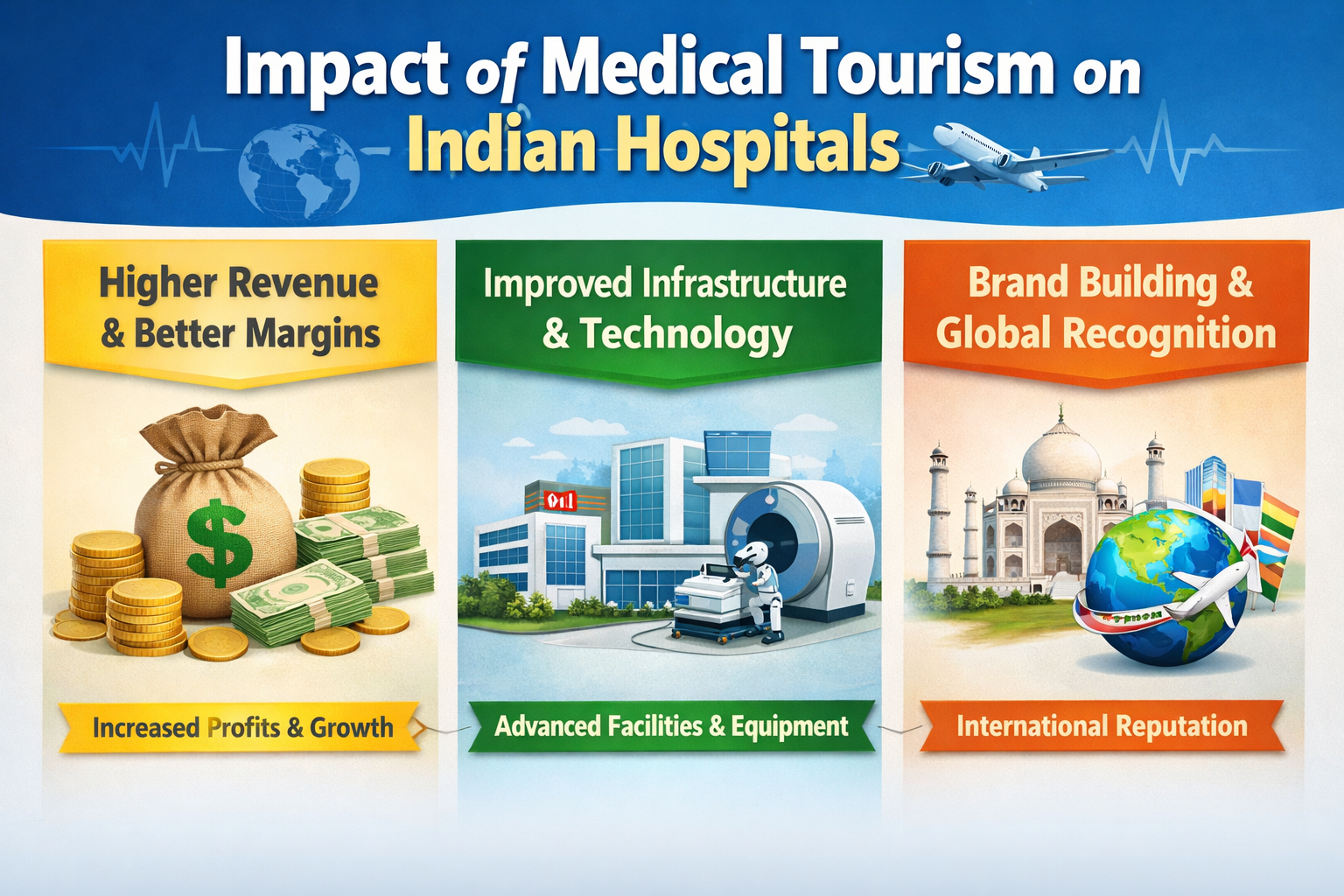
Medical tourism has had a multi-dimensional impact on the growth of Indian hospitals.
1. Higher Revenue and Better Margins
International patients generally opt for premium services, private rooms, and longer hospital stays. This leads to higher revenue per patient and improves overall hospital profitability. For hospitals, medical tourism enhances both top-line growth and operating margins.
2. Improved Infrastructure and Technology
To attract global patients, hospitals continuously invest in advanced medical equipment, digital systems, and patient care facilities. These upgrades also benefit domestic patients, raising the overall standard of healthcare delivery in India.
3. Brand Building and Global Recognition
Hospitals that treat international patients build global brand credibility. Successful outcomes for foreign patients lead to word-of-mouth referrals and partnerships with overseas medical facilitators, creating a sustainable pipeline of international demand.
Role of Government Support
Government initiatives have further accelerated medical tourism growth.
Policies such as medical visas, faster immigration processing, and dedicated healthcare facilitation desks have made it easier for foreign patients to access Indian hospitals. Additionally, India's focus on promoting healthcare under national tourism campaigns has helped position the country as a trusted medical destination.
Contribution to Capacity Expansion
Medical tourism also supports bed capacity expansion. Since international patients increase demand for specialized treatments, hospitals are encouraged to add new beds, expand specialty wings, and open new centers in metro and Tier-1 cities.
This expansion not only increases hospital scale but also improves operating leverage, as fixed costs are spread across a larger patient base.
Challenges in Medical Tourism
Despite its strengths, medical tourism faces challenges such as global travel disruptions, geopolitical instability, and competition from countries like Thailand and Turkey. However, India's cost-quality balance and clinical expertise continue to provide a strong competitive edge.
Future Outlook
India's medical tourism market is expected to grow at a double digit CAGR over the next decade. Rising healthcare costs globally, combined with India's improving infrastructure and policy support, suggest that medical tourism will remain a key growth driver for private hospitals.
Hospitals that focus on specialized care, international accreditation, and patient experience are likely to benefit the most from this trend.
Conclusion
The role of medical tourism in the growth of Indian hospitals is both significant and sustainable. By driving higher revenues, supporting capacity expansion, and improving healthcare quality, medical tourism has become a strategic pillar of India's hospital sector.
As global healthcare demand continues to rise, India is well-positioned to strengthen its status as a leading global medical tourism destination, making this segment a long-term growth engine for Indian hospitals.