Can Pondy Oxides’ New Copper Cathode Plant Transform Its Earnings?
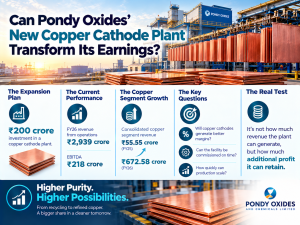
Pondy Oxides and Chemicals is investing ₹200 crore in a copper cathode plant that could change the scale and profitability of its copper business. The facility is planned for 36,000 metric tonnes per annum (MTPA), with production capacity coming online in two phases.
The opportunity is significant because the company’s existing copper segment generated ₹672.58 crore in FY26 revenue but reported segment results of only ₹25 crore. The new plant is intended to take Pondy Oxides further up the value chain by producing copper cathodes rather than relying only on recycled copper products.
But capacity alone does not establish the earnings opportunity. Investors need to understand the potential revenue and EBITDA at different utilisation levels, whether customers have committed to buying the output, and how quickly the plant can reach commercial production.
The key question is whether the new facility can generate enough additional earnings to justify the investment without relying on an unrealistically fast ramp-up.
What Could the ₹200 Crore Investment Earn?
Pondy Oxides plans to build 36,000 MTPA of copper cathode capacity in two phases. To understand its potential, we can calculate the revenue and EBITDA at different utilisation levels.
The following scenarios use two assumptions drawn from the research notes: copper realisation of ₹10 lakh per tonne and expected cathode EBITDA of ₹60,000-₹65,000 per tonne. These are modelling assumptions, not guaranteed future prices or confirmed results.
1.At 50% utilisation
- Annual production: 18,000 tonnes.
- Illustrative revenue: ₹1,800 crore.
- Illustrative EBITDA: ₹108-117 crore.
2. At 70% utilisation
- Annual production: 25,200 tonnes.
- Illustrative revenue: ₹2,520 crore.
- Illustrative EBITDA: ₹151.2-163.8 crore.3. At 90% utilisation
- Annual production: 32,400 tonnes.
- Illustrative revenue: ₹3,240 crore.
- Illustrative EBITDA: ₹194.4-210.6 crore.
These figures represent a full-year operating run rate, not revenue or EBITDA expected immediately after commissioning. They also assume the entire output can be sold at the assumed realisation and EBITDA per tonne.
The scenarios show why the plant could become a major growth driver. However, actual earnings will depend on commissioning, product quality, customer demand, utilisation and the margin achieved per tonne.
Why Does the Existing Copper Business Generate Relatively Little Profit?
Pondy Oxides’ consolidated FY26 segment disclosures show copper revenue of ₹672.58 crore and copper segment results of ₹25 crore. The segment result is equivalent to approximately 3.7% of revenue.
This difference highlights an important feature of metal recycling: high revenue does not necessarily mean high profitability. The value of the copper sold accounts for a substantial portion of revenue, while the business earns its margin from processing the material and managing procurement and operating costs.
The research notes record existing copper-recycling EBITDA of around ₹40,000 per tonne, compared with expected cathode EBITDA of ₹60,000-₹65,000 per tonne. If that improvement is achieved, the cathode plant could earn more per tonne than the existing recycling operation.
However, the annual report does not provide a detailed cost bridge explaining the copper segment’s ₹25 crore result. It would therefore be inaccurate to attribute the entire gap to any single cost or operational problem.
The real test is whether forward integration produces a sustainable improvement in EBITDA per tonne. Higher cathode revenue alone will not prove that the investment has improved the company’s earnings quality.
Is There Enough Demand to Support the New Capacity?
The research notes attribute an expectation of more than 30,000 tonnes of copper cathode sales in FY28 to management. At the assumed realisation of ₹10 lakh per tonne, sales of 30,000 tonnes would translate into ₹3,000 crore of annual revenue.
That is a substantial opportunity, but it needs to be distinguished from confirmed demand.
The annual report establishes the planned capacity and the company’s intention to move further up the copper value chain. The materials reviewed do not establish binding customer agreements or confirmed orders covering the projected cathode sales volume.
Consequently, the more-than-30,000-tonne figure should be treated as an expected sales target reported in the research notes, rather than contracted revenue.
Investors should look for three pieces of evidence as the project progresses:
- Disclosed customer agreements or confirmed orders for copper cathodes.
- Actual sales volumes after commissioning.
- Evidence that customers accept the product at prices and margins consistent with management’s expectations.
Without that evidence, the plant’s revenue potential remains an opportunity rather than secured revenue. Demand visibility will be just as important as production capacity in determining whether the project delivers its intended returns. Check our latest video for more details.
What Earnings Would Justify the ₹200 Crore Investment?
The proposed ₹200 crore investment is equivalent to approximately 92% of Pondy Oxides’ standalone FY26 EBITDA of ₹218.15 crore. This makes the project significant relative to the company’s existing earnings base.
A simple way to assess the investment is to calculate the annual EBITDA required at different percentages of project cost.
- 10% of investment: ₹20 crore in annual EBITDA.
- 15% of investment: ₹30 crore in annual EBITDA.
- 20% of investment: ₹40 crore in annual EBITDA.
These are illustrative earnings hurdles, not formal ROCE calculations. They do not account for depreciation, tax, working capital, maintenance capital expenditure or the capital employed beyond the stated project investment.
Compare these hurdles with the utilisation scenarios in Section 1. At the assumed EBITDA of ₹60,000-₹65,000 per tonne, even the 50% utilisation scenario produces illustrative EBITDA of ₹108-117 crore. That is well above the ₹20-40 crore hurdles.
But this comparison depends heavily on the assumed margin per tonne and the ability to sell the output. It also assumes a full year of operations, whereas the plant is being commissioned in phases.
The investment could look attractive on paper, but the conclusion will only be justified when actual production, sales and EBITDA begin to validate the assumptions.
How Much Could Commissioning Delays Affect Earnings?
The copper cathode project is planned in two equal phases of 18,000 MTPA each. The research notes indicate that Phase I is expected to be commissioned by December 2026 and Phase II by Q3 FY28. The annual report confirms the overall capacity and two-phase execution plan.
The timeline matters because the utilisation scenarios describe a full-year operating rate. They should not be mistaken for earnings that Pondy Oxides can immediately generate in FY27.
The first phase would provide 18,000 MTPA of installed capacity. The second phase would take the planned total to 36,000 MTPA. Actual production and sales could still take time to ramp up after each phase is commissioned.
Delays can affect the project in two ways. First, they can postpone the start of commercial sales. Second, slower utilisation can leave the plant generating less EBITDA than its full-year potential, even after commissioning.
Investors should therefore track the commissioning dates, initial production, utilisation, customer approvals and sales volumes separately. A commissioned plant is an important milestone, but it is not the same as a fully operational and profitable facility.
Conclusion
Pondy Oxides’ ₹200 crore copper cathode investment could materially expand its copper business and improve earnings per tonne. Under the stated assumptions, the plant’s full-year revenue potential ranges from ₹1,800 crore at 50% utilisation to ₹3,240 crore at 90% utilisation.
However, these are illustrative scenarios rather than forecasts. The investment case depends on whether the company achieves the assumed EBITDA per tonne, secures customers for its output and brings both phases online as planned.
The next milestones to watch are customer commitments, commissioning, utilisation and realised EBITDA per tonne. Until those indicators emerge, the plant should be viewed as a potentially significant earnings driver, not as a guaranteed addition to profits.