The “Silicon Valley Meets India” Bet: Can Himadri Turn Global Battery Technology Into Profitable Growth?
Himadri Speciality Chemical is building a battery-materials business that extends beyond manufacturing graphite anodes and lithium iron phosphate (LFP) cathodes. It is investing in Australian silicon-carbon technology, a US-based battery-cell company and an Indian nanotechnology venture. The ambition is to combine technology developed across different countries with manufacturing capabilities in India.
The strategy has three distinct parts. Sicona gives Himadri access to silicon-carbon anode technology through an exclusive Indian licensing agreement. International Battery Company (IBC) provides a connection to battery-cell development and manufacturing. Invati Creations offers exposure to research into advanced electrode materials.
But the investment case needs more than an impressive list of partnerships. Himadri has committed substantial capital to these relationships, and each must eventually demonstrate commercial value. The questions are how much revenue the technologies could generate, what rights Himadri actually receives from its investments, and how long it might take for these opportunities to contribute meaningfully to earnings.
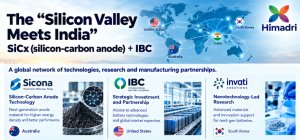
Sicona: The Opportunity to Commercialise Silicon-Carbon Anodes
Graphite remains the dominant material in lithium-ion battery anodes. However, battery manufacturers are looking for ways to increase energy density and reduce charging times, particularly for electric vehicles.
Silicon offers greater lithium-storage potential than graphite, but its expansion during charging and the resulting degradation have complicated its commercial adoption. Silicon-carbon composites attempt to capture some of silicon's performance advantages while improving its suitability for battery applications.
Australian company Sicona Battery Technologies has developed SiCx®, a silicon-carbon composite designed to function as an additive to conventional graphite-based anodes. According to Australia's Renewable Energy Agency (ARENA), using approximately 20% SiCx® in current battery formulations can deliver 20% higher energy density and 40% faster charging. These are reported technology-performance claims, not guarantees for every commercial cell. The available description does not establish a universal test protocol or independently verified performance across all battery designs.
Himadri secured an exclusive technology licence to access, localise and commercialise SiCx® in India. The relationship gives Himadri access to an external technology platform rather than requiring it to develop every silicon-carbon formulation independently.
The capital commitment is significant. Himadri's April 2026 investor presentation disclosed an investment of approximately ₹138.34 crore in Sicona, entitling it to around 19%-22% post-conversion equity, subject to the terms of its compulsorily convertible notes. Himadri also has two nominee directors on Sicona's board. The company subsequently announced a further investment in Sicona in May 2026, so the April figure should not be treated as the final cumulative commitment.
Sicona's commercialisation programme provides a useful milestone. ARENA's funded project is designed to validate its production process using a 150-tonne-per-annum demonstration plant, with planned operation at approximately 35 tonnes per annum during the project. The programme is intended to establish consistent production quality and support further scale-up.
Himadri's April 2026 disclosures also said Sicona's capacity expansion was targeted for completion by Q2 FY27, supporting further customer-sample approvals. However, this is a milestone for Sicona's production capability, not a confirmed date for commercial production at Himadri's Indian facility.
The opportunity is therefore real but conditional. Himadri must establish its Indian manufacturing arrangements, complete customer qualification and demonstrate that the technology can be sold at attractive margins.
What Could SiCx® Earn? An Analyst-Modelling Exercise
Himadri has not disclosed a confirmed Indian SiCx® sales volume or a realised selling price per tonne. That makes a precise revenue forecast premature. However, a transparent scenario model helps establish the scale of commercial success that could make the investment financially meaningful.
The following is illustrative analyst modelling, not Himadri guidance or a forecast. It assumes that local production and customer qualification have been completed and that the modelled volume represents annual sales.
| Annual SiCx® sales volume | Assumed realisation per tonne | Annual revenue | EBITDA at 15% margin | EBITDA at 25% margin |
| 500 tonnes | ₹10 lakh | ₹50 crore | ₹7.5 crore | ₹12.5 crore |
| 1,000 tonnes | ₹10 lakh | ₹100 crore | ₹15 crore | ₹25 crore |
| 2,000 tonnes | ₹10 lakh | ₹200 crore | ₹30 crore | ₹50 crore |
All selling prices, volumes and EBITDA margins are modelling assumptions. The ₹10 lakh-per-tonne realisation is a placeholder, not a disclosed market price. EBITDA excludes interest, tax, depreciation and amortisation.
The model reveals two important points.
First, even 1,000 tonnes of annual sales at the assumed realisation would produce ₹100 crore of revenue. That would establish a meaningful product line, although its actual contribution would depend on the cost of manufacturing, technology-related payments, customer qualification expenses and working capital.
Second, revenue alone does not justify the investment. At ₹100 crore of sales and a 15% EBITDA margin, annual EBITDA would be ₹15 crore. At a 25% margin, it would be ₹25 crore. These figures are not the same as cash flow available to recover the investment: capital expenditure, taxes, interest and working-capital requirements would also matter.
The ₹138.34 crore investment disclosed in April 2026, followed by the additional May investment, makes this distinction important. Investors need to assess whether commercial volumes can generate sufficient cash returns on the capital committed, rather than assuming that access to a promising technology automatically creates shareholder value.
IBC: Does a 20.47% Stake Guarantee Commercial Sales?
Himadri's investment in International Battery Company is strategically different from its relationship with Sicona. IBC develops and manufactures prismatic lithium-ion cells, with a 50 MWh cell facility in South Korea. Its technology and manufacturing operations provide a potential platform for evaluating Himadri's materials inside complete battery cells.
Himadri initially disclosed an investment of approximately US$5.43 million, or ₹46.89 crore, for a 17.29% stake in IBC. In June 2026, it announced a further investment of US$0.66 million, taking its disclosed holding to 20.47%.
The stake gives Himadri equity exposure to IBC and a nominee director on its board. These are meaningful governance and strategic connections, but they should not be confused with a commercial supply contract.
The public disclosures reviewed establish a strategic relationship involving material validation, scale-up and customer engagement. They do not establish a guaranteed purchase volume, a minimum-revenue commitment, exclusive supplier status or a disclosed revenue-sharing arrangement for Himadri. Unless separate binding agreements establish such rights, the equity stake alone does not guarantee sales.
That distinction matters because IBC's 50 MWh facility does not tell investors how many tonnes of Himadri's materials it will purchase. Nor does it establish how much of IBC's future cell production will use those materials.
The more immediate benefit is technical validation. Himadri's FY26 disclosures described work to validate LFP cathode active material and anode solutions through IBC's South Korean manufacturing facility. This can help move materials beyond laboratory testing and towards commercial adoption.
The financial contribution, however, remains dependent on subsequent steps: successful validation, customer acceptance, repeat orders and increased cell-production volumes.
There is another source of potential value. If IBC grows as a cell manufacturer, Himadri could benefit from the equity investment itself, independently of any material sales. But that return depends on IBC's future financial performance and the value of Himadri's holding. It should be assessed separately from the potential earnings of Himadri's own battery-materials business. Check our latest video for more details.
Invati: A Longer-Term Bet on Electrode Innovation
Invati Creations adds a research-led component to the strategy. Himadri acquired a 40% stake for a total consideration of ₹45.16 crore in 2024. The transaction included ₹19.99 crore of cash investment and ₹25.17 crore settled through a share swap. Himadri also secured two nominee directors on Invati's board.
Invati focuses on engineering lithium-ion electrode materials through nanotechnology, molecular engineering and patented or patentable technologies.
Unlike Sicona, which offers access to a specific silicon-carbon technology, Invati represents a broader research opportunity. Its work could potentially produce new formulations that improve electrode performance, energy density or battery life.
The commercial path is longer. Research must lead to a viable formulation, the formulation must pass testing and customer qualification, and the product must then be manufactured at a cost that makes commercial adoption attractive.
The ₹45.16 crore consideration is therefore an identifiable investment, but its return cannot be calculated from the stake percentage alone. Himadri has not disclosed a product-wise revenue target or a quantified earnings contribution from Invati in the material reviewed.
For now, Invati should be treated as a source of technological optionality rather than a proven near-term earnings driver. Its value will become easier to assess when research projects progress into qualified products, commercial contracts and recurring sales.
Which Investment Is Closest to Commercial Revenue?
The three investments are connected strategically, but their commercial maturity differs.
| Investment and capital committed | Technology or capability | Disclosed stage | Next milestone to watch | Potential financial contribution |
| Sicona: ₹138.34 crore disclosed in April 2026, followed by further investment in May; approximately 19%-22% post-conversion equity under the disclosed terms | SiCx® silicon-carbon anode technology; exclusive Indian commercialisation licence | Pilot-scale progress and capacity expansion; customer-sample approvals ongoing | Demonstration of repeatable production, Indian manufacturing readiness, customer qualification and first recurring sales | Direct revenue and EBITDA from SiCx® sales, plus potential equity value |
| IBC: ₹46.89 crore initially disclosed, followed by US$0.66 million additional investment in June 2026; stake increased to 20.47% | Prismatic lithium-ion cell development and manufacturing | Material validation, scale-up and customer engagement through the South Korean facility | Qualified materials entering commercial cells, followed by repeat orders and higher production volumes | Potential material sales and a separate return on the equity holding |
| Invati: ₹45.16 crore for a 40% stake | Nanotechnology-enabled electrode materials and molecular research | Research and intellectual-property development | Successful product development, customer qualification and commercialisation | Potential future product revenue and equity value; timing and magnitude remain uncertain |
Capital figures are based on the disclosures cited in this article. The Sicona figure is the amount reported in April 2026, before a subsequent investment announced in May. IBC's June investment increased its stake; the cumulative capital commitment should be confirmed from the relevant filings before calculating a final portfolio total.
The table also highlights why the three relationships should not be treated as interchangeable.
Sicona has a defined technology-licensing pathway, but commercial success depends on manufacturing scale and qualification. IBC is already a cell-manufacturing partner, but that does not mean it has committed to buying a specified quantity of Himadri's materials. Invati provides access to research that may generate future products, but its financial contribution is less directly measurable today.
The earliest material sales could emerge from whichever product completes qualification first. The available disclosures do not justify assigning a firm commercial revenue date to all three investments.
The Capital-Allocation Question: What Would Make These Investments Worthwhile?
The three relationships represent meaningful commitments of capital, but the return calculation is not identical for each.
For Sicona, the investment must be evaluated against the combined economics of the equity holding and the licensed technology. Investors need to know how much Himadri must spend on local production, whether additional licensing or technology-related payments apply, and how much annual EBITDA the resulting business can generate.
For IBC, the return has two potential components: earnings from any material sales to IBC and appreciation in the value of Himadri's equity holding. The first requires commercial purchase commitments and profitable supply arrangements; the second depends on IBC's own business performance.
For Invati, the key question is whether the research pipeline can generate products with a commercially meaningful addressable market and attractive margins. A 40% stake does not mean Himadri receives 40% of every future product's revenue. The actual economic benefit depends on the ownership structure, the company's profitability, any distributions and the terms governing commercialisation.
The disclosures reviewed do not provide enough information to calculate a definitive return on invested capital for each relationship. That is a limitation investors should acknowledge, not fill with unsupported assumptions.
A practical monitoring framework would track four developments:
- Commercial volume: annual tonnes of SiCx® and other advanced materials sold, alongside the realisations achieved.
- Profitability: product-level gross margins or EBITDA, after accounting for manufacturing and technology costs.
- Capital intensity: further investment needed to scale production, qualify products and support working capital.
- Commercial conversion: the movement from samples and testing to binding supply agreements, repeat orders and cash collection.
These measures would reveal whether the investments are producing operating earnings or remain largely strategic assets.
Conclusion: A Global Technology Network Is Only the Beginning
Himadri is building a battery-materials strategy that combines Indian manufacturing ambitions with overseas technology and cell-development partnerships. Sicona offers access to silicon-carbon anode technology, IBC provides a route to cell-level validation and potential commercial supply, while Invati expands the company's exposure to electrode research.
The opportunity is to develop a broader portfolio of battery materials and capture more value as manufacturers seek better performance and supply chains beyond China.
But the financial case must be built on commercial evidence. Sicona needs to move towards repeatable production and customer qualification. IBC needs to translate technical collaboration into actual purchases if it is to generate material-supply revenue for Himadri. Invati needs to turn research into products that customers will buy.
Himadri has paid for access to technology, manufacturing relationships and research capabilities. The next test is whether those assets can generate enough recurring cash flow to justify the capital committed.