Why is Lemon Tree Hotels Demerging Fleur Hotels?
Lemon Tree Hotels’ demerger is easier to understand when viewed through the capital sitting behind the hotel portfolio, rather than simply as a move to become “asset-light.”
The group entered FY26 with ₹1,500 crore of borrowings, down from ₹1,699 crore a year earlier, while its owned portfolio was still absorbing significant refurbishment investment.
Management said renovation, technology investment and GST-related costs together affected FY26 EBITDA margins by 580 basis points. It also said the normal renovation cycle should eventually fall to 1.2%-1.4% of revenue, indicating that a meaningful part of the recent spending was linked to the owned portfolio.
There was therefore a genuine capital-allocation trade-off: cash generated by the group was being used both to improve existing hotels and to reduce debt, while Lemon Tree was simultaneously signing and opening more third-party managed and franchised hotels.
The FY26 numbers make the separation clearer:
- Pre-demerger: ₹1,452.7 crore revenue and ₹699.3 crore EBITDA.
- Lemon Tree pro forma: ₹1,332.7 crore revenue and ₹554.1 crore EBITDA.
- Fleur pro forma: ₹247 crore revenue and ₹149 crore EBITDA.
That translates into EBITDA margins of 48.1% for the pre-demerger group, 41.6% for Lemon Tree and 60.3% for Fleur.
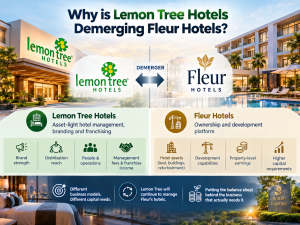
The key point is that Fleur is receiving the asset base and its associated capital requirements, while Lemon Tree retains the operating platform. The demerger therefore changes where future capital has to be deployed and where investors see the resulting returns.
What Exactly Is Being Transferred And What Is The Economic Value?
The transaction is not a simple transfer of a few hotels.
Fleur will receive 17 hotels: 15 operating hotels and two under construction, along with the development capabilities and relevant subsidiaries. After restructuring, Fleur’s owned portfolio is expected to reach 5,813 rooms across 41 hotels, while Lemon Tree continues to operate the hotels under its brands.
The FY26 pro-forma numbers provide the clearest measure of the earnings being separated:
| Pre-demerger | Lemon Tree | Fleur | |
| Revenue | ₹1,452.7 Cr | ₹1,332.7 Cr | ₹247 Cr |
| EBITDA | ₹699.3 Cr | ₹554.1 Cr | ₹149 Cr |
| EBITDA Margin | 48.1% | 41.6% | 60.3% |
The numbers do not mean Fleur is economically larger than Lemon Tree simply because its EBITDA margin is higher. Fleur owns the underlying hotels and therefore carries the capital, depreciation, financing and refurbishment burden that the management company does not.
There is another important transfer investors need to track: debt. Lemon Tree has said the debt moves to Fleur, leaving Lemon Tree debt-free after implementation. As of March 31, 2026, group borrowings were ₹1,500 crore. By June 2026, management said Fleur’s debt was around ₹1,200 crore and group debt around ₹1,275 crore, after considering cash.
So the demerger is effectively transferring not only hotels and earnings, but also the financing burden attached to the ownership model.
The ₹960 Crore Warburg Investment Is More Important Than It First Appears
Warburg Pincus’ involvement changes the transaction from an internal restructuring into a capitalisation event for Fleur.
Warburg first agreed to acquire APG’s existing 41.09% Fleur stake and separately committed up to ₹960 crore of primary equity. The primary money is not being paid to Lemon Tree shareholders; it goes into Fleur to fund future growth.
The valuation is now clearer than when the scheme was initially announced. In the August 2026 earnings call, management said the primary investment is being made at a US$1 billion valuation, with US$100 million representing 10% primary equity. Management also described it as a fair valuation fixed today rather than a future public-market valuation.
That distinction matters.
Warburg is effectively putting fresh equity into Fleur at a pre-agreed private valuation, giving Fleur capital before its planned public listing. The company has also indicated that any unused portion of the ₹960 crore commitment would not necessarily be taken after listing, when Fleur could instead raise capital from public investors.
The primary infusion therefore creates dilution, but it also means Fleur receives new capital without putting the entire expansion burden onto Lemon Tree shareholders or Fleur’s lenders.
How Much Of Fleur Will Lemon Tree Shareholders Actually Own?
This is where the headline shareholding can be misleading.
Before the primary investment, the scheme gives:
- Lemon Tree shareholders directly: 32.96%
- Lemon Tree itself: 41.03%
- Warburg Pincus: 26.01%
Therefore, Lemon Tree shareholders’ aggregate economic exposure to Fleur is approximately 73.99% before the primary infusion: 32.96% directly plus 41.03% indirectly through their ownership of Lemon Tree. The company’s presentation describes this as roughly 74%.
But the ₹960 crore primary investment changes that.
Management has subsequently explained the economics as approximately 74% existing shareholders and 26% Warburg before the primary infusion, followed by a primary issuance that gives Warburg another 10% of Fleur. On that basis, existing shareholders’ combined stake becomes approximately 66.6%, while Warburg’s holding rises to approximately 36% after the full primary infusion.
This means the 41.03% Lemon Tree stake matters enormously. Without it, the direct Fleur distribution would leave shareholders with only 32.96% exposure. The indirect stake effectively adds another 41.03 percentage points before dilution.
But investors should not treat 74% as their permanent Fleur ownership. The relevant figure after the full primary infusion is approximately 66.6% at the combined Lemon Tree-shareholder level. Check our latest video to know more.
What Are Shareholders Actually Giving Up And Receiving?
The demerger changes the earnings mix rather than simply creating additional earnings.
Lemon Tree’s pro-forma EBITDA falls from the pre-demerger ₹699.3 crore to ₹554.1 crore, while Fleur gets ₹149 crore. On the face of it, shareholders are moving from one consolidated business to two separate earnings streams.
But shareholders retain exposure to both.
The company’s own presentation calculates ₹434 crore of EBITDA attributable to public shareholders before the scheme, versus ₹402 crore of total attributable EBITDA after the scheme on its stated pro-forma basis, while showing effective public ownership in Fleur increasing from 45.8% to 57.5% under the presentation’s definition. It says total attributable EBITDA increases by more than 8% under its broader post-scheme analysis.
These figures should not be confused with a cash return to shareholders. The benefit is primarily structural and ownership-related: shareholders receive direct Fleur shares while Lemon Tree retains a large Fleur stake.
The ultimate value transfer will therefore depend on what the market assigns to two very different earnings streams.
Why Retaining 41.03% Of Fleur Matters?
Lemon Tree’s continuing 41.03% stake creates an important economic link between the two companies.
Fleur owns the hotels, but Lemon Tree continues to manage them. In FY26, Lemon Tree earned ₹95.8 crore of management fees from Fleur, while fees from third-party hotels were ₹73.9 crore. Total management fees were ₹169.7 crore.
That means Fleur’s expansion can potentially benefit Lemon Tree in two separate ways:
- At Fleur level: more rooms can increase property-level revenue and EBITDA.
- At Lemon Tree level: those same hotels can generate management fees without Lemon Tree having to fund their construction.
And shareholders participate in Fleur through Lemon Tree’s 41.03% ownership.
This is why the relationship survives the demerger. Fleur becomes the capital provider and hotel owner; Lemon Tree remains the operator and brand platform.
The arrangement also creates a potential conflict to watch: Fleur’s interests will not always be identical to those of Lemon Tree’s minority shareholders, particularly once Warburg becomes a substantial shareholder. The management agreement, fees, capital allocation and related-party governance will therefore become more important after the listing.
What Can Go Wrong?
The structure solves one problem, separating capital-heavy ownership from management but it does not eliminate hotel-sector risk.
- Fleur could become too leveraged.
Management has indicated that deploying ₹1,500 crore of capital could take Fleur’s debt to ₹2,500-3,000 crore temporarily before the new assets contribute EBITDA. That creates a timing risk: debt service starts immediately, while new hotels take time to stabilise.
- New projects may take longer to generate returns.
Fleur has under-construction properties including Aurika Shimla and Aurika Shillong. As of June 30, 2026, management said ₹108 crore had been deployed into Shimla and ₹33 crore into Shillong. Construction delays or slower ramp-up would postpone the EBITDA expected from this capital.
- Occupancy remains critical.
Hotel ownership provides operating leverage in both directions. Higher occupancy and ARR can sharply improve property EBITDA, but weak demand leaves Fleur carrying depreciation, interest and maintenance costs against a smaller revenue base. CRISIL specifically identifies hospitality cyclicality and slower-than-expected ramp-up of new assets as risks to profitability.
- Warburg’s primary infusion dilutes existing shareholders.
The ₹960 crore strengthens Fleur, but the full infusion also reduces existing shareholders’ combined Fleur ownership from roughly 74% to roughly 66.6%.
- Lemon Tree must prove the trade-off works.
Its pro-forma EBITDA falls to ₹554.1 crore from ₹699.3 crore. The asset-light model therefore has to generate sufficient incremental management and franchise income over time to compensate shareholders for owning a smaller proportion of the asset-owning business.
The Real Test Is Not Whether Lemon Tree Becomes Asset-Light
The demerger should ultimately be judged through capital efficiency on both sides of the structure.
For Lemon Tree, the key question is whether management and franchise fees can grow faster than the capital required to generate them. FY26 provides an encouraging starting point: third-party management and franchise fees grew 23% to ₹73.9 crore, while total management fees reached ₹169.7 crore.
For Fleur, the test is different. It needs to show that the capital transferred into it and the additional ₹960 crore from Warburg can produce attractive property-level returns without excessive leverage.
The distinction is important because a hotel added to Fleur is not automatically value creation. If ₹1 of additional capital produces insufficient EBITDA after interest, depreciation and maintenance capex, the larger asset base can actually dilute returns.
Conversely, if Fleur can grow its owned portfolio while maintaining disciplined leverage and Lemon Tree can add third-party rooms without comparable balance-sheet investment, the two entities can become complementary rather than competing for the same capital.
That is the actual thesis behind the restructuring.
So Why Is Lemon Tree Doing This Now?
The numbers suggest the demerger is less about simplifying a corporate chart and more about changing the capital-allocation architecture of the group.
FY26 showed both sides of the business at scale: ₹699.3 crore consolidated EBITDA, ₹1,500 crore of borrowings, significant renovation spending and ₹169.7 crore of management fees.
The new structure puts future ownership and development capital into Fleur, while Lemon Tree focuses on management, franchising, branding and distribution. Warburg provides up to ₹960 crore of fresh equity at a stated US$1 billion valuation, while existing Lemon Tree shareholders retain roughly 74% combined exposure to Fleur before that primary infusion and approximately 66.6% after a full 10% primary issuance.
So the demerger does not create value merely by moving hotels from one company to another.
It creates a testable proposition: can Lemon Tree become a higher-return fee platform while Fleur uses institutional capital and its balance sheet to compound hotel assets?